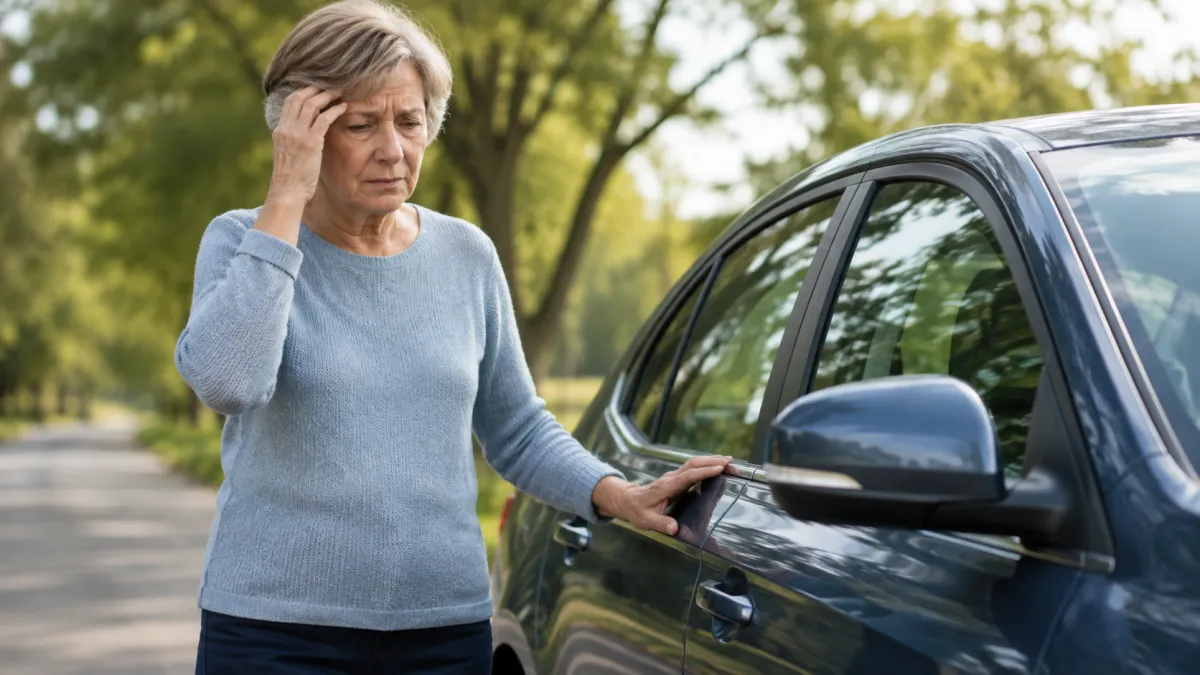
Driving after a stroke can represent freedom, independence and a return to normal life, yet getting behind the wheel again may feel frightening even after you have been medically cleared to drive. You may worry about having another stroke, reacting too slowly, becoming confused, losing concentration or causing an accident. Anxiety about driving after stroke is understandable, but it does not automatically mean you are incapable of driving. With appropriate medical clearance, gradual practice and realistic assessment of your abilities, confidence can often be rebuilt.
After your stroke...
You may think about driving long before you actually get behind the wheel again.
Perhaps your car is sitting outside.
You see the keys.
You remember how effortless driving once felt.
Then something changes.
The thought of driving no longer feels ordinary.
It feels dangerous.
You begin wondering...
"What if I have another stroke while driving?"
"What if my reactions are too slow?"
"What if I miss something?"
"What if I become confused?"
"What if I panic?"
"What if I cause an accident?"
Perhaps everyone around you says:
"You'll be fine."
But they are not sitting behind the steering wheel.
You are.
And after experiencing something as sudden and unpredictable as a stroke, trusting your body and brain again can take time.
✦ ✦ ✦
The Good News
Driving anxiety can improve.
You do not necessarily have to choose between being terrified behind the wheel and giving up driving permanently.
Once you are legally and medically permitted to drive, confidence can often be rebuilt gradually.
The first drive does not need to involve:
Rush-hour traffic.
A motorway.
A complicated journey.
Bad weather.
Or an hour behind the wheel.
You can start small.
A quiet road.
A familiar route.
A short journey.
Then build from there.
For many survivors, confidence returns through repeated evidence that they can drive safely again.
✦ ✦ ✦
Why Can Driving Feel So Frightening After a Stroke?
A stroke can change your sense of safety.
Before your stroke, you may have trusted your brain without thinking about it.
You assumed your:
Vision would work.
Hands would respond.
Feet would move.
Memory would function.
Concentration would remain steady.
Then a stroke showed you that the body can change suddenly.
That experience can create understandable fear.
Driving also demands several abilities at the same time.
You need to:
✓ Watch the road
✓ Monitor mirrors
✓ Judge speed
✓ Anticipate other drivers
✓ Recognise signs
✓ Control the vehicle
✓ Make rapid decisions
✓ Divide your attention
✓ Respond to unexpected situations
After stroke, simply thinking about coordinating all of those tasks can feel overwhelming.
✦ ✦ ✦
Anxiety Does Not Automatically Mean You Cannot Drive
This distinction matters.
Being afraid of driving is not the same as being medically unfit to drive.
Someone may have excellent:
✓ Vision
✓ Reaction time
✓ Strength
✓ Coordination
✓ Attention
✓ Judgement
And still feel extremely nervous.
The opposite is also possible.
Someone may feel completely confident while still having impairments that could make driving unsafe.
Confidence should therefore never be the only test.
Driving after stroke requires both:
Safety
And
confidence.
Safety comes first.
Once safety has been established, confidence can be rebuilt.
✦ ✦ ✦
Know the Driving Rules After Stroke
Before worrying about confidence, make sure you are legally permitted to drive.
In Great Britain, car and motorcycle drivers must stop driving for at least one month following a stroke. Driving can only restart when a doctor or healthcare professional considers it safe.
You may need to tell the DVLA if problems remain after that period that could affect safe driving.
The rules can be different for:
✓ Bus drivers
✓ Coach drivers
✓ Lorry drivers
✓ People with certain ongoing neurological problems
✓ People experiencing seizures
✓ People with significant visual problems
Driving regulations can change and individual circumstances differ, so always check the current rules that apply to you rather than relying on somebody else's experience.
If you live outside Great Britain, different licensing rules may apply.
✦ ✦ ✦
Why Fear of Another Stroke Can Affect Driving
One of the biggest fears may have nothing to do with your driving ability.
You may simply think:
"What happens if another stroke occurs while I am driving?"
That fear can be difficult to dismiss because you already know that strokes can happen unexpectedly.
Perhaps your original stroke occurred without much warning.
Now every unusual sensation can feel threatening.
A headache.
A tingling sensation.
A moment of dizziness.
Fatigue.
A strange feeling in your arm.
You may immediately think:
"It's happening again."
Anxiety itself can also produce physical sensations.
Your heart may race.
Your breathing may become faster.
Your muscles tighten.
You may feel light-headed.
The sensations then frighten you further.
If fear of another stroke is significantly affecting everyday life, discuss it with your healthcare team.
Anxiety and worry are recognised emotional effects after stroke.
✦ ✦ ✦
What If Your Reactions Feel Slower?
Driving requires timely responses.
You may worry that your brain no longer reacts as quickly as it once did.
Perhaps you notice that you need slightly longer to:
✓ Process information
✓ Respond to questions
✓ Switch attention
✓ Make decisions
✓ Understand busy environments
That does not automatically mean you cannot drive.
But it deserves proper assessment.
The question is not:
"Do I feel slower than before?"
It is:
"Are my reactions and processing abilities sufficient for safe driving?"
If there is doubt, specialist driving assessment may be useful.
Stroke rehabilitation services may also help identify difficulties involving cognition, vision, movement and coordination before you return to driving.
✦ ✦ ✦
Vision Problems Can Make Driving Anxiety Worse
Driving relies heavily on vision.
After stroke, some people experience:
✓ Visual field loss
✓ Double vision
✓ Difficulty tracking moving objects
✓ Problems judging distance
✓ Visual neglect
✓ Sensitivity to light
✓ Problems processing busy scenes
You may therefore feel comfortable sitting at home but overwhelmed when looking at:
Traffic.
Road markings.
Pedestrians.
Signs.
Mirrors.
Cars approaching from different directions.
Visual problems should not simply be "pushed through."
If you have persistent visual changes after stroke, seek appropriate assessment before returning to driving.
Current DVLA guidance specifically considers residual visual and neurological impairment when assessing fitness to drive.
✦ ✦ ✦
Busy Roads Can Feel Completely Different
Perhaps your first journey around a quiet residential road feels fine.
Then you reach a major junction.
Suddenly there are:
Cars.
Buses.
Cyclists.
Pedestrians.
Traffic lights.
Road markings.
Signs.
Noise.
Movement everywhere.
Your brain feels overloaded.
This can happen because busy driving environments require rapid filtering of large amounts of information.
You have to decide what matters and what does not.
After stroke, that processing may initially require more effort.
This does not automatically mean that driving will always feel overwhelming.
But it may mean your progression needs to be slower.
✦ ✦ ✦
Start With Familiar Roads
Once you are medically and legally cleared to drive, your first journey does not have to test every aspect of your driving ability.
Choose somewhere familiar.
Perhaps:
✓ Around your neighbourhood
✓ To a nearby shop
✓ Along a road you have driven hundreds of times
✓ During a quiet part of the day
Familiarity reduces the number of new decisions your brain has to make.
You already know:
Where the junctions are.
Where the road bends.
Where you normally turn.
Where you can safely stop.
That allows you to concentrate more on the experience of driving itself.
✦ ✦ ✦
Keep the First Drives Short
A common mistake is trying to prove that everything is back to normal immediately.
You drive for an hour.
Become exhausted.
Your concentration deteriorates.
You arrive home shaken.
Then conclude:
"I can't drive anymore."
That conclusion may be premature.
Perhaps you can currently drive safely for fifteen or twenty minutes but not an hour.
That is useful information.
Start with manageable journeys.
Then increase gradually if things are going well.
The objective is not to prove anything.
It is to rebuild capacity safely.
✦ ✦ ✦
Avoid Rush Hour at First
Rush-hour traffic is demanding even for people who have never had a stroke.
There are more:
Cars.
Cyclists.
Pedestrians.
Decisions.
Lane changes.
Unexpected movements.
If you are already anxious, beginning there may simply overwhelm you.
Where possible, practise at quieter times.
Build confidence before adding complexity.
You might progress from:
A quiet residential road.
To local roads.
To a busier town route.
To dual carriageways.
To motorways.
Your progression does not need to follow this exact pattern.
The point is to increase difficulty gradually.
✦ ✦ ✦
Consider Driving With Someone You Trust
Your first few journeys may feel easier with another person in the car.
Choose someone calm.
Not someone who:
Gasps.
Grabs the dashboard.
Criticises every decision.
Gives constant instructions.
Or makes you more nervous.
A supportive passenger should help you feel safer, not behave like an additional hazard.
They may also notice whether you appear:
✓ Comfortable
✓ Distracted
✓ Overwhelmed
✓ Fatigued
✓ Uncertain at junctions
Feedback can be useful.
But remember that a family member's opinion is not a substitute for professional assessment where there are genuine concerns about fitness to drive.
✦ ✦ ✦
A Specialist Driving Assessment Can Help
If you are uncertain about whether your post-stroke abilities are sufficient for driving, you may benefit from a specialist driving assessment.
This is different from simply asking:
"Do I feel confident?"
A specialist assessment may consider things such as:
✓ Physical ability
✓ Reaction time
✓ Vision
✓ Cognitive skills
✓ Vehicle control
✓ Practical driving
✓ Whether vehicle adaptations might help
Stroke Association guidance notes that driving assessments and vehicle adaptations may help people return to driving after stroke.
Sometimes an assessment provides reassurance.
Sometimes it identifies a specific problem that can be addressed.
Either outcome is more useful than guessing.
✦ ✦ ✦
What If One Side of Your Body Is Weaker?
Weakness does not necessarily mean driving is impossible.
But you must be able to control the vehicle safely.
Depending on the side affected and the type of vehicle, difficulties might involve:
✓ Steering
✓ Indicators
✓ Gear changes
✓ Clutch control
✓ Braking
✓ Accelerator control
✓ Reaching controls
Adapted vehicles may help some stroke survivors.
For example, adaptations may alter how certain vehicle controls are operated.
If physical impairment remains, obtain professional advice rather than creating your own workaround.
Safe vehicle control matters more than proving you can drive an unmodified car.
✦ ✦ ✦
Fatigue Can Affect Driving Confidence
You may drive perfectly well when rested.
Then notice that things become harder when tired.
Post-stroke fatigue can affect physical and cognitive functioning and may influence attention and processing.
You might notice:
✓ Slower reactions
✓ Reduced concentration
✓ Irritability
✓ Difficulty processing busy roads
✓ Headaches
✓ Eye strain
✓ Difficulty maintaining attention
Pay attention to when you drive best.
Perhaps mornings are easier.
Perhaps thirty-minute journeys are currently enough.
Perhaps driving after a demanding day is unwise.
Driving safely matters more than maintaining your old driving routine.
✦ ✦ ✦
What If You Panic While Driving?
Panic can be terrifying because it creates physical sensations.
Your heart races.
Your breathing changes.
Your hands may feel sweaty.
You become intensely aware of your body.
You think:
"I need to get out of this car."
If anxiety begins rising while driving, your priority remains road safety.
Do not suddenly stop in an unsafe place.
Where appropriate, continue until you can pull over somewhere safe.
Once safely stopped:
Give yourself time.
Allow your breathing to settle.
Decide whether you are comfortable continuing.
If panic repeatedly occurs behind the wheel, seek professional support before continuing to expose yourself to situations you cannot safely manage.
✦ ✦ ✦
Avoidance Can Make Driving Anxiety Stronger
There is an understandable temptation to avoid driving completely.
You tell yourself:
"I'll try next week."
Then:
"Maybe next month."
Months pass.
The car begins to feel increasingly unfamiliar.
Anxiety grows.
Avoidance can sometimes reinforce fear because you never collect new evidence showing that the activity can be safe.
However...
This does not mean you should force yourself to drive when medically unsafe.
The distinction is critical.
If you have been medically cleared and the main barrier is anxiety, gradual exposure may help.
If there are unresolved concerns about vision, cognition, seizures, reaction time or vehicle control, assessment comes first.
✦ ✦ ✦
Build Confidence in Stages
Think of driving confidence as rehabilitation.
You would not expect a weak leg to become strong from one enormous exercise session.
You build gradually.
Driving may be similar.
Your stages might look something like:
✓ Sit in the driver's seat
✓ Familiarise yourself with the controls
✓ Start the car
✓ Drive around a quiet area
✓ Complete a five-minute journey
✓ Complete a familiar local journey
✓ Drive on moderately busy roads
✓ Drive somewhere unfamiliar
✓ Drive at busier times
✓ Return to longer journeys
You may not need every stage.
And you may move backwards temporarily.
That is fine.
The aim is safe progression, not speed.
✦ ✦ ✦
Do Not Judge Yourself by One Difficult Drive
Perhaps one journey goes badly.
Traffic is terrible.
You are exhausted.
Someone cuts in front of you.
You miss a turn.
Your anxiety rises.
You arrive home thinking:
"That's it. I can't drive."
One difficult drive does not necessarily answer that question.
Look at the circumstances.
Were you tired?
Was the journey unusually demanding?
Were you already anxious?
Did you actually drive unsafely, or did the experience simply feel frightening?
Separate discomfort from danger.
That distinction can stop one bad experience from destroying weeks of progress.
✦ ✦ ✦
Fear of Motorways After Stroke
Motorways may feel particularly intimidating.
Everything appears faster.
There is less time to hesitate.
You may worry about:
✓ Joining traffic
✓ Changing lanes
✓ Judging speed
✓ Large vehicles
✓ Finding somewhere to stop
You do not need to begin your return to driving on a motorway.
Build confidence elsewhere first.
If motorways remain a significant problem, specialist driving tuition may help.
There is nothing embarrassing about having a few professional lessons even if you drove confidently for decades before your stroke.
Your circumstances changed.
Your approach can change too.
✦ ✦ ✦
Driving at Night May Feel Harder
Night driving places different demands on vision.
Headlights.
Glare.
Reduced contrast.
Dark roads.
Rain reflecting light.
After stroke, these conditions may be particularly tiring or uncomfortable for some people.
If you feel significantly less comfortable at night, you do not need to force yourself to practise immediately.
Start during daylight.
Build confidence.
Then reassess.
If you have ongoing problems with vision, glare or visual processing, seek professional assessment rather than assuming anxiety is the only cause.
✦ ✦ ✦
What If You Are Afraid of Driving Alone?
You may initially feel comfortable with someone beside you but frightened when driving alone.
That does not mean you have failed.
Having another person present can create a psychological safety net.
You might gradually reduce your dependence on that reassurance.
For example:
First drive with someone.
Then drive alone around the block.
Then make a short familiar journey.
Then increase the distance.
Each successful journey gives your brain new evidence.
"I drove alone."
"I managed it."
"I got home safely."
That evidence slowly competes with the fear.
✦ ✦ ✦
Confidence Often Returns After Action
Waiting until you feel completely confident may keep you waiting indefinitely.
Confidence does not always arrive first.
Sometimes the sequence is:
Fear.
Action.
Success.
Then confidence.
You may feel nervous during your first journey.
Still nervous during the second.
Less nervous during the fifth.
Eventually, you get into the car without analysing every sensation.
Driving starts becoming ordinary again.
That is often the real goal.
Not feeling heroic.
Just feeling normal.
✦ ✦ ✦
The Emotional Importance of Driving
Driving may represent much more than transportation.
It may mean:
✓ Independence
✓ Freedom
✓ Returning to work
✓ Taking your children somewhere
✓ Shopping without assistance
✓ Visiting friends
✓ Travelling
✓ Not relying on other people
Losing the ability to drive after stroke can therefore feel like another piece of independence being taken away.
That is why getting your licence or confidence back can become emotionally important.
But independence should never be pursued at the expense of safety.
The goal is not simply to drive again.
The goal is to drive safely and confidently again where possible.
✦ ✦ ✦
My Perspective
Driving is one of those things many of us barely think about before a stroke.
You get in.
Start the engine.
Reverse.
Drive away.
Your brain quietly coordinates hundreds of decisions without you consciously appreciating what it is doing.
Then you have a stroke.
Suddenly you notice everything.
The movement of your foot.
Your hand on the steering wheel.
Cars approaching from the side.
Your reaction time.
Your vision.
Your concentration.
You become intensely aware of your brain because you no longer trust it completely.
That loss of trust is understandable.
But fear should not automatically become a permanent verdict on what you can do.
If you are medically safe to drive, confidence can be rebuilt in exactly the way many other aspects of recovery are rebuilt.
Gradually.
One challenge at a time.
One journey at a time.
One piece of evidence at a time.
You do not need to prove that the stroke changed nothing.
You simply need to discover what you can safely do now.
✦ ✦ ✦
When Should You Seek Further Advice?
Speak with your doctor, rehabilitation team or another appropriate healthcare professional if you are concerned about:
✓ Vision
✓ Concentration
✓ Reaction time
✓ Memory
✓ Coordination
✓ Weakness
✓ Seizures
✓ Dizziness
✓ Severe fatigue
✓ Your ability to control the vehicle
✓ Your legal fitness to drive
If necessary, ask about specialist driving assessment.
And if you experience sudden new symptoms suggesting another stroke, stop treating the problem as driving anxiety and seek urgent medical attention.
Stroke symptoms can include sudden facial weakness, arm weakness and speech difficulty, and suspected stroke requires emergency medical help.
✦ ✦ ✦
Frequently Asked Questions
Is It Normal to Be Scared of Driving After a Stroke?
Yes.
Anxiety, panic and worry can occur after stroke, and driving can bring additional concerns about safety, control and having another stroke.
How Long After a Stroke Can I Drive?
For ordinary car and motorcycle licences in Great Britain, you must stop driving for at least one month after a stroke and should only restart when your doctor or healthcare professional considers it safe. Other rules may apply depending on your symptoms and licence category.
Do I Have to Tell the DVLA?
This depends on your circumstances.
For a car or motorcycle licence, DVLA guidance says you generally do not need to notify them if you have recovered, but notification is required in certain circumstances when relevant problems remain after one month.
Always check the current DVLA rules for your individual situation.
What If I Am Medically Cleared but Still Afraid?
Start gradually.
Short, familiar journeys during quiet periods may help rebuild confidence.
If anxiety remains severe, consider speaking with a healthcare professional or driving specialist.
Can I Have a Driving Assessment?
Yes.
Specialist driving assessments can help determine whether you can drive safely and whether adaptations or additional support may be useful.
What If I Have Vision Problems?
Do not assume they are harmless.
Persistent visual problems after stroke should be appropriately assessed because some visual impairments can affect fitness to drive.
Will My Driving Confidence Come Back?
For many people, confidence can improve with practice and successful experiences.
The process may take time.
You do not need to rush.
✦ ✦ ✦
Key Takeaways
✓ Anxiety about driving after stroke is understandable.
✓ Being anxious does not automatically mean you are incapable of driving.
✓ Medical and legal fitness to drive must come before confidence-building.
✓ Car and motorcycle drivers in Great Britain must normally stop driving for at least one month after stroke.
✓ Persistent neurological or visual problems may need further assessment and DVLA notification.
✓ Start with short, familiar journeys when you are cleared to drive.
✓ Avoid unnecessarily difficult conditions at first.
✓ Fatigue can affect concentration and driving performance.
✓ A specialist driving assessment may provide useful information and reassurance.
✓ Vehicle adaptations can help some stroke survivors.
✓ One difficult journey does not necessarily mean you cannot drive.
✓ Gradual practice may help reduce anxiety.
✓ The goal is not simply to drive again.
✓ The goal is to drive safely, confidently and sustainably.
✦ ✦ ✦
Related Articles
Continue learning about independence and life after stroke:
Driving After a Stroke
When Can You Drive After a Stroke?
Vision Problems and Driving After Stroke
Fatigue and Driving After Stroke
Fear of Another Stroke
Anxiety After Stroke
Loss of Independence After Stroke
Returning to Work After a Stroke
Confidence After Stroke
Travelling After a Stroke
✦ ✦ ✦
About the Author
Alisia Gayle is a stroke survivor who achieved 96% neurological recovery following an ischaemic stroke.
After years of rehabilitation, she now shares practical, evidence-informed resources to help stroke survivors, carers and families better understand recovery and rebuild their lives with confidence.
Alisia is also the author of Brain Damage: My Journey to 96% Recovery, where she shares her personal stroke recovery story and the lessons she learned throughout her rehabilitation.
✦ ✦ ✦
Medical Disclaimer
This article is intended for educational purposes only and should not replace professional medical advice, diagnosis, rehabilitation guidance or official driving regulations.
Every stroke and every recovery is different.
Always speak with your doctor, stroke rehabilitation team or another appropriate healthcare professional regarding your fitness to drive.
You are also responsible for following the licensing and medical driving requirements that apply where you live.
If you develop sudden symptoms suggesting another stroke, seek emergency medical help immediately.
✦ ✦ ✦
Final Thoughts
Driving after a stroke...
Can feel frightening.
Even if you drove confidently for years.
Even if your doctor says you are recovering well.
Even if everyone around you thinks you should be fine.
You know what happened to your brain.
And learning to trust it again can take time.
Do not rush.
But do not automatically allow fear to make the decision for you either.
Make sure you are medically safe.
Make sure you are legally permitted to drive.
Then start where you are comfortable.
A quiet road.
A short journey.
A familiar destination.
One successful drive.
Then another.
You may grip the steering wheel tightly the first time.
You may analyse every movement.
You may feel relieved when you pull back onto your driveway.
But eventually...
The road may stop feeling like a test of your recovery.
The car may simply become your car again.
And driving may become something you do...
Rather than something you are afraid to do.