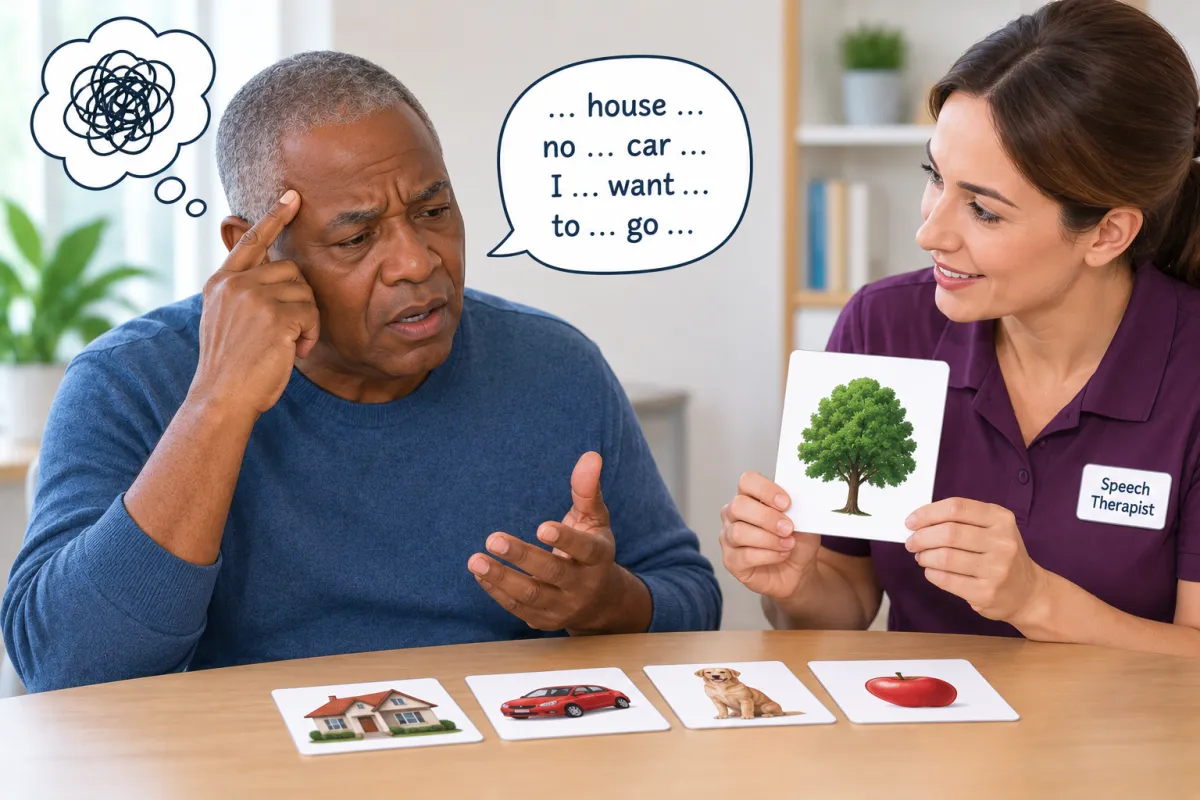
Aphasia is a common communication disorder that affects many stroke survivors. It can make speaking, understanding, reading and writing difficult, even though your intelligence remains unchanged. Learn what aphasia is, why it happens, the different types, and how rehabilitation can help you regain communication and confidence.
After your stroke...
You know exactly what you want to say.
The words are there...
Somewhere.
But they won't come out.
Or perhaps people speak to you...
And you struggle to understand what they're saying.
You begin wondering...
"Will I ever be able to communicate normally again?"
For many stroke survivors...
Aphasia is one of the most frustrating parts of recovery.
But there is hope.
✦ ✦ ✦
The Good News
Many people with aphasia make significant improvements.
Recovery often continues for months and even years after a stroke.
Speech and language therapy, daily practice and the brain's ability to adapt through neuroplasticity can all help improve communication.
Progress may be slow.
But meaningful recovery is absolutely possible.
✦ ✦ ✦
What Is Aphasia?
Aphasia is a language disorder caused by damage to the parts of the brain responsible for communication.
It can affect your ability to:
✓ Speak.
✓ Understand spoken language.
✓ Read.
✓ Write.
Some people struggle with only one of these skills.
Others experience difficulties in several areas.
Importantly...
Aphasia does not affect intelligence.
You still know who you are and what you want to say.
The challenge is getting the message into or out of your brain.
✦ ✦ ✦
Can a Stroke Cause Aphasia?
Yes.
Stroke is the most common cause of aphasia.
It usually occurs when a stroke affects the language centres of the brain, most commonly on the left side.
The severity depends on:
✓ The size of the stroke.
✓ The location of the damage.
✓ How quickly treatment was received.
✦ ✦ ✦
Types of Aphasia
There are several different types.
Expressive Aphasia (Broca's Aphasia)
You understand much of what people say.
But speaking becomes difficult.
You may:
✓ Speak in short sentences.
✓ Leave words out.
✓ Struggle to find the right word.
✓ Know exactly what you want to say but be unable to say it.
This is one of the most frustrating forms because you are often aware of your mistakes.
✦ ✦ ✦
Receptive Aphasia (Wernicke's Aphasia)
Speaking may remain fluent.
However, understanding spoken language becomes difficult.
You may:
✓ Misunderstand conversations.
✓ Say words that don't make sense.
✓ Be unaware that your speech is confusing.
✦ ✦ ✦
Global Aphasia
This is the most severe form.
Both understanding and speaking are significantly affected.
Reading and writing are often affected too.
Many people improve with rehabilitation, although recovery usually takes longer.
✦ ✦ ✦
Anomic Aphasia
The main difficulty is finding words.
You know what an object is...
You simply can't retrieve its name.
For example, you may describe an object instead of naming it.
✦ ✦ ✦
Symptoms of Aphasia
Symptoms vary depending on the type of aphasia.
You may experience:
✓ Difficulty finding words.
✓ Speaking in short sentences.
✓ Using the wrong words.
✓ Difficulty understanding conversations.
✓ Difficulty reading.
✓ Difficulty writing.
✓ Trouble following instructions.
✓ Feeling frustrated when communicating.
No two people experience aphasia in exactly the same way.
✦ ✦ ✦
How Does Aphasia Affect Everyday Life?
Communication affects almost everything we do.
Aphasia may make it harder to:
✓ Have conversations.
✓ Use the telephone.
✓ Read letters.
✓ Send messages.
✓ Order food.
✓ Return to work.
✓ Socialise.
✓ Express your needs.
This can sometimes lead to isolation and reduced confidence.
✦ ✦ ✦
Treatment and Rehabilitation
Speech and language therapy is the main treatment for aphasia.
Most people benefit from a combination of approaches.
✦ ✦ ✦
Speech and Language Therapy
Speech and language therapists help improve communication using exercises tailored to your individual needs.
Therapy may focus on:
✓ Speaking.
✓ Understanding.
✓ Reading.
✓ Writing.
✓ Word retrieval.
Regular practice is one of the most important parts of recovery.
✦ ✦ ✦
Communication Practice
Everyday conversations help reinforce what your brain is learning.
Speaking with family, friends and therapists provides valuable opportunities to practise.
Every conversation is therapy.
✦ ✦ ✦
Communication Aids
Some people benefit from:
✓ Picture boards.
✓ Communication books.
✓ Smartphone apps.
✓ Tablets.
✓ Writing.
These tools support independence while communication continues improving.
✦ ✦ ✦
Neuroplasticity
The brain has an incredible ability to reorganise itself.
With repeated practice, healthy areas of the brain can begin taking over some language functions.
This process is known as neuroplasticity.
It's one of the reasons recovery can continue long after the stroke.
✦ ✦ ✦
Practical Tips
Take Your Time
Don't rush conversations.
Give yourself time to find the words.
✦ ✦ ✦
Reduce Background Noise
A quiet environment makes communication much easier.
Turn off the television or radio during important conversations.
✦ ✦ ✦
Use Short Sentences
Simple language often makes conversations easier for both you and the person you're speaking with.
✦ ✦ ✦
Don't Be Afraid to Gesture
Pointing, writing, drawing or using facial expressions can all support communication.
Communication is about getting the message across—not speaking perfectly.
✦ ✦ ✦
Practise Every Day
Short, regular practice sessions are usually more effective than occasional long ones.
Consistency helps strengthen the brain's communication pathways.
✦ ✦ ✦
Tips for Family and Friends
Supporting someone with aphasia takes patience.
It helps to:
✓ Speak slowly.
✓ Give them time to answer.
✓ Avoid finishing every sentence.
✓ Ask one question at a time.
✓ Maintain eye contact.
✓ Encourage communication in any form.
Remember...
The person is still the same.
They simply have difficulty expressing themselves.
✦ ✦ ✦
When Should You Seek Medical Advice?
Speak with your healthcare professional if:
✓ Communication suddenly becomes worse.
✓ You develop new speech problems.
✓ You struggle to understand conversations more than before.
✓ Reading or writing suddenly changes.
Seek emergency medical attention immediately if speech or language problems appear suddenly, especially if accompanied by facial drooping, arm weakness or confusion.
These may be signs of another stroke.
✦ ✦ ✦
My Perspective
One of the hardest parts of aphasia is knowing exactly what you want to say...
But being unable to say it.
It can feel lonely.
Frustrating.
Exhausting.
But I've also seen how powerful persistence can be.
The brain learns through repetition.
Every word you practise...
Every conversation you have...
Every small success...
Is helping your brain rebuild communication.
✦ ✦ ✦
Frequently Asked Questions
Can Aphasia Improve After a Stroke?
Yes.
Many people improve significantly through speech and language therapy, regular practice and neuroplasticity.
Recovery varies from person to person.
✦ ✦ ✦
Is Aphasia Permanent?
Not always.
Some people recover almost completely.
Others continue improving for years and learn effective strategies to communicate confidently.
✦ ✦ ✦
Does Aphasia Affect Intelligence?
No.
Aphasia affects language—not intelligence.
People with aphasia still have thoughts, ideas and emotions.
The difficulty lies in communicating them.
✦ ✦ ✦
Can I Still Recover Years After a Stroke?
Yes.
The brain continues adapting throughout life.
Meaningful improvements remain possible months and even years after a stroke.
✦ ✦ ✦
Key Takeaways
✓ Aphasia is a common communication disorder after stroke.
✓ It may affect speaking, understanding, reading and writing.
✓ Intelligence is not affected.
✓ Speech and language therapy is the main treatment.
✓ Daily communication practice supports neuroplasticity.
✓ Recovery can continue for many months and even years.
✦ ✦ ✦
About the Author
Alisia Gayle is a stroke survivor who achieved 96% neurological recovery following an ischaemic stroke.
After years of rehabilitation, she now shares practical, evidence-informed resources to help stroke survivors, carers and families better understand recovery and rebuild their lives with confidence.
Alisia is also the author of Brain Damage: My Journey to 96% Recovery, where she shares her personal stroke recovery story and the lessons she learned throughout her rehabilitation.
✦ ✦ ✦
Medical Disclaimer
This article is intended for educational purposes only and should not replace professional medical advice, diagnosis or treatment.
Always seek advice from your doctor, speech and language therapist or other healthcare professional regarding symptoms, concerns or changes in your condition.
✦ ✦ ✦
Final Thoughts
Losing words doesn't mean you've lost your voice.
It means your brain is finding a new way to communicate.
Every word you practise...
Every conversation you have...
Every breakthrough you celebrate...
Is another step forward.
Be patient.
Keep speaking.
Keep trying.
Recovery happens one word, one sentence and one conversation at a time.