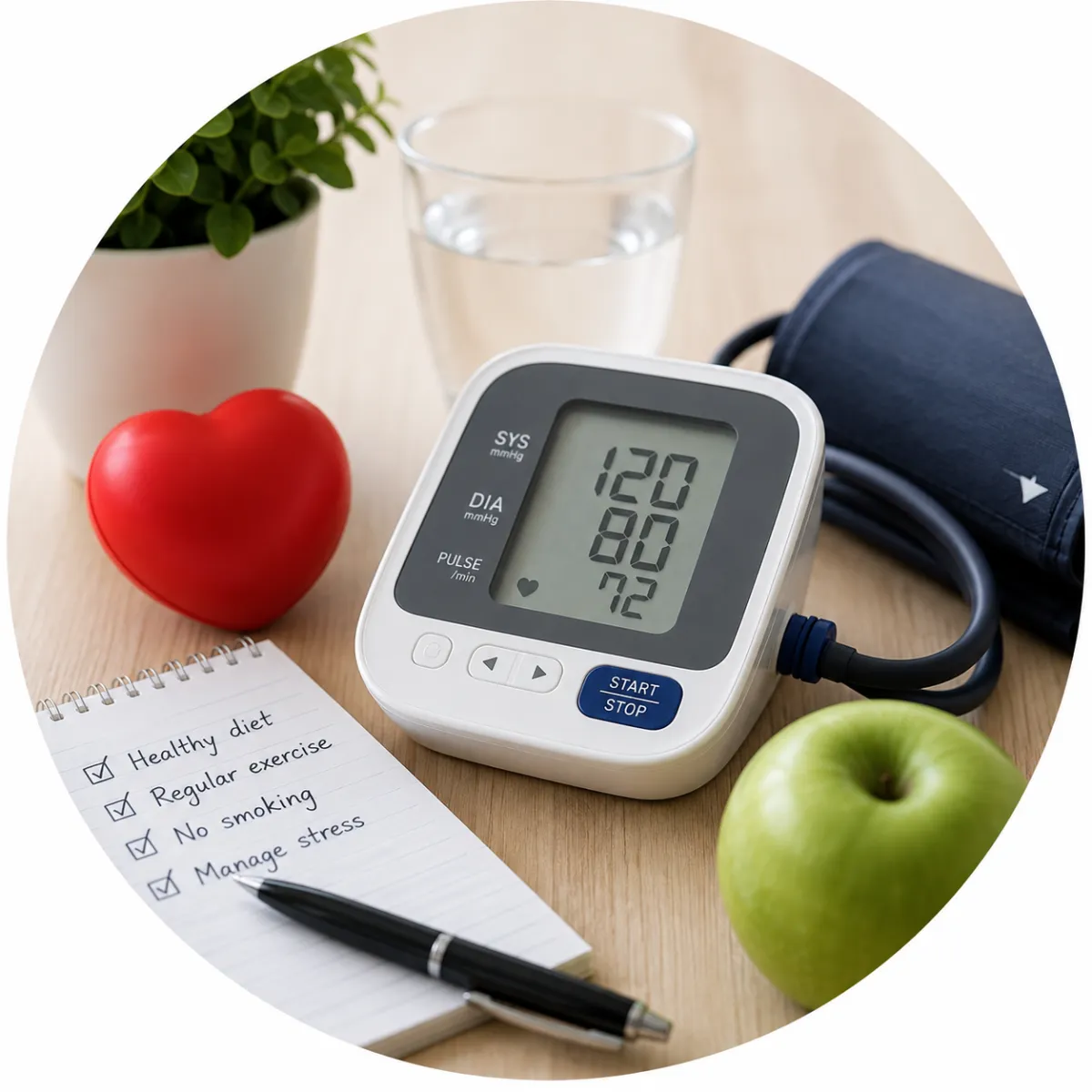
Keeping blood pressure under control is one of the most important parts of preventing another stroke. High blood pressure can damage blood vessels throughout the body and significantly increase the risk of both ischaemic and haemorrhagic stroke. But there is no single blood pressure number that is perfect for every stroke survivor. Your target may depend on your age, the type and cause of your stroke, other medical conditions, the medicines you take and how well you tolerate lower blood pressure. The safest approach is to know your individual target and monitor your readings rather than chasing an arbitrary number.
After your stroke...
Blood pressure suddenly becomes much more important.
You may find yourself staring at numbers on a monitor.
128/78.
142/89.
105/65.
Perhaps one reading is completely different from another.
You begin wondering...
"What should my blood pressure actually be?"
"Is 130/80 good after a stroke?"
"Is 140 too high?"
"Can my blood pressure become too low?"
"Should I still take tablets if my readings are normal?"
"What number should I be aiming for?"
These are sensible questions.
Blood pressure is one of the most important modifiable risk factors for stroke.
But blood pressure management after stroke is more complicated than simply saying:
"Lower is always better."
✦ ✦ ✦
The Good News
High blood pressure is something you can often do something about.
It can be:
✓ Monitored
✓ Treated
✓ Influenced by lifestyle
✓ Reviewed regularly
✓ Managed with medication when needed
The NHS explains that untreated high blood pressure increases the risk of stroke, heart disease, heart attack, kidney disease and other vascular problems. Even relatively small reductions in blood pressure can reduce cardiovascular risk.
That makes blood pressure control an important part of secondary stroke prevention.
But the goal is not simply getting the lowest number possible.
The goal is reaching a safe, appropriate and sustainable blood pressure for you.
✦ ✦ ✦
What Do the Blood Pressure Numbers Mean?
Blood pressure is recorded using two numbers.
For example:
130/80 mmHg
The first number is the:
Systolic Blood Pressure
This measures the pressure in your arteries when your heart contracts and pushes blood around your body.
In the example above:
130 is the systolic pressure.
The second number is the:
Diastolic Blood Pressure
This measures the pressure in your arteries while your heart relaxes between beats.
In the example:
80 is the diastolic pressure.
Blood pressure is measured in millimetres of mercury, written as:
mmHg
Both numbers matter.
But in many adults, particularly as people get older, systolic blood pressure becomes an especially important cardiovascular risk marker.
✦ ✦ ✦
What Counts as High Blood Pressure?
For the general UK adult population, the NHS usually considers blood pressure high when readings are:
✓ 140/90 mmHg or higher when measured by a healthcare professional
or
✓ 135/85 mmHg or higher when measured at home.
You may notice the home threshold is slightly lower.
That is because readings taken in a medical setting can sometimes be higher because of anxiety.
This is often referred to as the:
White coat effect.
Your doctor may therefore ask you to monitor blood pressure at home or use a 24-hour ambulatory blood-pressure monitor before deciding what your usual blood pressure actually is.
✦ ✦ ✦
What Should Blood Pressure Be After a Stroke?
There is no single universal answer.
This is important.
Different guidelines and different clinical situations may use somewhat different targets.
For many people with a previous stroke or TIA, long-term blood pressure control below the traditional hypertension threshold is desirable.
International stroke-prevention guidance has commonly supported a target around below 130/80 mmHg for many patients when it can be achieved safely and tolerated.
More recent US hypertension guidance also generally uses a treatment goal below 130/80 mmHg for many adults at increased cardiovascular risk.
However...
That does not mean every stroke survivor should independently try to force their blood pressure below 130/80.
UK guidance can use different targets depending on age, comorbidities and individual circumstances.
Your medical team should tell you what target applies to you.
✦ ✦ ✦
Why Is High Blood Pressure So Dangerous After Stroke?
High blood pressure places continuous stress on artery walls.
Over time, this can contribute to damage throughout the vascular system.
It may:
✓ Damage small blood vessels
✓ Accelerate atherosclerosis
✓ Increase the likelihood of blood vessel narrowing
✓ Contribute to clot-related stroke
✓ Increase the risk of bleeding in the brain
The Stroke Association explains that high blood pressure can contribute to stroke through several mechanisms, including damage to small blood vessels and conditions that increase the risk of blood clots.
If you have already experienced a stroke...
That history matters.
You are no longer discussing stroke risk theoretically.
Preventing another event becomes part of long-term care.
✦ ✦ ✦
Is 130/80 a Good Target After Stroke?
For many stroke survivors, a blood pressure around or below 130/80 mmHg may be an appropriate long-term goal.
But it should not be treated as a universal commandment.
Some people tolerate this level perfectly well.
Others may experience:
✓ Dizziness
✓ Weakness
✓ Fainting
✓ Light-headedness
✓ Falls
✓ Fatigue
✓ Symptoms when standing
A blood pressure that looks excellent on paper is not automatically excellent if you are repeatedly collapsing when you stand up.
Your treatment needs to balance stroke prevention against the risks of blood pressure becoming too low for you.
✦ ✦ ✦
Does Your Stroke Type Matter?
Yes.
Blood-pressure management can differ depending on whether you experienced:
✓ An ischaemic stroke
or
✓ A haemorrhagic stroke
An ischaemic stroke happens when blood flow to part of the brain becomes blocked.
A haemorrhagic stroke involves bleeding into or around the brain.
In the acute hospital phase, blood pressure management can be very different between the two.
For example, clinicians may deliberately avoid aggressively lowering blood pressure in certain people with acute ischaemic stroke, while blood pressure reduction may be an important part of acute treatment for some haemorrhagic strokes.
These hospital decisions are very different from your long-term blood-pressure target months or years later.
Do not confuse acute stroke treatment with long-term prevention.
✦ ✦ ✦
Blood Pressure Immediately After an Ischaemic Stroke
Blood pressure is often elevated shortly after an acute ischaemic stroke.
This does not necessarily mean doctors will immediately try to reduce it to your normal long-term target.
Why?
Because blood pressure may temporarily help maintain blood flow to brain tissue surrounding the stroke.
Doctors therefore use specific thresholds and clinical protocols during acute stroke treatment.
The target can also depend on whether you are being considered for treatments such as:
✓ Thrombolysis
✓ Thrombectomy
This is specialist hospital management.
Do not use long-term targets such as 130/80 to judge what should happen during the first hours of an acute stroke.
They are different clinical situations.
✦ ✦ ✦
Blood Pressure After Haemorrhagic Stroke
Blood pressure is particularly important in haemorrhagic stroke because very high pressure can contribute to continued bleeding or enlargement of the haemorrhage.
Clinical teams may therefore lower blood pressure relatively quickly in selected patients.
NICE guidance for acute intracerebral haemorrhage includes specific systolic blood-pressure targets during the early treatment period.
Again...
Those hospital targets are not necessarily the same as your long-term home blood-pressure target after recovery.
Your stroke team should tell you what you should aim for once you leave the acute stage.
✦ ✦ ✦
Can Blood Pressure Be Too Low After Stroke?
Yes.
This deserves attention because people sometimes become obsessed with getting the lowest possible reading.
Blood pressure is necessary to deliver oxygenated blood throughout your body.
If it becomes too low, you may experience:
✓ Dizziness
✓ Weakness
✓ Blurred vision
✓ Fainting
✓ Fatigue
✓ Confusion
✓ Falls
Some people experience symptoms particularly when standing.
This is known as:
Postural or orthostatic hypotension.
A substantial drop in blood pressure when you stand can make walking and rehabilitation more difficult and increase the risk of falls.
If low readings are accompanied by symptoms, tell your healthcare professional.
Do not simply assume:
"Lower must mean healthier."
✦ ✦ ✦
Is 90/60 Too Low?
Blood pressure around 90/60 mmHg is commonly regarded as being at the lower end of the normal range.
But numbers need context.
Some healthy people naturally have blood pressure around this level and feel completely well.
Others may feel:
Dizzy.
Weak.
Light-headed.
Faint.
The significance depends partly on:
✓ Your usual blood pressure
✓ Your symptoms
✓ Your medications
✓ Your hydration
✓ Your other medical conditions
If your blood pressure has suddenly become much lower than usual or you are repeatedly symptomatic, speak with your healthcare professional.
Do not change blood-pressure medication yourself.
✦ ✦ ✦
One Reading Does Not Tell the Whole Story
Blood pressure changes constantly.
It can be influenced by:
✓ Activity
✓ Stress
✓ Pain
✓ Caffeine
✓ Alcohol
✓ Medication
✓ Temperature
✓ Hydration
✓ Sleep
✓ Illness
✓ Time of day
So imagine you take one reading and see:
145/88.
You panic.
Then fifteen minutes later it is:
131/80.
Which number represents your true blood pressure?
Possibly neither on its own.
Patterns are generally much more useful than isolated readings.
That is why clinicians often ask for a series of home measurements.
✦ ✦ ✦
How to Measure Blood Pressure Properly at Home
Bad technique can produce misleading numbers.
Before taking a reading:
✓ Sit quietly for several minutes
✓ Use an appropriately sized upper-arm cuff
✓ Support your back
✓ Keep your feet flat on the floor
✓ Avoid crossing your legs
✓ Support your arm
✓ Keep the cuff approximately level with your heart
✓ Avoid talking during the measurement
If your healthcare professional has asked you to record home blood pressure, follow their specific instructions about timing and frequency.
You may be asked to take:
Two readings.
A minute apart.
Morning and evening.
For several days.
The average is often more informative than any individual measurement.
✦ ✦ ✦
Should You Check Blood Pressure Every Day?
Sometimes.
But not everyone needs to monitor blood pressure indefinitely every day.
Frequent monitoring may be useful when:
✓ Medication is being adjusted
✓ Blood pressure has recently been high
✓ Your doctor has requested home readings
✓ You experience symptoms
✓ Your treatment is being reviewed
Once blood pressure is stable, your healthcare professional may recommend less frequent monitoring.
There is little benefit in checking your pressure twenty times a day because every small variation frightens you.
Monitoring should produce useful information.
Not anxiety.
✦ ✦ ✦
What About Blood Pressure Spikes?
Blood pressure naturally rises temporarily in response to things such as:
Exercise.
Stress.
Pain.
Anger.
Caffeine.
Anxiety.
One temporary rise does not automatically mean your blood-pressure treatment has failed.
The bigger issue is whether blood pressure remains persistently elevated.
For example:
A single reading of 150/90 after rushing upstairs is very different from repeated resting readings in that range over several days.
Look for patterns.
And follow the thresholds your healthcare professional has given you.
✦ ✦ ✦
High Blood Pressure Often Has No Symptoms
This is why monitoring matters.
You may feel completely normal while your blood pressure is too high.
The NHS states that high blood pressure usually causes no symptoms, and many people do not know they have it until it is measured.
Occasionally, very high blood pressure may be associated with symptoms such as:
✓ Headaches
✓ Blurred vision
✓ Chest discomfort
But you cannot reliably judge blood pressure from how you feel.
"I feel fine" is not a blood-pressure measurement.
✦ ✦ ✦
Should You Stop Medication When Your Blood Pressure Becomes Normal?
No.
Not without discussing it with the clinician managing your treatment.
This is a common mistake.
Someone starts blood-pressure medication.
Three months later their readings are:
125/76.
They think:
"My blood pressure is normal now, so I don't need the tablet."
But the medication may be one of the reasons the blood pressure is normal.
Stopping it may simply allow the pressure to rise again.
The NHS notes that many people need medication, sometimes more than one medicine, to keep blood pressure controlled.
Normal readings while taking treatment do not automatically mean the underlying tendency to hypertension has disappeared.
✦ ✦ ✦
What If Blood Pressure Medication Makes You Dizzy?
Tell your healthcare professional.
Possible explanations may include:
✓ Blood pressure falling too low
✓ Postural hypotension
✓ Medication timing
✓ Dehydration
✓ Drug interactions
✓ Another medical condition
There are many types of blood-pressure medication.
Your doctor may be able to adjust:
✓ The dose
✓ Timing
✓ Combination of medicines
✓ Type of medicine
But medication changes should be deliberate.
Do not stop tablets abruptly because one morning you felt dizzy.
Get the problem assessed.
✦ ✦ ✦
Common Blood Pressure Medicines After Stroke
Several different medication classes may be used.
These can include:
✓ ACE inhibitors
✓ Angiotensin receptor blockers
✓ Calcium-channel blockers
✓ Thiazide-like diuretics
✓ Other medicines depending on your health conditions
Some people need one medicine.
Others require two or more.
The NHS notes that the choice of blood-pressure medicine can depend on factors including the person's blood pressure, age and ethnicity.
The best medication is not necessarily the one your friend takes.
Treatment should be individualised.
✦ ✦ ✦
Salt and Blood Pressure
Salt is particularly relevant.
A high-salt diet can contribute to raised blood pressure.
The NHS recommends reducing salt intake as one of the lifestyle measures that can help lower blood pressure.
Much of the salt people consume does not come from adding salt at the table.
It may be hidden in:
✓ Processed meat
✓ Ready meals
✓ Takeaways
✓ Crisps
✓ Sauces
✓ Stock cubes
✓ Soups
✓ Cheese
✓ Some breads
Reading food labels can reveal just how much sodium is present.
Reducing salt does not mean accepting flavourless food.
Use herbs, spices, garlic, lemon and other seasonings instead.
✦ ✦ ✦
Exercise and Blood Pressure
Regular physical activity can help reduce blood pressure and support cardiovascular health.
The NHS generally recommends aiming for around 150 minutes of physical activity each week for adults who can safely achieve it.
After stroke, your exercise programme may need adaptation because of:
✓ Weakness
✓ Balance problems
✓ Fatigue
✓ Cardiovascular disease
✓ Reduced mobility
Start at the level you can safely manage.
Exercise should become part of long-term prevention.
Not another opportunity to exhaust yourself.
✦ ✦ ✦
Weight and Blood Pressure
If you are overweight, reducing excess weight may help improve blood pressure.
But stroke survivors are not all trying to lose weight.
Some people experience:
✓ Swallowing difficulties
✓ Poor appetite
✓ Unintentional weight loss
✓ Muscle loss
So do not automatically begin a restrictive diet simply because you had a stroke.
Your nutritional strategy should reflect your actual needs.
If weight loss is appropriate, sustainable changes generally make more sense than extreme dieting.
✦ ✦ ✦
Alcohol and Blood Pressure
Regularly drinking too much alcohol can contribute to high blood pressure.
Current NHS guidance advises avoiding routinely drinking more than 14 units of alcohol per week and spreading intake across several days if you do drink.
If you do not drink alcohol...
You do not need to start.
If you have questions about alcohol interacting with stroke medication, ask your doctor or pharmacist.
✦ ✦ ✦
Smoking and Blood Pressure Risk
Smoking damages the cardiovascular system and increases stroke risk.
It also interacts with several other vascular risk factors.
The NHS includes stopping smoking among lifestyle measures recommended to reduce the health risks associated with high blood pressure.
After stroke, smoking cessation is not a minor lifestyle upgrade.
It is part of secondary prevention.
✦ ✦ ✦
Stress and Your Readings
Stress can temporarily increase blood pressure.
This can create an unpleasant cycle.
You measure your blood pressure.
It is slightly high.
You panic.
You immediately measure it again.
Now it is higher.
You panic more.
Then you take it six more times.
That does not necessarily provide useful information.
If you obtain an unexpectedly high reading without emergency symptoms, sit quietly and repeat the measurement according to the guidance you have been given.
Monitoring should be systematic.
Not compulsive.
✦ ✦ ✦
Blood Pressure and Older Stroke Survivors
Age matters.
Blood-pressure targets can be different for older adults.
For example, UK hypertension guidance generally uses less aggressive clinic targets for many adults aged 80 and over than for younger adults, and treatment decisions may also account for frailty and individual tolerance.
This is another reason a website article cannot give every stroke survivor one mandatory number.
A healthy, active 50-year-old and a frail 90-year-old may require different treatment strategies.
Individualisation matters.
✦ ✦ ✦
What If Your Blood Pressure Has Always Been Low?
Some people naturally have low blood pressure.
Perhaps your typical reading has always been:
100/65.
95/60.
Or similar.
That does not automatically mean something is wrong.
What matters is whether:
✓ You feel well
✓ The readings are stable
✓ You experience dizziness or fainting
✓ Medication has recently changed
✓ Your healthcare professional is concerned
If blood pressure is consistently low and you are taking antihypertensive medication after stroke, discuss the readings with the person prescribing it.
Do not assume you should continue exactly the same dose forever regardless of what your body is doing.
And equally...
Do not stop it yourself.
The treatment needs reviewing.
✦ ✦ ✦
My Perspective
Blood pressure after stroke can become strangely emotional.
Before stroke...
A reading may have meant almost nothing.
Afterwards...
Suddenly every number feels like a prediction of your future.
That can make people do one of two things.
Some ignore blood pressure completely.
Others become obsessed with it.
Neither approach is particularly useful.
You need information.
Know your target.
Know your normal range.
Take medication as prescribed.
Monitor appropriately.
Look at patterns.
And understand what lifestyle changes genuinely help.
Most importantly...
Do not chase a number just because you saw it online.
A blood pressure target needs to work for your body and your medical situation.
The objective is not winning a competition for the lowest blood-pressure reading.
The objective is reducing your risk of another stroke while remaining well enough to live your life.
✦ ✦ ✦
When Should You Seek Medical Advice?
Speak with your doctor or healthcare professional if:
✓ Your home readings are repeatedly above your agreed target
✓ Your blood pressure has changed significantly
✓ You repeatedly experience dizziness
✓ You feel faint when standing
✓ You actually faint
✓ Medication appears to be causing side effects
✓ Your readings are repeatedly very low
✓ You are unsure what target you should be aiming for
✓ You want to change or stop medication
High blood pressure often produces no warning symptoms, so regular monitoring and medical review are important.
✦ ✦ ✦
When Is It an Emergency?
A blood-pressure number should never distract you from symptoms.
If you develop sudden symptoms of stroke such as:
✓ Facial weakness
✓ Arm weakness
✓ Sudden numbness
✓ Speech difficulty
✓ Sudden vision problems
✓ Severe new neurological symptoms
seek emergency medical attention.
Do not stay home repeatedly checking your blood pressure while neurological symptoms are developing.
Likewise, severe chest pain, collapse or other serious symptoms require urgent assessment.
Treat the person.
Not just the monitor.
✦ ✦ ✦
Frequently Asked Questions
What Blood Pressure Should I Aim for After a Stroke?
Many stroke-prevention guidelines support long-term blood pressure around or below 130/80 mmHg for many patients when tolerated, but the correct target depends on the individual.
Ask your healthcare professional to give you your specific target.
Is 140/90 Too High After Stroke?
A clinic reading of 140/90 mmHg or above is generally considered high blood pressure in UK adults.
For a person with previous stroke, your medical team may want your long-term blood pressure lower than this.
Is 130/80 Good After Stroke?
For many people, yes.
But whether it is appropriate depends on your medical circumstances and whether you tolerate that level without symptoms.
Can Blood Pressure Be Too Low?
Yes.
Very low blood pressure may cause dizziness, fainting and falls in some people.
The number needs to be interpreted alongside your symptoms and normal baseline.
Should I Stop My Tablets If My Blood Pressure Is Normal?
No.
Not without speaking to the clinician managing your treatment.
The medication may be the reason your readings are controlled.
Should I Measure Blood Pressure Every Day?
It depends.
Daily monitoring may be useful during treatment changes or when your clinician asks for it.
Once your blood pressure is stable, you may need less frequent checks.
Is Home Blood Pressure Different From a Clinic Reading?
Yes.
UK thresholds generally define high blood pressure as 140/90 mmHg or higher in clinic and 135/85 mmHg or higher when measured at home.
✦ ✦ ✦
Key Takeaways
✓ High blood pressure is one of the most important modifiable risk factors for stroke.
✓ Blood-pressure control is an important part of preventing another stroke.
✓ A general UK clinic reading of 140/90 mmHg or higher is considered high.
✓ Home readings of 135/85 mmHg or higher are generally considered high.
✓ Many stroke-prevention guidelines favour a target around or below 130/80 mmHg for many patients when safely tolerated.
✓ There is no universal target appropriate for every stroke survivor.
✓ Age, stroke type, medical conditions and treatment tolerance matter.
✓ Very low blood pressure can also cause problems.
✓ Look at patterns rather than panicking over one isolated reading.
✓ Do not stop blood-pressure medication simply because your readings become normal.
✓ Ask your healthcare professional what your personal blood-pressure target should be.
✦ ✦ ✦
Related Articles
Continue learning about reducing your risk of another stroke:
High Blood Pressure After Stroke
Can You Prevent a Second Stroke?
Exercise and Stroke Prevention
Mediterranean Diet After Stroke
Smoking After Stroke
Cholesterol and Stroke Risk
TIA Warning Signs
Atrial Fibrillation and Stroke
Medication After Stroke
Lifestyle Changes After Stroke
✦ ✦ ✦
About the Author
Alisia Gayle is a stroke survivor who achieved 96% neurological recovery following an ischaemic stroke.
After years of rehabilitation, she now shares practical, evidence-informed resources to help stroke survivors, carers and families better understand recovery and rebuild their lives with confidence.
Alisia is also the author of Brain Damage: My Journey to 96% Recovery, where she shares her personal stroke recovery story and the lessons she learned throughout her rehabilitation.
✦ ✦ ✦
Medical Disclaimer
This article is intended for educational purposes only and should not replace professional medical advice, diagnosis or treatment.
Blood-pressure targets after stroke vary according to stroke type, age, other medical conditions, medication, symptoms and individual cardiovascular risk.
Do not start, stop or alter blood-pressure medication based solely on information in this article or on an isolated blood-pressure reading.
Ask your doctor, stroke team, pharmacist or another appropriate healthcare professional to confirm the blood-pressure target that applies to you.
Seek emergency medical help if you develop sudden stroke symptoms, severe chest pain, collapse or another serious medical emergency.
✦ ✦ ✦
Final Thoughts
Blood pressure after stroke...
Can feel like two numbers carrying enormous weight.
120/75.
130/80.
145/90.
You may find yourself asking:
"Is this good?"
"Is this dangerous?"
"Am I going to have another stroke?"
But one number rarely tells the whole story.
What matters is the pattern.
Your individual target.
Your medication.
Your lifestyle.
Your symptoms.
And your overall cardiovascular risk.
Know your numbers.
Measure them properly.
Take your prescribed medication.
Reduce excess salt.
Stay active where you safely can.
Do not smoke.
Attend your medical reviews.
And ask one very simple question if nobody has clearly answered it:
"What blood pressure do you want me to aim for?"
Because after stroke...
Controlling blood pressure is not about getting the lowest reading possible.
It is about keeping pressure low enough to protect your blood vessels...
Without pushing it so low that you create another problem.
The right target is not simply a number from the internet.
It is the number that makes sense for you.