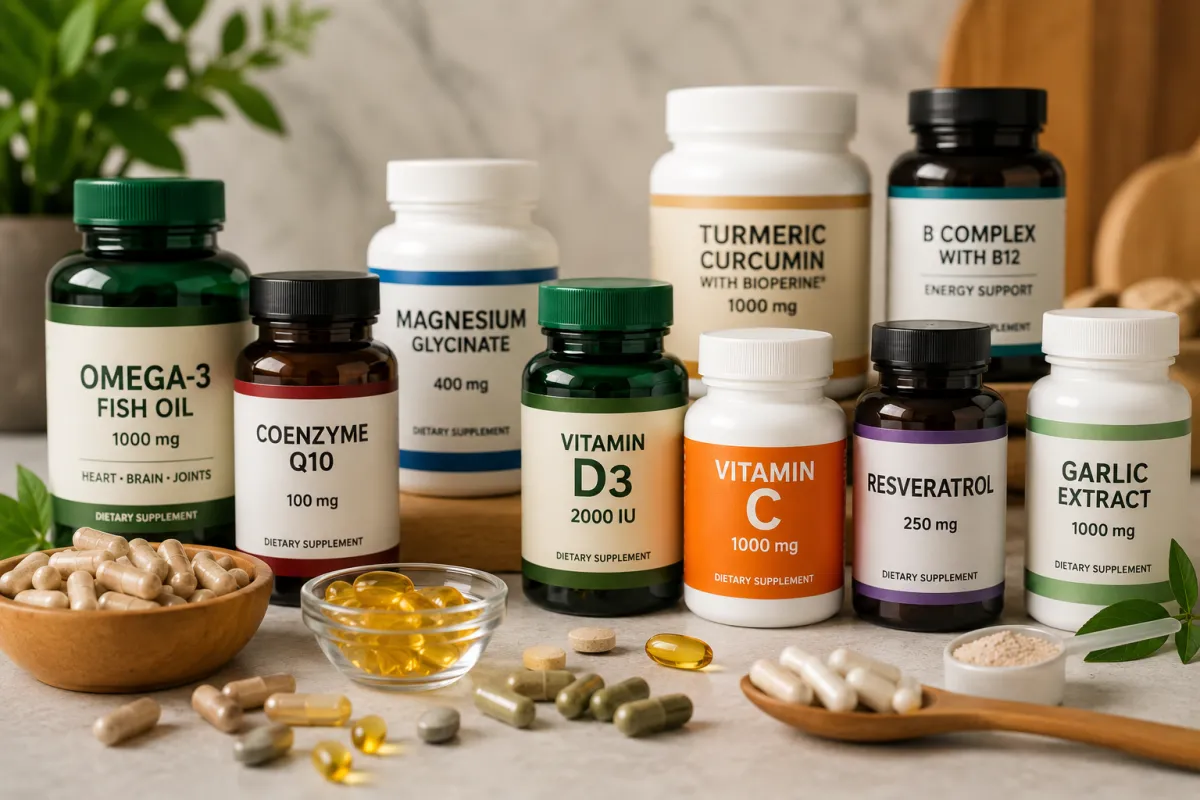
Supplements are often marketed as an easy way to protect the heart and brain, but there is no vitamin, mineral, herbal product or “brain supplement” proven to reliably prevent stroke in the way that controlling blood pressure, treating atrial fibrillation, managing diabetes, lowering harmful cholesterol, stopping smoking and taking prescribed medication can. Some supplements may be appropriate when you have a genuine nutritional deficiency, but taking more vitamins does not automatically mean greater protection from stroke — and some supplements can interact with stroke medications or even cause harm.
After a stroke...
It is natural to start looking for anything that might prevent another one.
You read about:
Omega-3.
Magnesium.
Vitamin D.
Vitamin B12.
Folic acid.
Turmeric.
Coenzyme Q10.
Multivitamins.
Antioxidants.
Herbal remedies.
And suddenly the internet makes it sound as though stroke prevention is available in a bottle.
You begin wondering...
"Should I be taking supplements?"
"Can vitamins stop another stroke?"
"Is there something my doctor has forgotten to prescribe?"
"Would omega-3 protect my arteries?"
"Should I take magnesium for my blood pressure?"
"What about vitamin D?"
These are sensible questions.
But this is an area where marketing can run far ahead of evidence.
The reality is much less exciting.
For most people...
Supplements are not the foundation of stroke prevention.
✦ ✦ ✦
The Good News
There are proven ways to reduce stroke risk.
They simply tend to be less glamorous than supplements.
For many people, prevention involves:
✓ Controlling blood pressure
✓ Managing cholesterol
✓ Treating diabetes
✓ Treating atrial fibrillation
✓ Taking prescribed antiplatelet or anticoagulant medication where appropriate
✓ Stopping smoking
✓ Being physically active
✓ Maintaining a healthy diet
✓ Managing weight where appropriate
NICE secondary-prevention guidance focuses on established treatments such as antiplatelet therapy and management of cardiovascular risk rather than routine vitamin supplementation.
A healthy diet rich in fruit, vegetables and wholegrains is also associated with lower cardiovascular and stroke risk.
So if you want to reduce your stroke risk...
Start with the factors that have the strongest evidence.
Supplements should never distract you from them.
✦ ✦ ✦
Why Are Supplements So Appealing After Stroke?
Because they offer something psychologically powerful.
Control.
A stroke can make you feel as though your body suddenly betrayed you.
You may have done everything normally one day...
Then your life changed.
Afterwards, taking a capsule every morning can feel like taking action.
You think:
"At least I am doing something."
That feeling is understandable.
The problem is that doing something and doing something proven to reduce stroke risk are not necessarily the same thing.
A supplement may feel preventative without actually producing a meaningful reduction in stroke risk.
That distinction matters.
✦ ✦ ✦
Can a Multivitamin Prevent Stroke?
There is no good reason to treat a standard multivitamin as stroke-prevention medication.
Vitamins and minerals are essential for health.
But getting enough of a nutrient is different from assuming that taking extra amounts protects your arteries or prevents blood clots.
Stroke Association dietary guidance specifically says that people generally do not need antioxidant supplements such as vitamins A, C or E simply to obtain the benefits associated with a healthy diet.
The better strategy for most people is to obtain nutrients through a varied diet unless a healthcare professional has identified a reason supplementation is needed.
A multivitamin may be appropriate for some individuals.
But it should not be sold to you mentally as:
"My anti-stroke tablet."
It is not.
✦ ✦ ✦
Food and Supplements Are Not the Same Thing
This is an important distinction.
Studies repeatedly associate diets rich in:
✓ Fruit
✓ Vegetables
✓ Wholegrains
✓ Fibre
✓ Nuts and seeds
✓ Appropriate protein sources
With better cardiovascular health.
The NHS says people who eat at least five portions of fruit and vegetables daily have a lower risk of heart disease and stroke.
But that does not mean taking isolated vitamins from those foods produces exactly the same effect.
Food contains:
Fibre.
Minerals.
Vitamins.
Plant compounds.
Protein.
Healthy fats.
And thousands of substances interacting together.
Taking one nutrient in concentrated tablet form is not equivalent to eating the food it originally came from.
That is why:
"Vitamin-rich foods are healthy"
Does not automatically mean:
"High-dose vitamin tablets prevent stroke."
✦ ✦ ✦
What About Omega-3 Supplements?
Omega-3 fatty acids are frequently marketed for cardiovascular health.
They are naturally present in oily fish and some other foods.
But when it comes specifically to preventing stroke, the evidence is not strong enough to assume that taking an ordinary omega-3 supplement will protect you.
Stroke Association guidance states that there is no strong evidence to say with certainty that omega-3 or omega-6 fatty acids reduce stroke risk.
That does not mean omega-3 fats are unhealthy.
It means:
Eating nutritious foods containing healthy fats and taking an omega-3 capsule are not automatically interchangeable interventions.
If your doctor has recommended a particular prescription treatment for high triglycerides or another medical reason, that is different from buying a generic fish-oil supplement and assuming it prevents stroke.
✦ ✦ ✦
What About Vitamin D?
Vitamin D is important for health.
The NHS recommends that adults consider taking a daily vitamin D supplement during autumn and winter, and certain people who have little exposure to sunlight may need supplementation throughout the year.
That recommendation is primarily about maintaining adequate vitamin D status and supporting areas such as bone and muscle health.
It should not be interpreted as:
"Vitamin D tablets prevent stroke."
Those are two different claims.
If you are vitamin D deficient, treating the deficiency is sensible.
But correcting a deficiency is not the same thing as using vitamin D as a substitute for proven stroke-prevention treatment.
✦ ✦ ✦
What About Folic Acid?
Folic acid is vitamin B9.
It plays an important role in normal cell function and blood formation.
Some people may be prescribed folic acid because blood tests reveal a deficiency.
There has also been scientific interest in folate and a substance called homocysteine.
Homocysteine is an amino acid in the blood.
Elevated levels have been associated with cardiovascular disease and stroke risk.
Folic acid and certain B vitamins can reduce homocysteine levels.
But that does not mean every stroke survivor should immediately start high-dose folic acid.
Your underlying nutritional status, medications, diet and medical history matter.
High-dose supplementation should be clinically justified rather than based simply on the assumption that more is better.
✦ ✦ ✦
What About Vitamin B12?
Vitamin B12 is important for:
✓ Nerve function
✓ Red blood cell formation
✓ DNA production
Deficiency can cause neurological symptoms and anaemia.
Some people are more likely to become deficient, including those with certain gastrointestinal conditions or dietary patterns.
If blood tests identify B12 deficiency, treatment can be important.
But again...
Treating a deficiency is not the same thing as taking B12 specifically to prevent stroke.
If your B12 level is normal, taking increasingly large doses does not automatically provide greater protection.
This principle applies to many nutrients.
Correct deficiency where it exists.
Do not assume excess equals prevention.
✦ ✦ ✦
What About Magnesium?
Magnesium has become extremely popular online.
It is promoted for:
Sleep.
Muscle cramps.
Blood pressure.
Stress.
Heart health.
Anxiety.
And sometimes stroke prevention.
Magnesium is an essential mineral.
But that does not mean routinely taking magnesium supplements prevents stroke.
If your diet contains sufficient magnesium and you do not have a deficiency, additional supplementation may provide no meaningful stroke-prevention benefit.
Magnesium supplements can also cause side effects such as diarrhoea and can interact with certain medicines.
People with significant kidney disease may need particular caution because the body may have difficulty clearing excess magnesium.
Do not treat "natural mineral" as meaning "risk-free."
✦ ✦ ✦
What About Antioxidant Supplements?
You may hear that stroke is associated with oxidative stress.
Then someone makes the leap:
"Therefore antioxidant supplements prevent stroke."
That reasoning sounds convincing.
But biological mechanisms are not enough.
A treatment needs to show meaningful benefit in actual people.
Stroke Association guidance notes that although fruits and vegetables contain antioxidants such as vitamins A, C and E, these nutrients can be obtained through a healthy diet and routine supplementation is not necessary for this purpose.
NICE cardiovascular guidance has also advised against using antioxidant supplements such as vitamins E and C or folic acid purely to reduce cardiovascular risk in relevant secondary-prevention settings.
Do not assume antioxidants in pill form reproduce the benefits associated with eating plants.
✦ ✦ ✦
What About Turmeric?
Turmeric and its component curcumin are often marketed for:
Inflammation.
Circulation.
Brain health.
Heart health.
Sometimes even clot prevention.
But "may influence inflammation in laboratory studies" is very different from:
"Has been proven to prevent stroke."
Turmeric supplements can also interact with medications and may affect bleeding risk in some situations.
That becomes especially important if you take:
✓ Anticoagulants
✓ Antiplatelet medication
✓ Other medicines affecting clotting
If you take medication following a stroke, discuss concentrated herbal supplements with a pharmacist or doctor before using them.
Do not assume something is harmless because it comes from a plant.
✦ ✦ ✦
Herbal Does Not Mean Safe
This deserves its own section.
A plant can contain biologically active chemicals.
That is exactly why some herbs can interact with medication.
Herbal supplements may:
✓ Alter blood clotting
✓ Affect blood pressure
✓ Change how drugs are metabolised
✓ Affect liver enzymes
✓ Interfere with medication absorption
✓ Increase side effects
And unlike prescribed medicines, different supplement products may vary considerably in concentration and formulation.
If you are taking medication after stroke...
Your doctor and pharmacist need to know what supplements you use.
That includes products you bought yourself.
"Natural" is not a synonym for "safe."
Hemlock is natural too.
✦ ✦ ✦
Supplements Can Interact With Blood Thinners
This is particularly important for people taking anticoagulants.
You may be taking medication such as:
✓ Apixaban
✓ Rivaroxaban
✓ Edoxaban
✓ Dabigatran
✓ Warfarin
Or an antiplatelet medication such as:
✓ Clopidogrel
✓ Aspirin
These medications affect blood clotting.
Adding supplements or herbal remedies that also influence clotting may potentially increase bleeding risk or alter treatment.
Warfarin is particularly sensitive to interactions because vitamin K intake and many medicines can affect its action.
Do not add a collection of supplements to an anticoagulant regimen without checking first.
Your pharmacist is an excellent person to ask.
✦ ✦ ✦
Can Supplements Replace Statins?
No.
If you have been prescribed a statin following an ischaemic stroke or TIA, do not replace it with:
Garlic tablets.
Red yeast rice.
Plant supplements.
Coenzyme Q10.
Or a "natural cholesterol formula."
Statins have established roles in cardiovascular and secondary stroke prevention for appropriate patients.
Supplements are not automatically equivalent simply because they claim to support cholesterol.
If you experience statin side effects, discuss them with your doctor.
There may be options involving:
✓ Dose adjustment
✓ A different statin
✓ Alternative lipid-lowering treatment
Stopping evidence-based medication and replacing it with an unproven supplement is a poor trade.
✦ ✦ ✦
Can Supplements Replace Blood Pressure Medication?
Again...
No.
High blood pressure is one of the strongest modifiable risk factors for stroke.
A supplement marketed as:
"Supports healthy circulation"
Or:
"Supports normal blood pressure"
Is not automatically equivalent to an antihypertensive medicine prescribed specifically to control hypertension.
If your blood pressure medication causes problems, speak with your doctor.
There are many different classes of blood pressure medicines.
Do not silently stop your medication and replace it with magnesium, beetroot capsules or another supplement because somebody online says it is "natural."
The consequence of uncontrolled blood pressure can be another stroke.
✦ ✦ ✦
Can Supplements Replace Anticoagulants?
Absolutely not.
If you have atrial fibrillation and have been prescribed an anticoagulant because your stroke risk warrants it...
Fish oil is not a substitute.
Garlic is not a substitute.
Turmeric is not a substitute.
Vitamin E is not a substitute.
Anticoagulant medication targets the clotting process in a clinically established way.
NICE guidance specifically includes anticoagulation as a core strategy for preventing stroke in people with atrial fibrillation when indicated.
Replacing it with supplements could leave the original stroke mechanism inadequately treated.
✦ ✦ ✦
When Supplements Actually Do Make Sense
This article is not saying supplements are useless.
That would also be inaccurate.
Supplements can be valuable when there is a specific reason to take them.
For example:
✓ A confirmed vitamin deficiency
✓ Restricted dietary intake
✓ Certain medical conditions
✓ Reduced absorption
✓ Specific nutritional needs
✓ Limited sunlight exposure requiring vitamin D
✓ A clinician or dietitian identifies a deficiency risk
In those circumstances...
The supplement has a job.
You are correcting or preventing a particular nutritional problem.
That is very different from taking fifteen supplements "just in case."
✦ ✦ ✦
Should You Have Blood Tests Before Taking Supplements?
Sometimes this is sensible.
If you are concerned that you may have:
✓ Vitamin B12 deficiency
✓ Folate deficiency
✓ Iron deficiency
✓ Vitamin D deficiency
Or another nutritional problem...
Talk to your GP.
Blood tests may help identify whether supplementation is actually necessary.
Without testing or clinical assessment, you may be treating a deficiency you do not have...
While ignoring one you do.
Targeted treatment is more intelligent than guessing.
✦ ✦ ✦
More Is Not Better
There is a persistent assumption with vitamins:
If some is essential...
More must be healthier.
That is false.
Some vitamins are water-soluble and excess amounts may be excreted.
Others can accumulate in the body.
High doses of certain vitamins and minerals can cause side effects or toxicity.
Supplements can also interact with medications.
So the correct question is not:
"How many vitamins should I take?"
It is:
"Do I actually need this supplement, at this dose, given my medical history and medication?"
That is a much better question.
✦ ✦ ✦
Beware of "Brain Recovery" Supplements
Stroke survivors are a perfect target for aggressive supplement marketing.
You are frightened.
You want your brain back.
You want faster recovery.
Then an advertisement promises:
"Neuroplasticity support."
"Brain regeneration."
"Enhanced circulation."
"Stroke recovery nutrients."
"Neurological repair."
Those phrases sound scientific.
But scientific-sounding language is not evidence.
Ask:
What clinical trials support this claim?
Was the supplement actually studied in stroke survivors?
Did it improve meaningful outcomes?
Was the study independent?
Was it large enough?
Were the results replicated?
If those questions cannot be answered...
You are looking at marketing, not medicine.
✦ ✦ ✦
Supplements Are Not a Shortcut Around Lifestyle
A common mistake is taking supplements while ignoring the major risk factors.
You take:
Fish oil.
Vitamin D.
Magnesium.
Turmeric.
A multivitamin.
But your blood pressure remains uncontrolled.
You still smoke.
You rarely take your prescribed medication.
Your diabetes remains poorly managed.
That is backwards.
The supplement cabinet cannot compensate for uncontrolled cardiovascular risk.
If you have limited energy, attention or money...
Prioritise what has the strongest evidence.
That may mean:
Taking prescribed medication consistently.
Checking your blood pressure.
Improving your diet.
Increasing activity appropriately.
Stopping smoking.
Attending medical reviews.
Those things are less exciting.
They also matter much more.
✦ ✦ ✦
Eat the Nutrients Where Possible
For most people, a varied diet is the first place to obtain vitamins and minerals.
The NHS recommends a balanced diet including plenty of fruit and vegetables, and notes that consuming at least five portions daily is associated with a lower risk of heart disease and stroke.
Foods can provide:
✓ Potassium
✓ Folate
✓ Vitamin C
✓ Fibre
✓ Magnesium
✓ Healthy fats
✓ Plant compounds
And they deliver those nutrients as part of an overall dietary pattern.
Think:
Fruit rather than vitamin-C megadoses.
Vegetables rather than antioxidant pills.
Oily fish rather than assuming fish-oil capsules reproduce every benefit.
Whole foods first where practical.
Supplement specific deficiencies where needed.
✦ ✦ ✦
What About Supplements During Stroke Recovery?
Stroke prevention and stroke recovery are different questions.
A supplement might be appropriate because:
You have poor appetite.
You have lost weight.
Your diet is nutritionally inadequate.
Blood testing shows deficiency.
You have swallowing problems.
You are spending very little time outdoors.
These issues may deserve nutritional intervention.
But that does not necessarily mean the supplement will directly repair damaged brain tissue or accelerate neurological recovery.
NICE stroke-rehabilitation guidance recommends appropriate nutritional support when problems such as dysphagia affect nutrition.
In this situation, a dietitian may be far more useful than choosing supplements yourself.
✦ ✦ ✦
My Perspective
I understand why supplements become attractive after stroke.
You want another layer of protection.
Something extra.
Something you can take every morning and think:
"This is helping stop it happening again."
But stroke prevention is not usually that simple.
There is no magic bottle sitting on a health-food shelf that your stroke consultant somehow forgot to mention.
If something dramatically prevented recurrent strokes, it would not remain a wellness secret.
It would become part of mainstream stroke treatment.
That does not make nutrition unimportant.
Nutrition matters enormously.
And deficiencies should absolutely be treated.
But the priority should be getting the basics right.
Blood pressure.
Cholesterol.
Blood sugar.
Heart rhythm.
Medication.
Smoking.
Movement.
Diet.
Weight.
Those are not glamorous.
But they are where much of the serious prevention work happens.
Supplements should fill genuine gaps.
They should not distract you from the things actually driving your risk.
✦ ✦ ✦
When Should You Speak With a Healthcare Professional?
Speak with your GP, pharmacist, dietitian or stroke team before starting supplements if:
✓ You take anticoagulants
✓ You take antiplatelet medication
✓ You take several prescription medicines
✓ You have kidney disease
✓ You have liver disease
✓ You are pregnant
✓ You have swallowing difficulties
✓ You are losing weight
✓ You suspect a nutritional deficiency
✓ You plan to take high-dose vitamins
✓ You are using herbal preparations
✓ You are considering replacing prescribed medicine with a supplement
Take a list of everything you use.
That includes:
Vitamins.
Minerals.
Powders.
Herbal products.
Teas marketed medicinally.
Protein supplements.
Traditional remedies.
Your healthcare team cannot check for interactions if they do not know what you are taking.
✦ ✦ ✦
Frequently Asked Questions
Can Vitamins Prevent a Stroke?
There is no general vitamin supplement proven to act as a substitute for established stroke-prevention measures.
A healthy diet containing naturally nutrient-rich foods is associated with lower cardiovascular and stroke risk.
Should Stroke Survivors Take a Multivitamin?
Not automatically.
Some people may benefit because of dietary limitations or specific deficiencies, but routine supplementation is not the same as stroke prevention.
Does Omega-3 Prevent Stroke?
Evidence is not strong enough to say that routine omega-3 supplementation reliably prevents stroke. Stroke Association guidance says there is no strong evidence to say for certain that omega-3 or omega-6 fats reduce stroke risk.
Should I Take Vitamin D After Stroke?
Vitamin D supplementation may be appropriate according to general NHS guidance, particularly during autumn and winter or for people with limited sunlight exposure.
That recommendation should not be interpreted as vitamin D being a specific stroke-prevention treatment.
Can Supplements Interfere With Blood Thinners?
Yes.
Some supplements and herbal products can affect clotting or interact with medications.
Always check with a pharmacist or doctor before combining supplements with anticoagulant or antiplatelet therapy.
Can I Replace My Statin With a Natural Supplement?
Do not replace prescribed stroke-prevention medication with a supplement without speaking to your doctor.
The two are not automatically equivalent.
Is It Worth Checking for Vitamin Deficiencies?
If your diet is restricted, you are losing weight, have absorption problems or symptoms suggesting deficiency, medical assessment and blood testing may be appropriate.
Are Natural Supplements Safer Than Medication?
No.
"Natural" describes where something came from.
It does not prove that it is harmless, effective or free from drug interactions.
✦ ✦ ✦
Key Takeaways
✓ No supplement can guarantee prevention of stroke.
✓ Supplements should not replace proven stroke-prevention medication.
✓ Controlling blood pressure, cholesterol, diabetes and atrial fibrillation is far more important.
✓ A healthy dietary pattern is different from taking isolated vitamin tablets.
✓ Routine antioxidant supplements are not required simply because antioxidant-rich foods are healthy.
✓ Evidence that ordinary omega-3 supplements prevent stroke is not strong.
✓ Vitamin D may be appropriate for general health according to NHS guidance, but it is not a specific stroke-prevention treatment.
✓ B12, folate and other supplements may be useful when a deficiency exists.
✓ More vitamins do not automatically mean more protection.
✓ Herbal supplements can interact with medication.
✓ People taking anticoagulants or antiplatelets should be particularly careful.
✓ Do not replace statins, blood pressure medication or anticoagulants with supplements.
✓ Ask a pharmacist or doctor about everything you take.
✓ A healthy diet should usually provide most nutrients.
✓ Treat genuine deficiencies rather than guessing.
✦ ✦ ✦
Related Articles
Continue learning about reducing stroke risk:
Preventing a Second Stroke
Stroke Risk Factors You Can Change
Diet After Stroke
Healthy Eating After Stroke
Diabetes and Stroke Risk
Atrial Fibrillation and Stroke
High Blood Pressure and Stroke Risk
High Cholesterol and Stroke Risk
Weight Management After Stroke
Medication After Stroke
✦ ✦ ✦
About the Author
Alisia Gayle is a stroke survivor who achieved 96% neurological recovery following an ischaemic stroke.
After years of rehabilitation, she now shares practical, evidence-informed resources to help stroke survivors, carers and families better understand recovery and rebuild their lives with confidence.
Alisia is also the author of Brain Damage: My Journey to 96% Recovery, where she shares her personal stroke recovery story and the lessons she learned throughout her rehabilitation.
✦ ✦ ✦
Medical Disclaimer
This article is intended for educational purposes only and should not replace professional medical advice, diagnosis, nutritional advice or treatment.
Supplements may interact with prescription medication and may not be appropriate for everyone.
Always speak with your doctor, pharmacist, dietitian or another appropriate healthcare professional before starting high-dose vitamins, minerals, herbal remedies or other supplements, particularly if you take anticoagulant, antiplatelet, blood pressure, diabetes or cholesterol medication.
Never stop or replace prescribed stroke-prevention medication because of information about supplements without first discussing it with your healthcare team.
If you experience sudden symptoms suggesting a stroke, seek emergency medical assistance immediately.
✦ ✦ ✦
Final Thoughts
After a stroke...
It is tempting to search for one more thing.
One vitamin.
One mineral.
One herb.
One capsule that might make you safer.
But preventing stroke is rarely about finding a secret supplement.
It is about controlling the risks that actually matter.
Your blood pressure.
Your cholesterol.
Your blood sugar.
Your heart rhythm.
Your medication.
Your smoking status.
Your diet.
Your activity.
Your weight.
If you have a genuine nutritional deficiency...
Treat it.
If your doctor recommends a supplement for a specific reason...
Take that advice seriously.
But do not confuse supplementation with protection.
A cupboard full of vitamins cannot compensate for uncontrolled high blood pressure.
Fish oil cannot replace anticoagulation for atrial fibrillation.
A herbal remedy cannot substitute for appropriate medical care.
Use supplements when they have a clear purpose.
Question exaggerated claims.
Check for interactions.
And focus most of your energy on the prevention strategies with the strongest evidence.
Because after a stroke...
You do not need more promises.
You need the things most likely to genuinely reduce your risk.