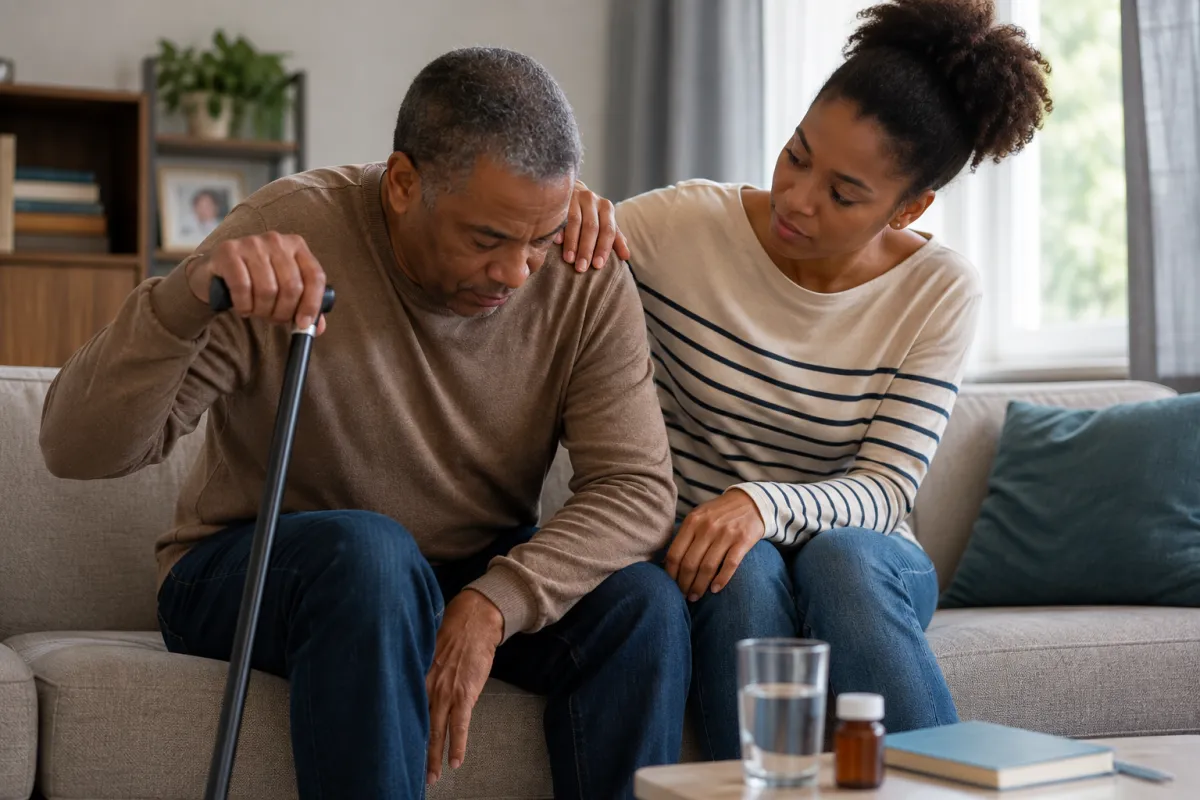
Caring for someone whose personality seems to have changed after a stroke can be confusing, upsetting and exhausting. The person you love may seem more irritable, impulsive, withdrawn, emotional, insensitive or difficult than they were before. These changes may result from the stroke itself, emotional distress, cognitive difficulties or the enormous adjustment that follows a serious brain injury. Learn why personality and behaviour can change after stroke, how to respond without losing yourself in the process and when professional help may be needed.
When the Person You Know Suddenly Seems Different
You may have prepared yourself for weakness, speech problems or difficulty walking after your loved one's stroke.
You may not have prepared yourself for their personality to change.
Perhaps someone who was previously patient becomes easily frustrated.
Someone affectionate becomes distant.
Someone careful becomes impulsive.
Someone independent becomes demanding.
Someone who rarely cried becomes intensely emotional.
Or someone who once seemed interested in everything around them now appears indifferent.
Behavioural changes are recognised effects of stroke and may arise because of damage to the brain itself or because of emotional difficulties following stroke.
For the person caring for them, this can create a particular kind of grief.
The person is still there.
But parts of the relationship may feel unfamiliar.
You may find yourself thinking:
“Where has the person I knew gone?”
“Why are they behaving like this?”
“Are they doing this deliberately?”
“Why am I the person they take everything out on?”
“Should I challenge this or ignore it?”
“Will they ever be themselves again?”
“How long am I expected to cope with this?”
These are difficult questions.
And caring about someone does not make those questions disappear.
✦ ✦ ✦
The Good News
Personality or behavioural changes after stroke are not necessarily permanent.
Some improve as the brain recovers.
Others become easier to manage as the survivor develops greater awareness, learns strategies and receives appropriate rehabilitation or psychological support.
Families can also learn ways of communicating that reduce conflict.
But improvement does not require you to pretend difficult behaviour is acceptable.
Understanding why behaviour occurs and setting limits around that behaviour can exist at the same time.
The goal is not simply to tolerate everything because somebody has had a stroke.
The goal is to understand what has changed, identify what can be treated or managed and create a situation in which both the survivor and the people caring for them can function safely.
Why Can Personality Change After Stroke?
A stroke injures the brain.
Depending on which areas and networks are affected, this can influence far more than movement.
Behaviour, judgement, motivation, emotional control, attention, decision-making and awareness can also be affected. The Stroke Association notes that behavioural changes can arise directly from brain injury or be associated with emotional difficulties after stroke.
At the same time, the person may be dealing with:
Emotional changes such as anxiety, anger, grief and low mood are also common following stroke.
This means there may not be one simple explanation for a change in personality.
Several things may be happening at once.
What Personality Changes Can Happen After Stroke?
Not everyone experiences personality changes.
When they do occur, they vary considerably.
You might notice that your loved one has become:
More irritable
Quick to anger
Impatient
Impulsive
Emotionally unpredictable
Withdrawn
Apathetic
Less motivated
More anxious
More dependent
More demanding
Less socially aware
Less sensitive to other people's feelings
More rigid in their thinking
More suspicious
More easily overwhelmed
Less able to control what they say
Less aware of the impact of their behaviour
Some people lose interest in activities they previously enjoyed or behave much more impulsively following stroke.
The changes may be obvious.
Others are subtle enough that relatives notice them long before the survivor does.
They May Not Realise That They Have Changed
One particularly difficult situation occurs when everyone around the survivor can see a change but the survivor cannot.
Brain injury can sometimes affect a person's insight or awareness.
They may genuinely believe that:
Nothing has changed.
Everyone else is overreacting.
Their behaviour is reasonable.
Their family has become controlling.
They do not need help.
Difficulties are always caused by somebody else.
This can make ordinary conversations about behaviour extremely difficult.
You cannot necessarily argue someone into having insight.
Repeatedly saying:
“You never used to behave like this.”
may therefore achieve very little.
It may simply produce another argument.
Instead, focus on specific behaviour and its consequences.
For example:
“When you shout at me, I cannot continue the conversation. We can talk again when things are calmer.”
That establishes a boundary without requiring the person first to agree that their entire personality has changed.
Irritability and Anger Can Be Difficult to Live With
Anger following stroke can be frightening for families.
Someone who previously tolerated frustration may suddenly become angry over relatively small things.
Common triggers may include:
Sometimes understanding the trigger allows you to prevent the escalation.
For example, a conversation that goes badly at 8 pm when the survivor is exhausted may be completely manageable at 10 am.
Keep an eye on patterns.
Ask yourself:
Does the behaviour happen at particular times?
Does it become worse when they are tired?
Does noise trigger it?
Does it happen during difficult tasks?
Does it follow medication?
Does it happen when several people give instructions?
Does it occur when the person feels embarrassed or unable to communicate?
Patterns can provide useful information for the rehabilitation team.
Understanding Anger Does Not Mean Accepting Abuse
This distinction matters.
A stroke may explain why someone has become more irritable, impulsive or emotionally dysregulated.
It does not mean that a carer must accept intimidation, threats, violence or persistent abuse.
You can recognise that behaviour may have a neurological or psychological cause while still protecting yourself.
You are allowed to say:
“I understand that you are frustrated, but you cannot speak to me like that.”
Or:
“I am going to leave the room now. We can continue this conversation when you are calmer.”
If you ever feel physically unsafe, protecting yourself takes priority over completing the conversation.
A diagnosis does not remove your right to safety.
What Is Emotional Lability?
Some people experience sudden or exaggerated emotional responses after stroke.
They may:
Cry very easily
Laugh unexpectedly
Move rapidly between emotions
React much more strongly than the situation appears to warrant
Have difficulty stopping once an emotional reaction begins
This may be embarrassing or distressing for the survivor.
Try not to tell them simply to “control themselves.”
Give the reaction time to pass.
Reducing stimulation, remaining calm and changing the subject once appropriate may help.
If emotional episodes are frequent or severe, discuss them with the stroke team or GP because assessment and treatment options may be available.
Apathy Can Look Like Laziness
Another difficult change is loss of motivation.
The survivor may spend long periods sitting or lying down.
They may stop initiating activities.
They may need repeated prompting to:
From the outside, this can look like laziness or a refusal to recover.
It may not be.
Apathy after brain injury can affect the ability to initiate behaviour even when the person understands what needs to be done.
Depression can produce similar behaviour.
Stroke fatigue may also dramatically reduce activity.
That is why a significant change in motivation deserves assessment rather than immediately being treated as stubbornness.
Impulsivity Can Create New Risks
Some people become less able to stop and consider consequences before acting.
They may:
Stand up when it is unsafe
Attempt to walk without assistance
Spend money impulsively
Interrupt conversations
Say inappropriate things
Ignore medical advice
Drive when they should not
Make unsafe decisions
Become sexually or socially disinhibited
When judgement and impulse control have changed, repeatedly saying “be more careful” may not solve the problem.
The environment may need to change.
For example:
Keep walking aids within reach.
Reduce unnecessary hazards.
Make routines predictable.
Use clear reminders.
Break complicated decisions into smaller steps.
Ask the rehabilitation team about cognitive assessment where appropriate.
The aim should be to preserve as much independence as possible without pretending that new risks do not exist.
Do Not Treat the Survivor Like a Child
Personality and cognitive changes can cause families to become increasingly controlling.
Sometimes this begins for understandable reasons.
You are frightened they will fall.
You are worried they will make a poor decision.
You are trying to keep medication organised.
You are attempting to prevent another accident.
But there is a difference between providing support and taking over someone's life.
Where possible:
Offer choices.
Ask before helping.
Speak directly to the survivor.
Explain concerns rather than issuing commands.
Allow extra time for decisions.
Encourage independence where it is safe.
Avoid discussing them as though they are not present.
A person can require considerable assistance and still deserve dignity.
Communication Problems Can Look Like Personality Problems
Sometimes what appears to be a personality change is partly a communication problem.
A person with aphasia or slower processing may appear:
Withdrawn
Irritable
Uninterested
Abrupt
Confused
Uncooperative
But imagine knowing exactly what you want to say and repeatedly being unable to say it.
That frustration can affect behaviour.
Communication difficulties can become harder when someone is tired, stressed or in a busy environment.
Try:
Asking one question at a time.
Giving the person time to answer.
Reducing background noise.
Avoiding constant correction.
Using gestures or written words if helpful.
Checking whether you understood correctly.
Not pretending to understand when you did not.
Patience can prevent frustration from turning into conflict.
Stroke Fatigue Can Change Behaviour Too
A person who seems pleasant in the morning and impossible by evening may not have two personalities.
They may be exhausted.
Stroke fatigue can affect concentration, emotional control, communication and tolerance for stimulation.
When the brain is overloaded, patience often disappears first.
Try scheduling:
Important conversations earlier in the day.
Rehabilitation around periods of greater energy.
Regular breaks.
Quiet periods after demanding activities.
Fewer activities on particularly demanding days.
You may discover that some behavioural problems become much less severe once fatigue is better managed.
Depression and Anxiety Can Change How Someone Behaves
Stroke does not only affect the body.
Depression and anxiety can occur following stroke, and anxiety is particularly common.
Depression does not always look like sadness.
It can appear as:
Do not assume every behavioural change is simply “their new personality.”
Treatable conditions may be contributing.
Speak to the GP or stroke team if you notice significant or persistent changes.
Choose Your Battles
When you live closely with somebody whose behaviour has changed, correcting everything can become a full-time occupation.
That will exhaust both of you.
Ask yourself:
Does this matter?
Is it dangerous?
Is somebody being harmed?
Or is it simply different from how they used to do things?
There is little value in turning every small disagreement into rehabilitation.
If they load the dishwasher differently, it may not matter.
If they repeatedly attempt to walk down stairs when they cannot do so safely, it matters.
Save your energy for the things that actually need intervention.
Keep Instructions Simple
When cognition has been affected, long explanations can make situations worse.
Instead of:
“I have told you three times that you need to put your shoes on because the taxi will be here soon and if we're late we'll miss your appointment and they'll probably make us rebook it.”
Try:
“Your appointment is next. Please put your shoes on.”
One instruction.
One task.
Then move to the next step.
This is not speaking down to the person.
It is reducing unnecessary cognitive demand.
Create Predictable Routines
Routine can reduce conflict.
If medication, meals, rehabilitation, rest and appointments occur in reasonably predictable patterns, the survivor has fewer decisions to process.
A daily structure might include:
Wake up
Medication
Breakfast
Wash and dress
Rest
Rehabilitation exercise
Lunch
Rest
Short activity
Evening meal
Wind-down routine
The routine does not need to be rigid.
Its purpose is to make everyday life require less mental effort.
Do Not Argue During Escalation
Once somebody is extremely angry or overwhelmed, attempting to prove that you are right usually makes matters worse.
This is particularly true if their processing, impulse control or emotional regulation has been affected.
You do not have to resolve every disagreement immediately.
Sometimes the most useful response is:
“We are both getting frustrated. We can come back to this later.”
Then disengage.
That is different from giving somebody the silent treatment.
It is deliberately ending an unproductive interaction.
Use Behaviour, Not Character, When You Speak
Avoid:
“You're horrible now.”
“Stroke has made you selfish.”
“You've become impossible.”
These statements attack the person's identity.
Describe the behaviour instead.
For example:
“You shouted at me three times this morning.”
“You spent £300 without discussing it.”
“You walked without your frame even though the physiotherapist asked you to use it.”
Specific behaviour can be addressed.
A global judgement about someone's character usually produces defensiveness.
Do Not Constantly Compare Them With Who They Were Before
It is tempting to say:
“You would never have done this before the stroke.”
Sometimes that observation is completely accurate.
But hearing it repeatedly can make the survivor feel as though they are constantly failing an earlier version of themselves.
You need to understand what has changed.
But recovery cannot consist entirely of trying to recreate the person who existed before.
Some things may return.
Some may improve.
Some may remain different.
The family may eventually need to build a relationship with the person who exists now.
Encourage Independence Without Abandoning Them
Caregiving often produces two opposite mistakes.
Doing everything.
Or expecting too much too soon.
Neither is particularly helpful.
Where possible, allow the survivor to do what they can safely manage.
If they can make breakfast but need help carrying the plate, let them make breakfast.
If they can dress themselves but need considerably longer, allow the time.
If they can choose their clothes, do not choose for them simply because it is faster.
Every unnecessary task you permanently take over can make dependence easier to establish.
Support should ideally help the person regain autonomy, not quietly remove it.
Caregiver Burnout Is Real
It is possible to love someone and become exhausted by caring for them.
Those two things do not contradict each other.
Caregiving after stroke can involve changes in family roles, significant emotional strain and relationship stress.
You may be managing:
while simultaneously processing what happened yourself.
Eventually you may feel:
Angry
Trapped
Guilty
Resentful
Exhausted
Lonely
Anxious
Emotionally numb
Those feelings do not automatically mean you do not love the person.
They may mean the situation has exceeded what one person can reasonably carry.
You Are Still Allowed to Have a Life
One of the most dangerous assumptions in caregiving is that the healthier person must surrender everything.
Your sleep.
Your friendships.
Your work.
Your exercise.
Your privacy.
Your hobbies.
Your plans.
Your identity.
That is not a sustainable care plan.
If the survivor requires more support than one person can provide, the answer should be to investigate additional support—not simply to consume the carer's entire life.
Where possible, protect regular periods when you are not functioning as a carer.
Even small amounts of predictable time can matter.
Stop Trying to Do Everything Perfectly
There may always be another exercise they could do.
Another appointment you could arrange.
Another meal you could prepare.
Another therapy you could research.
Another thing you could monitor.
You can turn somebody else's recovery into a job that never ends.
That is dangerous.
You are supporting their recovery.
You are not personally responsible for producing it.
The survivor remains a participant in their own rehabilitation wherever they have the capacity to do so.
What If They Refuse Help?
This can be one of the hardest situations.
You can see a problem.
They refuse to acknowledge it.
They reject therapy.
They will not follow advice.
They become angry when you intervene.
Start by finding out why.
They may be:
Frightened
Embarrassed
Exhausted
Depressed
Unable to understand the risk
Overwhelmed by appointments
Feeling controlled
Unable to remember the advice
Unaware that there is a problem
Those causes require different responses.
If judgement, cognition or awareness appears significantly impaired, discuss your concerns with the person's clinical team rather than attempting to manage everything privately.
Keep Notes If Behaviour Has Changed Significantly
You do not need to document every disagreement.
But when behaviour has changed dramatically, keeping a simple record can help professionals identify patterns.
Write down:
What happened
When it happened
What happened immediately beforehand
How long it lasted
Whether the person was tired
Whether medication had recently changed
Whether they remembered the incident afterwards
What helped calm the situation
This turns:
“They're completely different.”
into information a clinician can actually investigate.
Ask for Neuropsychological or Psychological Support
If significant personality, cognitive or behavioural changes persist, ask the rehabilitation team whether assessment by an appropriate professional may help.
Depending on the person's difficulties and local services, this may involve:
Behavioural changes should not simply be dismissed as something families have to live with. The Stroke Association advises that behavioural changes following stroke should be assessed, particularly because emotional difficulties such as depression or anxiety may contribute.
When Should You Seek Medical Advice?
Contact the GP, stroke team or another healthcare professional if you notice:
Major new personality changes
Persistent aggression
Severe anxiety
Persistent low mood
Increasing confusion
Hallucinations
Significant impulsivity
Dangerous decision-making
Major sleep changes
Severe apathy
Increasing social withdrawal
Behaviour that is becoming impossible to manage safely
Thoughts of self-harm or suicide
A sudden new neurological change should not simply be assumed to be part of the original stroke.
Seek urgent medical assessment for new symptoms that could indicate another stroke.
What If the Relationship Itself Has Changed?
Stroke can change roles dramatically.
A husband may become a carer.
A wife may become responsible for all household decisions.
An adult child may begin caring for a parent.
One partner may become financially dependent on the other.
The relationship can gradually become organised almost entirely around disability.
That is one reason relationships can become strained after stroke. The Stroke Association highlights both psychological effects and sudden changes in family roles as sources of relationship pressure.
Where possible, preserve parts of the relationship that are not about stroke.
Watch something together.
Talk about something other than rehabilitation.
Have coffee together.
Listen to music.
Go somewhere accessible.
Let them contribute to family decisions.
You are not merely patient and carer.
There was a relationship before the stroke.
Parts of that relationship may still need somewhere to exist.
What If You Miss the Person They Used to Be?
You may love the survivor deeply and still miss who they were before.
That grief can be difficult to admit because the person survived.
You may feel guilty even thinking it.
But survival does not mean nothing was lost.
The survivor may be grieving their previous body, independence, career or identity.
You may be grieving aspects of the person and relationship you once knew.
Both realities can exist.
Acknowledging that loss is often healthier than pretending nothing has changed.
Do Personality Changes Improve?
Sometimes.
Recovery after stroke varies enormously.
Some emotional and behavioural difficulties improve as the brain recovers and the person adjusts.
Others may persist but become easier to manage with:
Do not assume the behaviour you see during the first weeks or months represents the person's permanent future.
But do not postpone seeking help indefinitely either.
Persistent problems deserve attention.
My Perspective
Stroke does not happen only to the person whose brain has been injured.
It enters the household.
Everyone begins adjusting around it.
The survivor may be frightened, frustrated and grieving.
The person caring for them may also be frightened, frustrated and grieving while simultaneously being expected to remain patient, practical and endlessly supportive.
That is an enormous expectation.
Understanding personality changes after stroke matters because behaviour that appears selfish, lazy or irrational may have neurological, cognitive or emotional causes.
But understanding should never mean erasing the carer.
You still matter.
Your sleep matters.
Your mental health matters.
Your safety matters.
Your work matters.
Your relationships matter.
Your future matters.
You can have compassion for what happened to somebody and still say:
“This behaviour cannot continue.”
Those positions are not opposites.
Good caregiving is not unlimited tolerance.
It is helping someone recover while creating boundaries strong enough for both of you to survive the recovery.
Frequently Asked Questions
Can a stroke really change someone's personality?
Yes.
Stroke can affect brain systems involved in behaviour, emotional regulation, judgement, motivation and impulse control. Behavioural changes are recognised consequences of stroke, although not every survivor experiences them.
Why is my loved one so angry after their stroke?
There may be several reasons.
Brain injury can affect emotional regulation. Frustration, communication problems, fatigue, loss of independence, anxiety and depression may also contribute.
Look for patterns and triggers and discuss significant anger changes with the stroke team.
Why are they horrible to me but pleasant with everyone else?
Different environments place different demands on a person.
Some survivors may use considerable energy controlling themselves around professionals or visitors and become more irritable when tired at home.
However, stroke should not automatically be used to explain every instance of poor behaviour.
Look at the pattern rather than making assumptions.
Should I ignore inappropriate behaviour because they have had a stroke?
No.
The response may need to be different if the person's impulse control or awareness has been affected, but reasonable boundaries still matter.
Explain clearly which behaviour is unacceptable and what you will do when it occurs.
Can they control their behaviour?
Sometimes completely, sometimes partly and sometimes very little.
It depends on what has changed and why.
This is one reason professional assessment can be valuable.
Avoid assuming either that everything is deliberate or that nothing is within their control.
Does personality change mean dementia?
No.
Personality change after stroke does not automatically mean dementia.
However, stroke can also be associated with cognitive impairment, and conditions such as vascular dementia may involve changes in thinking, mood, personality and behaviour.
If cognition appears to be worsening or you are concerned about dementia, speak to the GP or stroke team.
How should I respond when they become angry?
Stay calm if you can.
Reduce stimulation.
Avoid lengthy arguments.
Give the person space if appropriate.
Return to the issue later.
If you feel threatened or unsafe, remove yourself from the situation and seek appropriate help.
What should I do if they refuse rehabilitation?
Try to understand why before assuming laziness.
Fatigue, depression, fear, pain, cognitive difficulties, poor insight or feeling controlled may all contribute.
Discuss persistent refusal with the rehabilitation team.
Is it wrong to feel resentful?
No.
Caring responsibilities can fundamentally change your workload, relationships and freedom.
Resentment can be a sign that the current arrangement needs more support, clearer boundaries or both.
Can I leave them alone?
That depends on their individual mobility, cognition, judgement, medical needs and safety.
Ask their occupational therapist, rehabilitation team or another appropriate professional if you are unsure whether independent time is safe.
What if I cannot cope anymore?
Say so.
Tell the GP, stroke team, social care team or other professionals involved.
You do not have to wait until you are completely exhausted before asking for additional support.
Key Takeaways
Personality and behavioural changes can occur after stroke.
Brain injury, fatigue, cognitive problems, anxiety, depression and adjustment may all influence behaviour.
Irritability, impulsivity, apathy, emotional changes and reduced social awareness may occur.
Behaviour that looks deliberate may sometimes reflect impaired awareness or impulse control.
Understanding the cause does not mean accepting abusive or dangerous behaviour.
Speak about specific behaviours rather than attacking the person's character.
Look for triggers such as fatigue, noise, frustration and cognitive overload.
Maintain as much independence and dignity as safely possible.
Significant behavioural changes deserve professional assessment.
Carer burnout is not something to ignore.
The survivor's recovery matters, but the carer's health, safety and identity matter too.
The Bottom Line
Caring for someone whose personality has changed after a stroke can be one of the hardest parts of recovery.
Physical disability is visible.
Personality change happens inside the relationship.
You may find yourself living with someone who looks exactly like the person you knew but responds to you in ways that feel completely unfamiliar.
Some of those changes may improve.
Some may require treatment or rehabilitation.
Others may require the family to develop entirely new ways of communicating and living together.
Learn what the stroke may have changed.
Ask for professional help when behaviour is significantly affecting daily life.
Set boundaries around behaviour that harms you.
And do not disappear inside somebody else's recovery.
Supporting another person should not require abandoning yourself.
Related Articles
Personality Changes After Stroke
Anger After Stroke
Emotional Changes After Stroke
Depression After Stroke
Anxiety After Stroke
Stroke Fatigue: Why You Feel Exhausted
Marriage After Stroke
Caring for Someone After a Stroke
Communication Problems After Stroke
Memory Problems After Stroke
About the Author
Alisia Gayle is a stroke survivor and the author of an award-winning stroke recovery memoir.
After experiencing a major ischaemic stroke and rebuilding her mobility, independence and confidence, she created this website to give stroke survivors and their families honest, practical and hopeful information about recovery.
Her articles combine lived experience with evidence-based information to help survivors and their families understand what may be happening and feel less alone during recovery.
Medical Disclaimer
This article provides general information and personal insight. It is not a substitute for individual medical advice, diagnosis or treatment.
Stroke affects every person differently. Significant changes in personality, behaviour, cognition or emotional control should be discussed with your GP, stroke consultant, rehabilitation team or another qualified healthcare professional.
Seek urgent medical attention for sudden new neurological symptoms that may indicate another stroke.
If behaviour places the survivor, carer or another person at immediate risk, prioritise safety and seek urgent professional assistance.
Final Thoughts
Sometimes the hardest part of caring for somebody after stroke is not helping them walk, preparing medication or taking them to appointments.
It is learning how to live with someone who seems different.
You may feel enormous compassion for what they have survived while privately mourning how your relationship used to feel.
You may be patient one day and exhausted the next.
You may love them and still need space from them.
None of those experiences cancels the others.
Stroke recovery is not about one person's needs swallowing everybody else's.
The strongest recovery environment is one in which the survivor receives understanding, rehabilitation and dignity while the people supporting them also receive respect, support and room to remain themselves.
You can stand beside somebody through one of the hardest periods of their life.
You do not have to disappear in order to do it.