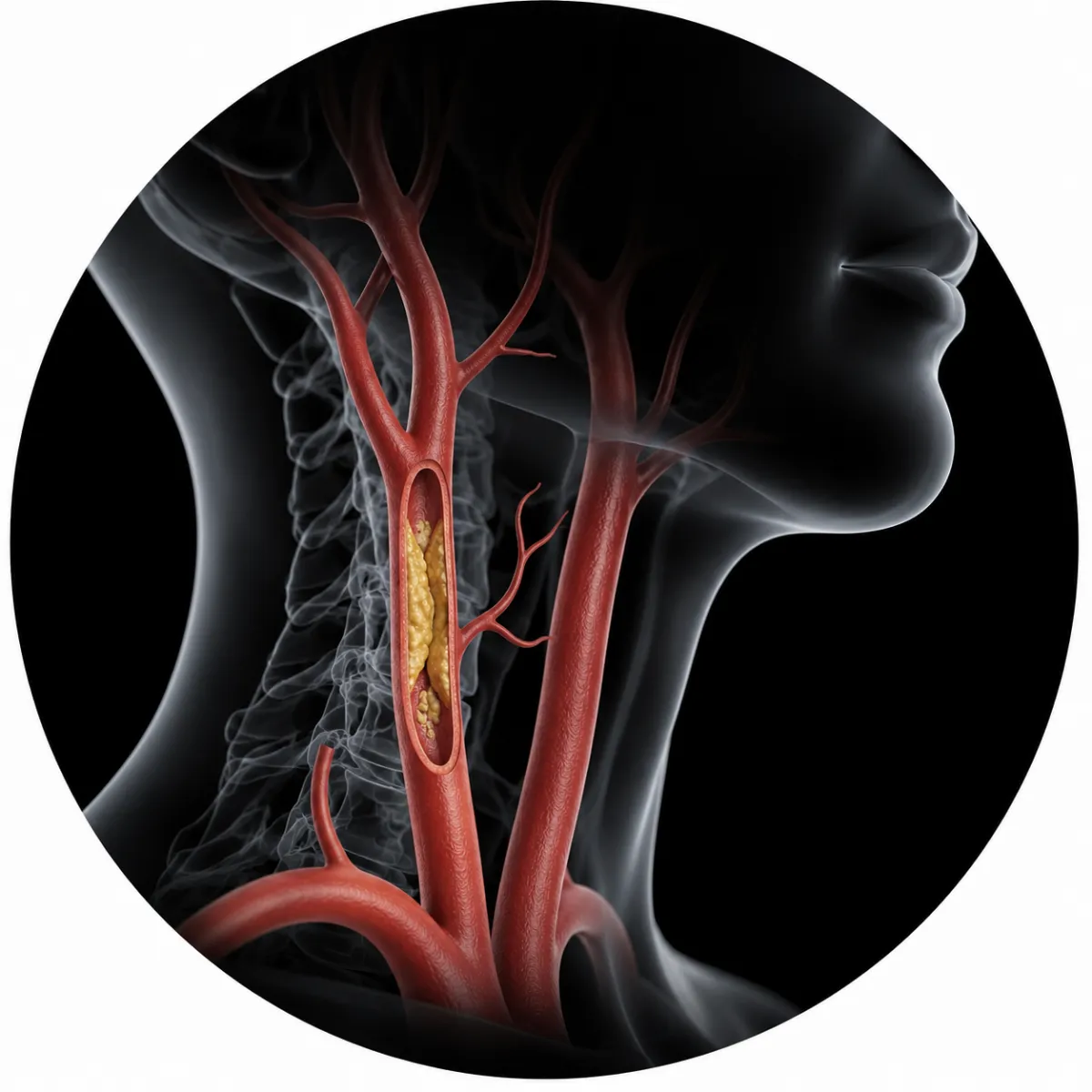
Carotid artery disease occurs when fatty deposits build up inside one or both of the carotid arteries in your neck, causing them to narrow. Because these arteries supply blood to the brain, significant narrowing can increase the risk of a transient ischaemic attack (TIA) or ischaemic stroke. Carotid artery disease often causes no symptoms until a TIA or stroke occurs, which is why identifying and treating it can be an important part of preventing another stroke.
After your stroke...
You may hear a completely new phrase.
"Carotid stenosis."
Perhaps a doctor tells you that one of the arteries in your neck is narrowed.
Maybe you are told there is plaque.
You have an ultrasound.
Someone mentions percentages.
50%.
70%.
90%.
And suddenly you are wondering...
"Is my artery blocked?"
"Did this cause my stroke?"
"Can it become completely blocked?"
"Can medication clear it?"
"Will I need surgery?"
"Could I have another stroke?"
These are understandable concerns.
Carotid artery disease can sound frightening because the arteries involved supply your brain.
But discovering the disease also gives your medical team something important:
A potential stroke risk factor that can be assessed and treated.
✦ ✦ ✦
The Good News
Carotid artery disease can be managed.
Treatment may include:
✓ Medication
✓ Cholesterol reduction
✓ Blood pressure management
✓ Stopping smoking
✓ Lifestyle changes
✓ Carotid surgery in selected people
✓ Carotid stenting in some circumstances
Not everyone with carotid narrowing needs an operation.
The appropriate treatment depends on factors such as:
How severe the narrowing is.
Whether you have experienced symptoms.
Your overall health.
Your age.
Your recent stroke or TIA history.
And whether the potential benefits of a procedure outweigh its risks.
The NHS notes that mild narrowing may be managed with medicines and risk-factor control, while more significant symptomatic narrowing may require urgent consideration of carotid endarterectomy.
✦ ✦ ✦
What Are the Carotid Arteries?
You have two main carotid arteries.
One runs up each side of your neck.
They divide into branches that supply blood to areas including your:
✓ Brain
✓ Face
✓ Head
You can sometimes feel your carotid pulse gently at the side of your neck.
These arteries are major routes supplying oxygen-rich blood towards the brain.
That is why significant disease within them matters.
If material from a diseased carotid artery travels into the circulation supplying the brain, it can block a smaller artery and cause an ischaemic stroke.
✦ ✦ ✦
What Is Carotid Artery Disease?
Carotid artery disease usually develops through atherosclerosis.
Atherosclerosis involves the build-up of fatty material, often referred to as plaque, within artery walls.
Over time, the artery may become:
✓ Narrower
✓ Stiffer
✓ Less healthy
This narrowing is known as carotid stenosis.
The degree of narrowing is often expressed as a percentage.
You might therefore hear your doctor describe:
"50% stenosis."
"70% stenosis."
"Severe stenosis."
These percentages help clinicians assess how significant the narrowing is and whether intervention may be beneficial.
But the percentage should not be interpreted in isolation.
Symptoms and individual medical circumstances also matter.
✦ ✦ ✦
How Can Carotid Artery Disease Cause a Stroke?
There are different ways carotid disease may contribute to stroke.
One important mechanism occurs when material associated with the plaque breaks away.
This material can travel upwards towards the brain.
If it becomes lodged in a smaller blood vessel, blood supply to part of the brain may be interrupted.
An ischaemic stroke can result.
The NHS explains that carotid narrowing increases the chance of fatty material breaking away and travelling towards the eye or brain, where it can cause a TIA or stroke.
So it is not necessarily simply the fact that the carotid artery is narrower that causes the problem.
The plaque itself can also become a source of material that travels further into the circulation.
✦ ✦ ✦
Does Carotid Artery Disease Cause Symptoms?
Often, no.
This is one of the difficult things about the condition.
You can have significant carotid narrowing without:
Pain.
Neck discomfort.
Headaches.
Dizziness.
Or any obvious warning.
For some people, the first indication of carotid disease is a:
✓ TIA
✓ Stroke
✓ Temporary loss of vision in one eye
This is why carotid disease is sometimes discovered during investigations after a stroke or TIA rather than because the person noticed a problem in their neck.
✦ ✦ ✦
What Is a TIA?
A transient ischaemic attack, or TIA, happens when blood supply to part of the brain is temporarily disrupted.
Symptoms may resemble those of a stroke but resolve.
Possible symptoms include sudden:
✓ Facial weakness
✓ Arm weakness
✓ Leg weakness
✓ Numbness
✓ Speech difficulty
✓ Visual disturbance
Some people with carotid disease may experience temporary loss of vision in one eye, sometimes called amaurosis fugax. NHS vascular guidance identifies this as one possible symptom associated with carotid stenosis.
A TIA should never be dismissed because the symptoms disappeared.
It can be a warning of significant vascular disease and future stroke risk.
✦ ✦ ✦
Remember FAST
Stroke symptoms require emergency action.
Remember:
Face
Has one side of the face dropped?
Arms
Can the person raise both arms?
Speech
Is speech slurred, confused or unusual?
Time
Call emergency services immediately.
If you develop new stroke symptoms, call 999 in the UK.
Do not wait to see whether symptoms disappear.
NICE guidance emphasises urgent assessment for suspected stroke and TIA.
✦ ✦ ✦
What Causes Carotid Artery Disease?
Carotid disease develops through many of the same processes responsible for cardiovascular disease elsewhere in the body.
Risk factors can include:
✓ Smoking
✓ High blood pressure
✓ High cholesterol
✓ Diabetes
✓ Increasing age
✓ Physical inactivity
✓ Excess weight
✓ Family history of cardiovascular disease
You may have several risk factors.
Or very few.
Having carotid disease does not necessarily mean you did something obviously wrong.
Atherosclerosis usually develops over many years and is influenced by multiple factors.
✦ ✦ ✦
Smoking and Carotid Artery Disease
Smoking is particularly important.
Smoking damages blood vessels and contributes to atherosclerosis.
If you have already been diagnosed with carotid disease, continuing to smoke exposes already diseased blood vessels to further harm.
Stopping smoking therefore becomes an important part of vascular risk reduction.
Do not think:
"My artery is already narrowed, so quitting won't matter."
Preventing further vascular damage still matters enormously.
✦ ✦ ✦
High Blood Pressure
High blood pressure is one of the major modifiable risk factors for stroke.
You often cannot feel it.
You may have very high readings and still feel completely normal.
Managing blood pressure after a stroke may involve:
✓ Medication
✓ Reducing salt
✓ Physical activity where appropriate
✓ Weight management
✓ Limiting alcohol
✓ Regular monitoring
Your personal blood pressure target should be discussed with your healthcare team.
Do not stop prescribed medication because your home readings improve unless your clinician advises you to do so.
✦ ✦ ✦
Cholesterol and Carotid Disease
Cholesterol management is often central to treating atherosclerotic disease.
You may therefore be prescribed a statin after an ischaemic stroke or diagnosis of carotid disease.
Statins are not simply intended to change a number on a blood test.
They are used to reduce cardiovascular risk.
Your doctor may recommend medication even if you previously believed your cholesterol was "not that high."
That is because treatment decisions after stroke are based on overall cardiovascular risk, not simply whether one laboratory value appears dramatically abnormal.
✦ ✦ ✦
How Is Carotid Artery Disease Diagnosed?
One of the most common tests is a carotid ultrasound.
This is a non-invasive scan that uses sound waves to assess blood flow and narrowing in the carotid arteries.
It may help determine:
✓ Whether narrowing is present
✓ Which artery is affected
✓ How severe the stenosis appears
Depending on the circumstances, further imaging may include:
✓ CT angiography
✓ MR angiography
✓ Other vascular imaging
These tests give doctors more detailed information about the arteries and help guide treatment decisions.
✦ ✦ ✦
What Does 50% or 70% Narrowing Mean?
If you are told that your artery is 50%, 70% or 90% narrowed, it is easy to panic.
But the number needs context.
Doctors consider:
✓ Degree of narrowing
✓ Whether symptoms have occurred
✓ How recently symptoms occurred
✓ Which side is affected
✓ Your overall surgical risk
✓ Other medical conditions
✓ Imaging findings
A person with symptomatic severe stenosis may be managed very differently from someone whose moderate narrowing was discovered incidentally and has never caused symptoms.
Do not make treatment decisions by comparing percentages with strangers online.
Your situation is individual.
✦ ✦ ✦
What Is Symptomatic Carotid Disease?
"Symptomatic" generally means the carotid disease has been associated with a neurological event such as:
✓ TIA
✓ Ischaemic stroke
✓ Temporary loss of vision in one eye
This distinction matters because stroke risk and treatment decisions can differ significantly between symptomatic and asymptomatic disease.
NHS guidance states that people who have experienced stroke or TIA symptoms and have carotid narrowing greater than 50% may need urgent consideration for carotid endarterectomy.
That does not mean everyone above 50% automatically has surgery.
Specialists still assess whether the procedure is appropriate for that individual.
✦ ✦ ✦
What Is Asymptomatic Carotid Disease?
Asymptomatic carotid disease means narrowing is present but has not produced recognised TIA, stroke or related visual symptoms.
It might be discovered during:
✓ Imaging for another problem
✓ Cardiovascular investigations
✓ Assessment of vascular disease elsewhere
Management may focus heavily on medical treatment and controlling vascular risk factors.
Some people with more severe asymptomatic disease may be considered for intervention, but treatment decisions are more nuanced.
This is an area where specialist vascular assessment is particularly important.
✦ ✦ ✦
What Medicines Might Be Used?
Medication depends on your circumstances.
Treatment may include medicines aimed at reducing:
✓ Blood clot risk
✓ Cholesterol
✓ Blood pressure
✓ Diabetes-related vascular risk
For example, some people may receive:
✓ Antiplatelet medication
✓ Statins
✓ Blood pressure medication
The Stroke Association notes that blood-thinning medicines can reduce stroke risk by helping prevent blood clots, although the appropriate type depends on why you are at risk.
Never start aspirin or another blood-thinning drug simply because you have read that carotid disease can cause clots.
These medications have risks and should be taken according to medical advice.
✦ ✦ ✦
Can Medication Unblock the Carotid Artery?
This question comes up frequently.
Medication is extremely important, but it should not be thought of as something that simply dissolves established carotid plaque and returns the artery to normal overnight.
Instead, treatment may aim to:
✓ Reduce further vascular risk
✓ Lower cholesterol
✓ Reduce clot formation
✓ Stabilise vascular disease
✓ Control blood pressure
✓ Reduce the chance of future stroke
In some people this medical management is sufficient.
In others, the narrowing and recent symptoms may make a procedure appropriate.
That decision belongs with the specialist team.
✦ ✦ ✦
What Is a Carotid Endarterectomy?
A carotid endarterectomy is an operation designed to remove plaque from inside a narrowed carotid artery.
During surgery, the vascular surgeon accesses the artery through the neck and removes the material responsible for the narrowing.
The aim is to reduce future stroke risk.
The NHS describes carotid endarterectomy as a procedure used when carotid disease creates a significant risk of TIA or stroke.
It is preventative surgery.
It is not performed to reverse brain damage that has already happened.
Its purpose is to reduce the chance of another event caused by that artery.
✦ ✦ ✦
How Soon Is Surgery Performed?
Timing matters in symptomatic carotid disease.
Someone who has recently experienced a TIA or relatively minor stroke from significant carotid narrowing may be referred urgently because the risk of another stroke can be highest in the period after the initial event.
This is why carotid investigations may happen rapidly after TIA or ischaemic stroke.
The objective is not simply to diagnose the narrowing.
It is to identify people who might benefit from treatment before another stroke occurs.
Do not delay attending appointments because you feel recovered.
A TIA disappearing does not mean the underlying cause disappeared with it.
✦ ✦ ✦
Does Carotid Surgery Have Risks?
Yes.
All operations have risks.
Carotid endarterectomy is performed specifically to reduce stroke risk, but complications can themselves include stroke and other surgical problems.
This creates what may initially seem like a strange decision:
Undergo a procedure that itself has risk...
To reduce a larger future risk.
That is why surgery is recommended selectively.
Your specialist weighs:
The likelihood of another stroke without surgery.
Against:
The risks of the procedure.
The correct decision depends on the individual.
✦ ✦ ✦
What Is Carotid Artery Stenting?
Carotid artery stenting is another method of treating significant carotid narrowing in selected patients.
A stent is placed within the artery to help keep the narrowed area open.
This is generally less invasive than traditional open surgery.
However, carotid stenting is not automatically safer or better simply because it does not require the same type of neck operation.
NICE guidance recognises carotid artery stenting as an option in selected symptomatic patients, while carotid endarterectomy remains an established treatment.
Which procedure is appropriate depends on your anatomy, health, age and other clinical considerations.
✦ ✦ ✦
Can Both Carotid Arteries Be Narrowed?
Yes.
Carotid disease can affect:
One artery.
Or both.
The severity may also differ from side to side.
Having disease in both arteries does not automatically mean both will be operated on.
The NHS notes that if both carotid arteries require surgery, procedures may be carried out separately rather than operating on both at the same time.
Your vascular team will determine which artery poses the greatest concern and how treatment should be prioritised.
✦ ✦ ✦
Can a Carotid Artery Become Completely Blocked?
Yes, carotid arteries can become completely occluded.
But a completely blocked carotid artery is not simply treated in the same way as a partially narrowed artery.
The brain has a network of blood vessels, and alternative circulation may sometimes compensate to varying degrees.
Management depends on the individual situation.
Do not assume:
"100% blocked means I am definitely about to have another stroke."
Nor should you assume it is harmless.
This requires specialist interpretation.
✦ ✦ ✦
Can Lifestyle Changes Help?
Yes.
Lifestyle changes cannot guarantee that existing plaque disappears.
But they can be an important part of reducing future vascular risk.
This may include:
✓ Stopping smoking
✓ Eating a cardiovascular-friendly diet
✓ Controlling blood pressure
✓ Managing diabetes
✓ Maintaining an appropriate weight
✓ Becoming physically active where medically appropriate
✓ Limiting excessive alcohol
✓ Taking prescribed medication consistently
The goal is bigger than one carotid artery.
Atherosclerosis can affect blood vessels throughout the body.
Protecting your vascular health therefore means treating the whole cardiovascular system.
✦ ✦ ✦
What About Exercise?
Physical activity is generally an important part of cardiovascular health and stroke recovery.
But exercise advice needs to reflect:
✓ Your stroke recovery
✓ Mobility
✓ Heart health
✓ Blood pressure
✓ Other vascular disease
✓ Recent procedures
If you have recently undergone carotid surgery or have complex cardiovascular disease, ask your clinical team what activities are appropriate.
You do not need to become an endurance athlete.
Regular walking and gradually increasing activity may be more realistic and sustainable for many people.
✦ ✦ ✦
Do You Need Regular Scans?
Some people with carotid disease undergo follow-up imaging.
Whether you require repeated ultrasound scans depends on factors such as:
✓ Severity of disease
✓ Previous treatment
✓ Whether a stent has been placed
✓ Whether narrowing is being monitored
✓ Your specialist's assessment
For example, follow-up ultrasound may be used after carotid stenting to assess the treated artery.
Do not assume that everyone with carotid disease needs scanning every six months or every year.
Follow the plan recommended for your particular condition.
✦ ✦ ✦
The Emotional Impact
Being told that an artery supplying your brain is narrowed can be frightening.
You may become hyperaware of every sensation.
A headache.
A tingling hand.
A moment of dizziness.
A strange feeling in your neck.
And immediately think:
"Is another stroke happening?"
Some vigilance is sensible.
But constant fear can make recovery extremely difficult.
Learn the genuine warning signs.
Take your medication.
Attend your appointments.
Control the risk factors you can control.
And seek urgent medical help when genuine new neurological symptoms appear.
The goal is informed awareness.
Not living every hour waiting for disaster.
✦ ✦ ✦
My Perspective
Carotid artery disease is a good example of why understanding the cause of a stroke matters.
Stroke is the event.
But behind that event there may be another problem that needs attention.
For some people, that problem is carotid disease.
Finding significant narrowing after a stroke may be frightening.
But there is another way to look at it.
The doctors have identified something.
They can measure it.
Monitor it.
Treat the risk factors around it.
And, when necessary, intervene.
That gives you something much more useful than fear:
A plan.
Your job is not to obsess over whether an artery is 50%, 60% or 70% narrowed.
Your job is to understand what your medical team recommends and why.
Take the medication.
Stop smoking if you smoke.
Manage blood pressure.
Address cholesterol.
Attend your follow-up appointments.
And take new stroke symptoms seriously.
You cannot control every future risk.
But you can control whether you ignore the ones already identified.
✦ ✦ ✦
When Should You Seek Emergency Help?
Call 999 immediately if you develop sudden:
✓ Facial weakness
✓ Arm or leg weakness
✓ Numbness on one side
✓ Speech difficulty
✓ Confusion
✓ Loss of vision
✓ New severe neurological symptoms
Do not drive yourself to hospital.
Do not wait for symptoms to disappear.
Do not assume it is "just another TIA."
Even temporary neurological symptoms need urgent assessment.
✦ ✦ ✦
Frequently Asked Questions
Is Carotid Artery Disease the Same as a Blocked Artery?
Carotid artery disease usually involves atherosclerotic plaque narrowing the artery.
The degree of narrowing can range from mild stenosis to complete occlusion.
Can Carotid Artery Disease Cause a Stroke?
Yes.
Carotid disease can increase the risk of TIA and ischaemic stroke when plaque or associated material interferes with blood supply to the brain.
Does Carotid Artery Disease Cause Neck Pain?
Often there are no obvious symptoms before a TIA or stroke.
Neck pain alone should not be used to determine whether you have carotid disease.
How Is Carotid Disease Diagnosed?
A carotid ultrasound is commonly used.
Additional imaging such as CT angiography or MR angiography may also be required.
Does Everyone With Carotid Stenosis Need Surgery?
No.
Treatment depends on the severity of narrowing, symptoms and individual risk.
Some people are managed with medication and vascular risk-factor control.
What Is Carotid Endarterectomy?
It is an operation in which plaque is removed from inside a narrowed carotid artery to reduce future stroke risk.
Can Carotid Disease Come Back After Surgery?
Atherosclerosis is a systemic condition, so continued management of vascular risk factors remains important even after successful treatment.
✦ ✦ ✦
Key Takeaways
✓ Carotid artery disease occurs when plaque narrows arteries supplying blood towards the brain.
✓ It is an important potential cause of TIA and ischaemic stroke.
✓ Carotid disease may cause no symptoms until a TIA or stroke occurs.
✓ Ultrasound and vascular imaging can measure carotid narrowing.
✓ Treatment depends on both the severity of narrowing and whether symptoms have occurred.
✓ Medication may include antiplatelet therapy, cholesterol-lowering treatment and blood pressure management depending on the individual.
✓ Selected people with significant symptomatic stenosis may benefit from carotid endarterectomy.
✓ Carotid artery stenting is another option for some patients.
✓ Smoking, blood pressure, cholesterol and diabetes are important vascular risk factors to address.
✓ New stroke symptoms require emergency medical attention even if they disappear quickly.
✦ ✦ ✦
Related Articles
Continue learning about stroke causes and prevention:
Ischaemic Stroke
What Causes an Ischaemic Stroke?
Transient Ischaemic Attack (TIA)
Atherosclerosis and Stroke
High Cholesterol After Stroke
High Blood Pressure After Stroke
Smoking After Stroke
Blood-Thinning Medication After Stroke
How to Prevent a Second Stroke
Mediterranean Diet After Stroke
Atrial Fibrillation and Stroke
Carotid Endarterectomy After Stroke
✦ ✦ ✦
About the Author
Alisia Gayle is a stroke survivor who achieved 96% neurological recovery following an ischaemic stroke.
After years of rehabilitation, she now shares practical, evidence-informed resources to help stroke survivors, carers and families better understand recovery and rebuild their lives with confidence.
Alisia is also the author of Brain Damage: My Journey to 96% Recovery, where she shares her personal stroke recovery story and the lessons she learned throughout her rehabilitation.
✦ ✦ ✦
Medical Disclaimer
This article is intended for educational purposes only and should not replace professional medical advice, diagnosis or treatment.
Carotid artery disease can significantly increase stroke risk, and treatment decisions depend on the severity of narrowing, your symptoms and your individual medical circumstances.
Do not start, stop or change antiplatelet medication, cholesterol medication, blood pressure treatment or any other prescribed medicine without speaking to an appropriate healthcare professional.
If you develop sudden weakness, facial drooping, speech problems, vision loss or other possible stroke symptoms, call emergency services immediately.
✦ ✦ ✦
Final Thoughts
Carotid artery disease...
Can sound terrifying.
An artery in your neck is narrowed.
That artery supplies your brain.
And perhaps you have already experienced the consequences once.
But diagnosis gives you information.
And information gives you options.
The narrowing can be measured.
Your risk factors can be addressed.
Medication can reduce future risk.
And some people can have procedures designed specifically to reduce the chance of another stroke.
So do not become obsessed with a percentage.
Focus on the bigger picture.
Take your medication.
Manage your blood pressure.
Control cholesterol.
Stop smoking.
Attend your appointments.
Understand your treatment plan.
And recognise the warning signs of another stroke.
Because after a stroke...
Knowing why it happened can sometimes be just as important as recovering from what happened.