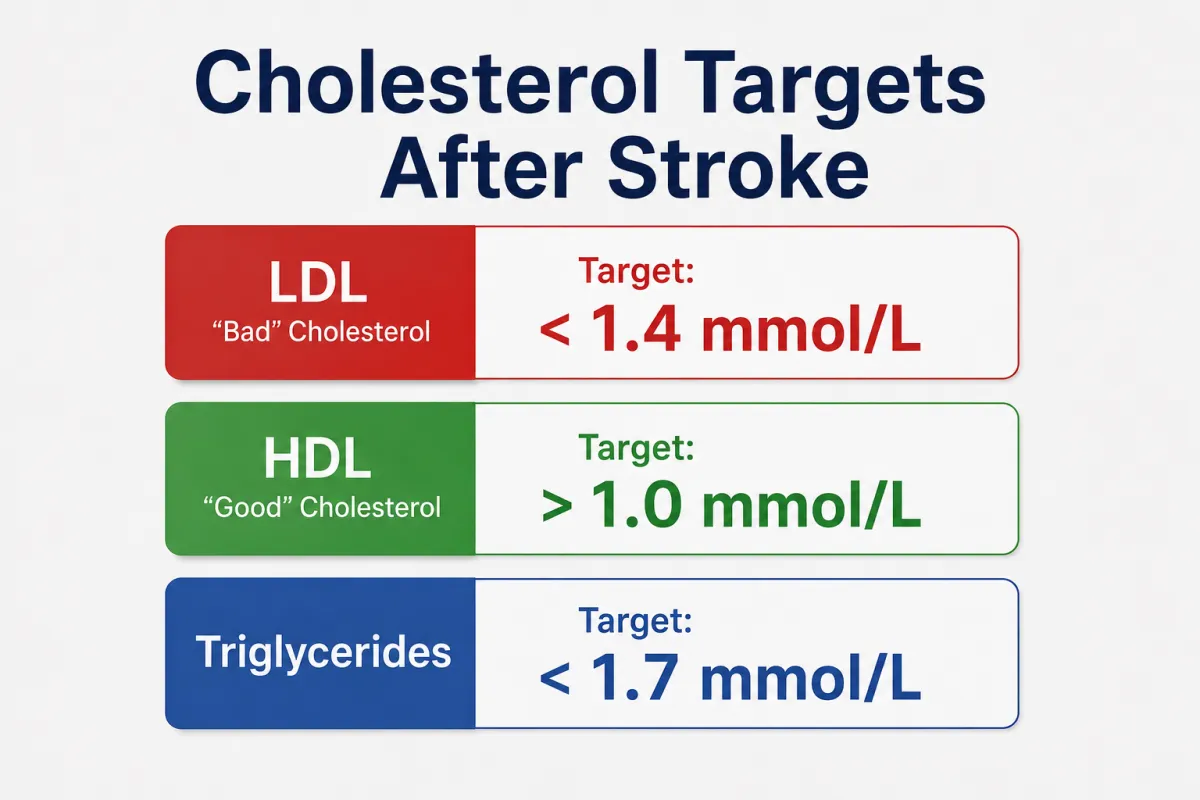
Cholesterol targets after a stroke are usually lower than the levels considered acceptable for someone who has never had cardiovascular disease. This is because an ischaemic stroke places you in a higher-risk category for future vascular events. In current UK secondary-prevention guidance, treatment commonly aims for LDL cholesterol of 2.0 mmol/L or lower, or non-HDL cholesterol of 2.6 mmol/L or lower, although some stroke-specific guidance recommends even lower targets. Your personal target depends on the type and cause of your stroke, other vascular disease, medication tolerance and your overall cardiovascular risk.
After your stroke...
You have blood tests.
Then somebody starts talking about cholesterol.
Total cholesterol.
LDL.
HDL.
Non-HDL.
Triglycerides.
Perhaps you are prescribed atorvastatin.
Maybe your cholesterol never seemed particularly high before your stroke.
You begin wondering...
"What should my cholesterol actually be now?"
"Why is my doctor trying to get it so low?"
"Is 5 mmol/L normal?"
"Why am I taking a statin when my cholesterol wasn't high?"
"Which number actually matters?"
"Can cholesterol become too low?"
These are important questions.
Because the cholesterol target used after an ischaemic stroke may be very different from the number quoted for a generally healthy adult.
✦ ✦ ✦
The Good News
Cholesterol is one of the stroke risk factors that can often be changed substantially.
Treatment can include:
✓ Statins
✓ Dietary changes
✓ Physical activity
✓ Weight management where appropriate
✓ Additional cholesterol-lowering medicines when needed
The aim is not simply to produce an impressive number on a laboratory report.
Lowering harmful cholesterol can reduce the chance of further cardiovascular events.
NICE identifies high-intensity statins as the most clinically effective first-line treatment for reducing lipid levels in people who already have cardiovascular disease.
So when your doctor talks about cholesterol after a stroke, the real conversation is usually about future risk.
✦ ✦ ✦
What Is Cholesterol?
Cholesterol is a fatty substance that your body needs.
It is involved in processes including:
✓ Cell structure
✓ Hormone production
✓ Vitamin D production
✓ Bile production
So cholesterol itself is not inherently bad.
The problem occurs when certain cholesterol-containing particles circulate at levels that contribute to fatty deposits within artery walls.
This can lead to atherosclerosis.
Atherosclerosis can make arteries:
Narrower.
Stiffer.
More vulnerable to plaque rupture or blockage.
And when arteries supplying the brain become blocked, an ischaemic stroke can occur.
The NHS confirms that high cholesterol can contribute to blocked blood vessels and increase the likelihood of heart disease and stroke.
✦ ✦ ✦
What Is LDL Cholesterol?
LDL stands for low-density lipoprotein.
You will often hear it called:
"Bad cholesterol."
That description is simplistic, but useful.
LDL particles carry cholesterol around the bloodstream.
When LDL levels remain too high, cholesterol can accumulate in artery walls and contribute to atherosclerotic plaque.
After an ischaemic stroke caused by vascular disease, reducing LDL therefore becomes an important part of preventing further arterial events.
This is why your doctor may focus heavily on the LDL number even if your total cholesterol does not look dramatically high.
✦ ✦ ✦
What Is HDL Cholesterol?
HDL stands for high-density lipoprotein.
It is commonly called:
"Good cholesterol."
HDL helps transport cholesterol away from tissues towards the liver.
For the general population, NHS reference values describe HDL levels above 1.0 mmol/L for men and above 1.2 mmol/L for women as healthier levels.
But after stroke, clinicians usually do not simply try to increase HDL while ignoring everything else.
LDL and non-HDL cholesterol are generally much more important treatment targets for secondary prevention.
✦ ✦ ✦
What Is Non-HDL Cholesterol?
Non-HDL cholesterol is extremely useful because it represents the cholesterol contained in several potentially harmful lipoprotein particles.
It is calculated by subtracting HDL cholesterol from total cholesterol.
For example:
Total cholesterol: 4.5 mmol/L
HDL cholesterol: 1.5 mmol/L
Non-HDL cholesterol: 3.0 mmol/L
After cardiovascular disease, including many ischaemic strokes, this number may become one of the main treatment targets.
The Stroke Association states that national clinical guidance for people who have already had a stroke suggests aiming for non-HDL cholesterol of approximately 2.6 mmol/L or less, or lowering it substantially from the starting level.
✦ ✦ ✦
What Is the Cholesterol Target After Stroke?
This is where things become more complicated.
There is no single worldwide target.
Different guidelines use slightly different thresholds.
In England, current NHS secondary-prevention targets commonly aim for:
✓ LDL cholesterol of 2.0 mmol/L or lower
or
✓ Non-HDL cholesterol of 2.6 mmol/L or lower
These targets are reflected in NHS England's 2026/27 cardiovascular prevention guidance and are aligned with NICE lipid-management recommendations.
However, stroke-specific guidance may sometimes use more aggressive targets.
For example, some UK stroke guidance recommends aiming for non-HDL cholesterol below approximately 2.5 mmol/L following ischaemic stroke or TIA.
International guidance may recommend even lower LDL levels in selected high-risk patients.
This is why your personal target should come from your clinical team rather than a single number copied from the internet.
✦ ✦ ✦
Why Is the Target Lower After a Stroke?
Because your risk category has changed.
If you have never had cardiovascular disease, the aim is primarily to prevent a first event.
That is called:
Primary prevention.
Once you have experienced an ischaemic stroke or another established cardiovascular event, treatment becomes:
Secondary prevention.
The objective now is to reduce the likelihood of another event.
That means clinicians are usually willing to treat cholesterol more aggressively.
An LDL level that might not trigger medication in an otherwise healthy person may be considered too high for someone who has already experienced vascular disease.
This difference is crucial.
✦ ✦ ✦
Why "Normal" Cholesterol May Not Be Good Enough After Stroke
Suppose your total cholesterol is:
4.8 mmol/L.
You look at NHS general population guidance and see that total cholesterol below 5 mmol/L is usually described as a healthy level.
You might therefore think:
"My cholesterol is normal."
But that does not automatically mean your cholesterol is adequately controlled for secondary stroke prevention.
Your doctor may still want your:
LDL lower.
Non-HDL lower.
Or both.
This is why comparing your results with general population reference ranges can be misleading after a stroke.
Your target is based on your cardiovascular risk.
Not simply whether the laboratory marks the result in red.
✦ ✦ ✦
Why Was I Given a Statin If My Cholesterol Wasn't High?
This is one of the most common questions after ischaemic stroke.
You may say:
"My cholesterol wasn't even high."
But statins are not prescribed only to people with dramatically high cholesterol.
After established cardiovascular disease, high-intensity statins are commonly recommended because lowering LDL reduces the risk of future cardiovascular events. NICE identifies high-intensity statins as the preferred lipid-lowering treatment for secondary prevention.
Atorvastatin is commonly used in the UK and is licensed to lower cholesterol and help prevent heart attacks and strokes.
Your doctor therefore may be treating your risk, not simply correcting an abnormal blood test.
✦ ✦ ✦
What Does a High-Intensity Statin Mean?
A high-intensity statin is a statin dose expected to produce a substantial reduction in LDL cholesterol.
Atorvastatin is frequently used for this purpose.
Your clinician may consider:
✓ Your starting cholesterol
✓ Your stroke mechanism
✓ Other cardiovascular disease
✓ Your age
✓ Kidney or liver issues
✓ Other medicines
✓ Previous statin side effects
The aim is not necessarily to give everyone the maximum possible dose forever.
The goal is to achieve effective lipid lowering with treatment you can tolerate safely.
✦ ✦ ✦
How Much Should Cholesterol Fall?
The starting level matters too.
Sometimes doctors assess not only whether you reach a particular number but how much your cholesterol has fallen compared with baseline.
National lipid-management pathways have historically emphasised substantial reductions in non-HDL cholesterol from baseline as part of effective treatment.
In people with established cardiovascular disease, current management increasingly combines percentage reduction with an absolute LDL or non-HDL target.
For example:
If your LDL started at 4.0 mmol/L and falls to 1.8 mmol/L, that represents a major reduction.
If it started at 2.2 mmol/L and falls to 1.9 mmol/L, you may technically be close to one target but have achieved a much smaller relative reduction.
Your clinician considers the whole picture.
✦ ✦ ✦
Does the Cause of the Stroke Matter?
Yes.
This is extremely important.
Not every stroke is caused by atherosclerosis.
An ischaemic stroke can occur because of:
✓ Carotid artery disease
✓ Small-vessel disease
✓ Atrial fibrillation
✓ Other cardiac sources of embolism
✓ Arterial dissection
✓ Less common clotting disorders
✓ Other mechanisms
The evidence for aggressive cholesterol lowering is strongest where atherosclerotic cardiovascular disease contributes significantly to stroke risk.
People with carotid disease, for example, may receive particularly intensive lipid management because the underlying problem involves atherosclerotic plaque.
Your neurologist, stroke physician or GP should interpret cholesterol treatment in the context of why your stroke happened.
✦ ✦ ✦
What If My Stroke Was Haemorrhagic?
Do not assume that cholesterol management after a brain haemorrhage is identical to management after an ischaemic stroke.
A haemorrhagic stroke occurs because of bleeding rather than arterial blockage.
The balance of benefits and risks from lipid-lowering treatment can therefore be different and may depend on why you need a statin in the first place.
You may still have strong cardiovascular reasons for cholesterol-lowering treatment.
But the decision should be individualised.
Do not start, stop or alter statins after haemorrhagic stroke based on general advice written for ischaemic stroke survivors.
Speak to the clinician managing your vascular risk.
✦ ✦ ✦
What If My LDL Is Already Below 2.0 mmol/L?
That may mean you have reached one widely used UK secondary-prevention target.
But it does not automatically mean:
"Treatment finished."
Your doctor may still recommend continuing your statin because the medication is what helped you reach that target.
Stopping the medicine may allow cholesterol to rise again.
Some patients at particularly high cardiovascular risk may also be advised to aim lower than 2.0 mmol/L.
International stroke guidance, for example, commonly uses an LDL target below 1.8 mmol/L in certain secondary-prevention populations.
So do not stop treatment simply because one blood test looks excellent.
✦ ✦ ✦
Is Lower Always Better?
Within appropriate medical treatment, lowering LDL generally reduces cardiovascular risk.
But that does not mean you should independently try to drive your cholesterol towards zero.
Treatment still needs to be:
✓ Evidence-based
✓ Medically supervised
✓ Appropriate to your stroke type
✓ Compatible with your other conditions
✓ Tolerable
A cholesterol target is not a competition.
The objective is reducing future vascular risk safely.
✦ ✦ ✦
How Often Should Cholesterol Be Checked?
Your doctor may check cholesterol after starting or changing lipid-lowering treatment to assess whether it is working.
Once treatment is established, monitoring may become less frequent.
NICE guidance recommends ongoing lipid measurement in people receiving secondary prevention so treatment can be reviewed and optimised.
Your schedule may depend on:
✓ Current cholesterol levels
✓ Recent medication changes
✓ Whether targets are being reached
✓ Treatment tolerance
✓ Other medical conditions
Do not worry if your testing schedule is different from somebody else's.
✦ ✦ ✦
What If the Statin Does Not Lower Cholesterol Enough?
Sometimes a statin alone is not enough.
Your clinician may first consider:
✓ Whether you are taking it consistently
✓ Whether the dose is appropriate
✓ Whether the statin can be intensified
✓ Whether lifestyle factors can be improved
If cholesterol remains above target despite maximally tolerated statin treatment, additional therapies may be considered.
These can include medicines such as:
✓ Ezetimibe
✓ PCSK9-targeting therapies in selected patients
✓ Inclisiran in eligible patients
NHS England's lipid-management pathway includes additional cholesterol-lowering options when statins alone do not achieve adequate control.
This is not evidence that the statin "failed."
Some people simply need combination treatment.
✦ ✦ ✦
What If Statins Cause Side Effects?
Some people experience problems they believe are related to statins.
These may include:
✓ Muscle pain
✓ Muscle weakness
✓ Digestive symptoms
✓ Headaches
✓ Other symptoms
Do not simply stop the medication permanently without discussing it.
Your clinician may consider:
✓ Checking whether the symptom is actually caused by the statin
✓ Changing the dose
✓ Trying another statin
✓ Changing the dosing strategy
✓ Using additional or alternative lipid-lowering medication
The cardiovascular protection matters.
But so does finding treatment you can realistically tolerate.
The answer should be optimisation.
Not silent suffering and not unsupervised discontinuation.
✦ ✦ ✦
Can Diet Replace a Statin?
Usually not when a statin has been prescribed for secondary prevention.
Diet can help.
It may improve:
✓ LDL cholesterol
✓ Blood pressure
✓ Weight
✓ Blood sugar
✓ Overall cardiovascular health
But after an ischaemic stroke, your risk may be high enough that lifestyle changes alone do not provide the degree of cholesterol reduction your medical team wants.
Think of healthy eating and medication as working together.
Not competing with each other.
✦ ✦ ✦
What Should You Eat to Help Lower Cholesterol?
A Mediterranean-style dietary pattern is a sensible foundation for many stroke survivors.
Focus on:
✓ Vegetables
✓ Fruit
✓ Wholegrains
✓ Beans
✓ Lentils
✓ Nuts
✓ Seeds
✓ Fish
✓ Unsaturated oils such as olive or rapeseed oil
Try to reduce foods containing large amounts of saturated fat.
These can include:
✓ Fatty processed meats
✓ Butter
✓ Ghee
✓ Some pastries
✓ Cakes and biscuits
✓ Foods containing large amounts of coconut or palm fat
You do not need a perfect diet.
You need a pattern you can maintain.
✦ ✦ ✦
Fibre Can Help
Soluble fibre can be particularly useful as part of cholesterol-lowering eating.
Foods containing useful amounts of fibre include:
✓ Oats
✓ Barley
✓ Beans
✓ Lentils
✓ Chickpeas
✓ Fruit
✓ Vegetables
✓ Wholegrains
Replacing heavily processed carbohydrates with higher-fibre foods can improve the overall quality of your diet.
Again, one bowl of porridge will not reverse atherosclerosis.
The benefit comes from your overall eating pattern.
✦ ✦ ✦
What About Eggs?
Eggs often become unnecessarily controversial.
For most people, saturated fat intake and the overall quality of the diet are more important considerations than obsessing over occasional dietary cholesterol from individual foods.
If your clinician or dietitian has given you specific advice because of familial hypercholesterolaemia or another condition, follow that personalised guidance.
Otherwise, concentrate on the bigger picture.
What are you eating most days?
That matters more than demonising one food.
✦ ✦ ✦
Exercise and Cholesterol
Regular physical activity supports cardiovascular health.
Depending on your stroke recovery, this might include:
✓ Walking
✓ Cycling
✓ Swimming
✓ Strength training
✓ Rehabilitation exercises
✓ Gradually increasing general activity
Exercise may help improve several stroke risk factors at the same time, including:
Blood pressure.
Weight.
Blood sugar.
Fitness.
And lipid profile.
Your activity should reflect your physical abilities and medical advice.
You do not need extreme exercise to benefit.
Consistency matters more.
✦ ✦ ✦
Smoking Makes the Bigger Picture Worse
Cholesterol is only one part of vascular risk.
If you smoke, controlling cholesterol while continuing to smoke leaves another major cardiovascular risk factor untreated.
Smoking contributes to damage within artery walls and promotes atherosclerotic disease.
So secondary prevention should not become:
"My cholesterol is low, therefore everything is fine."
The strongest approach addresses multiple risks together.
That means:
✓ Cholesterol
✓ Blood pressure
✓ Smoking
✓ Diabetes
✓ Physical activity
✓ Diet
✓ Medication adherence
✓ The underlying cause of your stroke
✦ ✦ ✦
What If My Cholesterol Is Very High?
Very high cholesterol may raise the possibility of an inherited condition such as familial hypercholesterolaemia, particularly when accompanied by a strong family history of premature cardiovascular disease.
NHS genomic guidance notes that total cholesterol above 7.5 mmol/L together with LDL cholesterol above 4.9 mmol/L can raise suspicion of a genetic cause such as familial hypercholesterolaemia.
This does not mean everyone above those values definitely has an inherited disorder.
But it may warrant further assessment.
If several close relatives experienced heart attacks or strokes at unusually young ages, tell your clinician.
✦ ✦ ✦
Learn Your Actual Numbers
Do not settle for:
"Your cholesterol is fine."
Ask what the numbers are.
Know your:
✓ Total cholesterol
✓ LDL cholesterol
✓ HDL cholesterol
✓ Non-HDL cholesterol
✓ Triglycerides
Then ask:
"What target are we aiming for in my case?"
This is much more useful than memorising a generic internet target.
For example:
LDL: 1.8 mmol/L.
Non-HDL: 2.4 mmol/L.
Those numbers give you something measurable.
And over time, you can see whether treatment is actually working.
✦ ✦ ✦
Do Not Become Obsessed With One Blood Test
Cholesterol is important.
But it is not the whole story.
Your future stroke risk may also depend heavily on:
✓ Blood pressure
✓ Atrial fibrillation
✓ Carotid artery disease
✓ Diabetes
✓ Smoking
✓ Weight
✓ Physical activity
✓ Medication adherence
✓ The original cause of your stroke
Someone with an LDL of 1.7 mmol/L but uncontrolled severe hypertension has not "solved" secondary prevention.
Treat the person.
Not merely the cholesterol result.
✦ ✦ ✦
The Emotional Impact
After a stroke, blood-test numbers can become frightening.
You may look at every result thinking:
"Is this going to cause another stroke?"
Cholesterol is particularly confusing because the target may suddenly seem much lower than anything you were told before.
Try to see the number differently.
It is not a prediction.
It is a risk factor that can be measured and treated.
That gives you something useful.
A target.
A treatment.
And a way of monitoring whether that treatment is working.
✦ ✦ ✦
My Perspective
After a stroke, it is easy to become fixated on one number.
You see:
4.6.
2.4.
1.8.
And begin treating that number as though it tells you whether another stroke is coming.
It does not.
Cholesterol is one piece of a much larger cardiovascular picture.
But it is an important piece because it is something you can influence.
If medication is recommended...
Understand why.
If your doctor gives you a target...
Know what it is.
If you experience side effects...
Discuss alternatives instead of quietly abandoning treatment.
And if your cholesterol looks "normal" according to general population standards, remember that your situation may no longer be general.
After an ischaemic stroke, prevention becomes more aggressive for a reason.
The goal is not perfect laboratory results.
The goal is fewer future strokes.
✦ ✦ ✦
When Should You Speak to Your Doctor?
Speak with your doctor or stroke team if:
✓ You do not know your cholesterol target
✓ Your LDL or non-HDL remains above target
✓ You experience possible statin side effects
✓ You have stopped taking your medication
✓ Your cholesterol rises despite treatment
✓ You have a strong family history of premature cardiovascular disease
✓ You are unsure why you were prescribed a statin
✓ You have had a haemorrhagic rather than ischaemic stroke and are unsure about lipid treatment
Do not change medication based solely on one internet article or laboratory result.
Stroke prevention needs individual interpretation.
✦ ✦ ✦
Frequently Asked Questions
What Should LDL Cholesterol Be After a Stroke?
Current NHS secondary-prevention guidance commonly uses an LDL target of 2.0 mmol/L or lower, although lower targets may be recommended in some stroke patients depending on their level of cardiovascular risk.
What Should Non-HDL Cholesterol Be After Stroke?
A commonly used UK secondary-prevention target is 2.6 mmol/L or lower. Stroke-specific guidance may sometimes recommend approximately 2.5 mmol/L or lower.
Why Am I on a Statin If My Cholesterol Was Normal?
Because after an ischaemic stroke, lipid-lowering treatment may be used to reduce your future cardiovascular risk rather than simply to correct an obviously abnormal cholesterol result.
Is Total Cholesterol Below 5 mmol/L Good Enough?
Below 5 mmol/L is a commonly quoted general-population healthy level, but secondary-prevention targets after stroke usually focus on lower LDL and non-HDL levels.
Can I Stop My Statin Once My Cholesterol Is Low?
Not without medical advice.
Your cholesterol may be low precisely because the medication is working.
Can Diet Lower Cholesterol After Stroke?
Yes.
A healthier diet can improve cholesterol and overall cardiovascular health, but it should not automatically replace prescribed secondary-prevention medication.
What If I Cannot Tolerate a Statin?
Speak to your clinician.
Different statins, doses or additional cholesterol-lowering medicines may be considered.
✦ ✦ ✦
Key Takeaways
✓ Cholesterol targets after an ischaemic stroke are generally lower than targets used for healthy people.
✓ Current UK secondary-prevention guidance commonly aims for LDL cholesterol of 2.0 mmol/L or lower.
✓ A commonly used non-HDL target is 2.6 mmol/L or lower.
✓ Some stroke-specific and international guidance recommends even lower cholesterol targets for selected high-risk patients.
✓ Total cholesterol alone does not give the full picture.
✓ Statins may be recommended even when your cholesterol did not previously appear high.
✓ Reaching your target does not automatically mean you should stop medication.
✓ Additional lipid-lowering treatment may be considered if statins alone are insufficient.
✓ Diet, exercise and stopping smoking support cholesterol management but do not automatically replace medication.
✓ Your cholesterol target should be interpreted alongside your stroke type, stroke cause and overall cardiovascular risk.
✦ ✦ ✦
Related Articles
Continue learning about stroke prevention and vascular health:
High Cholesterol After Stroke
Carotid Artery Disease
Atherosclerosis and Stroke
Mediterranean Diet After Stroke
Smoking After Stroke
High Blood Pressure After Stroke
How to Prevent a Second Stroke
Statins After Stroke
Atorvastatin After Stroke
Blood-Thinning Medication After Stroke
Atrial Fibrillation and Stroke
What Causes an Ischaemic Stroke?
✦ ✦ ✦
About the Author
Alisia Gayle is a stroke survivor who achieved 96% neurological recovery following an ischaemic stroke.
After years of rehabilitation, she now shares practical, evidence-informed resources to help stroke survivors, carers and families better understand recovery and rebuild their lives with confidence.
Alisia is also the author of Brain Damage: My Journey to 96% Recovery, where she shares her personal stroke recovery story and the lessons she learned throughout her rehabilitation.
✦ ✦ ✦
Medical Disclaimer
This article is intended for educational purposes only and should not replace professional medical advice, diagnosis or treatment.
Cholesterol targets after stroke vary according to the type and cause of stroke, your cardiovascular history, other medical conditions and the guidance being followed by your healthcare team.
Do not start, stop or change statins or other cholesterol-lowering medication without speaking to your doctor, stroke specialist or another appropriate healthcare professional.
If you have experienced a haemorrhagic stroke, seek individual medical advice because treatment considerations may differ from those following an ischaemic stroke.
✦ ✦ ✦
Final Thoughts
Cholesterol targets after stroke...
Can initially feel confusing.
Before your stroke, somebody may have told you:
"Below 5 is fine."
Now your doctor may be talking about:
LDL below 2.
Non-HDL below 2.6.
Or perhaps an even lower individual target.
That does not necessarily mean something has suddenly gone terribly wrong with your cholesterol.
It means your risk category has changed.
You are no longer simply trying to prevent a first cardiovascular event.
You are trying to prevent another one.
So learn your numbers.
Understand which number your doctor is targeting.
Take medication as prescribed.
Improve your diet.
Stay physically active where appropriate.
Stop smoking if you smoke.
Manage your blood pressure.
And remember...
The purpose of lowering cholesterol after stroke is not to win a competition for the lowest blood-test result.
It is to make another stroke less likely.