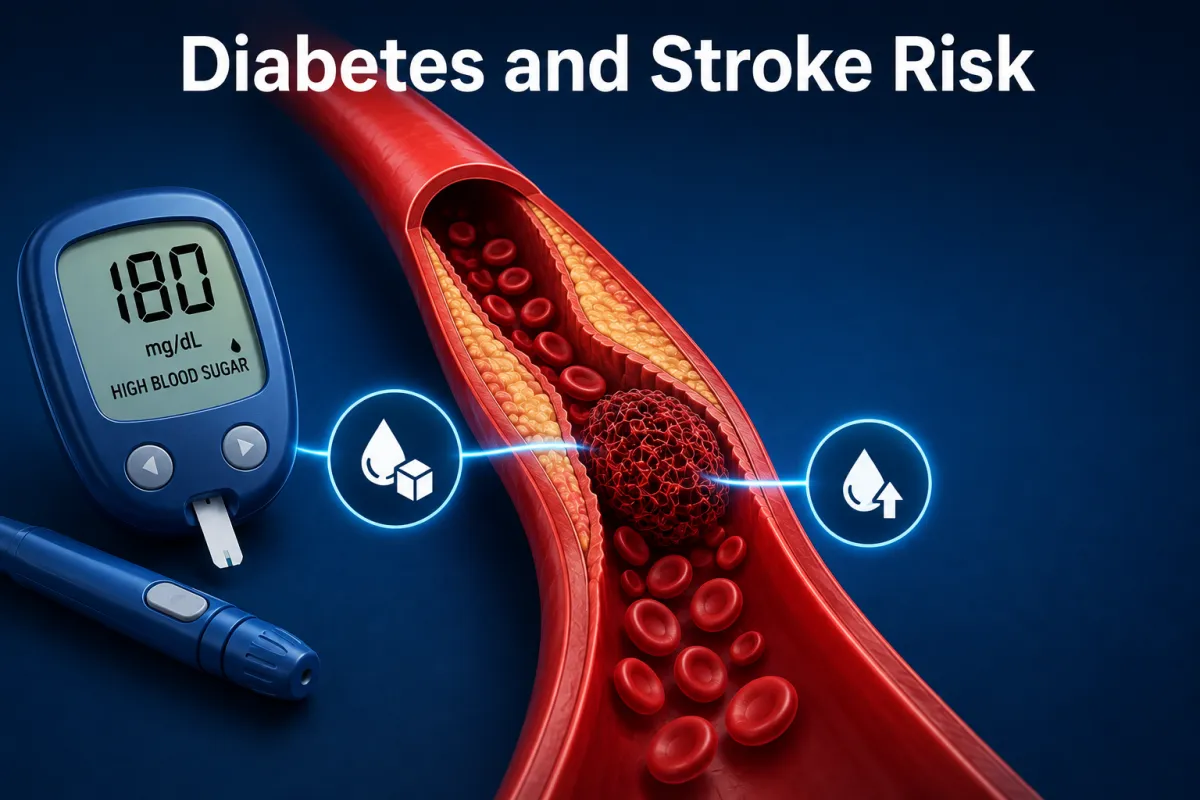
Diabetes can significantly increase the risk of stroke because persistently high blood glucose can damage blood vessels and contribute to atherosclerosis, clot formation and cardiovascular disease. Both type 1 and type 2 diabetes are associated with increased stroke risk. The good news is that managing blood glucose, blood pressure, cholesterol, weight, smoking and other cardiovascular risk factors can help reduce that risk.
After your stroke...
You may suddenly hear another word added to the long list of things being monitored.
Diabetes.
Perhaps you already knew you had it.
Maybe you were diagnosed while you were in hospital.
Perhaps someone tells you that your blood sugar is "borderline."
Maybe you have prediabetes.
Or perhaps you have no diagnosis at all but are now wondering whether blood sugar played a part in your stroke.
You begin asking...
"Can diabetes really cause a stroke?"
"Does having diabetes mean I will have another stroke?"
"Is type 2 diabetes more dangerous than type 1?"
"How low does my blood sugar need to be?"
"Can I reverse the risk?"
"What should I actually be doing?"
These are important questions.
Because diabetes is not just about sugar.
It is also about blood vessel health.
And after a stroke...
That matters enormously.
✦ ✦ ✦
The Good News
Having diabetes does not mean another stroke is inevitable.
But it does mean that managing your cardiovascular risk deserves serious attention.
The Stroke Association states that diabetes can increase the risk of stroke because excess glucose in the blood can damage blood vessels.
That means there are several things you may be able to influence.
These include:
✓ Blood glucose
✓ Blood pressure
✓ Cholesterol
✓ Smoking
✓ Physical activity
✓ Weight
✓ Diet
✓ Medication adherence
You cannot change the fact that you have already had a stroke.
But you can work on the conditions that affect what happens next.
✦ ✦ ✦
What Is Diabetes?
Diabetes is a long-term condition in which blood glucose levels become too high.
Normally, a hormone called insulin helps glucose move from your bloodstream into your cells, where it can be used for energy.
In diabetes, this system does not work properly.
In type 1 diabetes, the body does not produce enough insulin because the immune system damages the insulin-producing cells in the pancreas.
In type 2 diabetes, the body may not produce enough insulin or may not respond to insulin effectively.
Both can lead to persistently elevated blood glucose if not adequately managed.
Over time, high blood glucose can damage nerves and blood vessels throughout the body.
That includes the blood vessels supplying your brain.
✦ ✦ ✦
Why Does Diabetes Increase Stroke Risk?
Diabetes can contribute to several processes involved in cardiovascular disease.
Persistently elevated blood glucose may damage the inner walls of blood vessels.
Over time, this can contribute to:
✓ Inflammation
✓ Damage to arterial walls
✓ Atherosclerosis
✓ Narrowing of arteries
✓ Greater cardiovascular risk
✓ Increased likelihood of vessel blockage
The NHS specifically lists blood-vessel damage leading to coronary heart disease and stroke among the long-term complications of type 2 diabetes.
Type 1 diabetes can also damage blood vessels and increase the risk of heart disease and stroke.
So this is not simply a type 2 diabetes issue.
Both types require proper cardiovascular risk management.
✦ ✦ ✦
How Much Does Diabetes Increase Stroke Risk?
Diabetes is an established stroke risk factor.
Stroke Association information states that diabetes almost doubles the risk of stroke.
But statistics like this need to be interpreted properly.
They describe risk across groups of people.
They do not predict exactly what will happen to one individual.
Your personal stroke risk may also depend on:
✓ Your age
✓ Blood pressure
✓ Cholesterol
✓ Smoking
✓ Weight
✓ Physical activity
✓ Heart rhythm
✓ Kidney health
✓ Type and duration of diabetes
✓ How well diabetes is controlled
✓ The cause of your previous stroke
So do not read:
"Diabetes doubles stroke risk"
and immediately translate that into:
"I am going to have another stroke."
Risk is not destiny.
It is something to manage.
✦ ✦ ✦
Diabetes and Atherosclerosis
One of the major links between diabetes and stroke involves atherosclerosis.
Atherosclerosis happens when fatty material, cholesterol and other substances build up within artery walls.
These deposits can cause arteries to become:
Narrower.
Stiffer.
More vulnerable to blockage.
NICE includes ischaemic stroke and transient ischaemic attack within atherosclerotic cardiovascular disease.
If an artery supplying the brain becomes blocked, an ischaemic stroke can occur.
This is one reason managing cholesterol is so important when diabetes and stroke occur together.
Blood glucose is only one part of the picture.
✦ ✦ ✦
Diabetes and High Blood Pressure
Diabetes and high blood pressure often occur together.
That combination can place additional strain on the cardiovascular system.
High blood pressure is itself one of the strongest modifiable stroke risk factors.
The NHS lists both high blood pressure and diabetes among conditions that increase stroke risk.
So if you have both conditions, your healthcare team may pay close attention to:
✓ Home blood-pressure readings
✓ Medication
✓ Salt intake
✓ Kidney function
✓ Weight
✓ Exercise
✓ Cholesterol
Controlling blood sugar while ignoring persistently high blood pressure would leave an important part of your stroke risk untreated.
✦ ✦ ✦
Diabetes and Cholesterol
Diabetes can also occur alongside unhealthy cholesterol levels.
This matters because cholesterol contributes to atherosclerosis.
Depending on your individual circumstances, you may be prescribed lipid-lowering medication such as a statin as part of cardiovascular prevention.
NICE guidance specifically addresses lipid-lowering treatment in people with diabetes because of their cardiovascular risk.
Do not assume:
"My cholesterol wasn't extremely high, so I don't need treatment."
After a stroke, treatment decisions are often based on overall cardiovascular risk rather than a single laboratory number.
Discuss your individual treatment plan with your doctor.
✦ ✦ ✦
What Is HbA1c?
If you have diabetes, you may hear about your HbA1c.
HbA1c gives an indication of your average blood glucose level over roughly the previous two to three months.
It is different from a single finger-prick glucose reading.
One glucose test tells you what is happening at that moment.
HbA1c gives a broader picture.
Your healthcare team may use it to assess how well your diabetes is being managed over time.
Your target should be individualised.
Do not compare your HbA1c blindly with someone else's.
Targets may depend on factors such as:
✓ Age
✓ Type of diabetes
✓ Medication
✓ Risk of hypoglycaemia
✓ Other medical conditions
✓ Frailty
✓ Kidney function
✓ Cardiovascular disease
The aim is safe, sustainable control.
Not simply forcing the number as low as possible.
✦ ✦ ✦
Does Better Blood Sugar Control Remove Stroke Risk?
No.
Good blood glucose control is important.
But stroke prevention is broader than glucose alone.
Think about diabetes as part of your overall vascular health.
You may also need to manage:
✓ Blood pressure
✓ Cholesterol
✓ Smoking
✓ Body weight
✓ Physical activity
✓ Diet
✓ Atrial fibrillation if present
✓ Medication
The Stroke Association specifically emphasises controlling diabetes well because too much glucose in the blood damages blood vessels and increases stroke risk.
But good diabetes management should sit alongside your broader secondary stroke-prevention plan.
✦ ✦ ✦
Can Type 1 Diabetes Increase Stroke Risk?
Yes.
Type 1 diabetes can increase cardiovascular risk.
The NHS states that type 1 diabetes can damage blood vessels and lead to coronary heart disease and stroke.
This is why management is not limited to insulin.
Long-term care may also involve monitoring:
✓ Blood pressure
✓ Cholesterol
✓ Kidney health
✓ Eyes
✓ Feet
✓ Cardiovascular risk
Type 1 diabetes is not simply about preventing very high or very low blood sugar.
Long-term vascular protection matters too.
✦ ✦ ✦
Can Type 2 Diabetes Increase Stroke Risk?
Yes.
Type 2 diabetes is strongly associated with cardiovascular disease.
The NHS lists stroke among the long-term complications caused by blood-vessel damage in type 2 diabetes.
Type 2 diabetes often exists alongside other stroke risk factors, including:
✓ High blood pressure
✓ High cholesterol
✓ Excess weight
✓ Physical inactivity
That means treatment frequently involves more than glucose-lowering medication.
It may also involve significant attention to lifestyle and cardiovascular risk.
✦ ✦ ✦
What About Prediabetes?
Prediabetes means blood glucose levels are higher than normal but not yet within the diabetes range.
It matters because it can indicate an increased likelihood of developing type 2 diabetes.
For some people, lifestyle changes can significantly reduce progression to type 2 diabetes.
That may involve:
✓ Weight management where appropriate
✓ Increased physical activity
✓ Improved diet
✓ Regular monitoring
If you have had a stroke and are told you have prediabetes, do not dismiss it as:
"Not real diabetes."
It is a warning sign worth taking seriously.
But it is also an opportunity to act early.
✦ ✦ ✦
Can Diabetes Be Discovered After a Stroke?
Yes.
Some people discover previously undiagnosed diabetes during medical investigations around the time of a stroke.
However, blood glucose can also become temporarily elevated during serious illness and acute physiological stress.
This means one abnormal glucose measurement during an acute stroke does not always tell the whole story.
Further testing may be needed.
NHS research information notes that identifying diabetes after stroke can sometimes require careful interpretation because acute stroke itself can affect glucose readings.
Your healthcare team may therefore use additional testing, including HbA1c, to clarify whether diabetes was already present.
✦ ✦ ✦
What Should You Eat?
There is no single magical "diabetes and stroke diet."
A healthy eating pattern generally focuses on:
✓ Vegetables
✓ Fruit
✓ Wholegrains
✓ Beans
✓ Lentils
✓ Nuts
✓ Seeds
✓ Fish
✓ Lean protein
✓ Unsaturated fats
while reducing:
✓ Highly processed foods
✓ Sugary drinks
✓ Excess salt
✓ Processed meat
✓ Foods high in saturated fat
✓ Large amounts of refined carbohydrate
A Mediterranean-style eating pattern can work well because it overlaps strongly with general cardiovascular recommendations.
But your diabetes treatment matters.
Someone using insulin may need to think differently about carbohydrate intake than someone managing early type 2 diabetes through lifestyle changes.
Individual advice can therefore be valuable.
✦ ✦ ✦
Do You Need to Stop Eating Sugar Completely?
No.
The idea that someone with diabetes must never consume anything containing sugar is too simplistic.
Your overall carbohydrate intake, portion size, meal pattern and medication all matter.
However, foods containing large amounts of added sugar can make blood-glucose management harder and may contribute to excess calorie intake.
Examples include:
✓ Sugary drinks
✓ Sweets
✓ Cakes
✓ Biscuits
✓ Some desserts
✓ Sweetened cereals
✓ Some highly processed snacks
Sugary drinks are particularly easy to consume quickly without feeling full.
You do not need perfection.
But if sugary drinks form part of your everyday routine, they are an obvious place to start.
✦ ✦ ✦
Carbohydrates Are Not the Enemy
Some people respond to a diabetes diagnosis by becoming terrified of carbohydrates.
That can lead to unnecessarily extreme diets.
Carbohydrate affects blood glucose, but different carbohydrate foods have very different nutritional profiles.
Compare:
Wholegrain oats.
Beans.
Lentils.
Brown rice.
Whole fruit.
with:
Sugary drinks.
Sweets.
Highly refined pastries.
These are not nutritionally equivalent.
Rather than thinking:
"Carbohydrates are bad,"
think:
"What type, what portion, and what fits my treatment plan?"
✦ ✦ ✦
Physical Activity Can Help
Physical activity can help improve overall cardiovascular health and, for many people with type 2 diabetes, can improve insulin sensitivity.
After stroke, however, exercise ability may be limited by:
✓ Weakness
✓ Balance problems
✓ Fatigue
✓ Spasticity
✓ Mobility difficulties
✓ Heart problems
✓ Other medical conditions
So "exercise more" may be useless advice if nobody tells you how.
Start from your current ability.
That might mean:
✓ Walking
✓ Stationary cycling
✓ Strength exercises
✓ Seated exercise
✓ Swimming where safe
✓ Rehabilitation exercises
Your stroke team, physiotherapist or healthcare professional can help you determine an appropriate level.
Progress beats perfection.
✦ ✦ ✦
Weight and Diabetes Risk
Excess body weight can increase the risk of developing type 2 diabetes and can make diabetes more difficult to manage for some people.
But not everybody with diabetes is overweight.
And not every stroke survivor should be trying to lose weight.
Some people lose too much weight after stroke because of:
✓ Swallowing problems
✓ Poor appetite
✓ Fatigue
✓ Depression
✓ Difficulty preparing food
If you are overweight and your healthcare professional recommends weight loss, even modest sustainable changes can be useful.
But if you are underweight or unintentionally losing weight, restriction may be inappropriate.
Context matters.
✦ ✦ ✦
Smoking Makes the Situation Worse
If you have diabetes and smoke, you are combining two significant cardiovascular risk factors.
Smoking damages blood vessels.
Diabetes can damage blood vessels.
After stroke, continuing both risks makes little sense.
If you smoke, stopping is one of the most important changes you can make for your cardiovascular health.
You do not have to quit without support.
Nicotine replacement, stop-smoking services and medication may all be options depending on your circumstances.
Ask for help.
✦ ✦ ✦
Take Your Medication Properly
Diabetes medication may include:
✓ Metformin
✓ Other tablets
✓ Injectable medication
✓ Insulin
The correct treatment depends on your type of diabetes and individual medical circumstances.
Do not alter your medication because your glucose looked good for several days.
Likewise, do not double medication because you ate something you regret.
Use medication exactly as prescribed unless your healthcare team has taught you how and when to adjust it.
For people using insulin, dosing errors can be dangerous.
Diabetes management requires consistency.
Not improvisation.
✦ ✦ ✦
Be Careful About Hypoglycaemia
Lower blood glucose is not always better.
If glucose falls too low, you can develop hypoglycaemia.
Symptoms may include:
✓ Shaking
✓ Sweating
✓ Hunger
✓ Confusion
✓ Weakness
✓ Irritability
✓ Palpitations
✓ Difficulty concentrating
Severe hypoglycaemia can be dangerous.
This matters after stroke because some symptoms may also be confused with neurological problems.
If you use medication capable of causing hypoglycaemia, make sure you understand:
What your warning signs are.
How to check your glucose.
How to treat a low reading.
When to seek help.
Your goal is controlled glucose.
Not dangerously low glucose.
✦ ✦ ✦
Regular Diabetes Reviews Matter
Managing diabetes properly involves more than checking blood sugar.
Routine reviews may include monitoring:
✓ HbA1c
✓ Blood pressure
✓ Cholesterol
✓ Kidney function
✓ Foot health
✓ Eye health
✓ Weight
✓ Medication
Do not skip these because you feel well.
Many vascular complications develop silently.
You may not feel high cholesterol.
You may not feel early kidney disease.
You may not feel arterial damage.
Monitoring allows problems to be identified before they become much larger.
✦ ✦ ✦
The Emotional Impact
Managing diabetes after stroke can feel exhausting.
You may already be dealing with:
Medication.
Rehabilitation.
Appointments.
Fatigue.
Work.
Family.
Mobility difficulties.
Then someone gives you another list.
Check your sugar.
Watch your food.
Exercise.
Lose weight.
Take tablets.
Check your feet.
Attend reviews.
It can feel relentless.
But try not to think of diabetes management as another punishment after stroke.
Think of it as one part of protecting the recovery you have already fought for.
You are not trying to become medically perfect.
You are trying to reduce avoidable risk.
✦ ✦ ✦
My Perspective
After a stroke, people can become obsessed with finding one explanation.
"It was my blood pressure."
"It was my cholesterol."
"It was stress."
"It was diabetes."
But stroke risk is often more complicated than one number.
Diabetes matters.
But managing diabetes does not mean staring at your glucose monitor while ignoring everything else.
Look at the whole cardiovascular picture.
Blood pressure.
Cholesterol.
Smoking.
Exercise.
Weight.
Medication.
Diet.
Your underlying stroke cause.
Then work on the pieces you can control.
If your HbA1c is too high, deal with it.
If your blood pressure is high, deal with that too.
If you smoke, quitting matters.
If you are inactive, build activity gradually.
You do not need to transform your entire life in one week.
You need consistent improvements that you can actually maintain.
That is far more useful than three days of perfect behaviour followed by three months of giving up.
✦ ✦ ✦
When Should You Seek Medical Advice?
Speak with your doctor or diabetes team if:
✓ Your blood glucose is consistently above your agreed target
✓ You experience frequent low blood sugar
✓ Your medication causes troublesome side effects
✓ You are losing weight unexpectedly
✓ You are unusually thirsty or urinating frequently
✓ You have numbness or wounds on your feet
✓ Your vision changes
✓ You are unsure how to manage diabetes after your stroke
✓ You are struggling with diet or medication
Seek urgent medical attention for new stroke symptoms.
Remember FAST:
Face weakness.
Arm weakness.
Speech problems.
Time to call emergency services.
Do not assume sudden neurological symptoms are "just my blood sugar."
✦ ✦ ✦
Frequently Asked Questions
Can Diabetes Cause a Stroke?
Diabetes can significantly increase stroke risk because persistently high blood glucose can damage blood vessels and contribute to cardiovascular disease.
Does Diabetes Double Stroke Risk?
Stroke Association guidance states that diabetes almost doubles the risk of stroke.
Individual risk still depends on many other factors.
Is Type 1 Diabetes a Stroke Risk?
Yes.
Type 1 diabetes can damage blood vessels and increase the risk of heart disease and stroke.
Is Type 2 Diabetes a Stroke Risk?
Yes.
Long-term blood-vessel damage from type 2 diabetes can contribute to coronary heart disease and stroke.
Can Controlling Diabetes Prevent Another Stroke?
Good diabetes control can reduce an important contributor to cardiovascular risk.
But preventing another stroke also involves managing other risk factors such as blood pressure, cholesterol, smoking and the underlying cause of the original stroke.
Should I Stop Eating Carbohydrates?
Not automatically.
The type and amount of carbohydrate, your medication and your individual diabetes plan all matter.
A balanced diet containing higher-quality carbohydrates such as wholegrains, vegetables, beans and lentils can still fit diabetes management.
Can I Stop Diabetes Medication If My Blood Sugar Improves?
Not without discussing it with your healthcare professional.
Your medication may be one reason your glucose has improved.
✦ ✦ ✦
Key Takeaways
✓ Diabetes is an important modifiable contributor to stroke risk.
✓ Persistently high blood glucose can damage blood vessels.
✓ Both type 1 and type 2 diabetes can increase cardiovascular and stroke risk.
✓ Diabetes is associated with approximately twice the stroke risk seen in people without diabetes.
✓ Blood glucose is only one part of diabetes-related cardiovascular risk.
✓ Blood pressure and cholesterol also need attention.
✓ Healthy eating, physical activity and weight management can help where appropriate.
✓ Smoking adds further cardiovascular risk.
✓ Take diabetes medication as prescribed.
✓ Very low blood sugar can also be dangerous.
✓ Regular diabetes reviews help identify problems before symptoms appear.
✓ Good diabetes management should form part of a broader stroke-prevention strategy.
✦ ✦ ✦
Related Articles
Continue learning about stroke prevention and cardiovascular health:
Salt and Blood Pressure After Stroke
High Blood Pressure After Stroke
Mediterranean Diet After Stroke
Smoking After Stroke
Cholesterol After Stroke
Preventing a Second Stroke
Healthy Eating After Stroke
Weight Loss After Stroke
Exercise and Stroke Prevention
Alcohol After Stroke
✦ ✦ ✦
About the Author
Alisia Gayle is a stroke survivor who achieved 96% neurological recovery following an ischaemic stroke.
After years of rehabilitation, she now shares practical, evidence-informed resources to help stroke survivors, carers and families better understand recovery and rebuild their lives with confidence.
Alisia is also the author of Brain Damage: My Journey to 96% Recovery, where she shares her personal stroke recovery story and the lessons she learned throughout her rehabilitation.
✦ ✦ ✦
Medical Disclaimer
This article is intended for educational purposes only and should not replace professional medical, diabetes or nutritional advice.
Diabetes treatment and blood-glucose targets vary significantly between individuals.
Always follow the advice of your doctor, diabetes specialist nurse, pharmacist, dietitian or other healthcare professional regarding medication, insulin, blood-glucose monitoring and cardiovascular risk.
Never stop or change prescribed diabetes, blood-pressure, cholesterol-lowering, antiplatelet or anticoagulant medication without professional advice.
If you develop sudden symptoms of stroke, seek emergency medical attention immediately.
✦ ✦ ✦
Final Thoughts
Diabetes can sound like another frightening item on the list of things that can cause a stroke.
But knowing about the risk gives you something useful.
A target.
Blood glucose can be monitored.
Blood pressure can be treated.
Cholesterol can be managed.
Smoking can be stopped.
Diet can be improved.
Activity can be increased where your recovery allows.
Medication can be taken consistently.
You do not have to control everything perfectly.
You need to control what you reasonably can.
And if you already have diabetes...
Do not treat it as a separate condition sitting quietly in the background.
It is part of your cardiovascular health.
Part of your blood-vessel health.
And therefore...
Part of protecting your brain.
After stroke, prevention is not usually one dramatic intervention.
It is the accumulation of sensible decisions repeated over time.
Managing diabetes well can be one of the most important of those decisions.