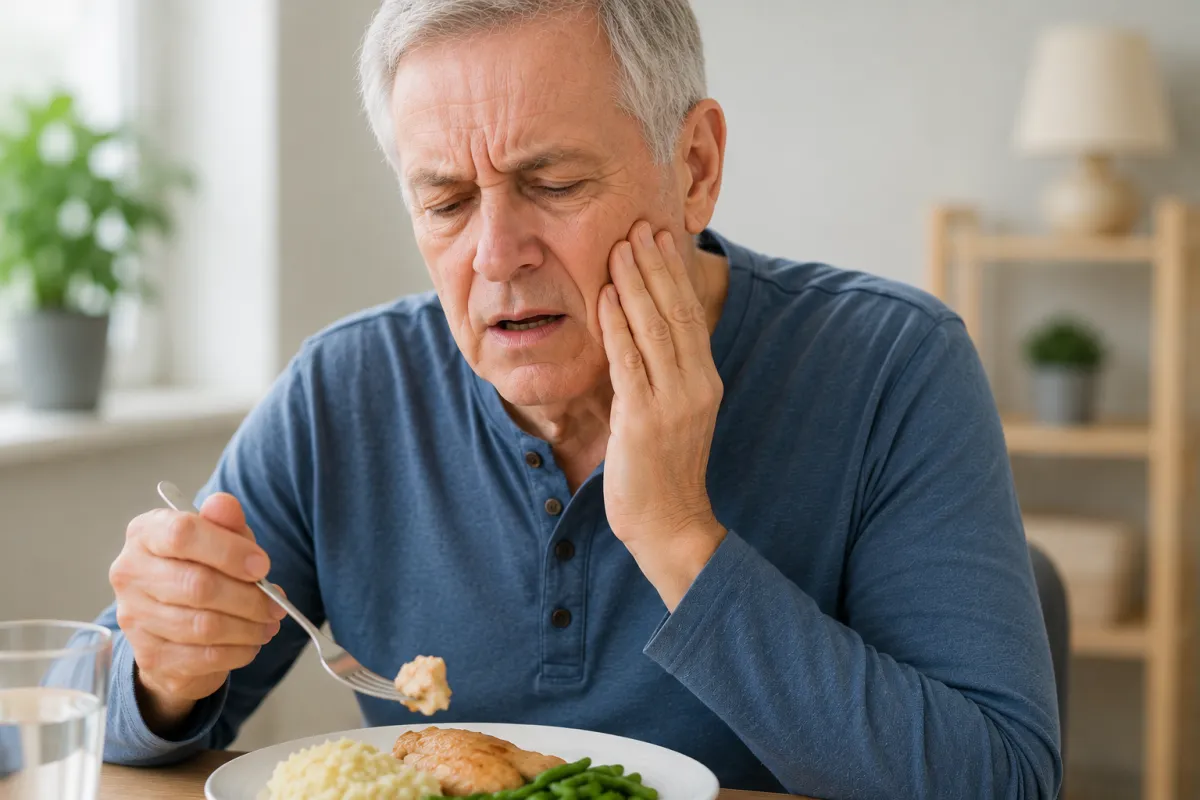
Difficulty chewing after a stroke can happen when weakness, reduced coordination, altered sensation or poor control of the lips, tongue, jaw or cheek affects the oral stage of eating. Food may take much longer to break down, collect in one side of the mouth, fall from the lips or remain in the cheek after you think you have swallowed. Chewing problems can also occur alongside dysphagia, so persistent difficulty should not simply be worked around at home without assessment. A speech and language therapist can assess whether eating and swallowing are safe and recommend appropriate food textures or strategies.
After your stroke, did you suddenly discover that chewing was no longer automatic?
Perhaps one side of your mouth feels weaker.
Maybe meat, bread or other firmer foods take so long to chew that you simply give up.
You may find food collecting in your cheek without realising it is there.
Or perhaps food sometimes falls from your mouth because your lips no longer seal as strongly as they did before.
It can feel strange because chewing seems like such a basic action.
Before your stroke, you probably never thought about where your tongue was, how your jaw was moving or whether both sides of your mouth were doing the same amount of work.
Your brain handled all of that automatically.
A stroke can interfere with that coordination.
And when it does, something as ordinary as eating a sandwich can suddenly require concentration.
✦ ✦ ✦
The Good News
Difficulty chewing after stroke does not automatically mean that you will always struggle to eat.
Some people improve as weakness, sensation and coordination recover. Others learn strategies that make meals safer and much less exhausting.
The important thing is identifying which part of eating is actually causing the difficulty.
Is your jaw weak?
Is one side of your face less mobile?
Can you feel food properly inside your mouth?
Is your tongue struggling to move food around?
Are you chewing reasonably well but having difficulty when you try to swallow?
Those are different problems and may require different approaches.
That is why proper assessment matters.
Rather than simply deciding that you need softer food forever, the aim should be to understand what your mouth and swallowing system are actually doing.
✦ ✦ ✦
Why Can Chewing Become Difficult After a Stroke?
Chewing is far more complicated than simply opening and closing your jaw.
Eating requires coordinated movement of your lips, cheeks, jaw and tongue. Food needs to be moved between the teeth, broken down, mixed with saliva, gathered together and moved towards the back of the mouth ready for swallowing.
A stroke can interfere with any part of that process.
✦ ✦ ✦
Weakness on One Side of the Face
Stroke can cause weakness on one side of the face as well as weakness in an arm or leg.
You might notice:
one side of your mouth drooping
difficulty keeping your lips closed
food escaping from one side
saliva leaking
reduced movement of one cheek
difficulty keeping food positioned between your teeth.
If one side is weaker, chewing may become uneven.
You may naturally start doing most of the work on the stronger side because it feels easier.
✦ ✦ ✦
Reduced Tongue Control
Your tongue does far more during a meal than you probably realised before your stroke.
It moves food around your mouth.
It positions food between your teeth.
It mixes food with saliva.
It gathers chewed food together.
And when you are ready, it helps move that food backwards towards the throat.
If tongue movement becomes weak or poorly coordinated, food can become difficult to control.
You may be able to chew it but struggle to gather everything together ready to swallow.
Pieces may remain scattered around your mouth even after you believe you have finished eating.
✦ ✦ ✦
Reduced Sensation Inside the Mouth
Stroke can affect sensation as well as movement.
That can create a particularly strange eating problem.
Food may be sitting inside your cheek, but your brain may receive weaker information telling you that it is there.
You can genuinely believe your mouth is empty when it is not.
This can result in food remaining around the gums or inside the cheek after a meal.
✦ ✦ ✦
Problems Coordinating Chewing
Strength is not the only issue.
Your brain also has to coordinate the timing of your jaw, tongue, lips and cheeks.
After stroke, those movements may become slower or less organised.
You may need far more chewing movements than before.
A food that once took seconds to eat may now take several minutes.
That is one reason meals can become exhausting.
✦ ✦ ✦
What Are the Signs of Chewing Difficulty After Stroke?
Chewing problems are not always obvious.
Sometimes the first sign is simply that you begin avoiding certain foods.
You might notice:
✓ taking much longer to finish meals
✓ avoiding meat, bread or firmer foods
✓ food collecting inside one cheek
✓ food falling from the mouth
✓ difficulty moving food from one side of the mouth to the other
✓ needing many more chewing movements before swallowing
✓ your jaw becoming tired during meals
✓ accidentally biting your cheek or tongue
✓ needing liquid to help clear food
✓ finding food in your mouth after the meal has finished
✓ avoiding eating around other people because you feel self-conscious.
If several of these are happening regularly, it is worth discussing them with your stroke team or speech and language therapist.
✦ ✦ ✦
What Is Food Pocketing After a Stroke?
Food pocketing means that food remains trapped inside the mouth, often between the cheek and gums.
It commonly occurs when one side of the mouth is weaker or has reduced sensation.
You may not immediately realise that food is still there.
Some people discover it several minutes after finishing a meal.
Others need somebody else to remind them to check their mouth.
This is more than an inconvenience.
Food remaining in the mouth can affect oral hygiene and may later move backwards when you are no longer concentrating on eating.
Regular food pocketing should therefore be discussed with a speech and language therapist.
✦ ✦ ✦
Is Difficulty Chewing the Same as Dysphagia?
Not exactly, but the two can overlap.
Dysphagia means difficulty swallowing.
Many people think swallowing begins when food enters the throat, but the process actually begins in the mouth.
Before you can swallow safely, you need to:
This is sometimes referred to as the oral stage of swallowing.
You might therefore have difficulty preparing food in your mouth while the later stages of swallowing work reasonably well.
Or you may have problems with both chewing and swallowing.
That distinction matters because difficulty chewing should not automatically be treated as an isolated dental or jaw problem.
✦ ✦ ✦
Warning Signs of a Wider Swallowing Problem
Pay particular attention if chewing difficulty occurs alongside:
✓ coughing while eating or drinking
✓ choking
✓ repeated throat clearing
✓ a wet or gurgly-sounding voice after swallowing
✓ food feeling stuck
✓ difficulty starting a swallow
✓ shortness of breath during meals
✓ repeated chest infections
✓ unexplained weight loss
✓ dehydration
✓ taking an extremely long time to finish meals.
These symptoms deserve professional assessment.
Not everyone with dysphagia coughs when food or liquid enters the airway, so the absence of coughing does not necessarily prove that swallowing is safe.
✦ ✦ ✦
Which Foods Can Be Harder to Chew?
The foods you struggle with will depend on your particular difficulties.
Commonly challenging foods can include:
tough meat
crusty bread
raw vegetables
nuts
dry biscuits
chewy foods
fibrous foods
foods with tough skins
dry or crumbly foods.
That does not mean every stroke survivor should remove these foods.
Your safest and most appropriate food texture depends on your individual ability.
✦ ✦ ✦
Should You Just Switch to Soft Food?
Not automatically.
Softer food may be easier to chew, but putting yourself on an unnecessarily restrictive diet is not the answer.
Modified-texture diets can affect:
food enjoyment
appetite
variety
nutrition
social eating
quality of life.
If your stroke team or speech and language therapist recommends a particular food texture, follow that advice.
But do not assume you need puréed food simply because chewing takes longer than it used to.
The objective is to use the least restrictive texture that is safe and manageable for you.
✦ ✦ ✦
Practical Ways to Make Chewing Easier
Small adjustments may make eating considerably less tiring.
Your own swallowing recommendations always take priority, but some practical approaches include the following.
✦ ✦ ✦
Take Smaller Mouthfuls
A large mouthful is harder to control.
Smaller bites give your tongue, cheeks and jaw less food to manage at once.
They also make it easier to tell whether your mouth has been cleared before taking another bite.
Do not rush to refill your mouth.
Finish one mouthful before starting the next.
✦ ✦ ✦
Give Yourself More Time
You may simply need longer to eat than you did before your stroke.
That can be frustrating, especially if everyone around you has already finished.
But rushing will not make impaired coordination disappear.
Allow enough time for meals so that you are not constantly fighting the clock.
✦ ✦ ✦
Reduce Distractions
Before stroke, you may have eaten while:
watching television
talking
checking your phone
helping children
thinking about work.
If chewing now requires conscious concentration, doing several things at once may make eating harder.
A quieter environment may help you pay attention to what your mouth is doing.
✦ ✦ ✦
Sit in the Position Recommended for You
Good positioning is important during meals.
Many people are advised to sit upright while eating and drinking, but individual needs differ.
If your speech and language therapist has given you specific positioning instructions, follow those rather than generic online advice.
✦ ✦ ✦
Check Your Mouth Before Finishing
If you experience food pocketing, develop a routine.
Before you consider the meal finished, check whether food remains:
inside either cheek
around your gums
under your tongue.
If sensation is reduced, you may not be able to rely entirely on how your mouth feels.
Ask your therapist for the safest way to check and clear any remaining food.
✦ ✦ ✦
What About Chewing Exercises?
It is tempting to search online for jaw, tongue and facial exercises.
But the correct exercise depends on the actual impairment.
If your problem is weakness, one approach may be appropriate.
If your problem is reduced sensation, strengthening alone may achieve very little.
If your difficulty is poor coordination, another approach may be required.
And if you have a swallowing disorder, exercises should ideally be selected after assessment.
A speech and language therapist can determine whether targeted oral or swallowing exercises are appropriate for you.
Do not assume that doing hundreds of random tongue movements will automatically fix the problem.
More exercise is not always better exercise.
The exercise needs to address the impairment.
✦ ✦ ✦
What If One Side of My Mouth Is Weaker?
You may naturally start chewing predominantly on the stronger side.
Sometimes therapists deliberately recommend particular food-placement strategies.
But this is not something everyone should copy.
Your safest strategy depends on factors such as:
strength
sensation
tongue movement
facial control
awareness
swallowing ability.
A technique that works for another stroke survivor may be completely inappropriate for you.
Get individual advice.
✦ ✦ ✦
Don't Forget Your Teeth and Dentures
Not every chewing problem after stroke is caused by stroke.
You can still develop ordinary dental problems.
Chewing may also be affected by:
missing teeth
loose or painful teeth
poorly fitting dentures
gum disease
mouth infections
dry mouth.
If chewing is painful rather than simply difficult, consider whether dental assessment is needed.
Good oral hygiene is particularly important if food tends to remain in the mouth.
✦ ✦ ✦
Chewing Problems Can Affect Nutrition
It is easy for your diet to shrink without you noticing.
First you stop eating steak because it takes too long.
Then crusty bread.
Then raw vegetables.
Then fruit with skins.
Eventually the range of foods you eat can become surprisingly small.
If chewing difficulty causes you to avoid important food groups, you may struggle to consume enough:
calories
protein
fibre
vitamins
minerals.
A dietitian can help if you are losing weight or your diet has become severely restricted.
The aim is not simply to find foods you can physically chew.
It is to find a way of eating that is safe, manageable and nutritionally adequate.
✦ ✦ ✦
Chewing Can Be Exhausting After Stroke
This is easy to underestimate.
If every mouthful requires concentration, eating becomes work.
Add post-stroke fatigue and you may start a meal reasonably well but become exhausted halfway through.
You may find it helpful to:
✓ eat when your energy is strongest
✓ choose foods that require less effort when you are particularly fatigued
✓ use smaller meals more frequently if appropriate
✓ ask for help with food preparation
✓ avoid using all your energy cooking before you even begin eating
✓ tell your healthcare team if meals regularly become too tiring to finish.
Eating should not consume your entire energy allowance for the day.
✦ ✦ ✦
When Should You Seek Medical Advice?
Ask for professional assessment if:
✓ chewing difficulty is new or persistent
✓ food regularly stays inside your mouth
✓ you cough or choke during meals
✓ your voice sounds wet or gurgly afterwards
✓ food feels stuck
✓ meals are taking an unusually long time
✓ you are unintentionally losing weight
✓ you are becoming dehydrated
✓ you repeatedly develop chest infections
✓ you are increasingly avoiding food
✓ you are unsure whether swallowing is safe.
If someone is choking and cannot breathe, speak or cough effectively, treat it as an emergency and call 999.
If new facial weakness, arm weakness, speech difficulty or other sudden neurological symptoms appear, call 999 immediately rather than assuming they are simply part of your previous stroke.
✦ ✦ ✦
My Perspective
Before stroke, chewing is one of those things you barely notice yourself doing.
You talk.
You watch television.
You think about something completely unrelated.
Meanwhile your tongue is positioning food, your jaw is breaking it down, your cheeks are keeping it where it needs to be and your brain is coordinating everything.
Stroke can suddenly make you conscious of every movement.
That is one of the strange realities of neurological recovery.
You discover how sophisticated the supposedly "simple" things really are.
And chewing problems should not be dismissed just because they seem less important than walking or moving an arm.
If every meal takes an hour, food constantly falls from your mouth or you are frightened of choking, it affects everyday life enormously.
It can affect your confidence.
Your appetite.
Your nutrition.
Your willingness to eat around other people.
Even your enjoyment of family meals.
So rather than simply accepting that your mouth "doesn't work properly anymore," find out what is actually happening.
The better you understand the problem, the more targeted your recovery strategy can become.
✦ ✦ ✦
Frequently Asked Questions
✦ ✦ ✦
Is Difficulty Chewing Common After a Stroke?
It can happen when stroke affects the strength, sensation or coordination needed to control food inside the mouth.
It may also occur as part of dysphagia.
✦ ✦ ✦
Why Does Food Stay in My Cheek After Stroke?
Weakness, reduced sensation or impaired tongue movement can make it difficult to clear food completely.
This is often referred to as food pocketing.
If it happens regularly, tell your speech and language therapist.
✦ ✦ ✦
Why Can I Chew but Still Struggle to Swallow?
Chewing and swallowing are connected but involve different stages.
You may be able to break food down but struggle to gather it together or move it backwards efficiently.
A swallowing assessment can help identify where the difficulty is occurring.
✦ ✦ ✦
Should I Chew Only on My Stronger Side?
Not as a universal rule.
Some people are advised to use specific sides or food-placement techniques, but this depends on their individual pattern of strength, sensation and swallowing ability.
Ask your therapist rather than copying somebody else's strategy.
✦ ✦ ✦
Can Chewing Improve After a Stroke?
Yes, it may improve as strength, sensation and coordination recover.
How much and how quickly varies considerably between stroke survivors.
Rehabilitation and compensatory strategies may also make eating easier.
✦ ✦ ✦
Who Can Help With Chewing Problems?
A speech and language therapist can assess eating and swallowing.
Depending on the problem, you may also benefit from input from a:
✦ ✦ ✦
Key Takeaways
✓ Difficulty chewing can occur after stroke.
✓ Facial weakness, altered sensation, reduced tongue control and poor coordination can all contribute.
✓ Food remaining in one cheek may indicate impaired oral control or reduced awareness.
✓ Chewing difficulty can be part of dysphagia.
✓ Coughing, choking, a wet voice, repeated chest infections and weight loss should not be ignored.
✓ Do not automatically place yourself on a puréed or severely restricted diet.
✓ Smaller mouthfuls, appropriate positioning, reduced distractions and additional time may make meals easier.
✓ Do not copy swallowing strategies from another survivor without knowing whether they are appropriate for you.
✓ Persistent problems should be assessed by a speech and language therapist.
✓ The goal is not simply softer food. It is eating safely, adequately and with as much independence as possible.
✦ ✦ ✦
The Bottom Line
Difficulty chewing after a stroke can transform eating from an automatic part of life into a slow, tiring and sometimes worrying task.
But not all chewing problems are the same.
The problem might be weakness.
It might be reduced sensation.
It might be tongue control.
It might be coordination.
Or it may be one part of a wider swallowing problem.
That distinction matters.
Instead of endlessly avoiding harder foods and hoping the problem disappears, try to understand what your mouth and swallowing system are actually doing.
Get assessed.
Use strategies suited to your impairment.
Protect your nutrition.
And remember that something being difficult today does not automatically mean it will always remain difficult.
✦ ✦ ✦
Related Articles
Dysphagia After a Stroke
Foods That Are Easier to Swallow After Stroke
Swallowing Exercises After Stroke
Food Getting Stuck in the Throat After a Stroke
Pocketing Food in the Cheek After a Stroke
✦ ✦ ✦
About the Author
Alisia Gayle is a stroke survivor and author of Brain Damage: My Journey to 96% Recovery.
Her work combines lived experience with practical, evidence-informed information designed to help stroke survivors and their families better understand the realities of recovery.
✦ ✦ ✦
Medical Disclaimer
This article is for general educational and informational purposes only and is not a substitute for individual medical advice, diagnosis or treatment.
Stroke-related chewing and swallowing difficulties vary considerably between individuals. If you experience persistent difficulty chewing, choking, coughing during meals, unexplained weight loss, dehydration or concerns about swallowing safety, speak to an appropriate healthcare professional.
Always follow the individual eating, drinking, positioning and food-texture recommendations provided by your stroke team or speech and language therapist.
✦ ✦ ✦
Final Thoughts
Before your stroke, you probably never considered chewing an achievement.
After stroke, ordinary things can become rehabilitation.
A mouthful that takes concentration is still progress.
A meal that takes longer is still a meal.
And needing help now does not tell you what your abilities will look like months from now.
Understand the problem.
Work on the right problem.
And give your brain the time and repetition it needs.