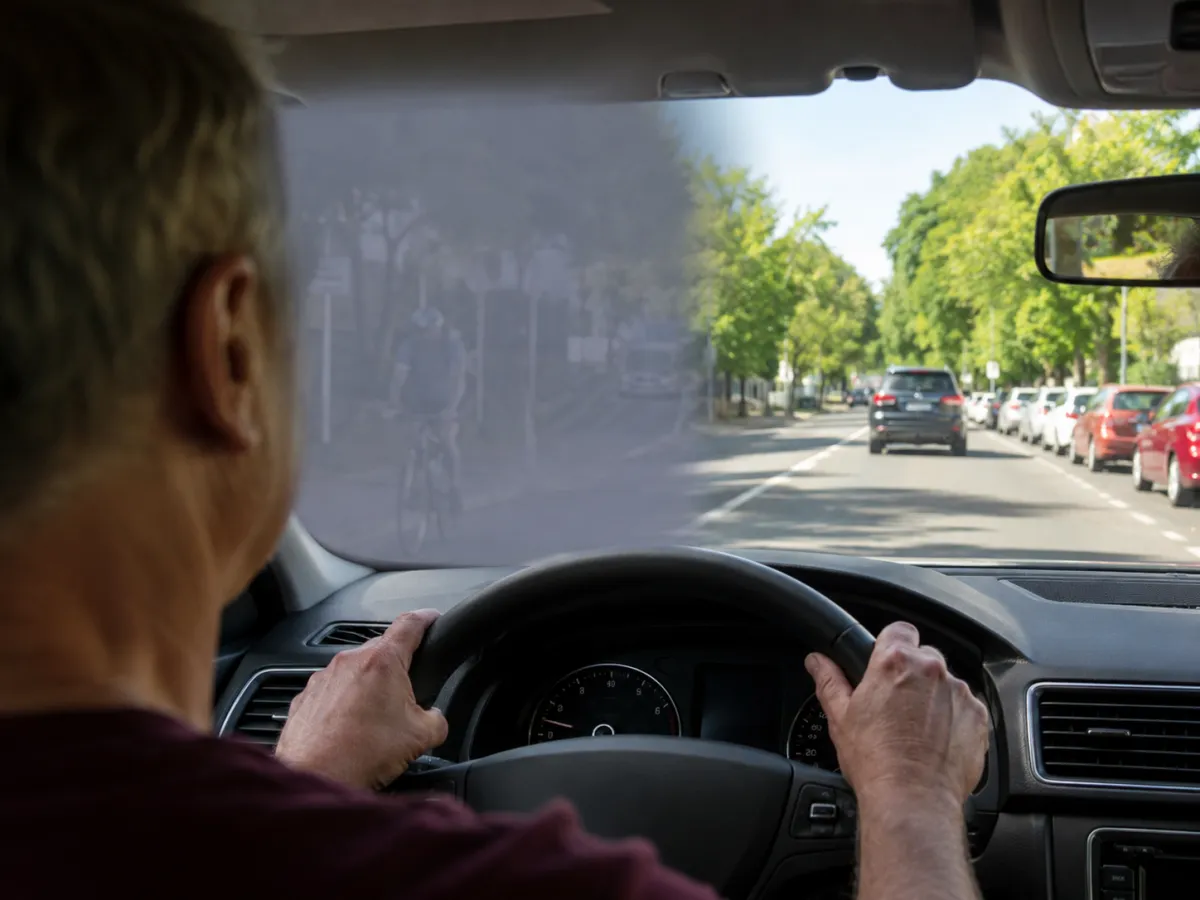
Driving after visual neglect following a stroke requires particular caution because visual neglect is not simply an eyesight problem. A person may be able to see clearly yet fail to notice vehicles, pedestrians, road signs or objects on one side of their surroundings. Because this can create a serious driving risk, visual neglect should be professionally assessed before you consider returning to the road. Recovery can occur, but feeling that your vision is normal does not necessarily mean that the neglect has resolved.
After your stroke...
Perhaps you noticed yourself bumping into doorframes.
Leaving food on one side of your plate.
Missing objects sitting beside you.
Reading only part of a page.
Or failing to notice someone standing on one side.
Maybe your family noticed before you did.
Then someone explained that you had visual neglect.
And eventually another question appeared...
"Can I drive again?"
"My eyesight seems fine, so why can't I drive?"
"What if I have learned to scan properly?"
"Can visual neglect recover?"
"How will I know when I am safe?"
These are important questions.
Because driving requires much more than being able to read a number plate or see clearly in front of you.
You need to notice what is happening across the entire road environment.
And visual neglect can interfere with exactly that ability.
✦ ✦ ✦
The Good News
Visual neglect can improve after a stroke.
Some people experience substantial recovery as the brain heals and adapts.
Rehabilitation may also help people become more aware of the neglected side and develop strategies such as systematic scanning.
But driving is different from practising visual exercises at home.
The consequences of missing something while reading a page may be frustrating.
The consequences of failing to notice a cyclist, pedestrian or vehicle can be catastrophic.
Current DVLA medical guidance indicates that visual neglect following stroke will usually prevent licensing until adequate recovery has occurred.
That does not necessarily mean you will never drive again.
It means recovery needs to be properly established.
✦ ✦ ✦
What Is Visual Neglect?
Visual neglect is sometimes called:
✓ Visual inattention
✓ Spatial neglect
✓ Hemispatial neglect
It commonly occurs following damage to areas of the brain involved in attention and spatial awareness.
The important point is this:
Your eyes may still be capable of seeing the information.
The difficulty lies in the brain failing to attend to or process information coming from one side of space.
For example, someone with left-sided neglect may:
✓ Ignore objects on the left
✓ Eat food only from the right side of a plate
✓ Shave or apply makeup to only one side of the face
✓ Read only the right side of a page
✓ Bump into objects on the left
✓ Fail to notice people approaching from the left
The person may sometimes be unaware that this is happening.
That lack of awareness is one reason visual neglect can be particularly concerning for driving.
✦ ✦ ✦
Visual Neglect Is Not the Same as Visual Field Loss
These two conditions are often confused.
Visual field loss means that part of the visual field is genuinely missing.
For example, hemianopia can cause loss of half of the visual field.
Visual neglect is different.
The visual information may reach the brain, but attention is not being directed towards it appropriately.
In everyday life the two conditions can look remarkably similar.
Someone may fail to see or respond to something on one side in either case.
Some stroke survivors can also experience both visual field loss and visual neglect.
That makes professional assessment particularly important.
DVLA guidance specifically requires drivers to report visual field defects, and persistent eyesight problems after stroke are among the conditions that must be reported after the initial one-month driving restriction.
✦ ✦ ✦
Why Is Visual Neglect Dangerous When Driving?
Driving constantly demands awareness of both sides of your environment.
Imagine approaching a junction.
You need to notice:
✓ Cars approaching from either direction
✓ Cyclists
✓ Pedestrians
✓ Motorcycles
✓ Traffic lights
✓ Road signs
✓ Lane markings
✓ Vehicles in your mirrors
✓ Hazards emerging from side roads
Now imagine that your brain intermittently fails to process information on one side.
You may genuinely believe the road is clear.
But something may be there.
That is what makes neglect particularly dangerous.
It is not simply a matter of blurry eyesight.
It involves attention.
And drivers sometimes have only fractions of a second to detect and react to a hazard.
✦ ✦ ✦
Why Might You Think Your Vision Is Fine?
This is one of the difficult aspects of visual neglect.
You may look straight ahead and think:
"I can see perfectly."
You can read.
Watch television.
Recognise faces.
Use your phone.
Perhaps even walk around independently.
But those activities do not recreate the demands of driving.
Driving requires continuous scanning across a large, rapidly changing environment.
A pedestrian appears.
A motorcycle moves alongside you.
A vehicle enters your blind spot.
Someone steps from behind a parked car.
Your attention must constantly move around the scene.
Visual neglect may only become obvious when the environment becomes complicated.
This is why simply feeling that your eyesight is normal cannot establish driving fitness.
✦ ✦ ✦
Can You Be Unaware of Visual Neglect?
Yes.
Some people have limited awareness of their neglect.
Family members may notice things first.
Perhaps you frequently leave items untouched on one side of your plate.
You repeatedly walk into the same side of furniture.
You overlook objects sitting directly beside you.
Yet from your perspective, nothing appears to be missing.
This creates an obvious problem with self-assessing driving safety.
You cannot reliably compensate for a difficulty that you do not realise is happening.
Awareness may improve with rehabilitation.
But where driving is concerned, objective assessment matters much more than confidence alone.
✦ ✦ ✦
Which Side Is Usually Affected?
Visual neglect most commonly affects the side opposite the brain injury.
For example, damage involving the right side of the brain may lead to neglect of the left side of space.
Left-sided neglect is particularly well recognised after right-hemisphere stroke.
However, neglect can vary considerably.
Some people have severe difficulties.
Others have subtle problems that become noticeable only during demanding tasks.
Symptoms can also fluctuate depending on:
✓ Fatigue
✓ Distraction
✓ Stress
✓ Environmental complexity
✓ Cognitive load
That variability matters for driving.
You might perform well in a quiet clinic but struggle when several things compete for your attention.
✦ ✦ ✦
What Might Visual Neglect Look Like on the Road?
A driver with unresolved neglect might potentially:
✓ Fail to notice a cyclist on one side
✓ Miss a pedestrian approaching a crossing
✓ Drift towards one side of the road
✓ Miss road signs
✓ Fail to check one mirror adequately
✓ Overlook vehicles at junctions
✓ Have difficulty positioning the car
✓ Miss hazards emerging from side streets
✓ Fail to notice vehicles during lane changes
✓ Struggle in complicated roundabouts
Some of these problems may initially appear to be poor driving technique.
But if the underlying difficulty is neurological attention, simply practising ordinary driving may not solve the problem.
The underlying impairment needs to be assessed.
✦ ✦ ✦
Do You Have to Stop Driving After a Stroke?
In Great Britain, car and motorcycle drivers must stop driving for at least one month following a stroke.
You should restart only when your doctor or healthcare professional considers it safe.
That one-month restriction is only the starting point.
If you still have relevant problems after a month — including eyesight, memory, understanding, balance or significant physical difficulties — DVLA notification may be required.
Visual neglect demands particular caution because it affects your awareness of the environment.
You should not assume:
"A month has passed, therefore I can drive."
The question is whether the neurological effects affecting driving have adequately recovered.
✦ ✦ ✦
Does Visual Neglect Need to Be Reported?
If you have persistent neurological or visual problems following stroke that could affect safe driving, you need appropriate medical and DVLA guidance.
Current DVLA guidance states that drivers must notify the agency if relevant eyesight problems persist after one month following a stroke.
The DVLA's medical advisory panels have also specifically considered visual neglect in relation to licensing, with recent guidance development recognising that unresolved neglect will generally prevent driving until adequate recovery has occurred.
Do not rely on old internet advice or assumptions.
Driving regulations can change.
Check the current rules applying to your licence and medical condition.
✦ ✦ ✦
Why a Standard Eye Test May Not Be Enough
You might visit an optician and successfully read every letter on the chart.
That does not necessarily mean visual neglect has resolved.
A traditional eyesight test primarily assesses how clearly you can see.
Visual neglect concerns how effectively your brain attends to visual space.
Different tests may therefore be needed.
Assessment may consider:
✓ Visual fields
✓ Visual scanning
✓ Spatial awareness
✓ Attention
✓ Eye movements
✓ Cognitive processing
✓ Functional behaviour
✓ Awareness of the impairment
In some cases, occupational therapists, orthoptists, neuropsychologists or specialist driving professionals may contribute to assessment.
The exact pathway depends on your circumstances.
✦ ✦ ✦
What Is Visual Scanning?
Visual scanning means deliberately moving your eyes and sometimes your head across the environment to search systematically for information.
After neglect, rehabilitation may teach you to consciously scan towards the affected side.
For example:
Look left.
Centre.
Look right.
Check again.
During reading, you might use a visual marker along one edge of the page.
During mobility exercises, you may deliberately search the neglected side for objects.
Over time, systematic scanning can become more habitual.
This can improve everyday functioning.
But being good at a scanning exercise does not automatically establish that you are ready to drive.
The road moves much faster than a therapy exercise.
✦ ✦ ✦
Can You Compensate for Visual Neglect?
Some people develop effective compensatory strategies.
These can include:
✓ Deliberate scanning
✓ Turning the head
✓ Visual anchors
✓ Environmental cues
✓ Repeated practice
✓ Increased awareness of the affected side
However, compensation needs to work consistently.
That is crucial.
A strategy that works perfectly when rested may fail when you are:
Tired.
Distracted.
Stressed.
Rushing.
Talking.
Navigating.
Driving through complicated traffic.
Safe driving depends on what happens under real-world conditions, not just your best performance in a quiet environment.
✦ ✦ ✦
Why Fatigue Matters So Much
Fatigue can make many post-stroke difficulties more noticeable.
Imagine consciously reminding yourself to scan towards one side throughout every journey.
That requires mental effort.
Now add:
Traffic.
Road signs.
Navigation.
Conversation.
Weather.
Pedestrians.
Motorcycles.
Roundabouts.
Fatigue may reduce your ability to maintain the compensatory strategy consistently.
You may perform well at the beginning of a journey and become less reliable later.
This is another reason driving assessment should consider more than whether you can physically operate a vehicle.
✦ ✦ ✦
Can Visual Neglect Improve?
Yes.
Recovery is possible.
The amount and speed of recovery vary enormously between individuals.
Improvement may occur through:
✓ Natural neurological recovery
✓ Neuroplasticity
✓ Occupational therapy
✓ Visual scanning training
✓ Attention rehabilitation
✓ Increased awareness
✓ Repeated practice
Some people experience substantial recovery.
Others continue to have residual difficulties.
And importantly, the level of recovery needed for ordinary daily activities may not be enough for driving.
You may be perfectly capable of cooking, walking, shopping and reading while still having an impairment that creates unacceptable risk on the road.
✦ ✦ ✦
Do Not Test Yourself by Driving
This is important.
Do not think:
"I'll just drive around the block and see how I get on."
If unresolved neglect exists, the first indication of a problem could be missing another road user.
There are safer ways to assess ability.
Speak to your medical team.
Have the appropriate vision and neurological assessments.
And where recommended, attend a specialist driving assessment.
You do not need to risk yourself or someone else to find out whether you are ready.
✦ ✦ ✦
A Specialist Driving Assessment Can Be Valuable
A specialist driving assessment can examine abilities that ordinary medical appointments may not fully capture.
Depending on the assessment, professionals may consider:
✓ Vision
✓ Visual scanning
✓ Attention
✓ Reaction time
✓ Judgement
✓ Coordination
✓ Cognitive ability
✓ Hazard awareness
✓ Practical vehicle control
✓ Performance in real driving situations
The purpose is not to catch you out.
It is to establish whether driving can be done safely.
If problems remain, the assessment may also help identify whether further rehabilitation or another period away from driving is appropriate.
✦ ✦ ✦
What About Visual Field Testing?
Visual field testing can identify areas of missing vision.
This is particularly important if visual field loss exists alongside neglect.
DVLA has specific visual field standards for drivers, and visual field defects are notifiable.
But remember:
Passing a visual field test does not automatically prove that visual neglect has resolved.
The conditions are related but different.
Someone may technically have information available within their visual field but fail to attend to it consistently.
That is why a broader assessment may be required.
✦ ✦ ✦
What If You Need to Drive for Work?
This creates additional pressure.
Perhaps you are:
A salesperson.
Construction professional.
Engineer.
Healthcare worker.
Consultant.
Delivery driver.
Site manager.
Surveyor.
Or someone whose role involves travelling between locations.
You may fear that admitting you cannot currently drive will affect your employment.
But work pressure cannot determine medical fitness.
If driving is unsafe, you need another arrangement.
Temporary alternatives might include:
✓ Public transport
✓ Taxis
✓ Remote meetings
✓ Colleague transport
✓ Reduced site travel
✓ Reallocation of driving duties
✓ Changes to your working location
✓ Temporary changes in responsibilities
The objective is to protect both employment and safety where possible.
✦ ✦ ✦
What About Lorry, Bus or Coach Driving?
Commercial driving is subject to stricter medical standards than ordinary car driving.
Group 2 licences cover larger vehicles such as lorries and buses and generally involve higher medical requirements because of the potential consequences of an accident.
If you held one of these licences before your stroke, do not assume the rules applying to an ordinary car licence apply to you.
You need to check the current DVLA requirements specifically for your licence category.
Professional drivers may face a considerably more demanding return-to-driving process.
✦ ✦ ✦
Returning to Busy Roads
A quiet road and a complicated urban junction place very different demands on the brain.
Busy roads may require you to process:
Pedestrians.
Cyclists.
Motorcycles.
Traffic lights.
Several lanes.
Road signs.
Buses.
Parked cars.
Vehicles approaching from several directions.
All at once.
Visual neglect may become more noticeable when the amount of information increases.
Therefore, doing well in simple environments should not automatically be interpreted as proof that complicated driving environments are safe.
✦ ✦ ✦
What About Roundabouts?
Roundabouts are particularly demanding.
You must quickly:
Scan approaching traffic.
Monitor vehicles already circulating.
Judge speed.
Choose a safe gap.
Maintain lane position.
Watch exits.
Monitor road markings.
Notice cyclists and motorcycles.
If attention to one side remains inconsistent, this environment can be extremely challenging.
The same applies to complicated junctions and motorway lane changes.
These situations demonstrate why driving requires considerably more than being able to operate the steering wheel and pedals.
✦ ✦ ✦
What About Mirrors?
Mirrors do not automatically solve neglect.
A mirror provides visual information.
But your brain still has to attend to that information.
If you repeatedly neglect one side, simply adding another mirror may not solve the underlying problem.
You need reliable scanning and awareness.
Any equipment or adaptations should therefore form part of professional advice rather than being treated as a substitute for neurological recovery.
✦ ✦ ✦
Confidence Is Not Proof of Safety
Perhaps you feel completely confident.
You may genuinely believe:
"My vision is fine."
"I know I can drive."
"I have driven for thirty years."
"I know these roads."
None of those things proves that visual neglect has resolved.
Confidence is psychological.
Driving fitness is functional.
The two may eventually align.
But they are not interchangeable.
A professional driver can have enormous experience and still develop a neurological impairment that affects hazard detection.
Past competence cannot override a current neurological problem.
✦ ✦ ✦
Anxiety Is Not Proof That You Are Unsafe Either
The opposite is also true.
You may eventually recover sufficiently and receive medical clearance but still feel nervous about returning.
That does not automatically mean you are unsafe.
You have experienced a major neurological event.
Being cautious about driving again is understandable.
Once appropriate professionals have established that you can return, confidence may rebuild gradually through controlled experience.
One journey.
Then another.
Then another.
The goal is neither reckless confidence nor permanent fear.
It is safe, evidence-based independence.
✦ ✦ ✦
Emotional Impact
Losing the ability to drive can have a much bigger emotional impact than people expect.
You may lose:
✓ Independence
✓ Spontaneity
✓ Access to work
✓ Social opportunities
✓ Family responsibilities
✓ Freedom to travel
You may suddenly have to ask:
"Can someone take me?"
"Can you pick me up?"
"Is there a train?"
"How will I get to work?"
That loss of independence can be deeply frustrating.
It is understandable that you may desperately want to return.
But wanting your independence back cannot make visual neglect disappear.
Recovery must determine the timetable.
Not frustration.
✦ ✦ ✦
My Perspective
Driving is one of those abilities we often take completely for granted until stroke removes it.
Before your stroke, you may have driven without consciously thinking about everything your brain was doing.
Checking mirrors.
Watching pedestrians.
Judging speed.
Scanning junctions.
Monitoring vehicles.
Reading signs.
Making hundreds of tiny decisions.
Then a stroke reveals just how complicated driving actually is.
Visual neglect makes that particularly clear.
The problem is not simply whether your eyes work.
It is whether your brain consistently notices what your eyes are showing it.
That distinction matters enormously.
There may be a strong temptation to prove that you are independent again.
But driving is not the place to prove anything.
The goal is not to return as quickly as possible.
The goal is to return safely.
If that requires rehabilitation...
Do the rehabilitation.
If it requires assessment...
Have the assessment.
If it requires more time...
Give yourself more time.
Getting your independence back matters.
Getting there without putting yourself or someone else at unnecessary risk matters more.
✦ ✦ ✦
When Should You Seek Medical Advice?
Speak to your doctor, stroke team, orthoptist, ophthalmologist, occupational therapist or another appropriate healthcare professional if you experience symptoms that could suggest visual neglect.
These might include:
✓ Repeatedly missing objects on one side
✓ Bumping into things
✓ Leaving food on one side of your plate
✓ Missing words on one side of a page
✓ Failing to notice people approaching from one direction
✓ Difficulty navigating crowded environments
✓ Problems scanning
✓ Unexplained collisions with objects
✓ Concerns raised by family members
Do not drive while you have unresolved symptoms that could impair your ability to detect road hazards.
And seek urgent medical attention for any sudden new neurological or visual symptoms, particularly if they are accompanied by weakness, speech changes, facial drooping or other possible signs of another stroke.
✦ ✦ ✦
Frequently Asked Questions
Can You Drive With Visual Neglect After a Stroke?
Unresolved visual neglect can make driving unsafe because you may fail to notice hazards on one side.
Current DVLA medical discussions indicate that visual neglect would usually prevent licensing until adequate recovery has occurred.
Is Visual Neglect the Same as Hemianopia?
No.
Hemianopia is visual field loss.
Visual neglect is primarily a problem with attention to one side of space.
However, they can occur together.
Can Visual Neglect Recover?
Yes.
Some people experience substantial improvement through neurological recovery and rehabilitation.
The degree of recovery varies.
Can Scanning Exercises Make Me Safe to Drive?
Scanning training may help rehabilitation, but successfully performing scanning exercises does not by itself establish that you are medically fit to drive.
Driving requires reliable performance in rapidly changing real-world conditions.
Should I Have a Driving Assessment?
If there is uncertainty about your fitness to drive, a specialist driving assessment may provide valuable information about vision, attention, scanning, reaction time and practical driving ability.
What If My Eyesight Test Is Normal?
Normal visual acuity does not necessarily rule out visual neglect.
Visual neglect concerns attention and spatial processing rather than simply how clearly you see.
Can I Drive One Month After My Stroke?
The one-month period is a minimum restriction for ordinary car and motorcycle drivers in Great Britain.
You should restart only when a doctor or healthcare professional considers it safe, and ongoing relevant problems may need to be reported to DVLA.
✦ ✦ ✦
Key Takeaways
✓ Visual neglect is primarily an attention and spatial-awareness problem, not simply poor eyesight.
✓ You may be able to see clearly yet fail to notice information on one side.
✓ Visual neglect and visual field loss are different conditions, although they can occur together.
✓ Unresolved visual neglect can create a serious driving risk.
✓ Feeling that your eyesight is normal does not prove that neglect has resolved.
✓ Visual scanning rehabilitation may help some stroke survivors.
✓ Fatigue and distraction may make compensation less reliable.
✓ Do not test your readiness by simply getting into a car and driving.
✓ Specialist vision, neurological and driving assessments may be appropriate.
✓ Current DVLA guidance should always be checked before returning to the road.
✓ Returning safely is more important than returning quickly.
✦ ✦ ✦
Related Articles
Continue learning about vision and driving after stroke:
Driving After a Stroke
Returning to Driving for Work After Stroke
Visual Neglect After Stroke
Visual Field Loss After Stroke
Hemianopia After Stroke
Peripheral Vision Loss After Stroke
Double Vision After Stroke
Eye Movement Problems After Stroke
Depth Perception Problems After Stroke
Visual Processing Problems After Stroke
✦ ✦ ✦
About the Author
Alisia Gayle is a stroke survivor who achieved 96% neurological recovery following an ischaemic stroke.
After years of rehabilitation, she now shares practical, evidence-informed resources to help stroke survivors, carers and families better understand recovery and rebuild their lives with confidence.
Alisia is also the author of Brain Damage: My Journey to 96% Recovery, where she shares her personal stroke recovery story and the lessons she learned throughout her rehabilitation.
✦ ✦ ✦
Medical Disclaimer
This article is intended for educational purposes only and should not replace professional medical, neurological, ophthalmological, licensing or driving advice.
Visual neglect can significantly affect driving safety, even when eyesight appears otherwise normal.
Driving rules vary according to licence type, medical circumstances and location, and regulations can change.
Always check the current rules that apply where you live and seek advice from your doctor, stroke specialist, orthoptist, ophthalmologist, occupational therapist, DVLA or other relevant professional before returning to driving.
Never drive if you have been advised not to drive or if unresolved visual or neurological symptoms could prevent you from detecting hazards safely.
✦ ✦ ✦
Final Thoughts
Visual neglect after a stroke...
Can be confusing.
Frustrating.
And particularly difficult when you want your independence back.
You may look around and think:
"I can see perfectly well."
But visual neglect is not necessarily about whether your eyes can see something.
It is about whether your brain reliably notices it.
And on the road...
That difference matters.
A missed word on a page can be corrected.
A missed item on a supermarket shelf does not matter.
A missed pedestrian, cyclist or vehicle can change lives.
So do not rush.
Allow your brain time to recover.
Take rehabilitation seriously.
Practise scanning.
Understand your symptoms.
Listen when family members or professionals notice something you may not.
Have the appropriate assessments.
And follow the current driving rules.
Because returning to driving after stroke should represent regained independence.
Not unnecessary risk.
And if the day comes when you are professionally assessed, medically cleared and able to drive safely again...
Turning that key may mean far more than starting a car.
It may represent another part of your independence finally returning.