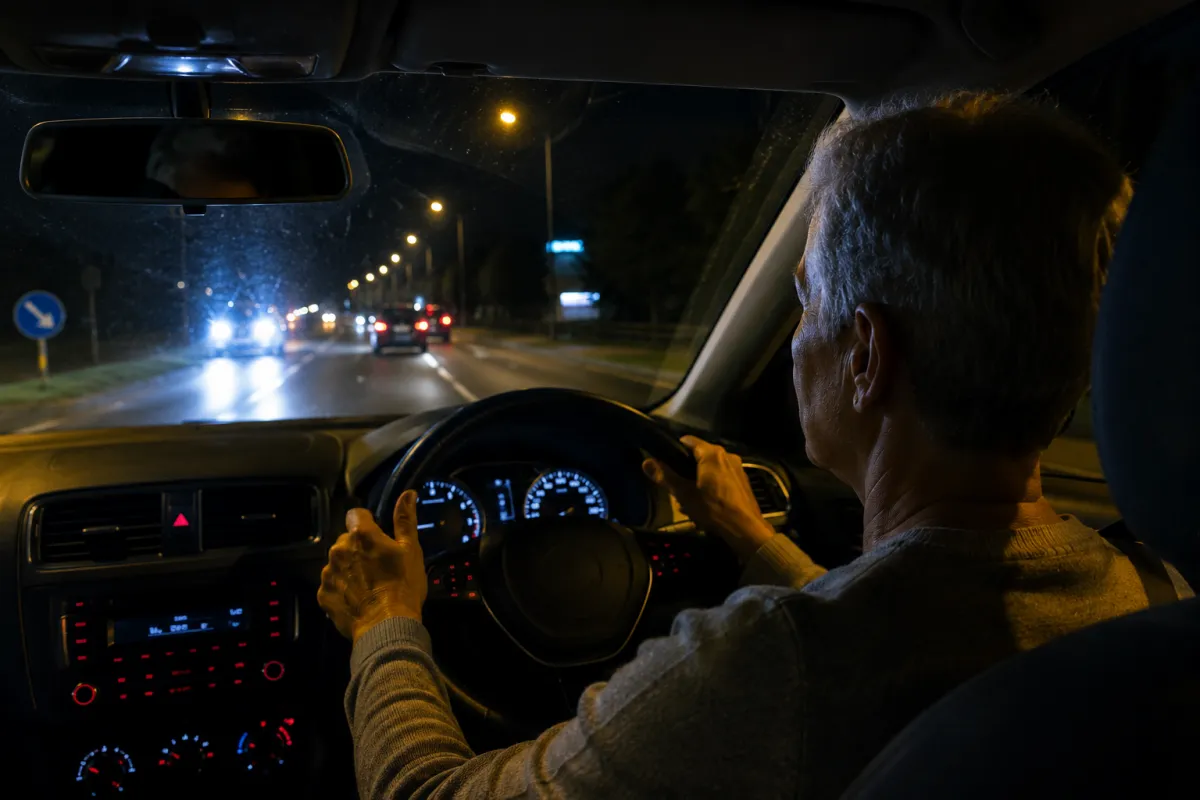
Driving at night after a stroke can feel very different from driving during the day. Darkness reduces visual information, headlights create glare, judging distance can become harder and fatigue may worsen concentration, reaction time and visual processing. Some stroke survivors are legally and medically able to drive but still find night driving uncomfortable or overwhelming. Understanding why this happens, recognising your limits and gradually rebuilding confidence can help you decide whether night driving is safe and realistic for you.
After your stroke...
You finally return to driving.
During the day, things seem reasonably comfortable.
You recognise the roads.
You can follow traffic.
You feel increasingly confident.
Then one evening...
Everything changes.
Headlights seem painfully bright.
Road markings are harder to see.
Cars appear to emerge from the darkness.
Judging how far away another vehicle is feels more difficult.
Rain makes everything worse.
You arrive home exhausted.
And you start wondering...
"Why can I drive during the day but struggle at night?"
"Has my eyesight changed?"
"Is this because of my stroke?"
"Will night driving become easier?"
"Should I even be driving at night?"
These are important questions.
Driving at night places additional demands on everyone's visual system.
After a stroke, those demands may become much more noticeable.
✦ ✦ ✦
The Good News
Difficulty driving at night does not automatically mean you will never drive comfortably again.
Some problems improve as the brain continues to recover and adapt.
Others can sometimes be managed through:
✓ Vision assessment
✓ Rehabilitation
✓ Better fatigue management
✓ Appropriate glasses
✓ Gradual driving practice
✓ Changes to when and where you drive
✓ Specialist driving assessment
However, driving is different from many other rehabilitation activities.
Safety comes first.
You should not use busy public roads as a place to experimentally discover whether you can see, react or concentrate well enough.
If you have concerns about whether stroke-related problems are affecting your driving, discuss them with an appropriate healthcare professional or driving assessment service.
In Great Britain, car and motorcycle drivers must stop driving for at least one month following a stroke and may restart only when a doctor or healthcare professional considers it safe. Ongoing problems after that period can also trigger DVLA notification requirements.
✦ ✦ ✦
Why Can Night Driving Be Harder After Stroke?
Night driving removes much of the visual information your brain normally uses.
During daylight, you can easily see:
Road edges.
Signs.
Pedestrians.
Buildings.
Other vehicles.
Junctions.
Changes in the road surface.
At night, much of this information is poorly lit.
Your brain has to extract important information from a darker and less detailed scene.
At the same time...
Bright headlights can suddenly appear against that dark background.
If your visual system is already working harder after stroke, this extra demand may become exhausting.
You may notice:
✓ Slower recognition of objects
✓ Difficulty seeing road edges
✓ Problems judging distance
✓ Increased glare
✓ Reduced confidence
✓ Difficulty following signs
✓ Visual overload
✓ Faster mental fatigue
This may happen even if a standard eyesight test seems relatively normal.
Driving involves far more than reading letters from a chart.
✦ ✦ ✦
Vision Problems After Stroke Can Affect Driving
Vision problems are common following stroke and can include visual field loss, eye movement problems, double vision and difficulties processing visual information.
Some changes are obvious.
You may know that you have double vision.
Other problems can be subtle.
You may technically see an object but take longer to notice or interpret it.
Possible stroke-related visual difficulties include:
✓ Visual field loss
✓ Double vision
✓ Blurred vision
✓ Poor eye coordination
✓ Visual inattention
✓ Reduced depth perception
✓ Difficulty scanning
✓ Sensitivity to light
✓ Visual processing difficulties
Driving exposes these problems because you must continually monitor a rapidly changing environment.
At night, you have less visual information available to compensate.
✦ ✦ ✦
Why Do Headlights Feel So Bright?
Some people become much more sensitive to bright light after stroke.
At night, the contrast can be dramatic.
The road is dark.
Then suddenly...
A vehicle approaches with powerful headlights.
Your pupils and visual system must adjust rapidly to the change in brightness.
You may experience:
✓ Glare
✓ Eye discomfort
✓ Temporary difficulty seeing the road
✓ Headaches
✓ Disorientation
✓ Visual fatigue
✓ A lingering bright image after the vehicle passes
Stroke Association information on driving specifically recognises light sensitivity as one of the visual effects that may occur after stroke.
If glare temporarily prevents you from seeing important road information, do not dismiss it as something you simply need to tolerate.
That is a safety issue.
✦ ✦ ✦
Rain Can Make Night Driving Much Worse
Night driving becomes particularly demanding in rain.
Streetlights reflect from wet roads.
Headlights scatter across the windscreen.
Road markings may become more difficult to distinguish.
Reflections appear everywhere.
You may be trying to differentiate:
Actual headlights.
Reflections.
Traffic lights.
Road markings.
Streetlights.
Signs.
Pedestrians.
All while controlling the car.
For a brain that already struggles with visual filtering, this can become overwhelming.
Some stroke survivors therefore find:
Daylight driving is manageable.
Night driving is more difficult.
Night driving in rain is extremely difficult.
There is nothing unusual about different environments producing very different levels of difficulty.
✦ ✦ ✦
Visual Field Loss and Night Driving
Visual field loss means part of what you would normally see is missing.
For example, you may lose part of the left or right side of your visual field.
After stroke, this often affects corresponding areas of vision in both eyes rather than simply affecting one eye.
During the day, you may learn to compensate by turning your head and scanning more deliberately.
At night...
Compensation may become harder.
A cyclist.
Pedestrian.
Parked vehicle.
Animal.
Or poorly lit object...
May be more difficult to detect if it appears in the affected area.
Visual field problems can have significant implications for driving eligibility, so they require proper assessment rather than self-testing on the road.
✦ ✦ ✦
What About Visual Inattention?
Visual inattention is different from simply having poor eyesight.
Your eyes may technically receive the information.
But your brain does not reliably attend to one side of the environment.
For example...
A vehicle may be present.
But you may not consciously register it quickly enough.
That creates obvious driving risks.
Stroke Association guidance notes that persistent visual inattention will usually prevent driving.
This is why feeling that your eyesight is "fine" does not necessarily answer whether your visual processing is safe for driving.
The eyes and brain work together.
Driving requires both.
✦ ✦ ✦
Can Double Vision Affect Night Driving?
Yes.
Double vision can make driving particularly difficult.
Instead of seeing one vehicle...
You may see two.
Lights can become doubled.
Road markings may appear displaced.
Judging the exact position of objects becomes harder.
This may also lead to:
✓ Headaches
✓ Eye strain
✓ Dizziness
✓ Nausea
✓ Fatigue
✓ Poor depth judgement
Driving standards relating to double vision are specific and should be discussed with the appropriate medical professional and licensing authority rather than assuming that you can simply compensate yourself. Stroke-related visual problems such as double vision are specifically recognised as potentially affecting driving.
✦ ✦ ✦
Depth Perception Matters More Than You May Realise
Depth perception helps you judge:
How far away another vehicle is.
How quickly it is approaching.
Where the edge of the road is.
How much space exists between vehicles.
When to brake.
Whether there is enough room to manoeuvre.
If depth perception has been affected by stroke, night driving may expose the problem.
Darkness reduces some of the visual cues the brain normally uses to estimate distance.
You might notice that:
Vehicles seem closer than expected.
Parking feels harder.
Junctions feel uncomfortable.
You brake earlier.
You hesitate when turning across traffic.
Do not ignore repeated difficulties judging distance.
They deserve assessment.
✦ ✦ ✦
Why Can Road Signs Be Harder to See?
Reading road signs involves more than eyesight.
Your brain must:
Notice the sign.
Focus on it.
Read the information.
Understand it.
Remember it.
Then act on it.
All while continuing to control the vehicle.
At night, signs may become harder to detect or read because of:
✓ Reduced contrast
✓ Glare
✓ Visual fatigue
✓ Slower processing
✓ Reduced attention
✓ Poor scanning
You may technically read perfectly well at home but struggle to process signs quickly while driving.
The difference is cognitive demand.
At home, you can look at a word for as long as you want.
On the road...
Information arrives continuously.
✦ ✦ ✦
Fatigue Can Make Night Driving Much Harder
This is one of the biggest issues.
Post-stroke fatigue can affect physical and mental functioning.
Perhaps you drive comfortably at 10am.
But by 8pm...
Your brain has already spent the entire day:
Walking.
Talking.
Reading.
Working.
Processing information.
Managing noise.
Making decisions.
Now you are asking it to perform one of the most cognitively demanding everyday activities.
You may notice:
✓ Slower responses
✓ Reduced concentration
✓ Increased visual problems
✓ Poorer decision-making
✓ Difficulty scanning
✓ Irritability
✓ Reduced awareness
✓ Trouble processing several things simultaneously
Do not judge your night-driving ability solely by how well you drive when rested during the daytime.
Your capacity may be very different when tired.
✦ ✦ ✦
Driving Home Can Be Harder Than Driving Out
This pattern is easy to miss.
You drive somewhere in daylight.
You feel fine.
Several hours later...
You have to drive home.
Now it is dark.
And you are tired.
Perhaps you have spent the evening:
Socialising.
Talking.
Eating.
Walking.
Listening to music.
Processing a busy environment.
By the time you get into the car, your cognitive resources may already be depleted.
This combination of:
Darkness.
Glare.
Fatigue.
And reduced concentration...
Can create a very different driving experience from the journey out.
Plan the return journey, not just the outward journey.
✦ ✦ ✦
Cognitive Changes Can Affect Driving Too
Driving is not purely a visual task.
It also requires:
✓ Attention
✓ Memory
✓ Judgement
✓ Planning
✓ Reaction speed
✓ Problem solving
✓ Decision making
✓ Awareness of several things simultaneously
Stroke can affect some of these abilities even when physical recovery appears excellent.
You might struggle with:
Following complicated junctions.
Changing lanes.
Reacting to unexpected situations.
Navigating unfamiliar roads.
Following sat-nav instructions while monitoring traffic.
These problems may become more obvious at night because more concentration is already being used to see the road.
✦ ✦ ✦
Why Familiar Roads May Feel Easier
Many people find familiar journeys easier.
You already know:
Where the junctions are.
Where lanes change.
Where you need to turn.
Where speed limits change.
Where the roundabouts are.
That reduces cognitive demand.
An unfamiliar route requires additional processing.
You must follow signs.
Use navigation.
Look for road names.
Make unexpected decisions.
If you are rebuilding confidence, familiar routes may initially feel more manageable.
But familiarity must never be used to compensate for a genuine medical or visual problem that makes driving unsafe.
Knowing the road does not make impaired vision safe.
✦ ✦ ✦
Rebuilding Confidence Gradually
If you have been medically cleared to drive and are legally permitted to do so, rebuilding confidence does not mean immediately tackling the most difficult conditions.
You might progress gradually from:
Short familiar daytime journeys.
To slightly longer journeys.
To driving around dusk.
To short familiar journeys after dark.
Then eventually...
More challenging conditions if they remain comfortable and safe.
Do not rush simply because you drove confidently before your stroke.
Your brain has experienced a neurological injury.
Allow yourself time to relearn what feels manageable.
✦ ✦ ✦
Consider a Specialist Driving Assessment
If you are uncertain about your driving ability, a specialist assessment can be extremely useful.
Driving assessment centres can look at much more than whether you can physically operate a car.
An assessment may consider areas such as:
✓ Vision
✓ Attention
✓ Reaction
✓ Physical control
✓ Decision making
✓ Road awareness
✓ Practical driving ability
Stroke Association advises that driving assessments can be useful when someone wants to understand how the effects of stroke influence their ability to drive.
An objective assessment is more reliable than repeatedly wondering:
"Am I safe?"
✦ ✦ ✦
Have Your Vision Properly Assessed
If night driving feels dramatically different after stroke, consider having your vision assessed.
Depending on your symptoms, this might involve:
✓ Optometrist assessment
✓ Orthoptic assessment
✓ Ophthalmology
✓ Visual field testing
✓ Assessment of eye movements
✓ Discussion with your stroke team
Do not assume the answer is simply stronger glasses.
Stroke-related vision problems can originate in the brain rather than the eye itself.
A standard sight test may therefore not explain every difficulty.
✦ ✦ ✦
Keep the Windscreen and Glasses Clean
This sounds almost too simple.
But glare becomes worse when light scatters across:
A dirty windscreen.
Smears.
Condensation.
Scratched lenses.
Dirty glasses.
Keep:
✓ The windscreen clean inside and outside
✓ Mirrors clean
✓ Glasses clean
✓ Lights working correctly
✓ Wiper blades in good condition
These measures will not cure neurological visual problems.
But there is no reason to add avoidable visual interference to an already demanding task.
✦ ✦ ✦
Do Not Wear Dark Sunglasses at Night
If headlights feel painfully bright, wearing dark sunglasses may sound logical.
But sunglasses reduce the amount of light reaching your eyes.
At night, that can make pedestrians, cyclists, road edges and other hazards even harder to see.
Do not improvise solutions that make the environment darker.
If glare is severe, get professional advice about the cause and whether your vision is suitable for night driving.
Reducing discomfort is not useful if it reduces safety.
✦ ✦ ✦
Do Not Drive Because Other People Expect You To
Driving represents independence.
That makes giving it up, even temporarily, emotionally difficult.
You may feel pressure because:
Your family expects you to drive.
Your job requires it.
Public transport is inconvenient.
You hate relying on other people.
But none of these things changes whether driving is safe.
Driving is one area where determination cannot compensate for a serious deficit.
You cannot "push through" poor visual awareness.
You cannot motivate yourself out of double vision.
You cannot force an exhausted brain to react normally.
Be ambitious with rehabilitation.
Be conservative with road safety.
✦ ✦ ✦
Know the UK Driving Rules After Stroke
If you live in Great Britain and hold a car or motorcycle licence, current DVLA guidance says you must stop driving for at least one month after a stroke.
You can restart only when a doctor or healthcare professional says it is safe.
If certain problems remain after one month — including some visual, cognitive, movement or seizure-related problems — you may need to notify DVLA. Different rules apply to bus, coach and lorry licences.
The rules can depend on:
✓ The type of licence you hold
✓ The effects of your stroke
✓ Whether problems persist
✓ Whether seizures occurred
✓ Your vision
✓ Other medical complications
Do not rely on what another stroke survivor was told.
Check the rules applying to you.
✦ ✦ ✦
Emotional Impact
Difficulty driving at night can feel like another loss of independence.
You may feel:
✓ Frustrated
✓ Embarrassed
✓ Dependent
✓ Nervous
✓ Angry
✓ Less confident
✓ Restricted
You may begin avoiding:
Evening events.
Restaurants.
Visiting friends.
Winter journeys.
Social activities.
That can affect quality of life.
But there is an important distinction between:
Choosing not to drive at night because you are frightened despite being safe.
And choosing not to drive because your vision or processing makes it unsafe.
The first may respond to gradual confidence-building.
The second requires appropriate medical or driving assessment.
Knowing which one applies matters.
✦ ✦ ✦
My Perspective
Driving after stroke carries enormous emotional weight because it represents freedom.
Getting behind the wheel again can feel like reclaiming a piece of your old life.
But night driving can reveal difficulties that daylight driving hides.
The dark road.
Bright headlights.
Rain.
Fast-moving traffic.
Road signs.
Pedestrians.
Navigation.
Fatigue.
Your brain has to process all of it simultaneously.
If that suddenly feels harder after stroke, do not dismiss it.
But do not immediately assume your driving days are over either.
Find out what the actual problem is.
Get your vision checked.
Understand whether fatigue is contributing.
Consider a driving assessment.
Practise gradually if you have been cleared to drive.
And be willing to say:
"I can drive safely during the day, but I am not comfortable driving at night."
That is not failure.
Independence is valuable.
But independence without safety is not independence.
It is risk.
✦ ✦ ✦
When Should You Stop and Seek Advice?
Do not continue driving and simply hope symptoms improve if you experience significant problems while behind the wheel.
Seek professional advice if you notice:
✓ New double vision
✓ Significant blurred vision
✓ Missing areas of vision
✓ Difficulty noticing vehicles or pedestrians
✓ Severe glare
✓ Repeated problems judging distances
✓ Becoming confused on familiar roads
✓ Significant concentration problems
✓ Episodes of altered awareness
✓ New seizures
✓ New or worsening neurological symptoms
Any sudden new neurological symptoms, including sudden weakness, speech difficulty or sudden loss or blurring of vision, should be treated as a possible stroke emergency rather than as a driving problem. NHS guidance advises calling 999 for suspected stroke symptoms.
✦ ✦ ✦
Frequently Asked Questions
Why Can I Drive in Daylight but Struggle at Night After Stroke?
Night driving provides less visual information while exposing you to glare and rapidly changing light levels.
Stroke-related vision, processing and fatigue problems may therefore become more noticeable.
Can Stroke Cause Sensitivity to Headlights?
Yes.
Light sensitivity can occur after stroke and may make headlights and other bright lights more uncomfortable.
Does Struggling at Night Mean I Should Stop Driving Completely?
Not necessarily.
But you should not ignore symptoms.
Your vision, cognition and overall driving ability may need assessment.
Some people may ultimately drive safely in certain conditions while avoiding others.
Can Fatigue Make My Driving Worse?
Yes.
Mental and physical fatigue can affect concentration and your ability to process information efficiently.
If you know that fatigue substantially affects your stroke symptoms, consider this seriously when deciding whether to drive.
Should I Get My Eyes Tested?
Yes, particularly if you notice new or persistent visual difficulties.
Because some stroke-related vision problems involve the brain's processing of visual information, you may need more than a routine sight test.
Can Visual Field Loss Affect My Driving Licence?
Yes.
Visual field requirements form part of medical fitness-to-drive standards, and significant stroke-related field loss can affect whether you are permitted to drive.
Will Night Driving Get Easier?
It may.
Some problems improve through recovery, rehabilitation, better fatigue management and increasing experience.
However, improvement should never simply be assumed where safety is concerned.
✦ ✦ ✦
Key Takeaways
✓ Driving at night places greater demands on the visual system.
✓ Stroke-related visual difficulties may become more noticeable in darkness.
✓ Headlight glare and light sensitivity can make night driving uncomfortable.
✓ Visual field loss, double vision and visual inattention can have important driving implications.
✓ Fatigue may make evening driving substantially harder than daytime driving.
✓ Rain and wet roads can increase visual complexity and glare.
✓ Familiar roads may reduce cognitive demand but cannot compensate for unsafe vision.
✓ A specialist driving assessment can provide objective information about your ability.
✓ Have significant vision problems properly assessed rather than attempting to compensate yourself.
✓ In Great Britain, specific DVLA rules apply to driving after stroke.
✓ Being medically cleared to drive does not mean you have to drive at night if you do not feel comfortable doing so.
✓ Safety matters more than proving that you can still drive.
✦ ✦ ✦
Related Articles
Continue learning about driving and vision after stroke:
Driving After a Stroke
Getting Your Driving Licence Back After Stroke
Fear of Driving After Stroke
Vision Problems After Stroke
Visual Field Loss After Stroke
Double Vision After Stroke
Depth Perception Problems After Stroke
Light Sensitivity After Stroke
Visual Processing Problems After Stroke
Fatigue After Stroke
✦ ✦ ✦
About the Author
Alisia Gayle is a stroke survivor who achieved 96% neurological recovery following an ischaemic stroke.
After years of rehabilitation, she now shares practical, evidence-informed resources to help stroke survivors, carers and families better understand recovery and rebuild their lives with confidence.
Alisia is also the author of Brain Damage: My Journey to 96% Recovery, where she shares her personal stroke recovery story and the lessons she learned throughout her rehabilitation.
✦ ✦ ✦
Medical Disclaimer
This article is intended for educational purposes only and should not replace professional medical advice, diagnosis, rehabilitation guidance, vision assessment or official driving guidance.
Every stroke and every recovery is different.
Always seek advice from your doctor, stroke rehabilitation team, optometrist, orthoptist, ophthalmologist or another appropriate healthcare professional if you are concerned about your ability to drive after stroke.
Driving and licensing rules vary by country and by licence type. If you live in Great Britain, check the current DVLA requirements that apply to your circumstances before returning to driving.
✦ ✦ ✦
Final Thoughts
Driving at night after stroke...
Can feel completely different from driving during the day.
The road becomes darker.
Headlights become brighter.
Distances become harder to judge.
And a tired brain may struggle to process everything quickly enough.
Do not ignore those changes.
But do not immediately assume they mean permanent loss of independence either.
Find out what is causing the difficulty.
Have your vision assessed.
Understand your fatigue.
Get professional advice when needed.
Use a specialist driving assessment if there is uncertainty.
And if you are cleared to drive...
Rebuild confidence gradually.
You do not have to prove anything by driving in the most difficult conditions.
Perhaps you drive during daylight.
Perhaps you avoid rain at night.
Perhaps you eventually become comfortable driving after dark again.
What matters is not whether your driving looks exactly like it did before your stroke.
What matters is whether it is safe.
Because getting your independence back is important.
But getting home safely is more important.