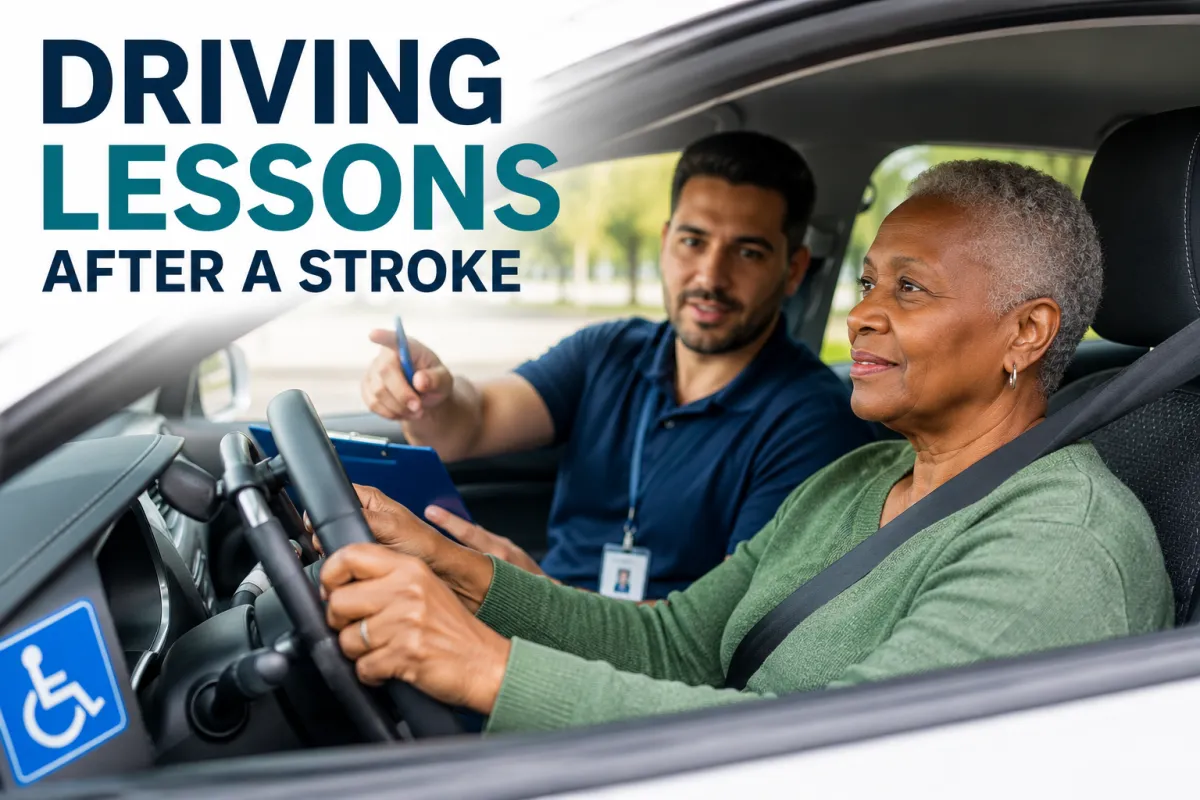
Driving lessons after a stroke can help you rebuild confidence, identify difficulties that are not obvious in everyday life and determine whether you can return to driving safely. A stroke may affect vision, concentration, reaction time, coordination, judgement, movement and fatigue, even when you otherwise appear to have recovered well. For some survivors, a few refresher lessons are enough. Others may benefit from a specialist driving assessment, vehicle adaptations or more rehabilitation before returning to the road.
After your stroke...
You may have worked hard to regain your independence.
Walking again.
Going shopping.
Returning to work.
Managing appointments.
Travelling independently.
And eventually...
You start thinking about driving.
Perhaps you drove every day before your stroke.
Maybe driving was how you got to work.
Picked up your children.
Visited friends.
Went shopping.
Or simply escaped the house whenever you wanted.
Then suddenly...
Your keys are sitting somewhere untouched.
You begin wondering...
"Will I still know how to drive?"
"Will my reactions be fast enough?"
"What if my affected leg does not respond properly?"
"Can I take driving lessons before driving alone?"
"What if I have lost confidence?"
"Will an instructor understand stroke?"
These are reasonable concerns.
Driving after stroke is not simply about remembering how to operate a car.
It requires your brain and body to perform many tasks simultaneously.
That is why returning gradually and getting professional support can sometimes be extremely useful.
✦ ✦ ✦
The Good News
Having a stroke does not automatically mean you will never drive again.
Many people do return to driving.
However, returning depends on the type of stroke, any remaining impairments and whether you meet the legal and medical standards for driving.
In Great Britain, car and motorcycle drivers must stop driving for at least one month after a stroke. Driving can resume after that minimum period only when a doctor or healthcare professional considers it safe.
If stroke-related problems remain after one month, such as weakness, visual difficulties, memory problems, balance problems or seizures, you may need to notify the DVLA and must follow its decision before returning to driving.
For many people, the route back to driving may involve:
✓ Medical clearance
✓ Vision checks
✓ A specialist driving assessment
✓ Refresher driving lessons
✓ Vehicle adaptations
✓ Gradually rebuilding confidence
The important thing is not simply getting back behind the wheel.
It is getting back behind the wheel safely.
✦ ✦ ✦
Why Can Driving Feel Different After a Stroke?
Driving is an incredibly demanding neurological activity.
Your brain must continuously:
✓ Scan the road
✓ Monitor mirrors
✓ Judge distance
✓ Track moving vehicles
✓ Recognise hazards
✓ Process road signs
✓ Control steering
✓ Operate pedals
✓ Make rapid decisions
✓ Ignore irrelevant information
✓ Maintain attention
✓ React unexpectedly
Before your stroke, you probably did most of this automatically.
After stroke, one or several parts of that system may work differently.
Stroke can affect movement, vision, concentration, memory, perception and other cognitive abilities that are important for safe driving.
This means that being able to walk normally or speak clearly does not necessarily tell you everything about your ability to drive.
Driving places much greater demands on the brain.
✦ ✦ ✦
Why Might Driving Lessons Help?
You may technically know how to drive perfectly well.
The issue is not necessarily that you have forgotten.
You may simply need to discover how your current abilities perform in real traffic.
A qualified instructor can observe things that are difficult to judge yourself.
For example:
✓ Are you checking mirrors consistently?
✓ Are you judging distances accurately?
✓ Are your reactions appropriate?
✓ Are you missing hazards?
✓ Are you positioning the vehicle correctly?
✓ Are you struggling with busy junctions?
✓ Does fatigue affect performance?
✓ Are you hesitating excessively?
✓ Are you overconfident?
Lessons can therefore provide something important:
Objective feedback.
You may discover that your driving ability is much better than you feared.
Or the lessons may identify specific areas that need more work.
Both outcomes are valuable.
✦ ✦ ✦
Refresher Lessons Are Not the Same as Learning From Scratch
If you were an experienced driver before your stroke, you probably do not need somebody to teach you what a steering wheel does.
Your lessons may instead focus on:
✓ Rebuilding confidence
✓ Testing reaction times in real conditions
✓ Becoming comfortable in traffic again
✓ Practising junctions
✓ Driving at different speeds
✓ Parking
✓ Roundabouts
✓ Motorway or dual-carriageway driving
✓ Managing distractions
You may start somewhere quiet.
Then gradually progress.
Residential roads.
Busier streets.
Roundabouts.
Higher-speed roads.
This gradual exposure can be much more useful than immediately taking your own car onto a busy road after months away from driving.
✦ ✦ ✦
Consider a Specialist Driving Assessment
For some stroke survivors, ordinary driving lessons may not be enough.
A specialist driving assessment may be more appropriate.
The Stroke Association advises that people returning to driving may benefit from specialist mobility or driving assessment services, particularly where there are concerns about physical, visual or cognitive effects of stroke.
These assessments can look at much more than basic driving technique.
They may assess:
✓ Vision
✓ Reaction times
✓ Attention
✓ Decision making
✓ Coordination
✓ Physical ability
✓ Road awareness
✓ Practical driving
They can also identify whether vehicle adaptations could help.
This can provide a much clearer answer than simply asking:
"Do I feel ready?"
✦ ✦ ✦
Physical Weakness and Driving
Stroke may leave weakness in an arm or leg.
This does not necessarily prevent driving.
DVLA guidance recognises that arm or leg disability after stroke may sometimes be accommodated through the type of vehicle driven or through suitable adaptations.
Possible difficulties include:
✓ Pressing pedals reliably
✓ Moving between accelerator and brake
✓ Steering
✓ Operating indicators
✓ Changing gears
✓ Using the handbrake
✓ Turning to look behind you
Depending on the impairment, possible solutions might include:
✓ An automatic vehicle
✓ Hand controls
✓ Steering aids
✓ Left-foot accelerator adaptations
✓ Other specialist equipment
Adaptations should be professionally assessed and fitted.
Do not improvise your own solution simply because it appears to work.
✦ ✦ ✦
What If Your Leg Was Affected?
Leg weakness deserves particular attention.
You may be perfectly capable of walking but still have difficulty moving rapidly between pedals.
Driving sometimes requires:
Immediate braking.
Controlled pressure.
Repeated ankle movements.
Fast responses.
If your right leg was affected, an assessor may want to see whether:
✓ You can move quickly between pedals
✓ You can brake firmly
✓ Your ankle has sufficient control
✓ Fatigue affects movement
✓ Spasticity or weakness interferes with pedal use
Do not judge this only by sitting in a stationary car.
Road situations are different.
A professional assessment can determine whether normal pedal operation is appropriate or whether adaptations should be considered.
✦ ✦ ✦
What If Your Arm or Hand Was Affected?
You need reliable control of the steering wheel and other vehicle controls.
Residual weakness, reduced sensation or poor coordination may make this more difficult.
You may notice:
✓ Difficulty turning the wheel quickly
✓ Reduced grip
✓ Tremor
✓ Slower movement
✓ Difficulty operating indicators
✓ Problems using secondary controls
Again, mild impairment does not automatically rule out driving.
But it needs to be assessed in terms of actual driving safety.
A specialist instructor or assessment centre may be able to recommend adaptations if required.
✦ ✦ ✦
Vision Problems After Stroke
Vision can be one of the most important issues affecting driving.
Stroke may cause:
✓ Visual field loss
✓ Double vision
✓ Eye movement problems
✓ Reduced visual attention
✓ Difficulty scanning
✓ Problems judging distance
✓ Visual processing difficulties
Visual problems may not always be obvious to the survivor.
You may feel that your eyesight is fine because you can read or watch television.
Driving is different.
You need to detect information across a wide field while simultaneously processing movement and speed.
DVLA rules require drivers to meet specific visual standards, and persistent visual problems after stroke may require notification and further assessment.
If you have any uncertainty about your vision, seek professional assessment before driving.
✦ ✦ ✦
Visual Neglect Can Be Particularly Important
Some people develop visual neglect after stroke.
This is not exactly the same as losing vision.
Instead, the brain may fail to pay adequate attention to information on one side.
You might:
Miss objects.
Fail to notice people approaching.
Bump into things.
Ignore part of a plate while eating.
Driving with significant neglect could obviously be extremely dangerous.
Someone may believe they are looking properly while their brain is failing to process information on one side.
This is one reason self-assessment alone is not always reliable after neurological injury.
An occupational therapist or specialist driving assessment may help identify these kinds of problems.
✦ ✦ ✦
Reaction Time After Stroke
Driving sometimes gives you only seconds to respond.
A pedestrian steps into the road.
A vehicle brakes suddenly.
A cyclist appears beside you.
Traffic lights change.
Reaction time involves much more than moving your foot.
Your brain must:
See the hazard.
Recognise its significance.
Choose the correct response.
Send the instruction to your body.
Then perform the movement.
A stroke can potentially affect any part of this process.
Driving lessons or specialist assessment can help determine whether your reactions remain appropriate under real-world conditions.
✦ ✦ ✦
Concentration and Attention
You may concentrate perfectly well during a conversation.
But driving requires sustained attention.
Sometimes for hours.
You must remain alert even when nothing particularly interesting is happening.
Stroke-related cognitive changes can affect the ability to maintain attention, divide attention between tasks or switch rapidly between different sources of information.
You might manage a quiet road well but become overwhelmed when:
✓ Traffic becomes heavy
✓ Several vehicles move simultaneously
✓ Someone speaks to you
✓ A satnav gives instructions
✓ Pedestrians appear
✓ You need to navigate an unfamiliar area
This is why assessment in different driving environments can be useful.
✦ ✦ ✦
Post-Stroke Fatigue and Driving
Fatigue is particularly important because safe driving depends on continuous attention.
The Stroke Association warns that fatigue after stroke may make it difficult to remain focused or awake while driving.
You may drive very well for twenty minutes.
Then your performance begins deteriorating.
Possible warning signs include:
✓ Reduced concentration
✓ Missing road signs
✓ Slower reactions
✓ Irritability
✓ Heavy eyes
✓ Difficulty processing traffic
✓ Headaches
✓ Feeling mentally overloaded
Do not use driving as a way of testing how tired you can become.
If fatigue affects your concentration, discuss this with your healthcare professional.
And when you eventually resume driving, begin with manageable journeys rather than immediately attempting several hours on the motorway.
✦ ✦ ✦
What If You Have Lost Confidence?
Sometimes your physical and cognitive abilities have recovered well but your confidence has not.
That is extremely understandable.
You know what happened to your brain.
You may be frightened that something will suddenly go wrong.
A driving lesson provides a controlled way to challenge that fear.
You have another person beside you.
You are not immediately responsible for completing a long journey.
You can begin somewhere quiet.
Perhaps the first lesson simply involves:
Getting comfortable in the vehicle.
Driving slowly.
Practising braking.
Driving around familiar roads.
Then gradually progressing.
Confidence is more likely to return through successful experience than through repeatedly wondering whether you are ready.
✦ ✦ ✦
Do Not Confuse Anxiety With Inability
Feeling nervous does not necessarily mean you are unsafe.
You may sit behind the wheel for the first time and feel extremely uncomfortable.
That is not surprising.
You may not have driven for months.
Your last memories before stopping may be connected to illness and loss of independence.
Give yourself time.
On the other hand, do not dismiss genuine difficulties as "just nerves."
If you repeatedly:
Miss hazards.
Drift position.
Confuse pedals.
Fail to notice traffic.
Become disoriented.
Or cannot process busy situations...
That requires professional attention.
The goal is not to prove that you can drive.
The goal is to determine whether you can drive safely.
✦ ✦ ✦
Start Somewhere Quiet
When you are legally and medically permitted to begin practical driving again, it usually makes sense to start with easier conditions.
For example:
✓ Daylight
✓ Good weather
✓ Familiar roads
✓ Quiet traffic
✓ Short journeys
✓ No distracting passengers
Then progress gradually.
You might later introduce:
✓ Busier traffic
✓ Larger junctions
✓ Roundabouts
✓ Unfamiliar routes
✓ Higher-speed roads
✓ Night driving
Do not make your first drive after stroke a two-hour motorway journey in heavy rain.
That is unnecessary.
Build complexity gradually.
✦ ✦ ✦
Should a Family Member Teach You?
A supportive family member can sometimes help you practise once you are legally permitted to drive and insured appropriately.
But family members are not always the best judges.
They may be:
Too nervous.
Too reassuring.
Too critical.
Emotionally invested.
A professional instructor provides independent feedback.
That matters.
If your partner says:
"You seem fine."
You may still wonder whether they are simply trying to encourage you.
If a specialist instructor objectively evaluates your driving and identifies no major concerns, that can carry much more weight psychologically.
✦ ✦ ✦
Driving an Automatic After Stroke
Some survivors find that an automatic car reduces the physical and cognitive demands of driving.
You no longer need to repeatedly operate:
The clutch.
The gear lever.
Complex gear changes.
For somebody with weakness or reduced coordination, this may make driving easier.
DVLA guidance specifically notes that difficulties affecting the limbs may sometimes be overcome by driving an automatic vehicle or using suitable adaptations.
However, switching to an automatic does not solve difficulties involving:
Vision.
Attention.
Judgement.
Reaction time.
Processing.
You still need to meet the overall standard for safe driving.
✦ ✦ ✦
Tell Your Insurance Company
Do not focus only on the DVLA.
Your motor insurer also matters.
The Stroke Association advises people returning to driving after stroke to inform their insurance company about their stroke and any relevant changes.
Failing to provide information required under your policy could create problems with cover.
Ask your insurer directly what information they require.
Do not assume that because you have a valid licence your insurer automatically has everything it needs.
✦ ✦ ✦
When Should You Delay Driving Lessons?
Driving lessons are not appropriate simply because you are eager to get back on the road.
It may be better to delay if you still have significant:
✓ Vision problems
✓ Severe fatigue
✓ Poor concentration
✓ Confusion
✓ Uncontrolled seizures
✓ Significant weakness
✓ Poor coordination
✓ Severe dizziness
✓ Problems understanding road situations
✓ Advice from a healthcare professional not to drive
Your legal position must also be clear before you undertake on-road driving.
In Great Britain, the minimum one-month driving restriction after stroke is only the starting point. Persistent impairments may require DVLA notification and a longer period away from driving.
Do not treat the one-month point as automatic permission.
✦ ✦ ✦
What If the Assessment Says You Are Not Ready?
That can be extremely disappointing.
Driving represents independence.
Being told:
"Not yet."
May feel like another thing the stroke has taken away.
But an assessment identifying a problem is useful information.
Perhaps you need:
More rehabilitation.
Vision therapy.
Strengthening.
More time.
Vehicle adaptations.
Cognitive rehabilitation.
Or another assessment later.
"Not ready today" does not necessarily mean:
"Never again."
Use the result as information about what needs improving.
✦ ✦ ✦
What If You Cannot Return to Driving?
For some survivors, the effects of stroke mean driving is no longer safe.
That can be a major emotional adjustment.
You may feel:
✓ Angry
✓ Dependent
✓ Trapped
✓ Embarrassed
✓ Frustrated
✓ Grief for your previous independence
Those reactions are understandable.
But driving is ultimately a safety-critical activity.
The consequences of driving when medically unsafe do not affect only you.
They affect:
Passengers.
Pedestrians.
Cyclists.
Other drivers.
If driving is no longer possible, rehabilitation may need to focus on alternative ways of maintaining independence.
That might include public transport, taxis, community transport, lifts, mobility services or restructuring daily routines.
Losing the ability to drive does not mean losing the ability to build an independent life.
✦ ✦ ✦
My Perspective
Driving after stroke is one of those areas where confidence and competence need to be separated.
You can feel terrified and still be a perfectly safe driver.
You can also feel completely confident and have problems you do not recognise.
That is why objective assessment matters.
A driving lesson is not an admission that you have forgotten how to drive.
Think of it as testing the system.
Your eyes.
Your attention.
Your hands.
Your feet.
Your reactions.
Your judgement.
Your ability to manage several things simultaneously.
If everything works well...
Excellent.
You gain evidence that you can move forward.
If something does not work well...
Even better that you discovered it with an instructor or specialist assessor rather than during an emergency on the road.
Independence matters.
But safety matters more.
The goal is not simply getting your licence back or getting behind the wheel as quickly as possible.
The goal is reaching the point where driving becomes ordinary again.
Not frightening.
Not reckless.
Just safe.
✦ ✦ ✦
When Should You Seek Medical Advice?
Speak with your doctor, stroke team, occupational therapist or another appropriate healthcare professional before returning to driving if you have concerns about:
✓ Vision
✓ Weakness
✓ Coordination
✓ Cognitive difficulties
✓ Concentration
✓ Memory
✓ Seizures
✓ Dizziness
✓ Severe fatigue
✓ Medication side effects
In Great Britain, you must stop driving for at least one month after a stroke and should only resume when a doctor or healthcare professional considers it safe. Persistent stroke-related problems may also need to be reported to the DVLA.
If you develop new neurological symptoms, seek urgent medical attention.
Do not continue driving and wait to see whether they disappear.
✦ ✦ ✦
Frequently Asked Questions
Can I Take Driving Lessons After a Stroke?
Potentially, yes, once you are legally permitted and medically considered safe to undertake on-road driving.
Some people use refresher lessons, while others benefit from specialist driving assessment services.
How Long After a Stroke Can I Drive?
For car and motorcycle licences in Great Britain, you must stop driving for at least one month after a stroke. You can only restart when a doctor or healthcare professional says it is safe.
Different rules apply in some circumstances and to bus and lorry licences.
Do I Have to Tell the DVLA?
Not every car or motorcycle driver automatically needs to notify the DVLA after a stroke.
However, DVLA notification is required in certain circumstances, including where specified stroke-related problems remain after one month.
Check the current DVLA rules for your individual situation.
Should I Have a Driving Assessment?
If you have residual physical, visual or cognitive difficulties, uncertainty about your driving ability, or have been advised to obtain one, a specialist assessment can be extremely useful.
Can I Drive an Automatic If My Leg or Arm Is Weak?
Possibly.
An automatic vehicle or specialist adaptations may make driving possible for some people with limb impairment.
This should be professionally assessed.
Can Stroke Fatigue Affect Driving?
Yes.
Fatigue may affect your ability to remain alert and focused while driving.
Do not drive when fatigue makes concentration unreliable.
What If I Am Too Nervous to Drive?
Start gradually once you are legally and medically cleared.
Professional refresher lessons in quiet conditions can help rebuild confidence without immediately placing you in highly demanding traffic.
✦ ✦ ✦
Key Takeaways
✓ A stroke does not automatically mean you will never drive again.
✓ In Great Britain, car and motorcycle drivers must stop driving for at least one month after stroke.
✓ You should only return when medically and legally permitted.
✓ Driving requires vision, attention, judgement, coordination and rapid reactions.
✓ Refresher lessons can help rebuild confidence and provide objective feedback.
✓ Specialist driving assessments may be particularly useful where impairments remain.
✓ Limb weakness may sometimes be accommodated with automatic vehicles or adaptations.
✓ Vision problems, neglect, cognitive changes and fatigue can all affect driving safety.
✓ Do not treat confidence as proof that you are safe to drive.
✓ The goal is not simply returning to driving. It is returning safely.
✦ ✦ ✦
Related Articles
Continue learning about independence and recovery after stroke:
Driving After a Stroke
Getting Your Driving Licence Back After Stroke
Vision Problems and Driving After Stroke
Reaction Time After Stroke
Fatigue After Stroke
Confidence After Stroke
Returning to Work After Stroke
Travelling Independently After Stroke
Balance Problems After Stroke
Cognitive Problems After Stroke
✦ ✦ ✦
About the Author
Alisia Gayle is a stroke survivor who achieved 96% neurological recovery following an ischaemic stroke.
After years of rehabilitation, she now shares practical, evidence-informed resources to help stroke survivors, carers and families better understand recovery and rebuild their lives with confidence.
Alisia is also the author of Brain Damage: My Journey to 96% Recovery, where she shares her personal stroke recovery story and the lessons she learned throughout her rehabilitation.
✦ ✦ ✦
Medical Disclaimer
This article is intended for educational purposes only and should not replace professional medical advice, diagnosis, rehabilitation guidance, legal advice or official driving guidance.
Driving laws and medical standards vary between countries and can change.
The legal information in this article refers primarily to Great Britain and current DVLA guidance. Northern Ireland uses the DVA and may have different procedures.
Always check the latest official driving rules and speak with your doctor, stroke team, occupational therapist or another appropriate healthcare professional before returning to driving after stroke.
Never drive if you have been advised that you are medically unfit to do so.
✦ ✦ ✦
Final Thoughts
Driving lessons after a stroke...
Can feel like another reminder of everything that happened.
You may have driven for twenty years.
Thirty years.
Perhaps longer.
And suddenly you are sitting beside an instructor again.
That can feel strange.
But there is another way to see it.
You are testing your recovery.
Safely.
You are discovering what your brain and body can do now.
Perhaps you start on a quiet road.
Then a junction.
A roundabout.
A busier route.
Eventually...
You realise you are no longer concentrating on every movement.
Driving starts becoming automatic again.
For some people, that process happens quickly.
For others, it takes time.
And for some, the assessment identifies difficulties that need further rehabilitation or adaptation.
All of those outcomes provide useful information.
Do not rush.
Get the right medical advice.
Follow the legal requirements.
Use professional assessment when you need it.
And rebuild gradually.
Because getting back behind the wheel after stroke can represent something much bigger than driving.
It can represent another piece of independence returning.