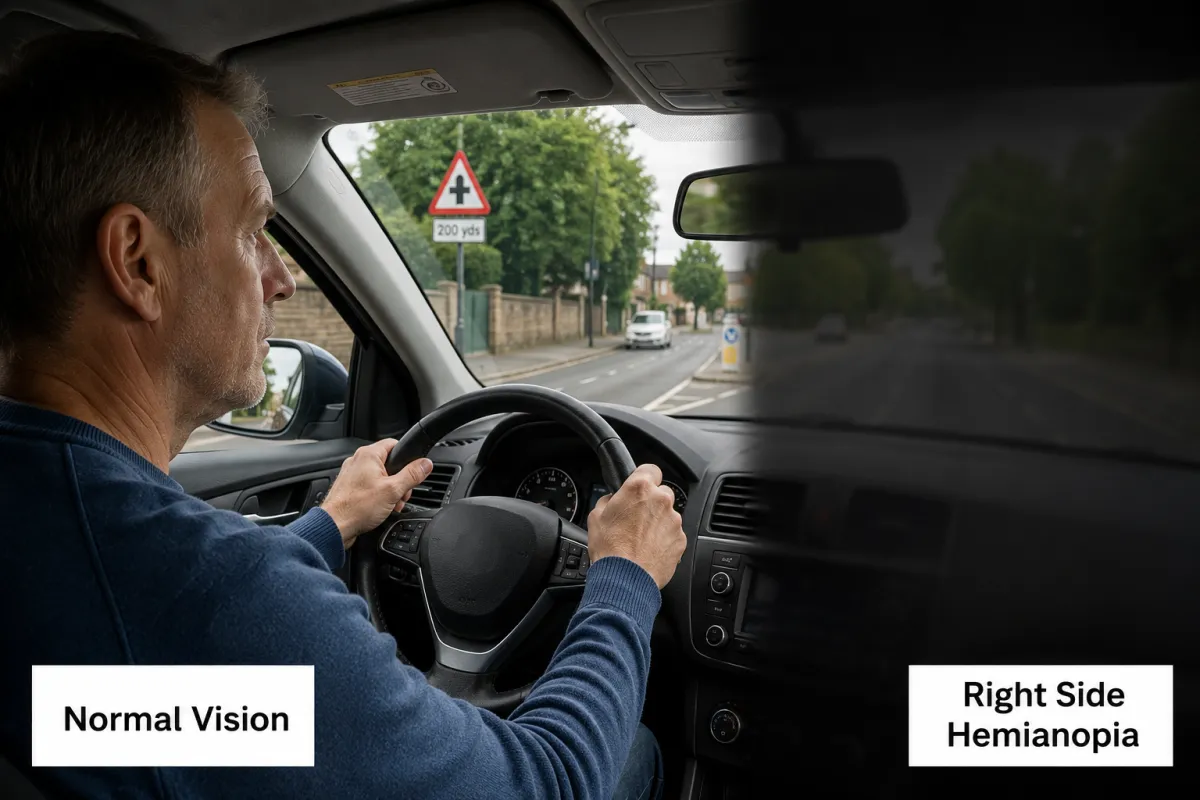
Driving with hemianopia after a stroke can be one of the most challenging issues stroke survivors face. Hemianopia causes loss of vision on one side of your visual field, making it difficult to detect hazards, pedestrians and vehicles approaching from the affected side. Many people worry that losing part of their vision automatically means they will never drive again. Learn how hemianopia affects driving, what assessments may be required and what options may be available.
After your stroke...
You begin recovering physically.
You start thinking about returning to normal life.
Then you notice something strange.
People seem to appear out of nowhere.
You bump into doorframes.
Food remains on one side of your plate.
You realise that part of your vision is missing.
And then another thought appears...
"What about driving?"
"Will I ever be allowed to drive again?"
These fears are completely understandable.
✦ ✦ ✦
The Good News
A diagnosis of hemianopia does not automatically mean that life is over.
However, driving with significant visual field loss can be complex and is subject to strict regulations.
Some people may not be able to return to driving.
Others may undergo specialist assessments to determine whether driving remains safe.
Understanding your condition and seeking appropriate advice is the first step.
✦ ✦ ✦
What Is Hemianopia?
Hemianopia is the loss of half of the visual field in one or both eyes.
Following a stroke, you may lose vision on:
✓ The left side.
✓ The right side.
✓ Part of the upper visual field.
✓ Part of the lower visual field.
The eyes themselves may be completely healthy.
The problem usually occurs because the stroke has damaged visual pathways in the brain.
✦ ✦ ✦
How Does Hemianopia Affect Driving?
Driving relies heavily on visual awareness.
Hemianopia may make it difficult to:
✓ Detect cars approaching from one side.
✓ Notice pedestrians.
✓ See cyclists.
✓ Read road signs quickly.
✓ Detect hazards at junctions.
✓ Judge traffic situations safely.
Because driving environments change rapidly, even small visual deficits can have significant consequences.
✦ ✦ ✦
Symptoms You May Notice
Before driving is even considered, many people notice difficulties such as:
✓ Bumping into objects.
✓ Missing items on one side of the table.
✓ Difficulty reading.
✓ Becoming startled by people approaching.
✓ Difficulty navigating crowded places.
These symptoms may suggest that driving could also be affected.
✦ ✦ ✦
Can Hemianopia Improve?
Sometimes.
Visual recovery may occur during the weeks and months after a stroke.
Improvements vary considerably.
Some people experience:
✓ Partial recovery.
✓ Better visual scanning.
✓ Improved awareness of the missing side.
Others may continue to have permanent visual field loss.
✦ ✦ ✦
Compensation Strategies
Some people learn to compensate by:
✓ Turning their head more frequently.
✓ Scanning more actively.
✓ Moving their eyes towards the affected side.
✓ Increasing awareness of their surroundings.
These strategies may improve daily function.
However, compensation in everyday life does not automatically mean driving is safe.
✦ ✦ ✦
Driving Regulations
Visual field standards for driving are strict because of the importance of public safety.
In many countries, including the UK, you are legally required to notify the appropriate driving authority about visual problems following a stroke.
Driving should not resume until you have received appropriate medical advice and clearance.
✦ ✦ ✦
Driving Assessments
Some people may undergo specialist driving assessments.
These assessments may include:
✓ Visual field testing.
✓ Cognitive testing.
✓ Reaction time assessments.
✓ On-road driving assessments.
✓ Assessment of compensatory strategies.
The purpose is to determine whether driving can be carried out safely.
✦ ✦ ✦
Why Some People Cannot Return to Driving
This can be emotionally difficult to hear.
However, significant visual field loss may increase the risk of:
✓ Missing hazards.
✓ Delayed reactions.
✓ Collisions.
✓ Reduced situational awareness.
For some individuals, driving may no longer be considered safe.
This does not reflect intelligence or effort.
It is simply about ensuring safety for everyone on the road.
✦ ✦ ✦
Emotional Impact of Losing Driving
Losing the ability to drive can feel devastating.
You may grieve the loss of:
✓ Independence.
✓ Freedom.
✓ Employment opportunities.
✓ Social activities.
✓ Confidence.
These feelings are completely understandable.
Many stroke survivors describe this as one of the hardest aspects of recovery.
✦ ✦ ✦
Adapting to Life Without Driving
If driving is no longer possible, support may include:
✓ Public transport training.
✓ Community transport services.
✓ Taxi schemes.
✓ Support from family and friends.
✓ Exploring alternative ways to maintain independence.
Although adjustment takes time, many people gradually rebuild confidence and routines.
✦ ✦ ✦
Rehabilitation Can Still Help
Even if driving does not become possible, rehabilitation may improve:
✓ Reading.
✓ Walking safety.
✓ Confidence outdoors.
✓ Visual scanning.
✓ Daily activities.
Recovery remains important regardless of driving outcomes.
✦ ✦ ✦
Tips for Family and Carers
If you're supporting someone with hemianopia:
✓ Encourage honesty regarding symptoms.
✓ Support visual rehabilitation.
✓ Attend appointments if appropriate.
✓ Understand the emotional impact of driving restrictions.
✓ Help explore alternative transport options.
Losing driving can represent a major life change.
Compassion and support are essential.
✦ ✦ ✦
When Should You Seek Medical Advice?
Speak with your healthcare professional if:
✓ You suspect visual field loss.
✓ You are bumping into objects.
✓ Reading has become difficult.
✓ You wish to discuss returning to driving.
Seek urgent medical attention immediately if you suddenly develop:
✓ New vision loss.
✓ Sudden weakness.
✓ New speech problems.
✓ Facial drooping.
These could be signs of another stroke.
✦ ✦ ✦
My Perspective
Driving often represents much more than transport.
It represents freedom.
Independence.
Normality.
Losing part of your vision can therefore feel frightening.
And the possibility of losing your driving licence can feel devastating.
But safety must always come first.
The most important thing is receiving proper assessment and guidance.
If driving remains possible, you want to know that you are safe.
And if it is not possible, there are still ways to rebuild independence and continue living a fulfilling life.
✦ ✦ ✦
Frequently Asked Questions
Can You Drive With Hemianopia?
Some people may be able to drive following specialist assessment, while others may not meet visual requirements.
This depends on the severity of visual loss and local regulations.
✦ ✦ ✦
Will My Vision Recover?
Some people experience partial recovery, particularly in the first few months after a stroke.
Others may continue to have long-term visual field loss.
✦ ✦ ✦
Do I Need to Tell the Driving Authority?
In many countries, including the UK, visual problems following stroke usually need to be reported to the relevant driving authority.
✦ ✦ ✦
Can Therapy Help?
Visual rehabilitation and scanning exercises may improve awareness and daily functioning.
✦ ✦ ✦
Key Takeaways
✓ Hemianopia causes loss of vision on one side of the visual field.
✓ This can significantly affect driving safety.
✓ Some people experience visual improvement over time.
✓ Specialist assessments are often required before driving can be considered.
✓ Driving restrictions can have a major emotional impact.
✓ Rehabilitation can still improve independence and quality of life.
✦ ✦ ✦
Related Articles
Continue learning about vision and driving after stroke with these helpful guides:
Can Vision Return After a Stroke?
Visual Neglect After a Stroke
Double Vision After a Stroke
Driving Assessment After a Stroke
Returning to Driving After a Stroke
✦ ✦ ✦
About the Author
Alisia Gayle is a stroke survivor who achieved 96% neurological recovery following an ischaemic stroke.
After years of rehabilitation, she now shares practical, evidence-informed resources to help stroke survivors, carers and families better understand recovery and rebuild their lives with confidence.
Alisia is also the author of Brain Damage: My Journey to 96% Recovery, where she shares her personal stroke recovery story and the lessons she learned throughout her rehabilitation.
✦ ✦ ✦
Medical Disclaimer
This article is intended for educational purposes only and should not replace professional medical advice, diagnosis or treatment.
Always seek advice from your doctor, ophthalmologist or other healthcare professional regarding vision problems and returning to driving after a stroke.
✦ ✦ ✦
Final Thoughts
Losing part of your vision after a stroke can feel frightening.
And questions about driving often bring uncertainty and grief.
But understanding your condition...
Seeking proper assessment...
And focusing on safety...
Will help guide the next steps.
Whether driving becomes possible or not, recovery is still about rebuilding independence, confidence and quality of life.
And that journey can continue in many different ways.