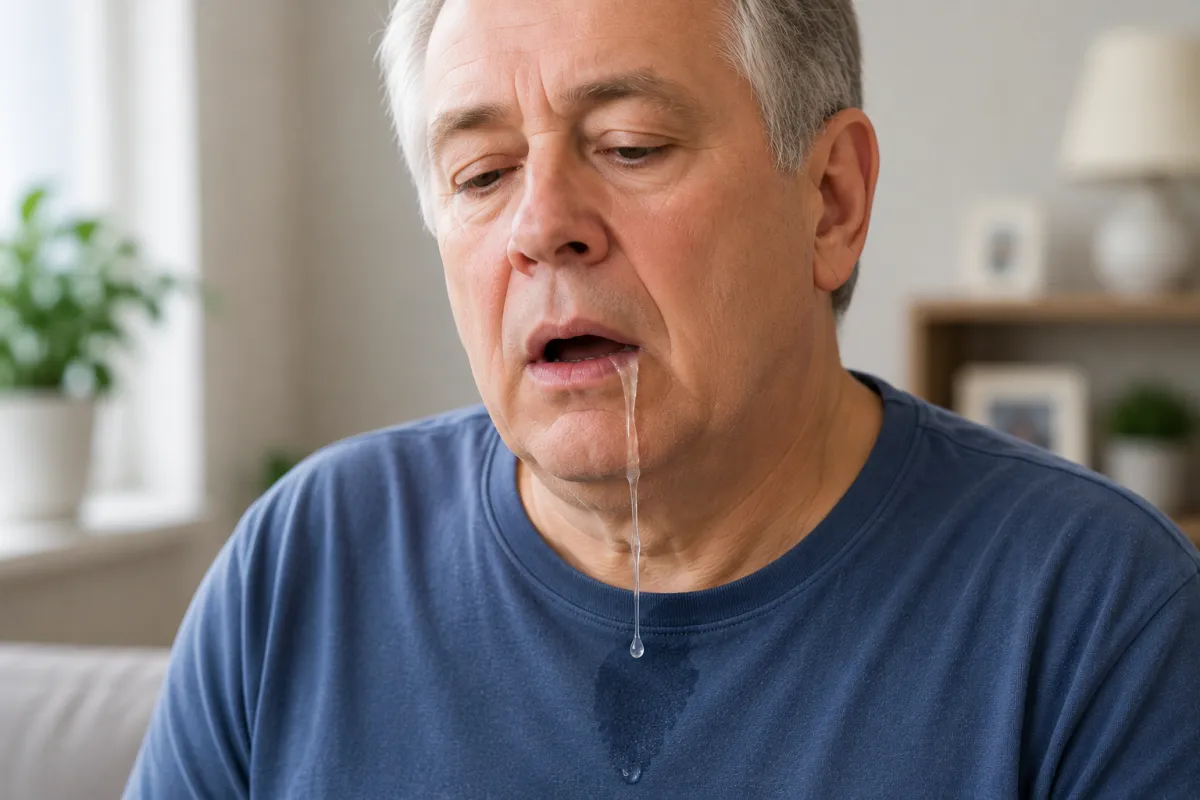
Drooling after a stroke can happen when the muscles and sensation involved in keeping saliva inside the mouth or swallowing it normally have been affected. It does not necessarily mean your body is producing too much saliva. For many stroke survivors, the problem is that saliva is not being cleared efficiently. Treatment depends on the cause and may include swallowing therapy, positioning, oral-care strategies and, in persistent cases, medication or other specialist treatment.
After your stroke, you may have expected weakness.
You may have expected problems walking.
You may even have expected difficulties speaking.
But perhaps nobody warned you that something as automatic as keeping saliva inside your mouth could suddenly require thought.
You notice your chin is wet.
Your pillow is damp when you wake.
You wipe your mouth before somebody else notices.
Perhaps saliva escapes more from one side, particularly when you are tired or concentrating on something else.
It can feel embarrassing.
It can make you reluctant to speak, eat around other people or leave the house.
But drooling after stroke is a neurological and swallowing problem — not a personal failing and not something you should simply be expected to control through willpower.
✦ ✦ ✦
The Good News
Drooling can improve after stroke.
For some people it settles as facial movement, sensation and swallowing improve. Others benefit from assessment and targeted treatment.
Most importantly, drooling does not automatically mean that you are producing excessive amounts of saliva. In neurological conditions, saliva commonly escapes because the mechanisms that normally contain and swallow it have been disrupted.
Once the reason for the drooling is understood, your rehabilitation team can work out what may help.
Sometimes that means improving swallowing.
Sometimes it means working on posture and mouth closure.
Sometimes saliva itself needs to be medically managed.
There is no single solution for everyone.
✦ ✦ ✦
What Is Drooling After a Stroke?
Drooling — sometimes called sialorrhoea — means saliva unintentionally escapes from the mouth.
Stroke can affect the complicated network of muscles, nerves and brain pathways responsible for:
✓ Closing the lips.
✓ Moving the tongue.
✓ Feeling saliva collecting inside the mouth.
✓ Coordinating swallowing.
✓ Maintaining an upright head and body position.
✓ Automatically swallowing saliva throughout the day.
If any of these processes are disrupted, saliva can pool inside the mouth and eventually spill over the lips.
The Stroke Association specifically notes that when the facial or lip muscles are affected after stroke, saliva may escape from the mouth.
✦ ✦ ✦
Why Does Drooling Happen After a Stroke?
There can be several reasons.
Weakness Around the Mouth
Stroke may weaken one side of the face.
If the lips do not close firmly enough, saliva can escape — often from the weaker side.
You may notice this particularly when you are:
✓ Tired.
✓ Talking.
✓ Concentrating.
✓ Eating.
✓ Sitting with your head lowered.
✦ ✦ ✦
Reduced Sensation
Sometimes the problem is not simply weakness.
Stroke can alter sensation.
You might not notice saliva collecting around the lips or inside the cheek as quickly as you once did.
Before your stroke, your brain automatically detected saliva and triggered swallowing without you ever thinking about it.
After stroke, that process may become less reliable.
✦ ✦ ✦
Difficulty Swallowing Saliva
Drooling can also be associated with dysphagia, the medical term for swallowing difficulties.
You swallow saliva hundreds of times throughout the day without consciously deciding to do it.
When stroke affects swallowing, those automatic swallows may become less frequent or less effective.
Saliva then has more opportunity to accumulate.
Dysphagia is common after stroke, and difficulties can involve food, drinks and saliva.
✦ ✦ ✦
Poor Head or Body Position
Posture can also influence saliva control.
If weakness causes your head to fall forward or towards one side, gravity can make saliva more likely to escape.
Poor trunk control can contribute as well.
That is why saliva management may involve much more than simply concentrating on the mouth.
✦ ✦ ✦
Am I Producing Too Much Saliva?
Possibly — but not necessarily.
This is an important distinction.
Clinical guidance on neurological drooling notes that it is often not caused by excessive saliva production. Instead, neuromuscular or sensory problems can interfere with the oral phase of swallowing and normal saliva clearance.
In other words, the amount of saliva may be perfectly normal.
What has changed is your ability to manage it automatically.
That matters because treatment should target the actual cause rather than simply trying to dry the mouth unnecessarily.
✦ ✦ ✦
Signs You May Be Having Difficulty Managing Saliva
You may notice:
✓ Saliva escaping from one side of the mouth.
✓ Frequently wiping your mouth or chin.
✓ Wet clothing around the neckline.
✓ A wet pillow after sleeping.
✓ Saliva pooling inside the cheek.
✓ Difficulty swallowing saliva.
✓ A wet or gurgly-sounding voice.
✓ Coughing when trying to clear saliva.
✓ Skin irritation around the mouth or chin.
✓ Drooling becoming worse when tired or distracted.
Persistent drooling can sometimes be one sign of an underlying swallowing problem and is worth discussing with your rehabilitation team.
✦ ✦ ✦
Why Drooling Can Affect More Than Your Mouth
Drooling may look like a small problem from the outside.
It does not always feel small when you are the person experiencing it.
You may become conscious of your mouth during conversations.
You may wonder whether someone has noticed.
You may repeatedly wipe your face.
You might avoid eating in public.
You may turn your face away before speaking.
And something you previously did without thinking can suddenly make you feel exposed.
The emotional consequences deserve attention too.
Stroke recovery is already asking you to adapt to enormous changes.
You should not have to pretend that the smaller, more personal changes do not matter.
✦ ✦ ✦
Is Drooling Connected to Dysphagia?
It can be.
Drooling does not automatically mean that you have dysphagia, but persistent problems controlling saliva can occur alongside swallowing difficulties.
This is important because swallowing problems after stroke can increase the risk of material entering the airway instead of travelling safely towards the stomach.
Even saliva can be aspirated if swallowing and airway protection are impaired.
Signs that should prompt a swallowing assessment include:
✓ Coughing or choking while eating or drinking.
✓ A wet or gurgly voice.
✓ Food remaining inside the mouth.
✓ Difficulty chewing.
✓ Frequent chest infections.
✓ Difficulty swallowing tablets.
✓ Unexplained weight loss.
✓ Breathlessness during meals.
✓ Persistent problems managing saliva.
Do not attempt to diagnose dysphagia yourself.
A speech and language therapist can assess swallowing and determine whether further investigation or treatment is needed.
✦ ✦ ✦
How Is Drooling After Stroke Assessed?
Assessment should look for why saliva is escaping.
A speech and language therapist may examine:
✓ Lip closure.
✓ Tongue movement.
✓ Facial movement and sensation.
✓ Awareness of saliva.
✓ Frequency and effectiveness of swallowing.
✓ Head and trunk posture.
✓ Cough strength and airway protection.
✓ Eating and drinking.
✓ Whether drooling happens mainly when awake, asleep or fatigued.
If swallowing safety is uncertain, more detailed swallowing assessment may be required.
NICE recommends specialist assessment and management for people with post-stroke dysphagia rather than relying on a single standard approach.
✦ ✦ ✦
Treatment and Management
Treatment depends entirely on what is causing the problem.
Swallowing Therapy
If saliva is accumulating because swallowing is inefficient, a speech and language therapist may recommend specific strategies or rehabilitation.
These should be individually prescribed.
Do not copy swallowing exercises from somebody else simply because they also had a stroke. The swallowing impairment following one stroke can be very different from another.
✦ ✦ ✦
Reminders to Swallow
Some people benefit from deliberately swallowing more frequently.
Oxford Health NHS guidance notes that prompting more frequent swallowing may help people who have difficulty clearing saliva effectively.
A therapist may suggest cues such as:
✓ Swallowing before beginning to speak.
✓ Checking whether saliva has collected.
✓ Using regular reminders.
✓ Swallowing again after completing an activity requiring concentration.
However, this strategy needs to be appropriate for your swallowing ability.
✦ ✦ ✦
Improving Posture
Sitting upright with good head and trunk support may make saliva easier to control.
If your head consistently falls forwards or towards one side, ask your physiotherapist, occupational therapist or speech and language therapist whether positioning could be contributing.
Sometimes improving the position of the body changes what happens at the mouth.
✦ ✦ ✦
Working on Lip and Facial Control
Where weakness around the mouth is contributing, rehabilitation may sometimes target oral motor function.
But exercises should be chosen for your particular impairment.
Doing random facial exercises is not necessarily the same as receiving targeted rehabilitation.
✦ ✦ ✦
Oral Care
Good mouth care is particularly important when swallowing is impaired.
Stroke can make oral hygiene harder because of weakness, cognitive difficulties, dysphagia and problems managing saliva.
Depending on your ability, this may mean:
✓ Brushing teeth regularly.
✓ Cleaning the tongue and gums.
✓ Checking the weaker cheek for trapped food.
✓ Keeping lips comfortable and protected.
✓ Asking for assistance if arm weakness makes oral care difficult.
If saliva is entering the airway, keeping the mouth clean also matters because oral bacteria can contribute to respiratory complications.
✦ ✦ ✦
What About Medication for Drooling?
Medication may sometimes be considered when persistent drooling is causing significant problems.
Some treatments work by reducing saliva production.
Specialist services may also consider treatments such as botulinum toxin injections into salivary glands in selected people with persistent neurological sialorrhoea.
These treatments are not appropriate for everybody.
Reducing saliva too much can cause problems of its own, including an uncomfortable dry mouth, thicker secretions and difficulties with oral health.
This is therefore something to discuss with a doctor or specialist team rather than trying to treat independently.
✦ ✦ ✦
Practical Things You Can Do
While waiting for assessment or alongside rehabilitation:
✓ Keep tissues or a soft cloth available without feeling embarrassed about using them.
✓ Sit as upright as you comfortably can.
✓ Notice whether drooling becomes worse when you are tired.
✓ Ask whether you should consciously swallow more frequently.
✓ Maintain good oral hygiene.
✓ Protect irritated skin around the mouth.
✓ Tell your therapist if saliva pools more on one side.
✓ Mention coughing, choking or a wet voice.
✓ Ask for a swallowing assessment if you are concerned.
✓ Give yourself time — saliva control can change as neurological recovery progresses.
And remember: do not deliberately restrict your fluids simply because you are worried about drooling. Hydration is important, and swallowing recommendations should come from your clinical team.
✦ ✦ ✦
When Should You Seek Medical Advice?
Speak to your GP, stroke team or speech and language therapist if drooling is persistent, worsening, causing skin problems, interfering with communication or affecting your confidence and daily life.
Seek assessment particularly if it occurs alongside:
✓ Coughing or choking during meals.
✓ Difficulty swallowing food, drinks or medication.
✓ A persistent wet or gurgly voice.
✓ Repeated chest infections.
✓ Unintentional weight loss.
✓ Difficulty maintaining hydration.
✓ Increasing difficulty clearing saliva.
New swallowing problems can require prompt assessment because dysphagia can lead to complications including aspiration, dehydration and poor nutrition.
And if facial weakness or other stroke symptoms suddenly appear or become newly worse, treat that as a possible new stroke and call 999. NHS guidance advises calling 999 immediately for sudden stroke symptoms, even if they subsequently improve.
✦ ✦ ✦
My Perspective
Stroke has a strange way of making you notice things your body once did quietly in the background.
Walking.
Swallowing.
Moving your hand.
Holding your face normally.
Before stroke, you rarely congratulate yourself for doing any of them.
Then something changes and suddenly an automatic movement can become another thing you have to think about.
That is why I think symptoms that may look “small” to somebody else deserve to be taken seriously.
Recovery is not only about whether you survived.
It is also about recovering the ordinary things that allowed you to move through the world without constantly thinking about your body.
If drooling bothers you, you are allowed to say that it bothers you.
You do not have to compare it with somebody else's difficulties before asking for help.
✦ ✦ ✦
Frequently Asked Questions
Is Drooling Normal After a Stroke?
It can occur after stroke, particularly when facial movement, sensation or swallowing have been affected. Persistent drooling should still be discussed with your rehabilitation team because the underlying cause matters.
✦ ✦ ✦
Does Drooling Mean I Have Dysphagia?
Not necessarily.
However, drooling can occur alongside dysphagia, particularly when saliva is not being swallowed effectively. If you also have coughing, choking, difficulty swallowing or a wet voice, ask for a swallowing assessment.
✦ ✦ ✦
Will Drooling Go Away?
It may improve as neurological function, facial control and swallowing recover, but recovery varies considerably between individuals.
Persistent symptoms can often still be assessed and managed.
✦ ✦ ✦
Why Is My Drooling Worse When I Am Tired?
Fatigue can make it harder to maintain posture, lip closure, attention and other movements that have become less automatic following stroke.
If you notice a clear pattern, tell your therapist. It can help them understand what is contributing to the problem.
✦ ✦ ✦
Why Does Saliva Come Out of Only One Side of My Mouth?
One-sided facial or lip weakness after stroke can make it harder to maintain a seal on the affected side, allowing saliva to escape. Reduced sensation on that side can also mean you notice it later.
✦ ✦ ✦
Should I Practise Swallowing More Often?
Some people are advised to increase the frequency of deliberate swallowing, but swallowing strategies should be appropriate for your particular impairment. If you have known or suspected dysphagia, ask a speech and language therapist before beginning exercises independently.
✦ ✦ ✦
Key Takeaways
✓ Drooling can occur after stroke because of facial weakness, altered sensation, posture or difficulty swallowing saliva.
✓ It does not necessarily mean your body is producing excessive saliva.
✓ Persistent drooling can sometimes be associated with dysphagia.
✓ A speech and language therapist can assess saliva control and swallowing.
✓ Treatment should address the underlying cause rather than simply trying to stop saliva.
✓ Posture, swallowing strategies, oral care and targeted rehabilitation may help.
✓ Medication or specialist saliva-reducing treatments may be appropriate for some people.
✓ New or suddenly worsening neurological symptoms require urgent medical attention.
✦ ✦ ✦
The Bottom Line
Drooling after a stroke can feel embarrassing because something that used to happen completely automatically has suddenly become visible.
But there is usually a reason for it.
Your lips may not close as firmly.
You may not feel saliva accumulating as quickly.
You may be swallowing less frequently.
Your posture may have changed.
Or swallowing itself may have been affected.
Finding out why is far more useful than simply trying harder to stop it.
Ask for help.
There are ways to assess it.
There are ways to manage it.
And for many people, saliva control can improve as recovery continues.
✦ ✦ ✦
Top 5 Related Articles
Dysphagia After a Stroke
Choking After a Stroke
Food Getting Stuck in the Throat After a Stroke
Foods That Are Easier to Swallow After Stroke
Taste Changes After a Stroke
✦ ✦ ✦
About the Author
Alisia Gayle is a stroke survivor who achieved 96% neurological recovery following an ischaemic stroke.
After years of rehabilitation, she shares practical, evidence-informed resources to help stroke survivors, carers and families better understand recovery and rebuild their lives with confidence.
Alisia is also the author of Brain Damage: My Journey to 96% Recovery, where she shares her personal stroke recovery story and the lessons she learned throughout rehabilitation.
✦ ✦ ✦
Medical Disclaimer
This article is intended for educational purposes only and should not replace professional medical advice, diagnosis or treatment.
Symptoms and swallowing problems after stroke vary significantly from person to person. Always seek advice from your doctor, speech and language therapist or stroke rehabilitation team regarding symptoms, treatment or changes in your condition.
If you develop sudden new facial weakness, arm weakness, speech problems or other symptoms suggesting another stroke, call 999 immediately.
✦ ✦ ✦
Final Thoughts
Perhaps before your stroke you never noticed yourself swallowing saliva.
Why would you?
Your body simply took care of it.
Then stroke happened.
And suddenly another invisible task became visible.
Another thing to think about.
Another thing to manage.
Another reminder that your brain and body are still finding their way back to one another.
Drooling may feel like a small symptom when somebody reads it on a list.
It may not feel small when it is happening to you.
So talk about it.
Ask to have it assessed.
And remember that recovery is not only about the milestones everyone else can see.
Sometimes it is about quietly getting back the things you once did without ever knowing your brain was doing them.