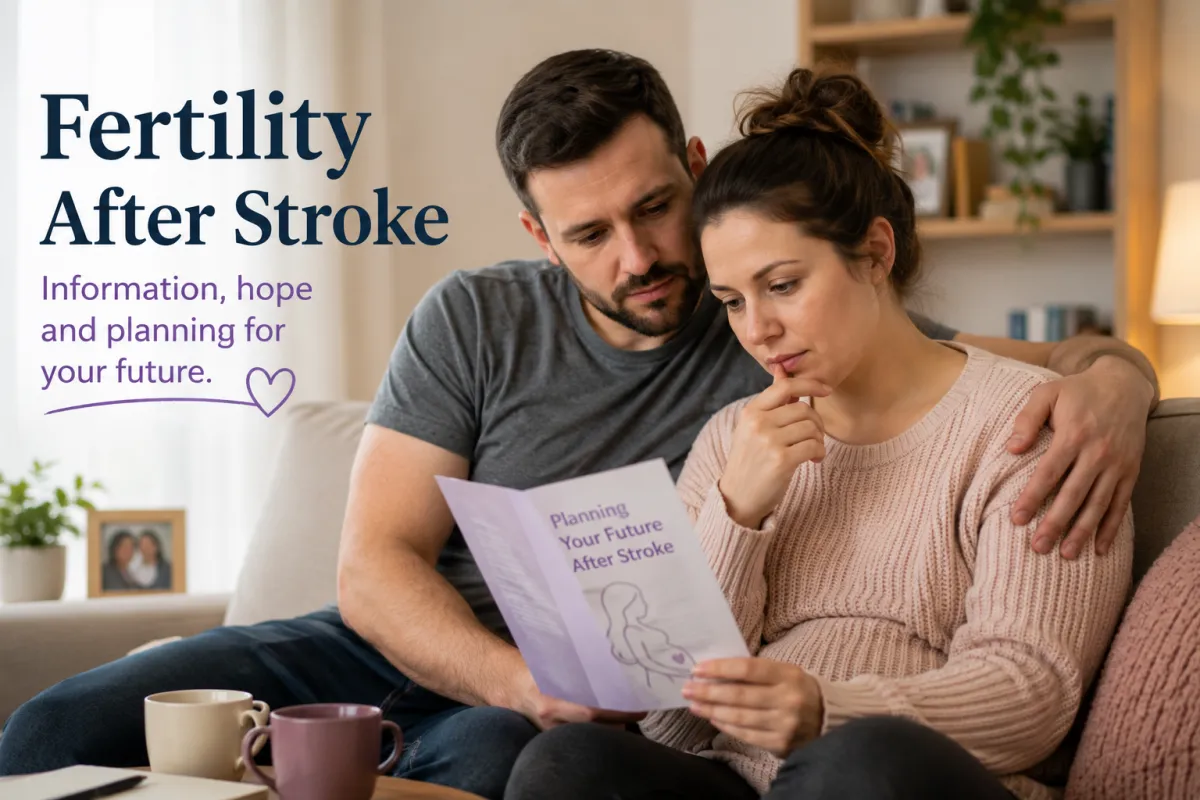
Having a stroke does not automatically mean that you will become infertile or that having children is no longer possible. For many survivors, fertility itself is unchanged. The more important questions are often whether the cause of the stroke, medications, other medical conditions or a future pregnancy create additional risks that need specialist management. Some people may also need fertility treatment, and previous stroke or clotting problems can influence how that treatment is planned. The safest approach is to separate two different questions: “Can I conceive?” and “Can pregnancy or fertility treatment be managed safely after my stroke?”
After your stroke...
The first questions may be about survival.
Walking.
Talking.
Getting home.
Becoming independent again.
Then, as life begins moving forward, another question appears.
"What about children?"
Perhaps you had always planned to start a family.
Maybe you already have one child and hoped for another.
Perhaps your stroke happened in your twenties or thirties.
Maybe you froze eggs before the stroke.
Perhaps you were already undergoing fertility treatment.
Or maybe your menstrual cycle has changed and you are frightened that the stroke has somehow made you infertile.
You begin wondering...
"Can I still get pregnant?"
"Has stroke damaged my fertility?"
"Is pregnancy too dangerous now?"
"Can I have IVF after stroke?"
"Will my medication affect a baby?"
"What if I need blood thinners?"
These questions deserve careful answers.
Because fertility after stroke is not simply:
Yes.
Or no.
Your ability to conceive and the medical safety of pregnancy are related...
But they are not the same question.
✦ ✦ ✦
The Good News
A stroke does not automatically stop the ovaries from releasing eggs.
It does not automatically stop sperm production.
And it does not automatically mean that pregnancy is impossible.
Many of the usual factors affecting fertility still apply.
These include:
✓ Age
✓ Ovulation
✓ Sperm quality
✓ Reproductive health
✓ General health
✓ Frequency and timing of intercourse or insemination
✓ Conditions such as endometriosis or polycystic ovary syndrome
The NHS notes that fertility depends on factors including age, general health and whether either partner has a fertility problem.
A previous stroke may add medical complexity.
But complexity is not the same as infertility.
That distinction is important.
✦ ✦ ✦
Does a Stroke Directly Cause Infertility?
Usually, stroke is not automatically considered a direct cause of infertility.
A stroke damages part of the brain.
Its effects depend on which brain area was affected and how severe the injury was.
Some survivors experience changes involving:
✓ Sexual desire
✓ Physical function
✓ Fatigue
✓ Mobility
✓ Confidence
✓ Medication
✓ Relationships
These changes can make sexual activity or trying to conceive more difficult.
But difficulty having sex is not the same thing as biological infertility.
Similarly...
Being frightened to become pregnant does not mean you cannot conceive.
If you have been trying to become pregnant and are not succeeding, you still deserve an ordinary fertility assessment rather than assuming:
"It must be because I had a stroke."
✦ ✦ ✦
Fertility and Pregnancy Risk Are Different
This is probably the most important point in this article.
Imagine a woman who ovulates normally and has no fertility problem.
Biologically...
She may be completely capable of becoming pregnant.
But she also has:
A previous stroke.
A blood-clotting disorder.
High blood pressure.
And medication that is unsuitable during pregnancy.
Her fertility may be normal.
Her pregnancy management may be medically complex.
Those are different issues.
So when discussing having children after stroke, ask two separate questions:
1. Is there any reason I may have difficulty conceiving?
2. What needs to happen to make pregnancy as safe as reasonably possible?
That distinction can prevent a lot of unnecessary fear.
✦ ✦ ✦
What Caused Your Stroke Matters
Before planning pregnancy, one of the most useful things you can know is:
Why did I have the stroke?
Possible causes in younger adults include:
✓ High blood pressure
✓ Arterial dissection
✓ Heart conditions
✓ Patent foramen ovale
✓ Antiphospholipid syndrome
✓ Other clotting conditions
✓ Autoimmune disease
✓ Pregnancy-related complications
✓ Atherosclerosis
✓ Sometimes no identified cause
This matters because future pregnancy can affect:
Blood pressure.
Blood volume.
The clotting system.
The cardiovascular system.
A woman whose previous stroke was associated with severe pre-eclampsia may need a different plan from someone whose stroke followed an arterial dissection.
Your previous diagnosis matters more than a generic statement that:
"Women can have babies after stroke."
✦ ✦ ✦
Pregnancy Changes the Cardiovascular System
Pregnancy creates major physiological changes.
Blood volume increases.
Heart function changes.
Hormonal changes affect blood vessels.
The body's clotting system also changes.
Pregnancy and the postpartum period are recognised as times when stroke risk can be increased, particularly in the presence of additional complications or risk factors.
That does not mean pregnancy commonly causes stroke.
Most pregnant women do not experience one.
But someone with a previous stroke deserves an individual risk assessment rather than assuming pregnancy carries exactly the same risk as it would for somebody without that history.
✦ ✦ ✦
Pre-Eclampsia Matters
Pre-eclampsia is a pregnancy-related condition associated with high blood pressure.
In severe cases, it can have serious complications, including stroke.
Risk can be greater in people with conditions such as:
✓ Chronic hypertension
✓ Diabetes
✓ Kidney disease
✓ Autoimmune conditions
✓ Previous pre-eclampsia
NICE recommends low-dose aspirin during pregnancy for some women at increased risk of pre-eclampsia, depending on their individual risk factors.
But this is not something to start yourself because you once had a stroke.
Pregnancy medication needs to be prescribed according to your actual medical circumstances.
✦ ✦ ✦
Have a Pre-Pregnancy Review
If you are considering pregnancy after stroke, ideally speak with your healthcare team before trying to conceive.
Depending on your circumstances, this may involve:
✓ Your GP
✓ Stroke physician or neurologist
✓ Obstetrician
✓ Maternal medicine specialist
✓ Cardiologist
✓ Haematologist
✓ Fertility specialist
The purpose is not to frighten you.
It is to identify problems while there is still time to manage them.
A review may consider:
✓ Why your stroke occurred
✓ Your current blood pressure
✓ Heart conditions
✓ Clotting disorders
✓ Previous pregnancy complications
✓ Current medications
✓ Whether any medication needs changing
✓ Your overall cardiovascular health
Planning is far easier than discovering an important medication issue after a positive pregnancy test.
✦ ✦ ✦
Medication Is One of the Biggest Issues
Many young stroke survivors take long-term medication.
Examples may include:
✓ Anticoagulants
✓ Antiplatelet medicines
✓ Blood-pressure tablets
✓ Statins
✓ Anti-seizure medication
✓ Other neurological medication
Some medications can be used during pregnancy.
Others may need changing.
Others may be avoided.
This is one reason you should never stop stroke medication yourself because you want a baby.
You could remove important stroke protection before an alternative plan has been established.
The correct approach is:
Review.
Plan.
Then change medication under professional supervision where necessary.
✦ ✦ ✦
Anticoagulants and Pregnancy
This is particularly important if your stroke prevention involves anticoagulation.
The NHS states that warfarin is not normally used during pregnancy because of risks to the developing baby, while direct oral anticoagulants such as apixaban, dabigatran, edoxaban and rivaroxaban are also not recommended during pregnancy.
That does not mean women requiring anticoagulation cannot become pregnant.
It means anticoagulant management needs specialist planning.
There may be alternative anticoagulation strategies that are more suitable during pregnancy.
The key rule is simple:
Do not wait until you are several months pregnant to mention that you take anticoagulants.
Discuss it before conception where possible.
✦ ✦ ✦
What If You Become Pregnant Unexpectedly?
Do not panic.
And do not abruptly stop every medication.
Contact your:
GP.
Stroke team.
Anticoagulation clinic.
Obstetric service.
or relevant specialist promptly.
Tell them exactly:
✓ What medication you take
✓ The dose
✓ When your last menstrual period occurred
✓ When you discovered the pregnancy
Medication risk needs to be balanced against the risk of leaving your underlying condition untreated.
That decision belongs with clinicians who understand both your stroke history and the pregnancy.
✦ ✦ ✦
Does Stroke Affect Your Menstrual Cycle?
Periods can sometimes change after serious illness.
Stress.
Weight loss.
Weight gain.
Changes in nutrition.
Hormonal disruption.
Medication.
Physical illness.
can all influence menstrual cycles.
So if your periods become irregular after stroke, that does not automatically mean the stroke permanently damaged your fertility.
However, if periods:
✓ Stop unexpectedly
✓ Become persistently irregular
✓ Become unusually heavy
✓ Change significantly
discuss this with your GP.
The cause may have nothing directly to do with your stroke.
A fertility or hormonal problem deserves its own investigation.
✦ ✦ ✦
Age Still Matters
A stroke does not freeze reproductive ageing.
This is particularly important for younger survivors who spend several years recovering before returning to the question of children.
Perhaps your stroke happened at 34.
You intended to start trying at 35.
But recovery, medication changes and fear mean you do not revisit the issue until 39.
That delay may matter to fertility independently of the stroke.
The NHS notes that fertility declines with age, and recommends seeking medical advice earlier when age or fertility concerns make delay important.
If having children matters greatly to you...
Do not avoid the discussion for years simply because it feels frightening.
You may have more options when you ask earlier.
✦ ✦ ✦
What About IVF After Stroke?
A history of stroke does not automatically mean IVF is impossible.
But IVF may require more careful assessment.
Fertility treatment can involve hormones used to stimulate the ovaries.
The Stroke Association notes that hormones used in fertility treatment can, in rare circumstances, contribute to complications involving blood clots and stroke.
This becomes particularly relevant if your previous stroke involved:
✓ A clotting disorder
✓ Previous venous thrombosis
✓ Antiphospholipid syndrome
✓ Hormone-related risk factors
✓ Significant cardiovascular disease
Your fertility clinic needs to know your complete stroke history.
Do not treat the stroke as irrelevant simply because it happened several years ago.
✦ ✦ ✦
Ovarian Hyperstimulation Syndrome
One recognised complication of fertility treatment is ovarian hyperstimulation syndrome, or OHSS.
In OHSS, the ovaries respond excessively to stimulation.
Severe cases can involve shifts in body fluid and an increased risk of thrombosis.
NHS fertility services recognise blood clots as a potentially serious complication of OHSS.
Modern fertility clinics assess risk and can modify treatment where appropriate.
A 2026 NHS fertility resource notes that people undergoing IVF are assessed for venous thromboembolism risk and that higher-risk individuals may receive preventative anticoagulation when indicated.
This is another reason specialist planning matters.
✦ ✦ ✦
Do Not Hide Your Stroke From the Fertility Clinic
You may worry that mentioning your stroke will mean:
"They won't treat me."
That is not a good reason to conceal it.
Your fertility team needs to know about:
✓ Previous stroke
✓ Blood clots
✓ Anticoagulants
✓ Antiplatelet medication
✓ High blood pressure
✓ Heart conditions
✓ Clotting disorders
✓ Relevant family history
because those factors may alter treatment decisions.
The aim is not to deny treatment unnecessarily.
It is to reduce avoidable risk.
A clinic cannot plan safely around medical information it does not have.
✦ ✦ ✦
What About Egg Freezing?
Some survivors may consider egg freezing because pregnancy needs to be delayed while health stabilises.
Egg freezing itself usually involves ovarian stimulation similar to part of an IVF cycle.
That means the same concerns about:
Hormonal treatment.
OHSS.
Thrombosis.
may need consideration.
If you are considering fertility preservation after a stroke, ask both specialists to communicate:
Your fertility specialist.
And the clinician responsible for your stroke prevention.
This is particularly important if you have an underlying clotting condition.
The decision is not simply:
"Are my ovaries healthy enough?"
It is also:
"Can the stimulation process be managed safely given my medical history?"
✦ ✦ ✦
What About Male Fertility After Stroke?
Stroke and fertility discussions often focus entirely on women.
But men may also have concerns.
A stroke does not automatically stop sperm production.
However, stroke can affect:
✓ Libido
✓ Erections
✓ Ejaculation
✓ Mobility
✓ Energy
✓ Confidence
✓ Relationship intimacy
These problems can make conception more difficult even when sperm production itself is normal.
Some medication may also affect sexual function.
If you and your partner are struggling to conceive, both partners should be considered.
Do not assume that every fertility problem after a male partner's stroke is caused by neurological damage.
A normal fertility assessment still matters.
✦ ✦ ✦
Sexual Difficulties Are Not the Same as Infertility
This distinction is worth repeating.
You might have:
Erectile dysfunction.
Reduced libido.
Pain.
Fatigue.
Difficulty with positioning.
Fear of having sex.
Those can all affect the frequency or feasibility of intercourse.
But they do not automatically mean the reproductive system cannot produce a pregnancy.
Treatment might involve:
✓ Reviewing medication
✓ Sexual-health advice
✓ Relationship support
✓ Physical adaptations
✓ Fertility assistance
✓ Medical treatment for erectile dysfunction where appropriate
Do not label yourself infertile simply because sex changed after your stroke.
✦ ✦ ✦
Contraception Still Matters After Stroke
If you are fertile but pregnancy currently carries additional medical risks, effective contraception can become especially important.
But contraception itself may need review.
A previous stroke may influence which methods are appropriate.
For example, some hormonal contraceptive methods may not be suitable for people with a history of stroke or certain cardiovascular risks. NHS guidance notes that the contraceptive injection may not be suitable for someone who has previously had a stroke, depending on their circumstances.
This does not mean every hormonal contraceptive is automatically forbidden.
It means the decision should consider your:
Stroke type.
Cause.
Blood pressure.
Clotting history.
Smoking.
Migraine history.
Other risk factors.
Ask for individual contraceptive advice.
✦ ✦ ✦
Do Not Stop Contraception Before Your Medication Review
If you want to start trying for a baby...
The temptation is:
Stop contraception tonight.
Then sort everything else out later.
Reverse that order.
First:
Review the stroke.
Review the medication.
Discuss pregnancy risk.
Make any necessary treatment changes.
Then begin trying when your clinicians consider the plan appropriate.
This may feel frustrating.
But a few weeks of preparation can prevent a much more complicated situation later.
Planned pregnancy is particularly valuable when you take medication that may need to be changed before conception.
✦ ✦ ✦
What If You Are Afraid to Become Pregnant?
This is completely understandable.
You survived something catastrophic.
Now pregnancy may feel like deliberately putting your body under cardiovascular strain again.
You may think:
"What if I have another stroke?"
That fear can become so powerful that you avoid:
Sex.
Fertility consultations.
Pregnancy discussions.
Even though you still desperately want a child.
Information helps.
Ask your medical team to explain:
✓ What your actual recurrence risks are
✓ Whether pregnancy changes those risks
✓ What monitoring would be offered
✓ How medication would be managed
✓ What warning signs would matter
A personalised plan is much more useful than spending two years imagining the worst possible outcome.
✦ ✦ ✦
What If Doctors Advise Against Pregnancy?
This can be devastating.
Especially if having children was central to your plans.
If pregnancy is considered unusually high risk, ask for the reasoning to be explained clearly.
You may want specialist input from a maternal medicine team experienced in complex medical pregnancies.
In some circumstances, people may also consider alternatives such as:
✓ Adoption
✓ Surrogacy where legally and medically appropriate
✓ Donor eggs or sperm
✓ Other family-building options
The right choice is deeply individual.
But you deserve clear medical information rather than a vague:
"You've had a stroke, so probably don't."
A major life decision requires a proper explanation.
✦ ✦ ✦
Do Not Let Fertility Marketing Exploit Your Fear
After serious illness, urgency can make people vulnerable.
You may encounter clinics or supplements promising:
"Boost fertility naturally."
"Repair hormones."
"Improve egg quality."
"Reverse infertility."
Be careful.
Particularly if you take anticoagulants or antiplatelet medication.
Some herbal products and supplements may interact with medication.
And delaying proper fertility assessment while experimenting with unproven treatments can cost valuable time.
If fertility matters...
Use qualified fertility services.
Get proper investigations.
Find out what the actual problem is.
Then treat that problem.
✦ ✦ ✦
My Perspective
Fertility after stroke can become emotionally tangled very quickly.
Because you are not only asking:
"Can I have a baby?"
You are asking:
"Can my body be trusted again?"
That is a much bigger question.
After a stroke, pregnancy can feel frightening even when specialists believe it is possible.
And if you are young, there can be anger too.
Why should something that happened to your brain suddenly interfere with decisions about your family?
But fear should not make the decision for you.
Neither should false reassurance.
Get the facts.
Find out what caused your stroke.
Understand your medication.
Ask whether fertility itself is affected.
Then separately ask what pregnancy or fertility treatment would mean medically.
Maybe the answer is:
You can try naturally with additional monitoring.
Maybe medication needs changing first.
Maybe IVF requires specialist precautions.
Maybe pregnancy carries risks that deserve very serious discussion.
Whatever the answer...
You deserve an individual one.
Not a generic assumption based simply on the words:
"Stroke survivor."
✦ ✦ ✦
When Should You Seek Medical Advice?
Speak with your healthcare professional if:
✓ You want to become pregnant after a stroke
✓ You are taking anticoagulants
✓ You take medication that may need review before pregnancy
✓ Your periods have stopped or become persistently irregular
✓ You have a known clotting disorder
✓ Your stroke occurred during pregnancy or after childbirth
✓ You previously had pre-eclampsia
✓ You are considering IVF or egg freezing
✓ You have been trying to conceive without success
✓ Sexual problems are preventing intercourse
If you become pregnant unexpectedly while taking stroke medication...
Contact your healthcare team promptly.
Do not abruptly stop treatment without medical advice.
✦ ✦ ✦
Frequently Asked Questions
Does Having a Stroke Make You Infertile?
Not automatically.
Many stroke survivors retain normal reproductive fertility.
Other factors such as age, reproductive conditions, general health and individual medical circumstances still determine fertility.
Can You Get Pregnant After a Stroke?
For many women, yes.
However, pregnancy may require specialist planning because the cause of the stroke, recurrence risk and medication can affect management.
Is Pregnancy Dangerous After Stroke?
Risk varies substantially between individuals.
Pregnancy itself changes the cardiovascular and clotting systems, so people with previous stroke should seek personalised pre-pregnancy advice.
Can I Take Blood Thinners While Pregnant?
Some anticoagulants are unsuitable during pregnancy.
Warfarin and direct oral anticoagulants such as apixaban and rivaroxaban are generally not recommended during pregnancy, so specialist medication planning is essential.
Can I Have IVF After a Stroke?
Potentially.
But previous stroke or clotting history should be discussed with the fertility team because ovarian stimulation and OHSS can sometimes increase thrombosis risk.
Can Stroke Affect Male Fertility?
Stroke does not automatically stop sperm production, but sexual function, fatigue and medication effects may make conception more difficult.
Should I Stop My Medication Before Trying for a Baby?
No.
Have a medication review first.
Some drugs may need changing, but stopping secondary stroke-prevention medication without an alternative could expose you to unnecessary risk.
✦ ✦ ✦
Key Takeaways
✓ Having a stroke does not automatically make you infertile.
✓ Fertility and pregnancy safety are two different questions.
✓ The cause of your stroke matters when planning pregnancy.
✓ Pregnancy changes the cardiovascular and clotting systems and may require additional monitoring after stroke.
✓ Pre-eclampsia is an important pregnancy-related vascular condition that can, in severe cases, cause stroke.
✓ Stroke medication should be reviewed before trying to conceive.
✓ Some anticoagulants are not suitable during pregnancy.
✓ Never stop stroke-prevention medication independently because you want to become pregnant.
✓ IVF and ovarian stimulation may require additional assessment in people with previous stroke or clotting risk.
✓ Sexual dysfunction after stroke does not automatically equal infertility.
✓ Male stroke survivors can also experience fertility-related challenges.
✓ Contraceptive choice may require review after stroke.
✓ Pre-pregnancy specialist planning can make decisions considerably safer and clearer.
✦ ✦ ✦
Related Articles
Continue learning about young stroke, pregnancy and relationships:
Stroke in Your 30s
Stroke Under 50
Pregnancy After Stroke
Stroke During Pregnancy
Stroke After Childbirth
Contraception After Stroke
Sex After Stroke
Dating After Stroke
Parenting After Stroke
Young Stroke Survivors
✦ ✦ ✦
About the Author
Alisia Gayle is a stroke survivor who achieved 96% neurological recovery following an ischaemic stroke.
After years of rehabilitation, she now shares practical, evidence-informed resources to help stroke survivors, carers and families better understand recovery and rebuild their lives with confidence.
Alisia is also the author of Brain Damage: My Journey to 96% Recovery, where she shares her personal stroke recovery story and the lessons she learned throughout her rehabilitation.
✦ ✦ ✦
Medical Disclaimer
This article is intended for educational purposes only and should not replace professional medical, fertility, obstetric or pharmaceutical advice.
Fertility, pregnancy risk and medication requirements after stroke vary considerably according to age, the cause and type of stroke, cardiovascular health, blood pressure, clotting conditions, medication and reproductive health.
Anyone considering pregnancy, IVF, egg freezing or other fertility treatment after stroke should discuss their individual circumstances with appropriately qualified healthcare professionals.
Do not stop anticoagulants, antiplatelet medicines, blood-pressure treatment or other prescribed stroke-prevention medication because you are trying to conceive.
Seek prompt professional advice if you become pregnant while taking medication that may require adjustment.
✦ ✦ ✦
Final Thoughts
Fertility after stroke...
Is not automatically lost.
A stroke does not suddenly erase your ability to become a parent.
But it may mean that the road toward parenthood requires more planning than you expected.
Separate the questions.
Can I conceive?
Is pregnancy medically appropriate?
Does my medication need changing?
Do I need specialist monitoring?
Is fertility treatment safe in my particular circumstances?
Those answers may all be different.
And that is okay.
Do not assume:
"I had a stroke, therefore I cannot have children."
But do not assume the opposite either.
Get proper advice.
Understand your stroke.
Review your medication.
Discuss pregnancy before conception where possible.
Tell fertility specialists about your medical history.
Ask questions until you understand the plan.
Because having a stroke young may already have taken enough control away from you.
When it comes to fertility and family planning...
Good information can help you take some of that control back.