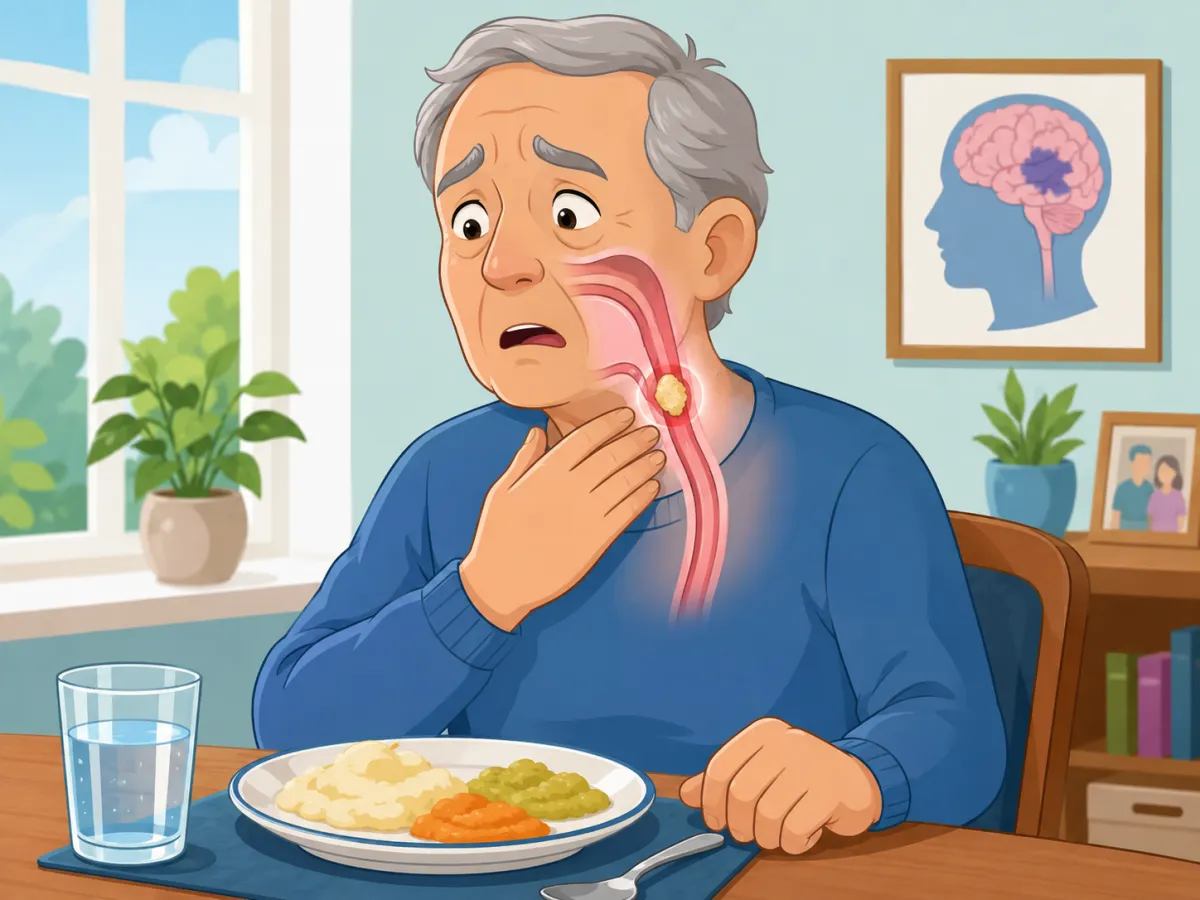
Feeling as though food is getting stuck in your throat after a stroke can be a sign of dysphagia — difficulty swallowing. A stroke can disrupt the muscles, sensation and coordination needed to move food safely from your mouth through your throat and towards your stomach. You might feel food lingering after you swallow, need several swallows to clear one mouthful, cough during meals or feel as though something simply has not gone down properly. This should not be ignored, because swallowing problems after stroke can increase the risk of choking, dehydration, malnutrition and aspiration, where food or fluid enters the airway.
After your stroke, did eating suddenly stop feeling automatic?
Perhaps you swallow a piece of food and immediately feel as though some of it is still sitting in your throat.
You swallow again.
And again.
You take a drink hoping to push it down.
Sometimes it clears. Sometimes the sensation remains.
Perhaps you have started avoiding bread, meat, tablets or dry foods because they seem particularly difficult.
Or maybe you are beginning to dread meals because you never quite trust what will happen when you swallow.
That sensation can be frightening.
Before your stroke, swallowing probably happened without thought. You chewed, swallowed and continued eating.
After a stroke, something you have done thousands of times can suddenly require concentration.
Understanding why food feels stuck is the first step towards making eating safer and less stressful.
✦ ✦ ✦
The Good News
Swallowing problems after stroke can improve.
Some people recover swallowing function relatively quickly, while others need rehabilitation and longer-term strategies.
Speech and language therapists play a central role in assessing and managing eating, drinking and swallowing difficulties. Depending on what they find, management may include swallowing techniques, rehabilitation exercises, changes to food texture or drink consistency, positioning advice and other individual strategies.
The important thing is not to repeatedly struggle through meals hoping the problem will disappear.
If food regularly feels stuck, there is a reason.
That reason can often be investigated.
And once the swallowing problem is understood, your healthcare team can decide what may make eating safer and easier.
✦ ✦ ✦
Why Can Food Feel Stuck After a Stroke?
Swallowing is much more complicated than it appears.
Your mouth prepares food, your tongue moves it backwards, and a rapid sequence of movements then carries it through your throat while protecting your airway.
Stroke can interfere with different parts of that process.
Weakness in the Swallowing Muscles
The muscles involved in swallowing may become weak after stroke.
If they do not generate enough force, some food may remain behind after a swallow rather than clearing completely.
You may then feel as though something is sitting in your throat.
You might instinctively swallow several times to try to clear it.
Poor Coordination
Swallowing requires several structures to work together extremely quickly.
Stroke can disturb that timing and coordination.
Food may therefore move less efficiently from the mouth through the throat.
The swallow can feel slow, delayed or incomplete.
Reduced Sensation
Stroke can also affect sensation.
This creates an important problem.
Some people strongly feel food remaining in the throat.
Others may have food or liquid entering the airway without experiencing the expected coughing response. This is known as silent aspiration.
So the absence of coughing does not always prove that swallowing is safe.
Food May Remain in the Mouth
Sometimes what feels like a throat problem actually begins earlier.
Weakness of the tongue, cheek or mouth can make it difficult to move food backwards effectively.
Food can collect inside the cheek or remain elsewhere in the mouth before eventually moving towards the throat.
This is one reason a proper swallowing assessment matters rather than trying to identify the cause yourself.
✦ ✦ ✦
What Does “Food Stuck in My Throat” Actually Mean?
People use the word stuck to describe several different experiences.
You might mean:
✓ food physically feels as though it remains in your throat
✓ you need repeated swallows to clear a mouthful
✓ swallowing feels delayed
✓ food seems to stop halfway down
✓ you cough immediately after swallowing
✓ food comes back towards your mouth
✓ you need liquid to help clear solid food
✓ your voice sounds different after eating
✓ you feel pressure or discomfort when swallowing.
These experiences can have different causes.
Dysphagia can occur because of stroke, but swallowing difficulties can also have causes unrelated to stroke. The NHS advises medical assessment for symptoms such as difficulty swallowing, coughing or choking while eating, bringing food back up or feeling that food is stuck in the throat or chest.
That means a new or persistent symptom should not automatically be blamed on your old stroke without assessment.
✦ ✦ ✦
Other Signs of Dysphagia After Stroke
Food sticking is only one possible symptom.
Other warning signs include:
✓ coughing while eating or drinking
✓ choking during meals
✓ needing several attempts to swallow
✓ food coming back up
✓ food remaining in the mouth
✓ a wet or gurgly-sounding voice after swallowing
✓ taking much longer than usual to eat
✓ difficulty swallowing tablets
✓ avoiding particular foods
✓ unexplained weight loss
✓ dehydration
✓ repeated chest infections.
The Stroke Association includes coughing or choking, food remaining in the mouth, food coming back up and changes to the voice among recognised signs of swallowing problems after stroke.
If several of these are happening together, the case for a swallowing assessment becomes even stronger.
✦ ✦ ✦
Is Food Getting Stuck the Same as Choking?
No.
They can be related, but they are not the same thing.
Dysphagia means difficulty swallowing.
Choking happens when something obstructs the airway, partly or completely.
A person who can still breathe and cough may have a partial obstruction, while complete airway obstruction is a medical emergency.
Feeling food lingering in the throat does not necessarily mean you are choking.
However, a swallowing problem can increase choking risk.
That is why repeatedly experiencing food sticking deserves proper assessment rather than being dismissed simply because you have always managed to clear it eventually.
✦ ✦ ✦
What Is Aspiration?
Aspiration is different again.
Aspiration occurs when food, fluid or saliva enters the airway instead of travelling safely towards the stomach.
After stroke, dysphagia can increase the risk of this happening.
You may cough when something goes towards your airway.
But not everybody does.
Silent Aspiration
Silent aspiration means material enters the airway without triggering an obvious cough.
That makes it especially difficult to recognise without professional assessment.
This is one reason you should not rely solely on:
"I'm not coughing, so my swallowing must be fine."
Swallowing safety is more complicated than that.
✦ ✦ ✦
Why Some Foods May Feel More Difficult
You might notice that the problem does not happen with everything.
Some textures can be harder to manage depending on the type of dysphagia you have.
Dry, crumbly, tough, chewy or mixed-consistency foods may be difficult for some people, while others struggle more with thin liquids.
But there is no universal list of foods that is safe for every stroke survivor with dysphagia.
Your swallowing difficulty may be completely different from somebody else's.
The Stroke Association advises people with swallowing difficulties to ensure that the consistency of food is suitable for their individual swallowing needs.
This is why copying another survivor's dysphagia diet can be a bad idea.
What is safe for them may not be safe for you.
✦ ✦ ✦
What Should You Do If Food Keeps Getting Stuck?
If this is happening repeatedly, tell your GP, stroke team or speech and language therapist.
A swallowing assessment can help determine which part of the swallowing process is causing difficulty.
Speech and language therapists assess, diagnose and manage swallowing disorders after stroke.
Depending on your symptoms, further assessment may also be needed.
Keep Track of What Is Happening
Before your appointment, it can be useful to notice:
✓ which foods cause the problem
✓ whether liquids also cause difficulty
✓ where you feel the food sticking
✓ whether you cough
✓ whether your voice changes afterwards
✓ whether you need repeated swallows
✓ whether you are losing weight
✓ whether meals are becoming longer
✓ whether you have had chest infections.
That information may help your healthcare professional understand the pattern.
✦ ✦ ✦
Practical Ways to Make Eating Safer
These are general principles only. Your individual swallowing plan should always take priority.
Sit Upright
Good positioning can support safer eating.
If you have been given specific positioning instructions by your speech and language therapist, follow them.
Reduce Distractions
If swallowing requires concentration, eating while talking, watching something intensely or rushing through a meal may make things harder.
Give the meal your attention.
Take Your Time
Do not race somebody else at the table.
Recovery does not care how quickly the person opposite you finishes.
Allow yourself enough time to chew and swallow properly.
Use Smaller Mouthfuls If Recommended
For some people with dysphagia, smaller amounts are easier to control.
However, follow your individual professional advice.
Finish One Mouthful Before Taking Another
Putting more food into your mouth while some remains uncleared can make swallowing increasingly difficult.
Follow Your Recommended Texture
If your speech and language therapist has recommended modified food or thickened fluids, do not change consistency without discussing it with them.
Texture modification may be used as part of an individual dysphagia management plan.
Do Not Invent Your Own Swallowing Exercises
Swallowing exercises are not generic fitness exercises.
Different swallowing impairments require different approaches.
Your therapist needs to identify the problem before choosing appropriate rehabilitation.
✦ ✦ ✦
What About Drinking Water to Push Food Down?
This is something many people instinctively try.
But if you have dysphagia, automatically washing every mouthful down with thin liquid may not be appropriate.
Some stroke survivors have difficulty controlling thin fluids and may have been prescribed a different drink consistency following swallowing assessment.
So if food regularly sticks, do not make repeated gulps of water your long-term solution without finding out why the food is sticking.
Your speech and language therapist can advise you on the safest strategy for your particular swallow.
✦ ✦ ✦
Can Food Sticking Affect Nutrition?
Yes.
The problem is not only what happens during the swallow.
Think about what happens psychologically after several frightening meals.
You begin avoiding the difficult food.
Then perhaps another.
Then another.
Your portions shrink.
Meals take longer.
Eventually eating becomes something you endure rather than enjoy.
Dysphagia can contribute to reduced food and fluid intake, malnutrition and dehydration.
If swallowing difficulty is causing unintentional weight loss, tell your healthcare team.
A dietitian may need to become involved alongside your speech and language therapist.
✦ ✦ ✦
Fear of Food Getting Stuck
The emotional side of dysphagia deserves more attention.
One frightening choking episode can change how you approach every meal afterwards.
You may:
eat extremely slowly
avoid eating alone
avoid restaurants
repeatedly check every swallow
stop eating certain foods
become anxious before meals.
Some caution is understandable when you genuinely have a swallowing problem.
But fear can eventually reduce your food intake and quality of life.
The goal is not to tell yourself that the fear is irrational.
The better approach is to find out what your swallow can safely manage.
A proper assessment can replace some of that uncertainty with specific information.
✦ ✦ ✦
When Should You Seek Medical Advice?
Contact your GP, stroke team or speech and language therapist if:
✓ food repeatedly feels stuck after swallowing
✓ swallowing has become more difficult
✓ you regularly cough during meals
✓ you choke on food or drinks
✓ you need several swallows for each mouthful
✓ your voice becomes wet or gurgly after eating
✓ you are avoiding more and more foods
✓ you are losing weight unintentionally
✓ you struggle to remain hydrated
✓ meals are taking excessively long
✓ you have recurring chest infections.
Dysphagia after stroke needs appropriate assessment because of its links with choking, aspiration, dehydration and inadequate nutrition.
Seek emergency help if somebody is choking and cannot breathe, speak or cough effectively.
And if swallowing suddenly becomes difficult alongside new stroke symptoms — such as new facial weakness, arm weakness or speech disturbance — seek emergency medical attention.
✦ ✦ ✦
My Perspective
There is something particularly unsettling about losing trust in an automatic function.
You expect rehabilitation to involve your leg.
Your arm.
Your balance.
Your speech.
You may not expect to have to think about getting a piece of food from your mouth to your stomach.
And once food has felt stuck a few times, it is difficult not to think about it during the next meal.
"Will this go down?"
"Should I take another bite?"
"What happens if I choke?"
That fear can quietly change your relationship with food.
For me, this is why symptoms like food sticking should never be brushed aside as a small inconvenience.
Eating is not merely nutrition.
It is independence.
Routine.
Family.
Pleasure.
Social life.
And after stroke, you deserve more than being told to simply chew more carefully.
You deserve to understand what has changed and what can be done about it.
✦ ✦ ✦
Frequently Asked Questions
Why does food feel stuck in my throat after a stroke?
Stroke can affect the strength, sensation and coordination involved in swallowing. This can make it harder to move food efficiently through the mouth and throat. Dysphagia is a recognised consequence of stroke.
Does food sticking mean I have dysphagia?
It can be a symptom of dysphagia, but it is not possible to determine the exact cause from that sensation alone.
Persistent food sticking should therefore be medically assessed.
Why do I have to swallow several times?
Repeated swallowing may happen when a single swallow does not completely clear the food.
If this happens frequently after stroke, mention it during your swallowing assessment.
Can dysphagia improve?
Yes. Swallowing function can improve after stroke, and swallowing therapy is commonly used in post-stroke dysphagia management.
Recovery varies considerably between individuals.
Is coughing after swallowing a warning sign?
Yes. Regular coughing or choking during eating or drinking is a recognised sign of swallowing difficulty.
What if I don't cough?
The absence of coughing does not guarantee that swallowing is safe because silent aspiration can occur.
Who assesses swallowing after stroke?
Speech and language therapists have a key role in assessing and managing eating, drinking and swallowing difficulties.
✦ ✦ ✦
Key Takeaways
✓ Food feeling stuck in your throat after stroke can be a sign of dysphagia.
✓ Stroke can affect swallowing strength, sensation and coordination.
✓ Food sticking, choking and aspiration are related concepts, but they are not the same thing.
✓ You can aspirate without obvious coughing.
✓ Repeated coughing, multiple swallows, voice changes, weight loss and chest infections deserve attention.
✓ Do not assume somebody else's dysphagia diet is appropriate for you.
✓ Follow the food texture, drink consistency and swallowing strategies recommended specifically for you.
✓ Persistent swallowing difficulty should be assessed by an appropriate healthcare professional.
✦ ✦ ✦
The Bottom Line
If food repeatedly feels as though it is getting stuck in your throat after a stroke, don't simply learn to tolerate it.
Your swallow may have changed.
There may be weakness.
There may be reduced coordination.
There may be altered sensation.
Or there may be another swallowing problem that needs investigation.
Most importantly, you cannot reliably work out the safety of your swallow from sensation alone.
Speak to your stroke team, GP or speech and language therapist.
Find out what is happening.
Learn which foods and drinks are appropriate for your swallowing ability.
And make meals safer rather than spending every mouthful wondering whether this will be the one that doesn't go down.
✦ ✦ ✦
Related Articles
Dysphagia After a Stroke
Choking After a Stroke
Aspiration After a Stroke
Why Do I Cough When Eating After Stroke?
Foods That Are Easier to Swallow After Stroke
✦ ✦ ✦
About the Author
Alisia Gayle is a stroke survivor and author of Brain Damage: My Journey to 96% Recovery.
Her work combines lived experience with practical, evidence-informed information designed to help stroke survivors and their families better understand the realities of recovery.
✦ ✦ ✦
Medical Disclaimer
This article is for general educational and informational purposes only and is not a substitute for individual medical advice, diagnosis or treatment.
Swallowing difficulties can have serious complications. If food regularly feels stuck, you cough or choke while eating or drinking, you are losing weight, or you develop other swallowing symptoms, speak to an appropriate healthcare professional.
If you have already received swallowing guidance from a speech and language therapist or stroke team, always follow your individual recommendations regarding food texture, drink consistency, positioning and swallowing strategies.
Seek emergency medical assistance if a person is choking and cannot breathe, speak or cough effectively.
✦ ✦ ✦
Final Thoughts
Food getting stuck after stroke is one of those symptoms that can look insignificant from the outside.
You swallowed eventually.
You finished the meal.
Nothing dramatic happened.
So perhaps everyone assumes everything is fine.
But you know what happened in those few seconds.
You felt the food stop.
You wondered whether it would move.
You wondered whether you would choke.
And then you approached the next mouthful differently.
You should not have to build your meals around that uncertainty.
Get the problem assessed.
Understand your swallow.
Use the strategies that are right for you.
Because eating after stroke should become something you can trust again — not something you have to fear.