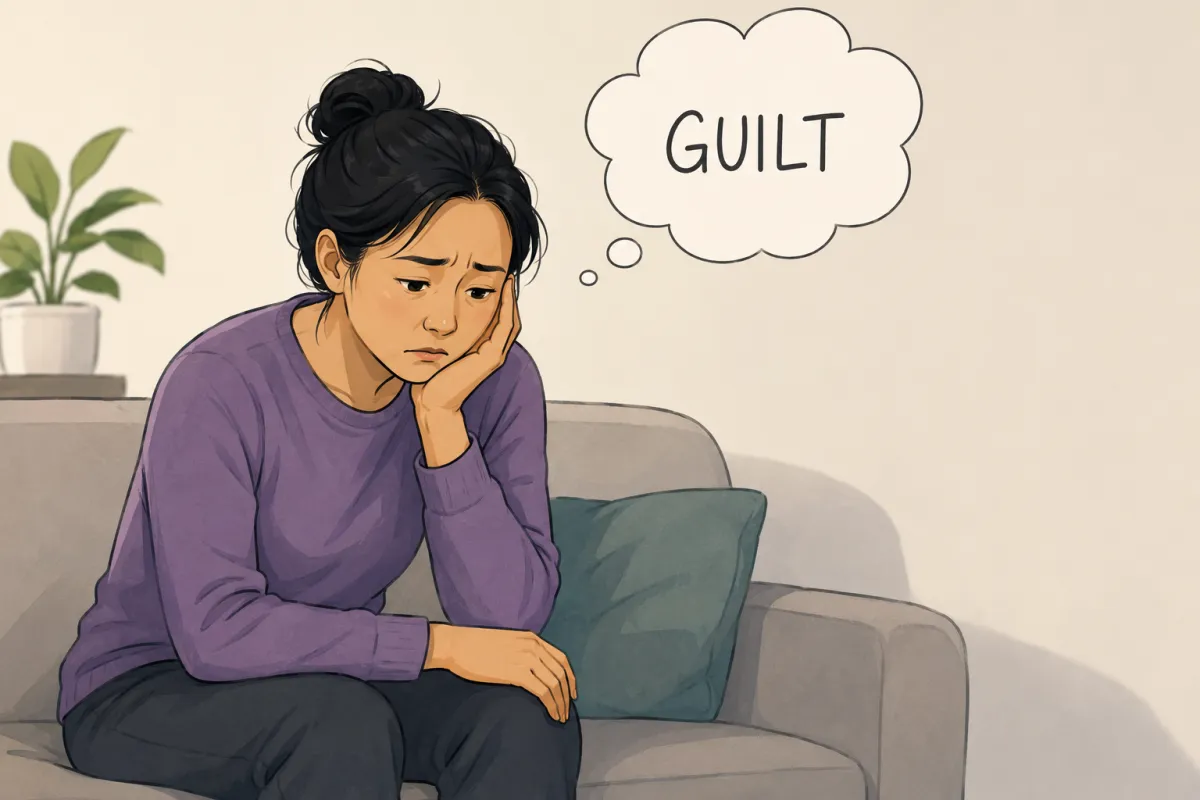
Guilt after a stroke can appear in ways you never expected. You may feel guilty that your family has to care for you, guilty that you cannot work, guilty about the money being spent on your recovery or even guilty that you survived when somebody else did not. These feelings can become another burden on top of rehabilitation. Learn why guilt is common after stroke, when it becomes unhealthy and how to stop treating yourself as though you have done something wrong simply because your life changed.
After a Stroke, You May Feel Guilty About Things That Were Never Your Choice
A stroke can change your life in seconds.
One day you may be working, parenting, driving, travelling, exercising and looking after everybody around you.
Then suddenly you may be the person who needs help.
Someone may need to cook for you.
Drive you to appointments.
Help you shower.
Take over childcare.
Manage the household.
Speak to doctors.
Complete paperwork.
Pay bills.
Or simply sit beside you while you try to understand what has happened.
For someone who was previously independent, receiving that level of help can be incredibly difficult.
You may find yourself repeatedly saying:
“I'm sorry.”
“I hate being a burden.”
“You shouldn't have to do this.”
“I should be further along by now.”
“Everyone's life has changed because of me.”
“My family didn't ask for this.”
“I should be grateful I'm alive, so why am I struggling?”
“Other people have had worse strokes than me.”
Eventually, guilt can become so familiar that you stop questioning whether it actually belongs there.
But needing help after a neurological injury is not a moral failure.
You did not choose to have a stroke.
✦ ✦ ✦
The Good News
Guilt is a feeling.
It is not proof that you have done something wrong.
Emotional changes are common after stroke. Stroke affects the brain, which plays a central role in emotion and behaviour, while survivors are also adjusting psychologically to sudden changes in health, independence, identity and future plans. Feelings including grief, sadness, frustration, anxiety and guilt can form part of that adjustment.
That means guilt can be understood, examined and challenged.
You may still dislike needing help.
You may still wish your family had not had to make sacrifices.
You may still grieve the life you had.
But you can eventually reach a point where you recognise the difference between:
“Something terrible happened to me.”
and:
“I did something terrible to everybody else.”
Those are not the same thing.
Why Do Stroke Survivors Feel Guilty?
There is no single form of post-stroke guilt.
It can develop from several different parts of the recovery experience.
You may feel guilty because:
Someone has become your carer.
Your partner has more responsibilities.
Your children have seen you unwell.
You cannot contribute financially as you once did.
You are unable to work.
You need expensive therapy or equipment.
Friends and relatives have changed their plans for you.
You cannot perform your previous household responsibilities.
You become tired easily.
You cancel plans.
You feel irritable or emotional.
Your recovery is taking longer than you expected.
You survived when somebody else did not.
Your stroke may have involved lifestyle risk factors.
You believe you should have recognised the symptoms earlier.
You have recovered well and feel uncomfortable around survivors with greater disability.
Some of these thoughts may contain genuine sadness or regret.
But guilt becomes destructive when you interpret every consequence of the stroke as evidence that you have personally failed.
Feeling Guilty About Becoming Dependent
For many survivors, dependence is one of the hardest psychological adjustments.
Before your stroke, you may have been the person everybody relied upon.
You may have managed the household.
Worked full time.
Raised children.
Supported relatives.
Drove everywhere.
Solved problems.
Earned money.
Then suddenly someone may need to help you stand up, wash, prepare food or get to the toilet.
That reversal can be brutal.
You may begin apologising every time somebody helps you.
But consider what the apology implies.
You are effectively saying:
“I have done something wrong by needing care.”
You have not.
Recovery from stroke can take weeks, months or years, and some people are left with long-term changes requiring adaptations or ongoing assistance.
Dependence during recovery is therefore not evidence of weakness.
It is sometimes simply the practical reality of recovering from brain injury.
Guilt About Your Partner or Family Becoming Carers
This can be particularly painful.
You may look at your partner and think:
“They didn't sign up for this.”
Perhaps they now:
Drive you to appointments.
Cook more frequently.
Handle medication.
Help with personal care.
Take over parenting duties.
Work while also caring for you.
Organise rehabilitation.
Deal with finances.
Manage things you previously handled.
Watching somebody you love become exhausted can create genuine distress.
You may even believe they would be better off without you.
But there is an important distinction between recognising somebody's workload and believing your existence is the problem.
The first can lead to useful conversations.
The second can become psychologically dangerous.
You can acknowledge:
“I know you're carrying much more than before, and I appreciate it.”
without turning that into:
“Your life would be better if I wasn't here.”
Those are radically different conclusions.
Guilt About Your Children
Parents can carry enormous guilt after stroke.
Perhaps your child saw you in hospital.
Perhaps you could no longer take them to school.
Play physically.
Attend activities.
Drive them places.
Cook dinner.
Help with homework.
Or behave like the parent they previously knew.
You may worry that your stroke damaged their childhood.
Children can certainly be affected when a parent becomes seriously ill.
Their routine may change.
They may become frightened.
They may ask difficult questions.
But children do not require a physically perfect parent.
What often matters more is maintaining connection where possible.
That might mean:
Parenting after stroke may look different.
Different does not automatically mean inadequate.
Guilt About Not Working
Work is strongly connected to identity for many adults.
You may have spent decades building a career.
Then suddenly you cannot work.
Your sick pay may reduce.
Your partner may become the primary earner.
Your colleagues continue progressing while you attend rehabilitation appointments.
That can make you feel useless.
But employment and human value are not interchangeable.
You are not worth £0 because you temporarily earn £0.
Your brain is recovering from an injury.
Rehabilitation itself can become demanding work.
Appointments, exercises, cognitive rehabilitation, speech therapy, fatigue management and learning how to function differently can consume enormous amounts of physical and mental energy.
Not being at work does not mean you are doing nothing.
Financial Guilt After Stroke
Stroke can be expensive.
Depending on where you live and what support is available, there may be costs associated with:
Physiotherapy.
Occupational therapy.
Speech therapy.
Neuropsychology.
Medication.
Private consultations.
Mobility aids.
Orthotics.
Transport.
Home adaptations.
Reduced working hours.
Lost income.
Childcare.
Help around the home.
You may look at the money being spent and think:
“This is all because of me.”
That thought can become particularly difficult if your household finances were already tight.
But medical treatment is not frivolous spending.
Rehabilitation is an investment in your function, independence and quality of life.
You would probably not describe somebody else's cancer treatment, surgery or rehabilitation as selfish expenditure.
Be careful not to create a harsher standard for yourself.
Survivor Guilt After Stroke
Some stroke survivors experience another form of guilt:
“Why did I recover when somebody else didn't?”
You may meet another survivor whose stroke happened around the same time as yours.
Their disability may be more severe.
They may remain unable to walk.
Speak.
Work.
Use one arm.
Live independently.
Or they may die.
Meanwhile, you improve.
Perhaps considerably.
That can create uncomfortable thoughts:
“Why me?”
“Why did I get another chance?”
“I shouldn't complain.”
“My stroke wasn't serious compared with theirs.”
“I feel guilty saying that I'm recovering well.”
“They deserved recovery too.”
Their outcome may genuinely make you sad.
But reducing your own recovery does not improve theirs.
You are allowed to be grateful that you recovered.
You are allowed to celebrate walking again.
You are allowed to celebrate speaking again.
You are allowed to return to work.
You are allowed to enjoy your life.
Another person's suffering does not create an obligation for you to suffer equally.
Guilt Because Your Stroke Was “Preventable”
This subject requires more nuance.
Some strokes are associated with modifiable risk factors such as smoking, high blood pressure, diabetes, high cholesterol, inactivity or heavy alcohol consumption.
Afterwards, you may replay your previous choices.
You may think:
“I did this to myself.”
Perhaps you ignored your blood pressure.
Smoked for years.
Stopped taking medication.
Rarely exercised.
Or avoided seeing your doctor.
There may be lessons worth learning.
But there is a difference between responsibility for changing future behaviour and punishing yourself indefinitely for past behaviour.
Medicine rarely operates with perfect hindsight.
You made decisions using the information, circumstances, habits and priorities you had at the time.
Once you know more, act differently.
Attend appointments.
Take prescribed medication.
Understand your risk factors.
Improve what can reasonably be improved.
That is useful accountability.
Self-hatred is not.
Guilt About Missing the Signs of Your Stroke
Some survivors repeatedly ask themselves:
“Why didn't I realise?”
Perhaps you delayed calling an ambulance.
Went to sleep.
Assumed it was a migraine.
Thought you were exhausted.
Told yourself you would feel better tomorrow.
Once you know that you had a stroke, the symptoms may seem obvious in retrospect.
But hindsight changes how events look.
You now know the ending.
You did not know it while the story was happening.
Learning stroke warning signs for the future is important.
Spending years mentally prosecuting yourself for not possessing information you did not have at the time is not.
Guilt About Feeling Angry
You survived.
Everybody tells you how lucky you are.
So you think you should be grateful.
But sometimes you are furious.
You may be angry that you cannot move properly.
Angry that your speech changed.
Angry that other people complain about trivial things.
Angry that recovery is slow.
Angry that your body no longer obeys you.
Angry that your friends disappeared.
Angry that your career has stalled.
Then you feel guilty for being angry.
Emotional reactions such as frustration, grief, anxiety and sadness are common after stroke, and both the direct effects of brain injury and the psychological consequences of stroke can contribute to emotional changes.
You can be grateful to be alive and angry that your life changed.
Two emotions can exist at the same time.
Guilt About Not Recovering Fast Enough
Stroke recovery can become competitive without you intending it to.
You see videos online:
“Walking again three months after my stroke.”
“Back in the gym after six months.”
“Returned to work after eight weeks.”
Then you look at yourself.
Perhaps you are still struggling to lift your arm.
Still using a walking aid.
Still searching for words.
Still exhausted after showering.
You begin thinking:
“I must not be trying hard enough.”
That conclusion is often completely unjustified.
Stroke affects different areas of the brain, with different severity, different complications and different starting points.
Recovery timelines therefore vary enormously. The NHS notes that some people recover within days or weeks while others continue recovering for months or years.
Someone else's timeline is not your rehabilitation schedule.
Guilt About Resting
This one can become particularly destructive.
You have been told rehabilitation requires repetition.
Practice.
Movement.
Consistency.
So when you rest, you feel guilty.
You may lie on the sofa thinking:
“I should be doing my exercises.”
But recovery is not improved by turning every waking hour into rehabilitation.
Stroke fatigue can be significant.
Your brain and body may require rest.
Rehabilitation works best when it is sustainable.
The goal is not to squeeze the maximum possible number of exercises into one day.
The goal is to continue rehabilitation over the long period your recovery may require.
Guilt When Your Recovery Goes Well
You may assume guilt only affects people struggling badly.
Not necessarily.
Sometimes substantial recovery creates its own discomfort.
You may join a stroke group and realise you have fewer visible disabilities than everyone else.
Someone may tell you:
“You're lucky.”
You know they are right.
But you also remember what happened to you.
You remember hospital.
Fear.
Loss of independence.
Pain.
Confusion.
Rehabilitation.
And perhaps symptoms that nobody can see.
You may therefore feel caught between two worlds.
Too recovered to feel entitled to struggle.
Too affected to feel like the person you were before.
Your recovery does not have to be catastrophic for your experience to matter.
Why Guilt Can Become a Problem
A little guilt can sometimes prompt useful reflection.
Persistent guilt can do the opposite.
It may lead you to:
Refuse help you genuinely need.
Push yourself beyond your physical limits.
Hide symptoms.
Apologise constantly.
Withdraw from family.
Avoid spending money on rehabilitation.
Stop asking for reasonable accommodations.
Believe you do not deserve enjoyment.
Tolerate poor treatment.
Compare yourself constantly with other survivors.
Become increasingly isolated.
Lose motivation.
It may also overlap with depression.
Depression is common after stroke, and professional assessment is particularly important when guilt appears alongside persistent sadness, hopelessness, loss of interest, worthlessness or thoughts of death.
Ask Yourself: Did I Actually Do Something Wrong?
This is one of the simplest ways to challenge guilt.
Take the thought:
“I feel guilty that my partner has to drive me to physiotherapy.”
Now ask:
What exactly did I do wrong?
Did you deliberately injure your brain?
No.
Did you deliberately lose the ability to drive?
No.
Did you create the rehabilitation appointment for entertainment?
No.
Then what you are feeling may not actually be guilt.
It may be:
Naming the emotion accurately matters.
You cannot solve guilt effectively if the emotion underneath it is really grief.
Replace Apology With Appreciation
Listen to how often you say “sorry.”
Sorry you had to bring me here.
Sorry I need help.
Sorry I'm tired.
Sorry we had to cancel.
Sorry I can't walk faster.
Sorry I forgot.
Sorry my recovery is taking so long.
Try replacing unnecessary apologies with appreciation.
Instead of:
“I'm sorry you have to take me to therapy again.”
Try:
“Thank you for taking me. I know it takes time out of your day.”
Instead of:
“Sorry I'm exhausted.”
Try:
“Thank you for understanding that I need to rest.”
Instead of:
“I'm sorry I'm such a burden.”
Try:
“I appreciate everything you're helping me with.”
The facts have not changed.
But your position within them has.
You have stopped presenting yourself as the problem.
Let Other Adults Make Their Own Decisions
Guilt sometimes causes survivors to decide what everybody else must be feeling.
You think:
“My partner resents me.”
“My children are miserable because of me.”
“My friends are tired of me.”
“My family doesn't want to help.”
Perhaps some of those things are true.
Perhaps they are not.
Ask.
Do not automatically turn assumptions into facts.
The people around you are adults capable of expressing their own needs.
If your partner is exhausted, discuss it.
If your family needs respite, organise it.
If responsibilities need redistributing, redistribute them.
That is healthier than deciding privately that everybody would be happier without you.
Allow People to Help You
This can be difficult.
Especially if you have spent your life being the helper.
You may reject assistance because receiving it makes you uncomfortable.
But sometimes accepting help is part of recovery.
There is dignity in independence.
There is also dignity in recognising when independence is temporarily unrealistic.
Allowing somebody to carry a shopping bag, drive you somewhere or help you prepare dinner does not erase everything you have contributed to that relationship over the years.
Relationships are rarely perfectly balanced every day.
Sometimes you carry somebody else.
Sometimes they carry you.
Stop Comparing Trauma
Another survivor's stroke being worse does not make yours insignificant.
You may have regained your walking but still struggle cognitively.
You may speak clearly but experience crushing fatigue.
You may return to work but feel completely different internally.
You may appear “normal” while working extremely hard to maintain that appearance.
There will almost always be someone:
More disabled.
Less disabled.
Further ahead.
Further behind.
Older.
Younger.
Luckier.
Unluckier.
Comparison has limited value in individual rehabilitation.
Your job is to work with the brain and body you have.
Make Amends Where Genuine Amends Are Needed
Not every feeling of guilt should automatically be dismissed.
Stroke can affect mood, inhibition, emotional regulation and behaviour.
Perhaps you have shouted at somebody repeatedly.
Said cruel things.
Refused reasonable help.
Directed your frustration at family members.
If you have genuinely hurt somebody, take responsibility.
You can say:
“I've been struggling since the stroke, but that doesn't make it acceptable for me to speak to you that way. I'm sorry.”
The stroke may explain behaviour.
It does not always excuse it.
Healthy recovery requires enough self-compassion to avoid unnecessary guilt and enough honesty to recognise genuine mistakes.
What Should Family Members Understand About Stroke Guilt?
Family members may become frustrated when a survivor repeatedly says:
“I'm a burden.”
Your instinct may be to reply:
“Stop saying that.”
That may not help.
Instead, address the fear underneath it.
You might say:
“Yes, things are harder right now, but helping you does not mean we wish you weren't here.”
Or:
“There are things we need to adjust as a family, but we will talk about those problems rather than blaming you for having a stroke.”
Practical honesty is often more reassuring than exaggerated reassurance.
If caring has become genuinely overwhelming, pretending everything is fine helps nobody.
Talk about:
Respite.
Outside support.
Care services.
Financial assistance.
Family responsibilities.
Therapy.
Boundaries.
Rest.
The solution to carer strain is support and adjustment.
Not making the survivor feel responsible for existing.
When Guilt Becomes Depression
Occasional guilt after a major life-changing event is not automatically depression.
But excessive or persistent guilt deserves attention, particularly when accompanied by other symptoms.
Speak to your GP, stroke team or another healthcare professional if you notice:
Persistent sadness.
Hopelessness.
Loss of enjoyment.
Severe anxiety.
Constant feelings of worthlessness.
Increasing withdrawal.
Major changes in sleep.
Major changes in appetite.
Difficulty engaging with rehabilitation.
Believing everybody would be better without you.
Thoughts of harming yourself.
Thoughts that life is no longer worth living.
Depression after stroke is common and treatable, and it can interfere with quality of life and rehabilitation when left untreated.
You do not have to wait until your mental health reaches crisis point before seeking help.
My Perspective
One of the strangest things about surviving a stroke is how quickly you can start apologising for surviving it.
You apologise because people have to help.
You apologise because recovery takes time.
You apologise because somebody has to drive you somewhere.
You apologise because you cannot do what you once did.
Eventually, you can start behaving as though you personally created the disaster everybody is now dealing with.
That is a heavy burden to carry on top of rehabilitation.
I think there is an important difference between gratitude and guilt.
You can be deeply grateful to the people who helped you without believing you owe them an apology for needing them.
You can recognise that your stroke affected your family without accepting responsibility for the fact that the stroke happened.
And you can acknowledge genuine mistakes you make during recovery without turning your entire existence into one enormous apology.
Recovery already asks enough of you.
Do not make yourself stand trial for being injured as well.
Frequently Asked Questions
Is guilt normal after a stroke?
It can be.
People may experience guilt as part of the emotional adjustment to stroke, alongside grief, anger, anxiety, sadness and frustration. NHS stroke information specifically recognises guilt as one of the emotions that can occur following stroke.
Persistent or overwhelming guilt should be discussed with a healthcare professional, particularly if it occurs alongside symptoms of depression.
Why do I feel like a burden after my stroke?
You may have moved suddenly from independence to needing practical or personal help.
That change can affect your identity and self-esteem.
Needing care does not automatically mean you are a burden.
If caring responsibilities have genuinely become difficult for your family, discuss practical support rather than assuming that your presence is the problem.
Why do I feel guilty when my family helps me?
You may be accustomed to being the person who provides help rather than receives it.
Try replacing unnecessary apologies with genuine appreciation.
“Thank you for helping me” communicates gratitude without suggesting that you have done something wrong.
Why do I feel guilty that I survived my stroke?
You may compare your outcome with somebody who was more severely disabled or died.
You can feel sadness about their outcome while still being grateful for your own recovery.
Your suffering does not need to match somebody else's in order for you to respect what happened to them.
Should I feel guilty for resting after stroke?
No.
Recovery can be physically and mentally demanding.
Rest and fatigue management can form part of learning how to live within your current energy levels.
Follow the rehabilitation and activity advice given by your healthcare team rather than treating exhaustion as evidence that you are lazy.
Why do I feel guilty that I'm not recovering faster?
Stroke recovery varies considerably between individuals.
Some people recover relatively quickly while others continue making improvements over months or years.
Your recovery should be measured primarily against your own previous abilities and rehabilitation goals rather than another survivor's timeline.
Is it normal to feel angry even though I survived?
Yes.
Gratitude and anger can exist together.
You may be grateful to be alive while simultaneously grieving lost abilities, independence, relationships or opportunities.
Can stroke itself affect emotions?
Yes.
Stroke can affect areas of the brain involved in emotion and behaviour, while the psychological impact of suddenly experiencing disability or serious illness can also affect emotional wellbeing.
When should I get professional help for guilt?
Seek professional support when guilt is persistent, overwhelming or interfering with your recovery, relationships or daily functioning.
You should particularly seek help if guilt is accompanied by hopelessness, severe withdrawal, persistent low mood, feelings of worthlessness or thoughts of self-harm.
Key Takeaways
Guilt can occur during the emotional adjustment to stroke.
Needing help after brain injury does not mean you have done something wrong.
Many survivors feel guilty about dependence, family responsibilities, finances, work and slow recovery.
Some survivors experience guilt because they recovered better than other people.
Gratitude and guilt are not the same thing.
Replace unnecessary apologies with appreciation where appropriate.
Your family's increased responsibilities can be discussed without treating your existence as the problem.
You are allowed to rest and recover without constantly proving that you are trying hard enough.
Genuine mistakes still require accountability, but stroke-related disability itself does not require an apology.
Persistent guilt, hopelessness or worthlessness may be signs that you need psychological or medical support.
The Bottom Line
A stroke may change your body, your responsibilities, your relationships and the amount of help you need.
Those changes can affect everyone around you.
But impact is not the same thing as blame.
You can recognise the sacrifices made by people who support you.
You can thank them.
You can contribute where you are able.
You can work towards greater independence.
You can address genuine problems when they arise.
None of that requires you to spend the rest of your recovery apologising for having survived.
You experienced a stroke.
You did not commit an offence.
Give yourself permission to recover without carrying guilt that was never yours to begin with.
Related Articles
Depression After Stroke
Anxiety After Stroke
Personality Changes After Stroke
Emotional Changes After Stroke
Loss of Identity After Stroke
About the Author
Alisia Gayle is a stroke survivor and the author of an award-winning stroke recovery memoir.
After experiencing a major ischaemic stroke and rebuilding her mobility, independence and confidence, she created this website to give stroke survivors and their families honest, practical and hopeful information about recovery.
Her articles combine lived experience with evidence-based information to help survivors understand what may be happening and feel less alone during recovery.
Medical Disclaimer
This article provides general information and personal insight. It is not a substitute for individual medical advice, diagnosis or treatment.
Stroke affects every person differently. Speak to your GP, stroke consultant, rehabilitation team, psychologist or another qualified healthcare professional if guilt, anxiety, depression or other emotional changes are affecting your recovery or everyday life.
Seek urgent professional help if you are thinking about harming yourself, believe others would be better off without you or feel that you cannot keep yourself safe.
Final Thoughts
You may never have imagined that surviving a stroke could make you feel guilty.
But recovery can create strange emotional contradictions.
You can be grateful and devastated.
Hopeful and angry.
Independent in some areas and completely dependent in others.
Proud of your progress while grieving everything you lost.
None of those contradictions make you ungrateful.
They make you someone adjusting to an enormous change.
Thank the people who stand beside you.
Accept help when you need it.
Make amends when you genuinely hurt somebody.
Work towards whatever independence is possible for you.
But stop apologising simply because recovery has required other people to care.
You deserve the opportunity to rebuild your life without treating yourself as the person who caused its destruction.