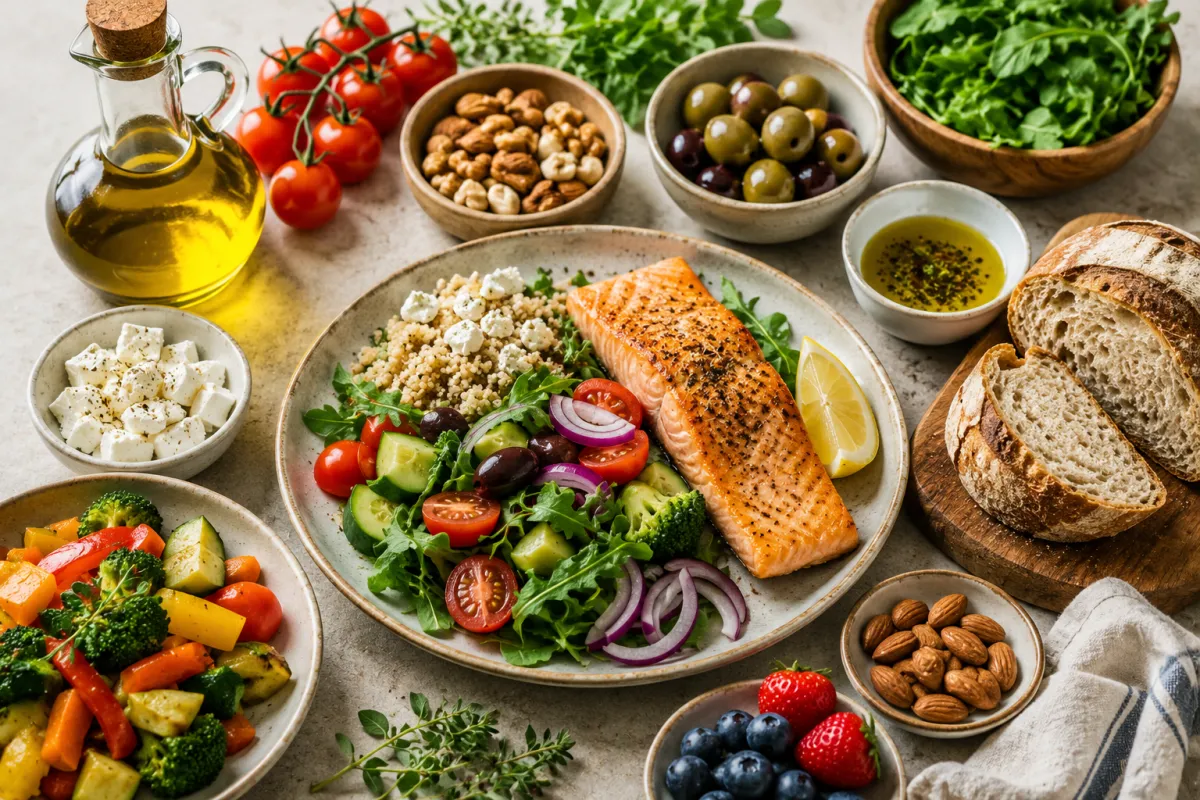
The Mediterranean diet is one of the eating patterns most consistently associated with better cardiovascular health. After a stroke, it can provide a practical framework for eating more vegetables, fruit, wholegrains, beans, lentils, nuts, fish and unsaturated fats while reducing processed meat, excess salt and foods high in saturated fat. It cannot guarantee that another stroke will never happen, but it can support healthier blood pressure, cholesterol, blood glucose and blood-vessel health as part of a wider stroke-prevention plan.
After your stroke...
Food may suddenly feel much more important.
Perhaps your doctor talks about cholesterol.
Your blood pressure is being monitored.
You are told to reduce salt.
Maybe you have diabetes.
Perhaps you have gained weight during recovery because you cannot exercise as much as you once did.
Then somebody tells you:
"You should eat a Mediterranean diet."
You begin wondering...
"What exactly does that mean?"
"Do I need to eat fish every day?"
"Is olive oil really healthy?"
"Do I have to stop eating meat?"
"Can this diet prevent another stroke?"
"What if I don't actually like Mediterranean food?"
These are sensible questions.
Because the Mediterranean diet is often presented as though it is a complicated collection of special foods.
It is not.
It is primarily a pattern of eating.
And that pattern can be adapted to almost any culture or style of cooking.
✦ ✦ ✦
The Good News
You do not need to move to Greece.
You do not need expensive ingredients.
You do not need to eat olives at every meal.
And you certainly do not need to cook elaborate recipes seven days a week.
The main principles are straightforward.
Eat more:
✓ Vegetables
✓ Fruit
✓ Wholegrains
✓ Beans and lentils
✓ Nuts and seeds
✓ Fish
✓ Unsaturated fats
And eat less:
✓ Processed meat
✓ Red meat in large amounts
✓ Butter and other foods high in saturated fat
✓ Highly processed foods
✓ Excess salt
✓ Sugary foods and drinks
HEART UK describes Mediterranean-style eating as rich in vegetables, fruit, legumes, nuts, grains, fish and unsaturated fats such as olive oil, with less meat and highly processed food.
That gives you considerable flexibility.
✦ ✦ ✦
What Exactly Is the Mediterranean Diet?
There is no single official Mediterranean menu.
Traditional diets differ between Spain, Italy, Greece and other Mediterranean countries.
What matters is the overall pattern.
The diet is usually built around plant foods.
That means your plate is more likely to contain:
✓ Vegetables
✓ Beans
✓ Lentils
✓ Wholegrains
✓ Fruit
✓ Nuts
✓ Seeds
Fish and seafood are commonly included.
Olive oil is often used as a main source of added fat.
Meat, particularly processed and red meat, tends to play a smaller role.
That is fundamentally different from a diet built around:
Processed meat.
Chips.
Ready meals.
Pastries.
Sugary drinks.
Large portions of refined carbohydrates.
The Mediterranean diet is therefore less about adding one magical ingredient...
And more about changing the balance of what you eat.
✦ ✦ ✦
Why Is Diet Important After Stroke?
After a stroke, preventing another vascular event becomes an important part of medical care.
Diet can influence several recognised stroke risk factors.
These include:
✓ Blood pressure
✓ Cholesterol
✓ Type 2 diabetes
✓ Body weight
✓ Cardiovascular health
A healthy diet also provides fibre, vitamins, minerals and other nutrients needed for general health.
The Stroke Association recommends a diet containing plenty of fruit, vegetables and fibre-rich foods, including wholegrains, beans and pulses, while reducing excess salt and highly processed foods.
Diet is not the entire prevention plan.
But it is one part you repeatedly influence every day.
✦ ✦ ✦
Can a Mediterranean Diet Prevent Another Stroke?
No diet can promise that.
Be suspicious of anyone claiming otherwise.
A second stroke may depend on factors including:
✓ The cause of your first stroke
✓ Blood pressure
✓ Atrial fibrillation
✓ Cholesterol
✓ Diabetes
✓ Smoking
✓ Genetics
✓ Medication
✓ Other medical conditions
However, Mediterranean-style eating is recommended within cardiovascular and stroke-prevention guidance because it supports several important risk factors.
NICE's secondary-prevention information references a Mediterranean-style dietary pattern high in vegetables, fruit, wholegrains, fish, nuts and olive oil and low in red meat.
Think of the diet as risk reduction, not a guarantee.
✦ ✦ ✦
Vegetables Should Take Up More Space
One of the simplest changes you can make is increasing vegetables.
Try building meals around vegetables rather than treating them as a tiny side portion.
Examples include:
✓ Broccoli
✓ Spinach
✓ Kale
✓ Peppers
✓ Tomatoes
✓ Carrots
✓ Courgettes
✓ Aubergine
✓ Cabbage
✓ Green beans
✓ Mushrooms
✓ Onions
The NHS recommends at least five portions of a variety of fruit and vegetables each day and notes that higher fruit and vegetable intake is associated with lower risks of conditions including heart disease and stroke.
Fresh vegetables are excellent.
But frozen vegetables are perfectly useful too.
That matters after stroke.
If fatigue makes cooking difficult, frozen vegetables may be the difference between actually eating vegetables and throwing away another bag of fresh produce.
✦ ✦ ✦
Fruit Is Part of the Pattern Too
Fruit provides fibre, vitamins and minerals.
Useful choices include:
✓ Apples
✓ Pears
✓ Berries
✓ Oranges
✓ Bananas
✓ Grapes
✓ Melon
✓ Peaches
✓ Plums
You do not need exotic fruit.
Ordinary fruit counts.
Whole fruit is generally preferable to relying heavily on fruit juice because it retains the structure and fibre of the fruit.
If you have diabetes, fruit can still form part of your diet, but your overall carbohydrate intake and portion sizes may need individual consideration.
A dietitian or diabetes team can help if blood-glucose control is difficult.
✦ ✦ ✦
Choose Wholegrains More Often
The Mediterranean pattern generally favours less-refined carbohydrates.
Examples include:
✓ Wholemeal bread
✓ Wholegrain pasta
✓ Brown rice
✓ Oats
✓ Barley
✓ Wholegrain couscous
✓ Wholegrain cereals
Wholegrain foods usually contain more fibre than refined versions.
The Stroke Association specifically recommends choosing wholegrain or wholemeal bread, pasta and rice and including foods such as oats, beans and lentils.
You do not need to eliminate carbohydrates after stroke.
That is unnecessary for most people.
Focus instead on:
Quality.
Portion size.
And what you eat alongside them.
✦ ✦ ✦
Beans and Lentils Are Underrated
Beans, chickpeas and lentils are some of the easiest foods to add.
They provide:
✓ Fibre
✓ Plant protein
✓ Minerals
✓ Fullness
They are also relatively inexpensive.
Try:
Lentils in soups.
Chickpeas in salads.
Kidney beans in chilli.
Beans in stews.
Hummus with vegetables.
Lentil curry.
You can also replace part of the meat in dishes with lentils or beans.
This does not mean you suddenly have to become vegetarian.
You are simply changing the balance.
✦ ✦ ✦
Fish and Stroke Prevention
Fish fits naturally into Mediterranean-style eating.
Oily fish includes:
✓ Salmon
✓ Sardines
✓ Mackerel
✓ Trout
✓ Herring
These provide omega-3 fats as well as protein.
Other fish and seafood can also form part of a balanced diet.
How you prepare fish matters.
Baked salmon with vegetables is very different nutritionally from repeatedly eating heavily battered, deep-fried fish with large amounts of salt.
You do not have to eat fish every day.
And if you do not eat fish at all, you can still follow many Mediterranean principles through plant foods, nuts, seeds, beans and unsaturated fats.
✦ ✦ ✦
What Is Special About Olive Oil?
Olive oil is one of the best-known features of Mediterranean eating.
Its main nutritional advantage is that it is rich in unsaturated fat.
Replacing foods high in saturated fat with foods containing unsaturated fat can help support healthier cholesterol levels. HEART UK lists olive oil, nuts, seeds, avocado and oily fish among important sources of unsaturated fats.
You can use olive oil:
✓ In salad dressing
✓ For roasting vegetables
✓ In sauces
✓ In cooking
✓ Drizzled lightly over food
But healthy does not mean unlimited.
Oil is energy-dense.
Pouring half a bottle of olive oil over your dinner does not make the meal twice as healthy.
Use it sensibly.
✦ ✦ ✦
Nuts and Seeds
Nuts and seeds can provide:
✓ Unsaturated fats
✓ Fibre
✓ Protein
✓ Vitamins and minerals
Examples include:
✓ Walnuts
✓ Almonds
✓ Pistachios
✓ Hazelnuts
✓ Pumpkin seeds
✓ Sunflower seeds
✓ Sesame seeds
A small handful makes a useful snack.
Choose unsalted varieties where possible.
That matters because after stroke you may simultaneously be trying to manage your blood pressure.
Healthy fats are useful.
Large amounts of added salt are not.
✦ ✦ ✦
Why Reducing Saturated Fat Matters
Saturated fat can raise LDL cholesterol.
LDL is often described as "bad cholesterol" because excessive levels can contribute to fatty deposits in artery walls.
HEART UK explains that saturated fats can increase LDL cholesterol and recommends replacing some saturated fat with unsaturated fats.
Foods that may contain significant saturated fat include:
✓ Butter
✓ Fatty meat
✓ Some processed meat
✓ Pastries
✓ Cakes
✓ Some takeaway foods
✓ Full-fat dairy products
The answer is not necessarily to eliminate every gram of saturated fat.
The goal is to improve the overall balance.
✦ ✦ ✦
What About Red Meat?
You do not necessarily need to become vegetarian.
Mediterranean-style diets generally contain smaller quantities of red and processed meat.
Processed meats include:
✓ Bacon
✓ Sausages
✓ Salami
✓ Processed ham
✓ Some deli meats
The Stroke Association recommends limiting processed meat as part of a healthier stroke-prevention diet.
You could replace some meat-based meals with:
✓ Fish
✓ Chicken
✓ Beans
✓ Lentils
✓ Chickpeas
Start with one or two meals per week.
This is much more sustainable than announcing that you will never eat meat again and abandoning the entire plan three days later.
✦ ✦ ✦
Salt Still Matters
A Mediterranean diet is not automatically low in salt.
You can eat olives, cheese, bread, cured meat and sauces and still consume enormous amounts of sodium.
After stroke, blood-pressure control can be extremely important.
So pay attention to:
✓ Processed foods
✓ Sauces
✓ Stock cubes
✓ Ready meals
✓ Processed meat
✓ Takeaways
✓ Salted nuts
✓ Cheese
Instead of relying heavily on salt, build flavour using:
Garlic.
Ginger.
Lemon.
Lime.
Black pepper.
Paprika.
Chilli.
Rosemary.
Thyme.
Cumin.
Coriander.
Healthy food should still taste good.
✦ ✦ ✦
Mediterranean Does Not Mean Expensive
There is a ridiculous version of healthy eating online that makes every meal look like it requires £40 of ingredients and two hours of preparation.
Ignore it.
Some of the cheapest Mediterranean-style foods are:
✓ Oats
✓ Lentils
✓ Beans
✓ Chickpeas
✓ Frozen vegetables
✓ Brown rice
✓ Tinned tomatoes
✓ Wholegrain pasta
✓ Tinned fish
You do not need artisan bread, imported olives and premium extra-virgin olive oil to improve your diet.
The fundamentals matter far more than the branding.
✦ ✦ ✦
What If Fatigue Makes Cooking Difficult?
This deserves serious attention.
Post-stroke fatigue can make cooking exhausting.
You may understand exactly how you should eat and still lack the energy to prepare food.
Make the healthy option easier.
Keep:
✓ Frozen vegetables
✓ Microwaveable wholegrain rice
✓ Canned beans
✓ Canned lentils
✓ Tinned fish
✓ Pre-cut vegetables
✓ Natural yoghurt
✓ Fruit
✓ Unsalted nuts
available.
The Stroke Association also provides simple recipe ideas designed with stroke survivors in mind.
Convenience is not the enemy.
Poor choices that become your default every day are the problem.
✦ ✦ ✦
What If You Have Swallowing Problems?
If you have dysphagia after stroke, ordinary dietary advice may need modification.
A salad may be healthy...
But completely unsafe if you cannot swallow it properly.
Your speech and language therapist may recommend specific food textures or thickened fluids.
Those recommendations come first.
A dietitian can then help make sure your modified diet still provides adequate:
✓ Calories
✓ Protein
✓ Fibre
✓ Vitamins
✓ Minerals
Do not abandon swallowing guidance because a Mediterranean recipe appears healthier.
Food has to be safe and nutritious.
✦ ✦ ✦
What If You Are Losing Weight?
Not every stroke survivor should be trying to lose weight.
Some people lose weight unintentionally after stroke because of:
✓ Dysphagia
✓ Poor appetite
✓ Fatigue
✓ Depression
✓ Difficulty shopping
✓ Difficulty cooking
✓ Changes in taste
If you are underweight or losing weight unexpectedly, a restrictive diet may be inappropriate.
You may need more energy-dense foods rather than fewer calories.
Speak with your doctor or dietitian.
"Healthy eating" does not mean everyone needs to become thinner.
✦ ✦ ✦
Mediterranean Diet and Blood Pressure
This eating pattern can support blood-pressure management partly because it encourages more whole plant foods and less reliance on highly processed, salty foods.
But diet should not replace prescribed medication.
If your blood pressure improves after changing your diet...
Excellent.
Continue monitoring it.
But do not decide:
"My numbers look good, so I'll stop my tablets."
Your medication may be one reason those numbers look good.
Any medication change should be discussed with your healthcare professional.
✦ ✦ ✦
Mediterranean Diet and Cholesterol
This is another area where Mediterranean eating can help.
The pattern typically replaces some saturated fats with:
✓ Olive oil
✓ Nuts
✓ Seeds
✓ Fish
✓ Other unsaturated fats
It also increases fibre through:
✓ Wholegrains
✓ Vegetables
✓ Beans
✓ Lentils
✓ Fruit
HEART UK describes Mediterranean-style diets as supportive of cardiovascular health and healthier blood lipid profiles.
Again...
That does not mean you can stop your statin because you bought some olive oil.
Diet and medication often work together.
✦ ✦ ✦
What About Diabetes?
Mediterranean-style eating can also work well for many people with type 2 diabetes because it emphasises minimally processed foods, fibre and healthier fat sources.
But diabetes treatment varies enormously.
Your medication.
Your glucose levels.
Your weight.
Your kidney function.
And your carbohydrate requirements all matter.
If your stroke and diabetes occur together, consider asking a dietitian for individual advice.
Generic healthy eating is useful.
Personalised diabetes management is better.
✦ ✦ ✦
Is Wine Part of the Mediterranean Diet?
This is where people sometimes choose the part of the Mediterranean diet they like and ignore everything else.
They hear:
"Red wine."
And conveniently forget:
Vegetables.
Fish.
Beans.
Wholegrains.
Nuts.
Physical activity.
No, you do not need wine to follow a Mediterranean diet.
If you do not currently drink alcohol, do not start for supposed cardiovascular benefits.
If you do drink after stroke, your individual medication, blood pressure, heart rhythm and medical history should guide whether alcohol is appropriate.
Wine is optional.
Vegetables are much closer to the point.
✦ ✦ ✦
A Simple Mediterranean-Style Day
You do not need complicated meal plans.
Breakfast
Porridge with berries and a small handful of unsalted nuts.
Lunch
Wholegrain wrap with chicken, salad, tomatoes and hummus.
Snack
Fruit and natural yoghurt.
Dinner
Baked salmon with brown rice and roasted vegetables.
Or:
Lentil and vegetable stew with wholegrain bread.
Or:
Chicken with salad, beans and roasted potatoes.
Nothing here requires specialist stroke food.
It is simply ordinary food arranged differently.
✦ ✦ ✦
Start With Swaps
You do not need to rebuild your kitchen overnight.
Try:
Butter → olive or rapeseed-based alternatives.
White bread → wholegrain bread.
Sausage dinner → fish or lentil dinner.
Crisps → unsalted nuts.
Sugary cereal → oats.
Processed ready meal → simple vegetables, protein and wholegrain carbohydrate.
Sugary drink → water.
Small substitutions repeated consistently can completely change your overall dietary pattern.
✦ ✦ ✦
Do Not Chase Superfoods
Blueberries will not prevent another stroke by themselves.
Neither will:
Olive oil.
Turmeric.
Garlic.
Salmon.
Walnuts.
No individual food carries that kind of power.
The Mediterranean diet works as a pattern.
Eating salmon on Friday does not cancel out heavily processed food, excessive salt and sugary drinks for the rest of the week.
Look at the whole diet.
That is what matters.
✦ ✦ ✦
My Perspective
After stroke, nutrition advice can become unnecessarily complicated.
People start searching for:
The best oil.
The best berry.
The best supplement.
The perfect breakfast.
The perfect anti-stroke food.
I think that misses the point.
Your body does not need a fashionable ingredient.
It needs a consistently better pattern.
More vegetables.
More fibre.
More whole foods.
Better fats.
Less processed meat.
Less excess salt.
Less highly processed food.
That is not glamorous.
But it is practical.
And practical changes are the ones you are most likely to maintain.
You do not need to eat perfectly.
You need to eat better often enough that your normal diet begins supporting your cardiovascular health rather than working against it.
✦ ✦ ✦
When Should You Seek Professional Advice?
Speak with your doctor or dietitian if:
✓ You have difficulty swallowing
✓ You are losing weight unintentionally
✓ You have diabetes that is difficult to control
✓ You have kidney disease
✓ You have been told to restrict potassium
✓ Your cholesterol remains high
✓ Your blood pressure remains poorly controlled
✓ You are unsure what to eat alongside your medication
✓ Fatigue or disability makes preparing meals difficult
Your nutritional needs after stroke may be very different from somebody else's.
A dietitian can help adapt general healthy-eating principles to your actual medical circumstances.
✦ ✦ ✦
Frequently Asked Questions
Is the Mediterranean Diet Good After Stroke?
It can be a very useful eating pattern because it emphasises vegetables, fruit, wholegrains, legumes, nuts, fish and unsaturated fats and aligns closely with cardiovascular and stroke-prevention guidance.
Can It Prevent Another Stroke?
It may help reduce cardiovascular risk, but it cannot guarantee that another stroke will not occur.
Stroke prevention also depends on medication and management of factors such as blood pressure, cholesterol, diabetes, smoking and atrial fibrillation.
Do I Have to Eat Fish?
No.
Fish is common in Mediterranean diets, but many of the benefits come from the broader eating pattern.
Is Olive Oil Good After Stroke?
Olive oil is rich in unsaturated fat and can be used instead of fats higher in saturated fat.
Portion size still matters.
Can I Eat Meat?
Yes.
Mediterranean eating does not require vegetarianism, but red and processed meats generally play a smaller role.
Can I Follow This Diet If I Have Diabetes?
Often yes, but carbohydrate intake and medication requirements should be considered individually.
Do I Need Expensive Ingredients?
No.
Beans, lentils, oats, frozen vegetables, brown rice and tinned fish can all fit the pattern and are relatively inexpensive.
✦ ✦ ✦
Key Takeaways
✓ Mediterranean-style eating can support cardiovascular health after stroke.
✓ The diet emphasises vegetables, fruit, wholegrains, beans, lentils, nuts, fish and unsaturated fats.
✓ Olive oil is useful primarily because it can replace fats higher in saturated fat.
✓ Processed meat, excess salt and highly processed foods should play a smaller role.
✓ Mediterranean eating does not require expensive ingredients.
✓ Frozen and canned foods can make healthier eating easier when fatigue affects cooking.
✓ Swallowing difficulties require specialist advice and safe food textures.
✓ Not every stroke survivor needs to lose weight.
✓ Diet can support blood-pressure, cholesterol and diabetes management but does not replace prescribed medication.
✓ No individual "superfood" can prevent another stroke.
✓ The overall eating pattern matters far more than one perfect meal.
✦ ✦ ✦
Related Articles
Continue learning about nutrition and reducing stroke risk:
Salt and Blood Pressure After Stroke
Diabetes and Stroke Risk
Smoking After Stroke
Alcohol After Stroke
High Blood Pressure After Stroke
Cholesterol After Stroke
Preventing a Second Stroke
Healthy Eating After Stroke
Weight Management After Stroke
Exercise and Stroke Prevention
✦ ✦ ✦
About the Author
Alisia Gayle is a stroke survivor who achieved 96% neurological recovery following an ischaemic stroke.
After years of rehabilitation, she now shares practical, evidence-informed resources to help stroke survivors, carers and families better understand recovery and rebuild their lives with confidence.
Alisia is also the author of Brain Damage: My Journey to 96% Recovery, where she shares her personal stroke recovery story and the lessons she learned throughout her rehabilitation.
✦ ✦ ✦
Medical Disclaimer
This article is intended for educational purposes only and should not replace professional medical or nutritional advice.
Dietary needs after stroke vary according to medical history, medication, swallowing ability, diabetes, kidney function, weight and other individual factors.
Always speak with your doctor, registered dietitian or stroke rehabilitation team if you are uncertain about your nutritional needs.
Do not stop or change prescribed blood-pressure, cholesterol-lowering, diabetes, antiplatelet or anticoagulant medication because you have improved your diet.
✦ ✦ ✦
Final Thoughts
The Mediterranean diet after stroke...
Does not need to be complicated.
It is not about finding one miracle ingredient.
And it is not about eating perfectly.
It is about changing the pattern.
More vegetables.
More fruit.
More beans.
More wholegrains.
Better-quality fats.
Fish where appropriate.
Less processed meat.
Less excess salt.
Less highly processed food.
Start with what you already eat.
Then improve it.
Change the bread.
Change the oil.
Add vegetables.
Swap one processed-meat dinner for fish or lentils.
Keep frozen vegetables available for tired days.
Make healthy eating easier rather than relying on motivation every evening.
Because after stroke...
The objective is not to win an award for the world's cleanest diet.
It is to create a way of eating that you can actually maintain.
One that supports your blood pressure.
Your cholesterol.
Your blood glucose.
Your blood vessels.
And ultimately...
The brain you are working so hard to protect.