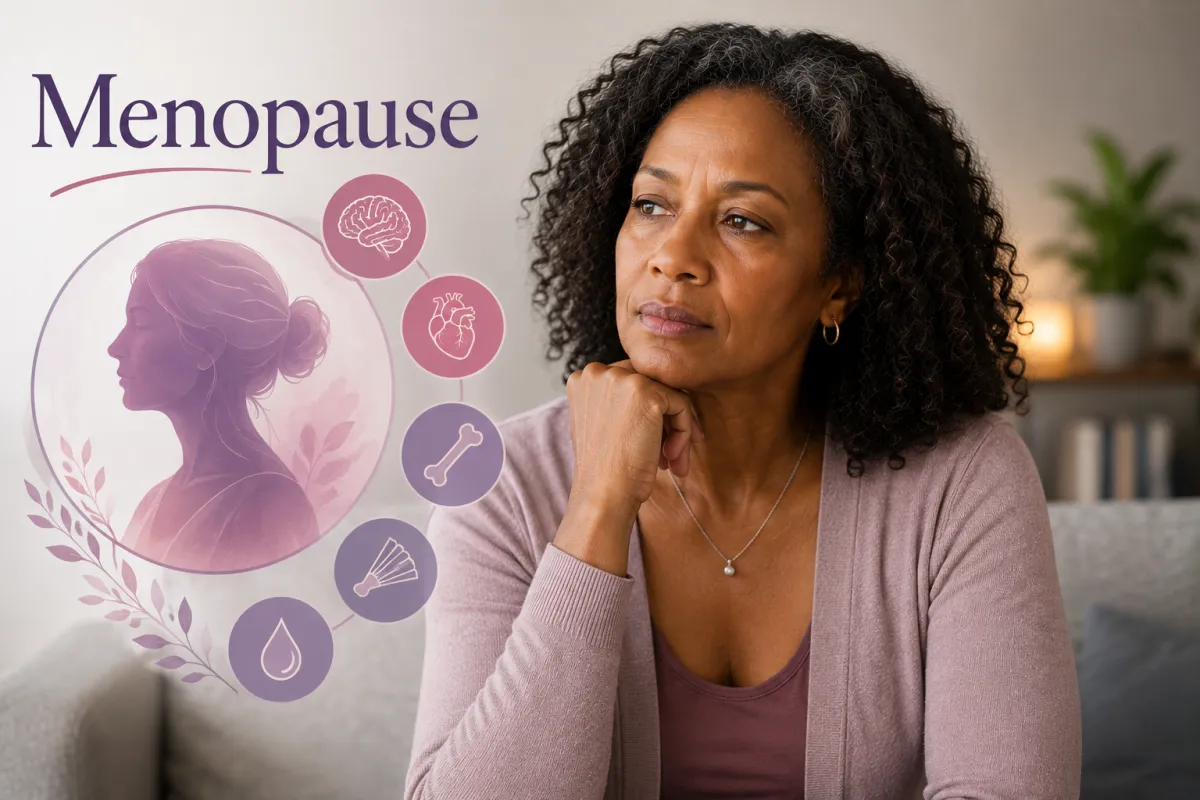
Menopause can make stroke recovery more complicated because several menopausal symptoms overlap with common post-stroke problems. Fatigue, poor sleep, brain fog, memory difficulties, low mood, anxiety, headaches, joint pain and reduced stamina may all occur during perimenopause and menopause as well as after stroke. Menopause also brings changes in cardiovascular health that deserve attention. If you have previously had a stroke, decisions about hormone replacement therapy should be individualised with an appropriately experienced healthcare professional rather than made from general menopause advice alone.
After your stroke...
You may already be trying to understand a body that feels different.
Your energy has changed.
Your concentration may not be what it was.
Perhaps your sleep is poor.
You experience headaches.
Your muscles ache.
Your mood seems unpredictable.
Then your periods begin changing too.
You start having:
Hot flushes.
Night sweats.
Sleep problems.
Brain fog.
Mood changes.
And suddenly you are asking:
"Is this the stroke?"
"Is this menopause?"
"Is menopause making my stroke symptoms worse?"
"Can I take HRT after having a stroke?"
"Why am I suddenly so exhausted again?"
"Am I going backwards in my recovery?"
These are important questions.
Because for women recovering from stroke in their forties and fifties...
Two major neurological and hormonal transitions can occur at exactly the same time.
And separating one from the other is not always easy.
✦ ✦ ✦
The Good News
Menopause does not automatically mean your stroke recovery has stopped.
And a bad week of:
Fatigue.
Poor concentration.
Sleep problems.
Hot flushes.
Mood changes.
does not necessarily mean your neurological recovery is reversing.
Perimenopause and menopause can themselves cause symptoms including problems with memory and concentration, low mood, anxiety and disturbed sleep.
That means symptoms you thought were entirely stroke-related may sometimes be influenced by hormonal changes too.
The useful question becomes:
"What is contributing to this symptom?"
rather than immediately assuming:
"My stroke is getting worse."
If menopause is contributing...
There may be ways to manage it.
✦ ✦ ✦
What Is Perimenopause?
Perimenopause is the transition leading up to menopause.
During this period, hormone levels fluctuate and periods often begin changing.
You may notice:
✓ Irregular periods
✓ Heavier or lighter bleeding
✓ Hot flushes
✓ Night sweats
✓ Poor sleep
✓ Mood changes
✓ Anxiety
✓ Brain fog
✓ Reduced concentration
✓ Headaches
✓ Joint or muscle discomfort
Menopause itself is reached when periods have stopped for 12 consecutive months for reasons not caused by another medical condition or treatment.
The NHS notes that menopause usually affects women between the ages of 45 and 55, although it can happen earlier.
That age range overlaps heavily with the age at which many working-age women are recovering from stroke.
✦ ✦ ✦
Why Can Menopause and Stroke Recovery Be Confusing?
Look at the overlap.
Stroke can cause:
✓ Fatigue
✓ Poor concentration
✓ Memory problems
✓ Low mood
✓ Anxiety
✓ Sleep difficulties
✓ Headaches
✓ Reduced stamina
Menopause can cause:
✓ Fatigue
✓ Poor concentration
✓ Memory problems
✓ Low mood
✓ Anxiety
✓ Sleep difficulties
✓ Headaches
✓ Reduced stamina
The NHS specifically lists sleep problems, low mood, anxiety, memory problems and brain fog among common menopause symptoms.
So when a stroke survivor enters perimenopause...
It can become genuinely difficult to know which condition is responsible.
Sometimes the answer may be:
Both.
✦ ✦ ✦
Menopause Can Make Post-Stroke Fatigue Feel Worse
Post-stroke fatigue can already be one of the most frustrating invisible effects of stroke.
Then menopause arrives.
Night sweats disturb your sleep.
Hot flushes wake you repeatedly.
Hormonal changes affect energy.
You wake exhausted.
Now the fatigue you were gradually learning to manage suddenly feels worse again.
This does not necessarily mean your brain has deteriorated.
Poor sleep alone can worsen:
✓ Concentration
✓ Memory
✓ Mood
✓ Physical stamina
✓ Perception of fatigue
The NHS notes that menopausal problems with memory and concentration can feel worse when sleep is poor and tiredness increases.
So before concluding that your stroke recovery is failing...
Look at your sleep too.
✦ ✦ ✦
Brain Fog Can Be Particularly Frightening After Stroke
For someone who has never experienced a stroke...
Forgetting a word during menopause may be annoying.
For a stroke survivor...
It can be terrifying.
You forget someone's name.
Lose your train of thought.
Walk into a room and forget why.
Struggle to retrieve a word.
Immediately you think:
"Is something happening to my brain?"
That fear is understandable.
Stroke survivors are naturally more alert to neurological changes.
But menopause can also affect memory and concentration.
The important distinction is pattern.
Gradual, fluctuating brain fog is very different from sudden neurological loss.
If you suddenly develop:
Facial weakness.
Arm weakness.
New speech problems.
Sudden numbness.
Sudden visual loss.
Do not label it menopause.
Seek emergency medical help.
✦ ✦ ✦
Hot Flushes Can Trigger Stroke Anxiety
A hot flush can arrive suddenly.
Your face feels hot.
Your heart may seem to race.
You sweat.
You feel strange.
For someone with a history of stroke, that sudden physical change may trigger panic.
You think:
"Something is wrong."
That anxiety can then intensify:
Heart rate.
Breathing.
Dizziness.
Heat.
The entire experience becomes frightening.
Learning your usual menopausal symptoms can help.
But do not become so accustomed to blaming menopause that you ignore genuinely new neurological symptoms.
Menopause can explain many things.
It does not explain sudden one-sided weakness or new aphasia.
✦ ✦ ✦
Sleep Matters More Than You May Realise
Poor sleep can influence almost every aspect of stroke recovery.
When you sleep badly, you may notice worse:
✓ Fatigue
✓ Concentration
✓ Irritability
✓ Motivation
✓ Balance
✓ Exercise tolerance
✓ Headaches
Night sweats and hot flushes can make sleep considerably more difficult during menopause.
You may begin thinking your daytime stroke symptoms have suddenly worsened.
But some of the deterioration may actually reflect repeated sleep disruption.
Practical measures may include:
✓ Keeping the bedroom cool
✓ Using lighter bedding
✓ Wearing breathable nightwear
✓ Limiting late alcohol
✓ Keeping a regular sleep schedule
✓ Discussing persistent symptoms with your GP
Sleep deserves treatment.
Not dismissal.
✦ ✦ ✦
Mood Changes Can Also Overlap
Stroke can affect emotional regulation directly.
It can also cause grief, anxiety and depression because of everything that has happened.
Menopause can add another layer.
You may become:
More anxious.
More irritable.
More emotional.
Less confident.
Lower in mood.
You may wonder:
"Why am I suddenly struggling again?"
Hormonal changes may be contributing.
The NHS recognises mood swings, low mood and anxiety among common menopausal symptoms.
But do not automatically attribute persistent severe depression or anxiety to menopause either.
Mental health symptoms deserve proper assessment.
Especially when they interfere with work, relationships or everyday functioning.
✦ ✦ ✦
Menopause Can Affect Confidence During Recovery
Stroke may already have changed how you feel about your body.
Perhaps you have:
A weaker leg.
A tremor.
A different gait.
Scars.
Weight changes.
Reduced fitness.
Then menopause may bring additional changes such as:
✓ Weight redistribution
✓ Skin changes
✓ Hair changes
✓ Vaginal dryness
✓ Reduced libido
✓ Sleep disruption
✓ Changes in body shape
The NHS notes that weight gain and changes around the abdomen and upper body are common during perimenopause and menopause.
For someone already rebuilding confidence after stroke...
That can feel like your body has changed twice.
Be careful not to turn every change into another reason to dislike yourself.
Your body is moving through two significant processes.
✦ ✦ ✦
Muscle and Joint Symptoms May Affect Rehabilitation
Some women experience:
Muscle aches.
Joint stiffness.
Joint discomfort.
Reduced stamina.
during perimenopause and menopause.
These symptoms can complicate physical rehabilitation.
You may think:
"My stroke leg is getting worse."
But perhaps both legs feel stiff.
Perhaps joints ache in places that were never affected by your stroke.
Look at the pattern.
Is the problem:
One-sided?
New?
Sudden?
Or more general?
If symptoms are new or worsening, discuss them with a healthcare professional rather than assuming either stroke or menopause is responsible.
There may also be unrelated musculoskeletal causes.
Not every symptom has to belong to one of those two diagnoses.
✦ ✦ ✦
Cardiovascular Health Becomes Increasingly Important
Menopause is not simply about hot flushes.
As women age through menopause, overall cardiovascular risk becomes increasingly important.
Blood pressure.
Cholesterol.
Weight.
Blood glucose.
Smoking.
Physical activity.
all deserve attention.
If you have already experienced a stroke...
You are not approaching menopause as somebody with no cardiovascular history.
That means your wider prevention plan remains important.
Continue monitoring and managing:
✓ Blood pressure
✓ Cholesterol
✓ Diabetes where relevant
✓ Smoking
✓ Alcohol
✓ Physical activity
✓ Diet
✓ Medication adherence
Menopause does not replace your existing secondary-prevention plan.
It becomes another factor to consider within it.
✦ ✦ ✦
Blood Pressure Still Matters
Blood pressure is one of the most important modifiable stroke risk factors.
Changes in lifestyle, weight, sleep and age can all influence readings.
If menopause symptoms make you:
Sleep poorly.
Exercise less.
Gain weight.
Drink more alcohol.
Become chronically stressed.
those changes may indirectly affect cardiovascular health.
Continue checking blood pressure as advised.
And if readings rise...
Do not assume:
"That's menopause."
Hypertension still needs proper management.
Likewise...
Do not stop prescribed blood-pressure medication because lifestyle changes improve your readings.
Discuss medication changes with your clinician.
✦ ✦ ✦
Cholesterol May Need Attention Too
Cardiovascular risk changes across midlife.
If you are already taking a statin after an ischaemic stroke...
Continue it according to medical advice.
Menopause is not a reason to replace evidence-based secondary prevention with supplements or dietary experiments.
A Mediterranean-style diet may support cardiovascular health.
Physical activity can help.
Weight management may help where appropriate.
But medication prescribed after stroke should be reviewed professionally.
Not abandoned because you begin a new menopause health routine.
✦ ✦ ✦
Can You Take HRT After a Stroke?
This is where general menopause advice becomes inadequate.
Hormone replacement therapy can be highly effective for menopausal symptoms.
But a previous stroke changes the conversation.
Current NICE guidance recommends specialist input when considering HRT in people with a personal history of coronary heart disease or stroke.
That does not mean every woman who has had a stroke will automatically be told:
"No HRT ever."
It means the decision deserves individual assessment.
Your clinician may need to consider:
✓ What type of stroke you had
✓ Why the stroke occurred
✓ Your blood pressure
✓ Whether you smoke
✓ Migraine history
✓ Clotting history
✓ Other cardiovascular risks
✓ The severity of your menopause symptoms
✓ Which form of HRT is being considered
This is not a decision to copy from somebody in a menopause Facebook group.
✦ ✦ ✦
Route of HRT Can Matter
Not all HRT is delivered in the same way.
Oestrogen may be taken as:
✓ Tablets
✓ Patches
✓ Gel
✓ Spray
The NHS currently states that HRT tablets slightly increase stroke risk, whereas patches, gels and sprays do not appear to increase stroke risk in the same way.
NICE similarly states that stroke risk is unlikely to increase with combined HRT using transdermal oestrogen.
But this information mainly describes population-level risk.
It does not automatically answer what is suitable after you have already had a stroke.
That is why specialist assessment matters.
✦ ✦ ✦
Do Not Stop or Start HRT by Yourself
Perhaps you were already taking HRT when your stroke occurred.
Or perhaps you are now considering starting it because menopausal symptoms are severely affecting your life.
Do not make the decision alone.
Likewise...
Do not abruptly conclude:
"I've had a stroke, so all hormones are forbidden forever."
The risk-benefit calculation can be more nuanced.
Discuss:
Your previous stroke.
Your other cardiovascular risks.
Your symptoms.
The HRT formulation.
Alternative treatments.
with an experienced clinician.
The safest option should be based on your actual health history rather than fear or internet generalisation.
✦ ✦ ✦
What If You Cannot or Do Not Want to Use HRT?
HRT is not the only possible approach to menopause symptoms.
Depending on the problem, treatment may involve:
✓ Lifestyle changes
✓ Psychological approaches
✓ Non-hormonal medicines
✓ Vaginal treatments
✓ Sleep management
✓ Treatment of mood symptoms
NICE recommends discussing treatment options based on symptoms, preferences and individual risks.
If HRT is not suitable for you...
That does not mean:
"Just tolerate everything."
Ask what alternatives exist for the symptoms affecting you most.
Treat the problem in front of you.
Hot flushes may need one strategy.
Sleep another.
Mood another.
Vaginal symptoms another.
✦ ✦ ✦
Vaginal Symptoms Deserve Attention Too
Menopause can cause:
✓ Vaginal dryness
✓ Soreness
✓ Pain during sex
✓ Urinary symptoms
These problems can further complicate intimacy after stroke.
You may already be dealing with:
Reduced confidence.
Fatigue.
Changed sensation.
Physical limitations.
Then painful sex is added on top.
Do not assume this is simply something you must accept.
Local vaginal oestrogen and other treatments may be considered for menopausal genitourinary symptoms, although people with a history of stroke should discuss suitability with their healthcare professional.
Sexual health remains part of health after stroke.
✦ ✦ ✦
Exercise Can Help Both Areas
Appropriate physical activity can support:
✓ Cardiovascular fitness
✓ Strength
✓ Mobility
✓ Bone health
✓ Mood
✓ Weight management
✓ Confidence
It can also remain an important component of stroke rehabilitation.
You do not need two completely separate exercise lives:
"Stroke exercise."
and:
"Menopause exercise."
Your programme can support both.
For example:
Walking.
Strength training.
Balance work.
Mobility exercises.
Appropriate cardiovascular exercise.
The exact level should reflect your neurological abilities and medical advice.
Build gradually.
Especially if fatigue is significant.
✦ ✦ ✦
Strength Training Becomes Particularly Useful
Stroke may have caused weakness on one side.
Menopause and ageing also make maintaining muscle and bone health increasingly important.
Resistance exercise can therefore serve several purposes.
You may work on:
✓ Leg strength
✓ Hip strength
✓ Upper-body strength
✓ Balance
✓ Functional movement
✓ Bone-loading activity where appropriate
The goal is not necessarily bodybuilding.
It is maintaining enough strength to support:
Walking.
Stairs.
Balance.
Work.
Daily activities.
Independence.
Strong muscles are useful at every stage of recovery.
✦ ✦ ✦
Nutrition Still Matters
Menopause does not require a strange specialist diet.
And neither does stroke recovery.
A broadly cardiovascular-friendly eating pattern remains useful.
Think:
✓ Vegetables
✓ Fruit
✓ Wholegrains
✓ Beans and lentils
✓ Fish
✓ Lean protein
✓ Nuts and seeds
✓ Unsaturated fats
Also pay attention to:
✓ Salt
✓ Alcohol
✓ Highly processed foods
✓ Excess saturated fat
If weight changes during menopause, resist extreme dieting.
You still need adequate:
Protein.
Energy.
Vitamins.
Minerals.
especially if you are physically rehabilitating.
You cannot build strength effectively while chronically under-fuelling.
✦ ✦ ✦
Alcohol May Make Symptoms Worse
Alcohol can affect:
Sleep.
Hot flushes.
Blood pressure.
Mood.
Balance.
Medication.
For a stroke survivor experiencing menopause, those effects can overlap dramatically.
Perhaps two glasses of wine now leave you:
Flushed.
Awake at 3am.
Exhausted the following morning.
Less steady.
More anxious.
Pay attention to your response.
You do not need to stop drinking solely because you are menopausal.
But you may discover that the amount you previously tolerated no longer works well for you.
Health advice after stroke should also guide your decision.
✦ ✦ ✦
Weight Gain Can Feel Especially Frustrating
You may already have become less active after stroke.
Then menopause changes body composition and weight distribution.
You look at yourself and think:
"I don't recognise this body."
Avoid responding with punishment.
Extreme restriction.
Crash diets.
Overtraining.
Instead focus on:
✓ Strength training
✓ Gradually increasing activity
✓ Adequate protein
✓ High-fibre foods
✓ Portion awareness
✓ Sleep
✓ Consistency
If weight has changed significantly or unexpectedly...
Speak with your healthcare professional.
Thyroid disease and other medical issues can sometimes produce similar symptoms.
Do not assume everything is menopause.
✦ ✦ ✦
Your Symptoms Deserve a Proper Review
If you are a stroke survivor entering perimenopause...
A useful clinical review may consider:
✓ Menstrual changes
✓ Hot flushes
✓ Sleep
✓ Mood
✓ Cognition
✓ Fatigue
✓ Blood pressure
✓ Medication
✓ Stroke history
✓ Cardiovascular risk
✓ Contraception
✓ HRT suitability
This prevents treatment becoming fragmented.
You do not want one clinician treating menopause as though the stroke never happened...
while another treats the stroke as though menopause cannot affect how you feel.
Both histories matter.
✦ ✦ ✦
Keep a Symptom Diary
When symptoms overlap, patterns are useful.
For several weeks, record:
✓ Sleep
✓ Hot flushes
✓ Periods
✓ Fatigue
✓ Headaches
✓ Mood
✓ Brain fog
✓ Exercise
✓ Medication changes
You may discover:
Your fatigue is much worse after poor sleep.
Your headaches cluster around hormonal changes.
Your concentration improves on better-rested days.
This does not diagnose the cause.
But it gives your healthcare professional much better information than:
"I just feel terrible all the time."
Patterns help.
✦ ✦ ✦
Do Not Dismiss New Symptoms as Menopause
This is critical.
Once menopause has been diagnosed, there can be a temptation to attribute everything to hormones.
Do not.
Sudden:
✓ Facial weakness
✓ Arm or leg weakness
✓ Speech difficulty
✓ New one-sided numbness
✓ Sudden visual loss
✓ Severe unexplained neurological change
still requires emergency assessment.
Likewise, chest pain, fainting, severe shortness of breath or other serious symptoms require appropriate medical attention.
Menopause is common.
That does not mean every symptom occurring during menopause is caused by menopause.
✦ ✦ ✦
And Do Not Blame Everything on Your Old Stroke
The reverse also matters.
You may have been saying for years:
"It's my stroke fatigue."
"It's stroke brain fog."
"My mood has never been right since the stroke."
Then perimenopause arrives unnoticed.
If symptoms change or intensify during your forties or fifties...
It is reasonable to ask whether hormonal changes are contributing.
A previous stroke does not make you immune from ordinary midlife health conditions.
You deserve assessment for the person you are now.
Not simply the diagnosis you received years ago.
✦ ✦ ✦
The Emotional Impact
Going through menopause after stroke can feel like another loss of control over your body.
You may think:
"Haven't I dealt with enough?"
You spent years recovering.
You finally learned how your body works.
Then it changes again.
That frustration is understandable.
You may experience another period of adjustment involving:
Body image.
Sexual confidence.
Energy.
Mood.
Work.
Sleep.
But menopause is not a second stroke.
And menopause symptoms do not erase the recovery you have already achieved.
You may simply need another period of adaptation.
✦ ✦ ✦
My Perspective
Menopause and stroke recovery can become incredibly confusing because the symptoms overlap so well.
Fatigue.
Brain fog.
Poor sleep.
Anxiety.
Reduced stamina.
Headaches.
If you have already experienced a stroke, you are likely to notice every neurological change more closely than someone who has not.
That makes sense.
But I would avoid two extremes.
Do not assume every bad day means your stroke is worsening.
And do not allow someone to dismiss every symptom with:
"It's just menopause."
Investigate what needs investigating.
Treat menopausal symptoms properly.
Continue managing stroke risk properly.
And make sure clinicians considering HRT understand your complete stroke history.
Your body is not divided into separate departments.
Hormones.
Brain.
Heart.
Blood vessels.
Sleep.
Mood.
Physical function.
They affect one another.
Your care should recognise that.
✦ ✦ ✦
When Should You Seek Medical Advice?
Speak with your GP, menopause specialist or stroke team if:
✓ Menopausal symptoms are significantly affecting everyday life
✓ Fatigue suddenly becomes much worse
✓ Sleep problems are persistent
✓ Brain fog or concentration problems change substantially
✓ Mood symptoms become difficult to manage
✓ You are considering HRT
✓ You were using HRT when your stroke occurred
✓ You have questions about vaginal oestrogen
✓ You experience significant changes in blood pressure
✓ Menopause symptoms are interfering with rehabilitation or work
NICE recommends specialist involvement when HRT is being considered in someone with a personal history of stroke or coronary heart disease.
Seek emergency medical help for new sudden neurological symptoms.
Never assume they are simply menopause.
✦ ✦ ✦
Frequently Asked Questions
Can Menopause Make Stroke Fatigue Worse?
Potentially.
Menopause can cause fatigue and disturb sleep, which may add to existing post-stroke fatigue.
Can Menopause Cause Brain Fog?
Yes.
Problems with memory and concentration are recognised menopause symptoms.
How Do I Know Whether Brain Fog Is Stroke or Menopause?
There may not always be a simple distinction.
Look at timing and pattern and discuss significant changes with your healthcare professional.
Sudden new neurological symptoms should always be treated as possible stroke symptoms.
Can I Take HRT After Having a Stroke?
Possibly in some circumstances, but this requires individual specialist assessment.
NICE recommends specialist advice when considering HRT in someone with a personal history of stroke.
Do HRT Patches Increase Stroke Risk?
Current NHS guidance states that HRT tablets slightly increase stroke risk, while patches, gels and sprays do not appear to increase stroke risk in the same way.
A previous stroke still requires individual assessment.
Can Menopause Affect My Balance?
Menopause can contribute to symptoms such as fatigue, dizziness and musculoskeletal problems, while stroke itself can affect balance.
New or worsening balance problems should therefore be properly assessed.
Should I Stop Stroke Medication When Starting HRT?
No.
Never stop or change prescribed stroke-prevention medication without medical advice.
Any HRT plan should take your existing medication and cardiovascular history into account.
✦ ✦ ✦
Key Takeaways
✓ Menopause and stroke recovery can produce overlapping symptoms.
✓ Fatigue, brain fog, sleep disturbance, mood changes and reduced stamina can occur with both.
✓ Worsening fatigue does not automatically mean stroke recovery is reversing.
✓ Poor menopausal sleep can amplify daytime cognitive and physical symptoms.
✓ New sudden neurological symptoms should never be dismissed as menopause.
✓ Menopause occurs during a period when cardiovascular risk deserves increasing attention.
✓ Blood pressure, cholesterol, diabetes, smoking and other stroke risks still need active management.
✓ HRT may be possible for some women after stroke, but specialist individual assessment is important.
✓ Oral HRT tablets and transdermal oestrogen do not carry identical stroke-risk profiles.
✓ Do not start or stop HRT without discussing your stroke history with an appropriate clinician.
✓ Physical activity, strength training, sleep and cardiovascular-friendly nutrition can support both general midlife health and stroke recovery.
✓ A symptom diary can help identify patterns when menopause and stroke symptoms overlap.
✓ Menopause does not erase the stroke recovery you have already achieved.
✦ ✦ ✦
Related Articles
Continue learning about women's health and stroke recovery:
Women and Stroke Risk
Stroke Under 50
Stroke in Your 40s
Hormone Replacement Therapy After Stroke
Fatigue After Stroke
Brain Fog After Stroke
Sleep Problems After Stroke
Weight Gain After Stroke
Sex After Stroke
High Blood Pressure After Stroke
✦ ✦ ✦
About the Author
Alisia Gayle is a stroke survivor who achieved 96% neurological recovery following an ischaemic stroke.
After years of rehabilitation, she now shares practical, evidence-informed resources to help stroke survivors, carers and families better understand recovery and rebuild their lives with confidence.
Alisia is also the author of Brain Damage: My Journey to 96% Recovery, where she shares her personal stroke recovery story and the lessons she learned throughout her rehabilitation.
✦ ✦ ✦
Medical Disclaimer
This article is intended for educational purposes only and should not replace professional medical, menopause or stroke-prevention advice.
Menopause treatment after stroke requires individual assessment because suitability may depend on the type and cause of stroke, cardiovascular risk factors, blood pressure, clotting history, migraine history, medication and the type and route of hormone therapy being considered.
Speak with your GP, menopause specialist, neurologist or stroke team before starting, stopping or changing HRT.
Do not stop prescribed antiplatelet, anticoagulant, statin, blood-pressure or other stroke-prevention medication because of menopausal symptoms without professional advice.
Seek emergency medical attention immediately for new or sudden symptoms of stroke.
✦ ✦ ✦
Final Thoughts
Menopause and stroke recovery...
Can feel like your body changing the rules again.
You may finally understand your post-stroke fatigue.
Then your sleep changes.
You finally trust your concentration.
Then brain fog appears.
You finally feel physically confident.
Then your body changes again.
It can be frustrating.
But it does not mean you have lost your recovery.
Sometimes the problem is the stroke.
Sometimes it is menopause.
Sometimes it is poor sleep.
Sometimes it is medication.
Sometimes several things are happening together.
That is why your symptoms deserve curiosity rather than assumptions.
Track changes.
Ask questions.
Manage your cardiovascular risks.
Continue rehabilitation.
Treat menopause symptoms when they need treatment.
And if you are considering HRT...
Make sure the decision is based on your stroke history rather than advice written for someone who has never experienced a vascular event.
Most importantly...
Do not allow menopause to make you believe you are neurologically going backwards without evidence.
And do not allow a previous stroke to make you believe you simply have to suffer through menopause without treatment.
You have already learned how complicated recovery can be.
This is another stage of understanding your body.
Not the end of the progress you have made.