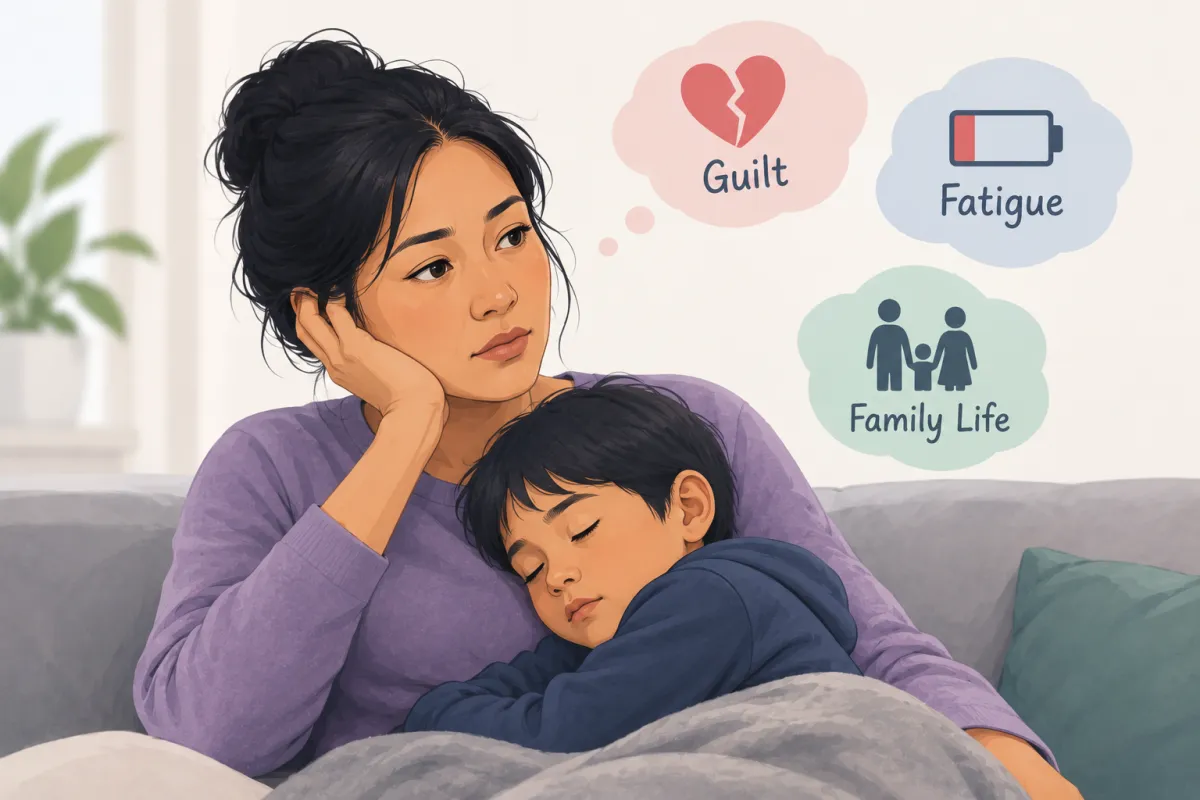
Parenting after a stroke can feel overwhelming.
You may be trying to recover movement, speech, memory or independence while still being responsible for a child who needs comfort, consistency and attention.
Before your stroke, you may have managed school runs, meals, homework, bedtime, appointments and family activities without thinking twice. After your stroke, even one of those tasks may require planning, assistance or recovery time.
You may worry that your child has lost the parent they once knew.
You may feel guilty because you cannot play, travel, work or care for them exactly as you did before. You may also feel frustrated when other adults begin making decisions that previously belonged to you.
But needing help does not mean you have stopped being a parent.
Your physical abilities may have changed. Your role has not disappeared.
This article explains how stroke can affect parenting, how children may respond and how to remain emotionally present and involved while protecting your recovery.
✦ ✦ ✦
Stroke Changes the Whole Family
A stroke happens to one person, but its consequences can spread through the entire household.
Your partner may suddenly become a carer. Grandparents may take over childcare. Children may stay with relatives. Family routines may change without warning.
You may return home to discover that everyone has adapted to life without your usual involvement.
That can be painful.
You may feel as though you have been replaced in your own family.
The people around you may be trying to help, but practical support can easily turn into taking over. Decisions may be made for you because you are tired, communicate slowly or cannot complete certain physical tasks.
Your family may need support.
But so do you.
Stroke can cause physical, emotional and hidden effects, including fatigue and changes in behaviour, and these effects can alter family responsibilities and relationships.
The goal is not to pretend that nothing has changed.
It is to create a new family structure that supports your recovery without removing your identity and authority as a parent.
✦ ✦ ✦
The Fear That You Are No Longer a Good Parent
Many parents judge themselves according to what they can physically provide.
You may believe that being a good parent means:
Preparing every meal
Taking your child to school
Working and earning money
Keeping the house organised
Playing physically
Attending every event
Helping with homework
Managing discipline
Remaining emotionally strong
Never needing help
After a stroke, some of these responsibilities may temporarily or permanently become difficult.
That can make you feel inadequate.
But parenting is not simply a list of physical tasks.
Children also need:
You may not be able to run around a playground.
You can still listen to your child.
You may not be able to complete the school run.
You can still ask what happened during their day.
You may need help preparing dinner.
You can still sit with your child while they eat.
Your parenting may need to change.
That does not mean it has ended.
✦ ✦ ✦
Children May Not Understand What Happened
Adults often use broad phrases around children:
“Mum is poorly.”
“Dad had an accident in his brain.”
“Mum needs to get better.”
“Dad is resting.”
“Everything will be fine.”
These explanations may be intended to protect the child, but vague information can create greater fear.
Children notice changes.
They may have seen an ambulance arrive. They may have visited you in hospital. They may notice that you walk differently, cannot use one arm or struggle to speak.
When adults refuse to explain what happened, children may invent their own explanation.
Their imagined version may be more frightening than the truth.
Explain the stroke in language that matches the child’s age.
For a young child, you might say:
“A blood vessel in my brain became blocked, and part of my brain was injured. That is why my arm is weak and I get very tired. The doctors and therapists are helping me practise.”
For an older child, you can provide more detail and allow questions.
You do not need to share every medical uncertainty.
You do need to give them enough truthful information to understand what they are seeing.
✦ ✦ ✦
Children May Believe the Stroke Was Their Fault
Young children can connect unrelated events.
A child may remember arguing with you before the stroke and secretly believe that the argument caused it.
They may think:
“Mum became ill because I was naughty.”
“Dad collapsed because I made him angry.”
“Maybe it will happen again if I upset her.”
“I should behave perfectly so he stays well.”
Tell your child directly that the stroke was not caused by anything they said, thought or did.
Do not assume they already understand this.
You may need to repeat the reassurance more than once.
Say clearly:
“You did not cause my stroke. Nothing you did made this happen.”
That sentence can remove a burden the child may have been carrying silently.
✦ ✦ ✦
How Children May React to a Parent’s Stroke
Children do not always express distress in obvious ways.
Some children cry or ask repeated questions.
Others appear unaffected at first.
A child may respond by:
Becoming unusually quiet
Becoming clingy
Refusing to leave you
Having difficulty sleeping
Experiencing nightmares
Becoming angry or aggressive
Struggling at school
Losing interest in activities
Complaining of headaches or stomach aches
Returning to younger behaviour
Becoming excessively helpful
Avoiding discussions about the stroke
Constantly checking whether you are alive or well
Becoming frightened whenever you rest
Worrying that another family member will also become ill
These reactions do not automatically mean that something is seriously wrong.
They may be the child’s attempt to process fear, uncertainty and disruption.
However, persistent changes should not be dismissed.
Speak with the child’s school, GP or another suitable professional when distress continues, worsens or interferes with everyday life.
✦ ✦ ✦
Your Child May Become Afraid of Losing You
Children may not understand the difference between being seriously ill and dying.
If they saw you unconscious, unable to move or attached to medical equipment, they may believe that you almost disappeared.
Even after you return home, they may remain alert for signs of danger.
They may watch how you walk. They may panic when you sleep deeply. They may become frightened if you complain of a headache or feel tired.
Reassurance should be truthful.
Avoid promising:
“I will never have another stroke.”
You cannot guarantee that.
Instead, say:
“The doctors are helping me understand why the stroke happened. I take medicine and follow advice to help reduce the risk. If I ever feel suddenly unwell, the adults know what to do.”
This gives the child reassurance without making a promise you cannot control.
✦ ✦ ✦
Stroke Fatigue Can Make Parenting Difficult
Stroke fatigue is not ordinary tiredness.
It can appear after physical movement, concentration, conversation, noise or emotional stress.
You may begin the day feeling capable and suddenly reach a point where your brain and body can no longer continue.
This can be difficult for children to understand.
A child may think you are refusing to play, ignoring them or choosing sleep over spending time together.
Explain fatigue in simple terms:
“My brain uses much more energy now. When my energy runs out, I need quiet and rest so I can function again.”
The Stroke Association identifies fatigue as one of the hidden effects that family and friends may need help understanding after stroke.
Plan around your energy
Identify the times of day when you function best.
Use those periods for the parenting tasks that matter most, such as:
Do not spend your limited energy proving that you can complete every household chore and then have nothing left for your child.
That is poor energy management, not successful parenting.
Let someone else wash the dishes when necessary.
Save some of yourself for the relationship.
✦ ✦ ✦
Create Short, Meaningful Time Together
You may not be able to spend several active hours with your child.
That does not mean the time you have is worthless.
Ten focused minutes can matter more than an hour in which you are exhausted, distracted or struggling to remain awake.
Low-energy ways to connect include:
Reading a book together
Watching a programme and discussing it
Listening to music
Drawing or colouring
Completing a puzzle
Looking through photographs
Asking about the best and worst part of the child’s day
Helping choose clothes for tomorrow
Sitting outside together
Practising spelling or times tables
Letting the child show you a game
Making simple plans for the weekend
Recording a bedtime message when you need to rest early
Do not dismiss these moments because they look small.
Children often remember repeated attention more than elaborate activities.
✦ ✦ ✦
When You Cannot Play as You Did Before
You may have previously played football, chased your child, cycled, swam or visited busy attractions.
After a stroke, weakness, balance problems, visual changes or fatigue may make those activities difficult or unsafe.
This loss can hurt both you and your child.
A child may continue asking:
“When can we play football again?”
You may not know the answer.
Do not repeatedly make promises based on the recovery you hope to achieve.
Say:
“I am working hard to get stronger. I cannot play in the same way right now, but we can find another way to do something together.”
You might:
Sit in goal while the child takes gentle shots
Keep score while another adult plays
Watch practice
Help choose equipment
Play a table-based version of the activity
Set small rehabilitation goals connected to family activities
Attend for a shorter period
Participate from a safe position
Adaptation is not surrender.
It keeps the relationship active while your abilities develop.
✦ ✦ ✦
Communication Problems Can Affect Parenting
Stroke can cause aphasia, dysarthria, slowed processing and difficulties with reading or writing.
Communication problems are common after stroke and can affect speaking, understanding, reading and writing.
You may know what you want to tell your child but struggle to produce the words.
You may find it difficult to read school letters, help with homework or follow rapid conversations.
This can be frustrating when you are trying to comfort or discipline a child.
Explain the communication difficulty
Tell your child:
“My brain knows what I want to say, but sometimes the words take longer to come out.”
Or:
“My speech sounds different, but I am still thinking and understanding.”
Children may otherwise assume that you no longer understand them.
Ask for communication support
Helpful strategies may include:
Speaking one at a time
Reducing background noise
Giving you longer to answer
Using short sentences
Writing down important information
Using gestures, pictures or a communication app
Checking what you understood
Avoiding finishing every sentence for you
Taking breaks when communication becomes tiring
Your child should not be expected to become your speech therapist.
But age-appropriate understanding can reduce frustration for everyone.
✦ ✦ ✦
Difficulty Controlling Emotions
Some stroke survivors experience emotionalism, irritability, anxiety, reduced inhibition or sudden changes in mood.
You may cry more easily. You may become overwhelmed by noise. You may lose your temper faster than before.
Stroke-related behaviour changes can affect both the survivor and the people around them.
Children may not understand that these reactions can be connected to brain injury and exhaustion.
They may believe your anger or tears are their fault.
Explain what is happening without using the stroke to excuse harmful behaviour.
You might say:
“My brain becomes overwhelmed more quickly now. That explains why I reacted strongly, but shouting at you was still not acceptable. I am sorry.”
That statement does three things:
It gives context.
It takes responsibility.
It reassures the child.
A stroke may explain why emotional control has become harder.
It does not mean children must tolerate frightening or abusive behaviour.
Seek professional support when anger, aggression, impulsivity or emotional changes are damaging family life.
✦ ✦ ✦
Discipline After Stroke
Some parents lose confidence in setting boundaries after a stroke.
You may feel guilty because your child has already been through a frightening experience.
You may allow behaviour you previously would have corrected because you do not want to cause more distress.
That approach usually backfires.
Children need compassion, but they also need structure.
Removing every boundary may make home feel less secure, not more secure.
Where possible:
Keep household rules clear.
Agree consistent consequences with other adults.
Avoid arguing about discipline in front of the child.
Do not let relatives undermine your authority.
Adjust expectations when the child is distressed, but do not abandon them completely.
Separate behaviour caused by fear from behaviour that still needs correction.
You can be understanding without becoming powerless.
✦ ✦ ✦
Do Not Let Other Adults Erase Your Authority
After a stroke, partners or relatives may take control of family routines because something needs to be done.
Initially, that may be necessary.
The problem begins when temporary assistance becomes permanent exclusion.
You may hear:
“Don’t worry about it.”
“I’ve already decided.”
“You need to focus on recovery.”
“It is easier if I handle the children.”
“You’re too tired to deal with this.”
“We don’t want to stress you.”
Some decisions may genuinely need to be delegated.
But you should not be removed from parenting simply because another adult can complete tasks faster.
Ask to remain involved in decisions about:
School
Health
Behaviour
Routines
Activities
Money
Childcare
Family rules
Important events
You may need information presented slowly or in writing.
You may need extra time to decide.
That is accommodation.
It is not evidence that your opinion no longer matters.
✦ ✦ ✦
Avoid Turning Your Child Into a Carer
Children often want to help after a parent’s stroke.
Small responsibilities can make them feel useful and included.
Depending on their age, they might:
Bring you a cushion
Pass you an item
Help prepare a simple snack
Remind you where something is
Join you during rehabilitation exercises
Help choose a quiet family activity
But a child should not become responsible for your safety, medication, personal care or emotional stability.
Warning signs that the child is carrying too much include:
Missing school to help you
Managing your medication
Helping with intimate personal care
Constantly checking whether you are breathing
Feeling unable to leave the house
Abandoning friendships or activities
Believing they must keep you happy
Acting as the main contact during emergencies
Concealing their own distress to protect you
Taking responsibility for younger siblings beyond what is reasonable
This is too much.
Children can contribute to family life.
They should not be made responsible for holding the family together.
✦ ✦ ✦
Do Not Use Your Child as Emotional Support
You may feel frightened, angry or devastated by what happened.
Those feelings are valid.
But your child cannot become the person who reassures you that everything will be fine.
Avoid repeatedly telling them:
That you are terrified of dying
That the family may lose its home
That your partner is failing you
That you feel your life is over
That they are the only reason you continue
That you need them to be strong for you
Children need honest information, but adult emotional burdens should be taken to another adult, counsellor or support service.
A child should know that you have feelings.
They should not feel responsible for managing them.
✦ ✦ ✦
Returning Home From Hospital
Coming home can be emotional.
You may expect relief, but the reality can be difficult.
Your child may rush towards you, climb onto you or expect everything to return to normal immediately.
Prepare them before you arrive.
Explain:
Whether you can be hugged
Whether one side of your body is painful or weak
Whether you use a wheelchair, stick or AFO
Whether your speech sounds different
Whether you need help on stairs
Why you need to sleep
Which medical equipment they should not touch
What to do if you suddenly become unwell
Let them see any mobility aid or equipment in advance when possible.
A wheelchair or walking stick may appear frightening when it arrives without explanation.
Present it as a tool that helps you move safely—not as evidence that you have stopped being their parent.
✦ ✦ ✦
Safety at Home
Parenting may involve lifting, cooking, bathing, driving and responding quickly to danger.
After a stroke, you may need to reconsider which tasks are currently safe.
Depending on your difficulties, risks may include:
Carrying a baby while balance is impaired
Lifting a child with one-sided weakness
Using stairs while carrying items
Cooking when attention or sensation is reduced
Bathing a young child alone
Driving before medical clearance
Taking children near roads when mobility is limited
Being the only adult present when seizures or medical complications remain uncontrolled
Supervising swimming when reaction time is affected
This is not about declaring you incapable.
It is about refusing to let pride create a preventable accident.
Ask an occupational therapist or another appropriate professional to help assess daily tasks and suggest safer methods.
Use equipment or another adult’s support where necessary.
Independence built on unsafe decisions is not independence.
✦ ✦ ✦
Parenting a Baby or Toddler After Stroke
Babies and toddlers require repeated lifting, carrying and supervision.
This can be particularly challenging when you have weakness, poor balance, sensory loss or fatigue.
Possible adaptations may include:
Changing the baby on a safe floor-level mat
Using a cot with accessible features where professionally recommended
Keeping supplies within easy reach
Using seated feeding positions
Avoiding carrying the baby on stairs
Using a lightweight pushchair suited to your abilities
Creating safe play areas
Asking another adult to handle bathing temporarily
Scheduling rest around the child’s sleep
Using one-handed equipment where appropriate
Do not improvise unsafe baby-handling techniques based solely on determination.
Ask an occupational therapist, physiotherapist or suitable childcare professional to observe the actual tasks you need to complete.
Generic advice is not enough when a baby’s safety is involved.
✦ ✦ ✦
Parenting Older Children and Teenagers
Older children may understand more, but that does not mean they are unaffected.
Teenagers may respond by becoming distant, angry or unusually independent.
They may resent:
Additional responsibilities
Reduced family income
Cancelled activities
Less privacy
Having friends visit a changed household
Being expected to behave like an adult
Feeling overlooked because attention is focused on recovery
They may also feel guilty for resenting any of these things.
Give them permission to have mixed emotions.
They can love you and still hate what happened.
They can understand your limitations and still feel disappointed.
Do not force them to produce constant gratitude or maturity.
Ask specific questions instead of:
“Are you okay?”
Try:
“What has been hardest since I came home?”
“Is there anything you have stopped doing because of my stroke?”
“Do you feel that too much is expected of you?”
“Is there something you are afraid to ask me?”
“What would make home feel more normal?”
Then listen without immediately defending yourself.
✦ ✦ ✦
School May Need to Know
A child’s concentration, attendance or behaviour may change after a parent’s stroke.
Informing the school can help staff interpret the child’s behaviour accurately.
You do not need to disclose every medical detail.
You can explain:
That a parent has had a stroke
Whether the parent remains in hospital
Whether routines or living arrangements have changed
Whether the child witnessed the emergency
Whether the child is taking on additional responsibilities
What signs of distress have appeared
Who the school should contact
What information may be shared with relevant staff
Ask the school to tell you about significant changes in:
Behaviour
Attendance
Academic performance
Friendships
Emotional regulation
Tiredness
Withdrawal
Children may behave normally at home and fall apart at school—or the other way around.
Information from both environments provides a clearer picture.
✦ ✦ ✦
Financial Pressure and Parenting
Stroke may affect your employment, income and ability to manage the household.
Children often notice financial stress even when adults try to conceal it.
They may hear arguments, notice cancelled activities or realise that purchases are being delayed.
You can be honest without making the child responsible.
Say:
“We need to be more careful with money while I recover. The adults are dealing with it. You do not need to fix it.”
Avoid discussing frightening possibilities in front of young children before you know whether they are likely to happen.
But do not tell them nothing when changes are obvious.
Clear, age-appropriate information is less frightening than overheard fragments.
✦ ✦ ✦
Coping With Parenting Guilt
Guilt can appear whenever your child misses something because of your stroke.
You may feel guilty because:
You cannot attend an event
You are too tired to play
Your child saw you in hospital
Family holidays changed
Your partner carries more responsibility
Your child helps around the home
You become frustrated more easily
Your income has fallen
You cannot provide the same routine
You are not the parent you imagined being
Some guilt can guide useful action.
For example, guilt after shouting may prompt an apology and better fatigue management.
But endless guilt is useless.
It does not restore your health.
It does not help your child.
It consumes energy that could be used to adapt.
Ask yourself:
“Is there something constructive I can do about this?”
When the answer is yes, act.
When the answer is no, stop repeatedly prosecuting yourself for having a brain injury.
You did not choose the stroke.
✦ ✦ ✦
Let Your Child See Recovery
Children may benefit from seeing that recovery involves effort rather than magic.
You might let them watch part of a therapy session or join a safe exercise approved by your rehabilitation team.
Explain:
“I am practising this because the brain can learn through repetition.”
This can help your child understand why progress may be slow.
It can also show them that setbacks do not mean you have stopped trying.
However, do not make the child responsible for motivating you.
They can encourage you.
They should not have to beg you to recover.
✦ ✦ ✦
When Recovery Is Slow
Children may ask repeatedly when you will be “normal again.”
You may want to give a hopeful date.
Do not invent one.
Stroke recovery varies widely, and no responsible person can guarantee exactly how much function will return or when.
Say:
“I am improving, but recovery takes time. Some things may return, some may remain different and we will keep adapting together.”
Hope does not require false certainty.
Children can cope with uncertainty better when adults are calm, honest and consistent.
✦ ✦ ✦
When Disability Remains
Some stroke effects may continue long term.
You may use mobility equipment, have communication difficulties or need support with daily activities.
Your child may grieve the loss of certain experiences.
So may you.
You do not need to pretend that permanent changes are easy.
But avoid teaching your child that a worthwhile family life depends on your body returning to its former condition.
A meaningful relationship can continue through:
Your child does not need a perfect parent.
They need a parent who remains connected to them.
✦ ✦ ✦
Parenting When You Have Aphasia
Aphasia can create particular difficulties when your child is upset or needs an immediate explanation.
You may feel trapped when the right words will not come.
Prepare tools before difficult moments occur.
These might include:
Written household rules
Emotion cards
Common phrases saved on a phone
Names and contact details
A visual timetable
Short written explanations of your stroke
A communication book
Yes-and-no questions when speech is difficult
A signal that means you need quiet or more time
Do not allow other adults to speak for you constantly.
Your child needs to learn how to communicate with you directly, even when that communication looks different.
✦ ✦ ✦
Parenting When You Are Depressed or Anxious
Depression and anxiety can affect your motivation, patience, sleep and ability to engage.
You may feel emotionally absent even when you are physically present.
Seek help when you experience:
Persistent hopelessness
Loss of interest in your child or family
Severe anxiety about another stroke
Constant irritability
Inability to sleep
Excessive sleeping
Feeling that your family would be better without you
Thoughts of harming yourself
Inability to complete basic responsibilities
These symptoms are not evidence that you are a bad parent.
They are signs that you may need medical or psychological support.
Do not expect your child to pull you out of depression through love or good behaviour.
That is not their job.
✦ ✦ ✦
When You Are Parenting Alone
Single parenting after stroke can be especially difficult.
You may not have another adult in the home to manage childcare while you rest or attend appointments.
Create a practical support network wherever possible.
Consider:
Do not rely on one person for everything.
One unavailable person should not cause the entire support system to collapse.
Keep an emergency plan that includes:
Who collects the child
Who has spare keys
Relevant medical information
Medication details
School contact information
Who can stay overnight
What the child should do in an emergency
Planning does not mean expecting disaster.
It means refusing to leave your child without instructions during one.
✦ ✦ ✦
When Your Partner Takes Over
Your partner may need to carry more responsibility after your stroke.
They may handle school, work, meals, appointments and your care simultaneously.
This can lead to exhaustion and resentment.
Do not dismiss their workload simply because you are the person who had the stroke.
At the same time, your partner should not use your disability to remove you from family decisions.
Discuss:
Which tasks they currently own
Which tasks you can resume
Which responsibilities can be shared
What outside help is needed
How discipline will remain consistent
When each adult receives rest
How disagreements will be handled privately
How progress will be reviewed
Do not rely on vague promises that things will eventually improve.
Assign responsibilities clearly.
Confusion creates conflict.
✦ ✦ ✦
What Children Need Most
Children do not need every problem to be solved immediately.
They need to know:
What happened
That the stroke was not their fault
Who is looking after them
What parts of life will remain stable
What has changed
What they are allowed to feel
Who they can speak to
That adults are handling the serious decisions
That their parent still loves them
That they are not responsible for recovery
Repeat these messages.
Children may understand them intellectually before they feel safe emotionally.
✦ ✦ ✦
When Should You Seek Additional Support?
Consider professional or family support when:
Your child’s behaviour changes significantly
Sleep problems or anxiety persist
School performance deteriorates
Your child refuses to leave you
The child believes the stroke was their fault
The child has become your main carer
You are unable to manage essential parenting tasks safely
Family conflict is escalating
Emotional or behavioural changes after stroke are frightening the child
You feel unable to connect with your child
Depression or anxiety is affecting your parenting
You have thoughts of harming yourself or someone else
You are concerned about neglect, abuse or family safety
Support may come from:
Your GP
Stroke rehabilitation team
Occupational therapist
Speech and language therapist
Psychologist or counsellor
Family therapist
School pastoral team
Social care services
Local parenting or carer organisations
Stroke support groups
Asking for support is not surrendering your parental role.
It is part of protecting it.
✦ ✦ ✦
My Perspective
After a stroke, it is easy to measure your value by everything you can no longer do.
You notice the school run you missed, the game you could not play and the bedtime routine someone else completed.
You may overlook what your child still receives from you.
Your attention.
Your voice, even when the words take longer.
Your encouragement.
Your standards.
Your knowledge of who they are.
Your presence.
A child does not only experience love through physical activity or perfect routines.
They experience it through repeated evidence that they still matter to you.
Parenting after stroke may require help, adaptation and humility.
But needing another person to carry a bag, prepare a meal or drive your child somewhere does not cancel your parenthood.
You are not only the tasks you perform.
You are the relationship you continue to build.
✦ ✦ ✦
Frequently Asked Questions
Can I still be a good parent after a stroke?
Yes. Your physical abilities and routines may change, but parenting also involves emotional connection, guidance, attention, reassurance and consistency.
How should I explain my stroke to my child?
Use honest, age-appropriate language. Explain that part of your brain was injured, describe the changes the child can see and make clear that the child did not cause it.
Should children visit a parent in hospital after stroke?
This depends on the parent’s condition, the child’s age and hospital guidance. Prepare the child for what they will see and avoid forcing a visit when the child is extremely distressed.
What if I cannot play with my child?
Adapt the activity. Choose seated, quiet or shorter forms of play and remain involved even when another adult handles the physical part.
Can stroke affect how I behave towards my children?
Yes. Stroke can affect emotional regulation, inhibition, mood and behaviour. Seek professional support when changes are harming or frightening your family.
Should my child help care for me?
Age-appropriate household help may be reasonable, but children should not become responsible for medication, personal care, emergency management or your emotional wellbeing.
What if my child is scared I will die?
Acknowledge the fear. Explain what doctors are doing to manage your health and tell the child which adults are responsible during an emergency. Do not make guarantees you cannot keep.
How do I manage parenting with stroke fatigue?
Prioritise essential tasks, schedule important interactions during your best periods, use short periods of focused attention and accept practical help.
Should I tell my child’s school about my stroke?
Usually, yes, when the stroke has affected the child’s routine, behaviour or emotional wellbeing. The school does not need every medical detail but should understand the situation.
What if my partner no longer treats me as an equal parent?
Discuss specific decisions and responsibilities. Ask for information and sufficient time to participate. Consider professional or family support when your parental authority is being unfairly removed.
✦ ✦ ✦
Key Takeaways
A stroke can change how you parent without ending your role as a parent.
Explain the stroke honestly using age-appropriate language.
Tell children clearly that they did not cause the stroke.
Protect children from becoming carers or emotional support providers.
Use your best energy for meaningful connection, not unnecessary proof of independence.
Adapt activities instead of abandoning them.
Take responsibility when emotional changes affect your child.
Accept practical help without surrendering every parenting decision.
Keep structure and boundaries even when you feel guilty.
Seek support when family distress, safety or mental health becomes difficult to manage.
Your child needs connection and consistency more than a perfect version of who you were before.
✦ ✦ ✦
Related Articles
How Stroke Affects the Whole Family
Understand how roles, responsibilities and relationships can change throughout a household after stroke.
Relationships After Stroke
Learn how stroke can affect communication, intimacy, independence and emotional connection between partners.
Emotional Changes After Stroke
Explore why crying, anger, anxiety and irritability may develop after a stroke.
Stroke Fatigue
Understand why neurological fatigue occurs and how to manage limited energy during everyday life.
Communication Problems After Stroke
Learn how aphasia, dysarthria and cognitive communication problems affect family conversations.
Returning Home After Stroke
Practical guidance for adjusting to daily life, safety and support after leaving hospital.
✦ ✦ ✦
About the Author
Alisia Gayle is a stroke survivor and the author of an award-winning memoir about stroke, survival and recovery.
After experiencing a major ischaemic stroke and initially losing movement on her left side, she rebuilt her mobility, independence and confidence through rehabilitation, repetition and neuroplasticity.
She now shares practical, honest and hopeful information to help stroke survivors and their families understand recovery and feel less alone.
✦ ✦ ✦
Medical Disclaimer
This article is for general information and education only. It is not a substitute for personalised medical, psychological, safeguarding or social care advice.
The effects of stroke and the support needed by each family vary. Speak with your GP, stroke rehabilitation team or another qualified professional about concerns relating to parenting, emotional changes, child safety, fatigue or mental health.
Seek urgent medical help for new stroke symptoms or another medical emergency. Contact the appropriate emergency or safeguarding service when a child or adult is in immediate danger.
✦ ✦ ✦
Final Thoughts
Parenting after stroke may not look like the life you planned.
You may need someone else to drive, cook, lift or supervise. You may need to rest while your child continues with an activity without you.
Those changes can feel like evidence that you are failing.
They are not.
Failure would be refusing necessary help, ignoring safety or demanding that your child carry adult responsibilities so you can preserve the appearance of independence.
Adaptation is not failure.
Your body may work differently. Your energy may be limited. Your speech may take longer.
But you can still notice your child, guide them, reassure them and remain interested in the person they are becoming.
You do not need to reproduce your pre-stroke family life perfectly.
You need to remain part of the family life being built now.