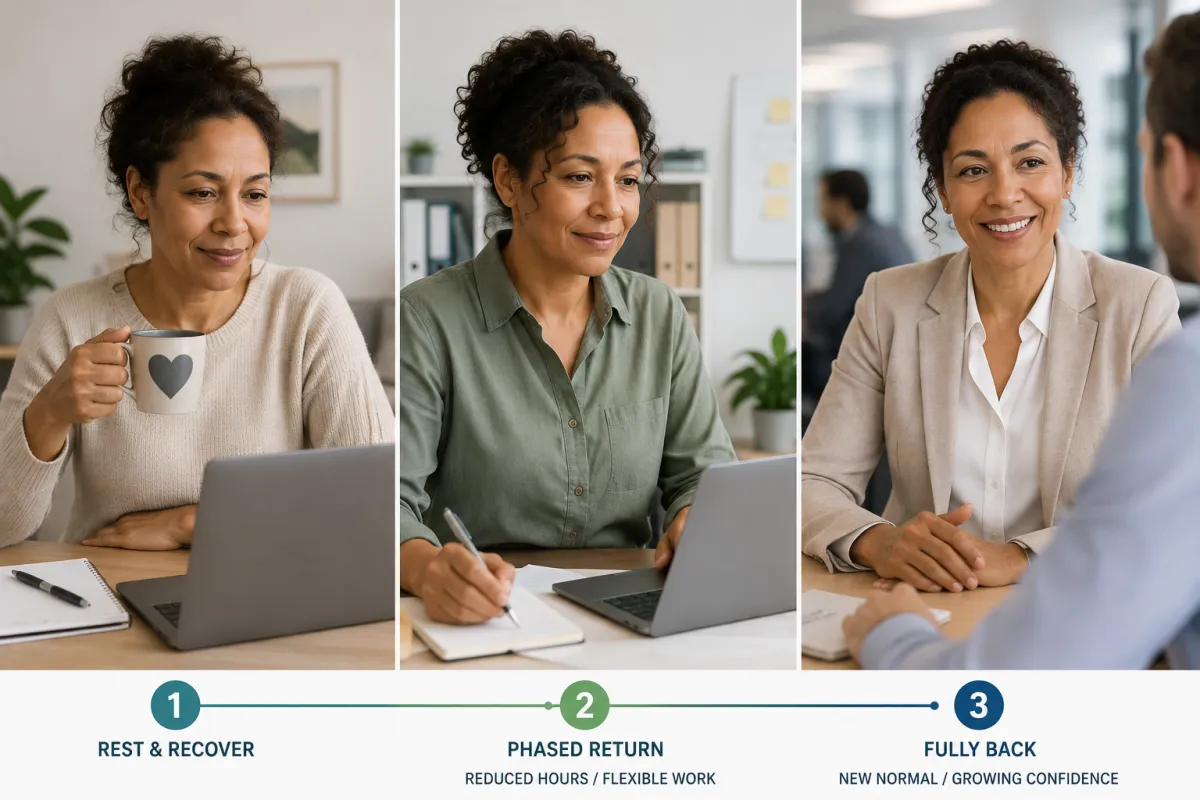
A phased return to work after a stroke allows you to rebuild your working hours, responsibilities and stamina gradually instead of immediately returning to your previous workload. For many stroke survivors, this can make the difference between a sustainable return and becoming overwhelmed by fatigue, cognitive demands or physical symptoms. A phased return is not about proving that you cannot cope. It is about giving your recovering brain and body time to adjust to the demands of working life again.
After your stroke...
Eventually, somebody may ask:
"When are you going back to work?"
Perhaps you have been asking yourself the same thing.
You may feel ready.
Or at least...
Almost ready.
But the idea of going from being at home recovering to suddenly working five full days again may feel enormous.
You begin wondering...
"Can I manage an entire working day?"
"What happens if I become exhausted?"
"Should I start with shorter hours?"
"How quickly should I increase my workload?"
"What if I cope well initially and then crash?"
"What exactly is a phased return?"
These are important questions.
Returning to work is not simply about whether you are physically capable of entering the workplace.
You also need enough energy, concentration, processing ability and stamina to function once you get there.
For some stroke survivors, gradually rebuilding those abilities through a phased return can make the transition much more manageable.
✦ ✦ ✦
The Good News
You do not necessarily have to return to your previous working pattern immediately.
A phased return means gradually returning to work, often beginning with reduced hours or duties and increasing them over time.
The Stroke Association specifically recommends considering a phased return after stroke, starting part-time and gradually building towards normal working hours where appropriate.
This might mean beginning with:
✓ Shorter working days
✓ Fewer days each week
✓ Reduced responsibilities
✓ More frequent breaks
✓ Working from home for part of the week
✓ Gradually increasing your workload
The exact arrangement will depend on:
Your stroke.
Your recovery.
Your symptoms.
Your job.
Your employer.
And the recommendations of the professionals supporting you.
There is no universal timetable.
The objective is not to return as quickly as possible.
The objective is to return successfully and sustainably.
✦ ✦ ✦
What Is a Phased Return to Work?
A phased return is a temporary arrangement that gradually increases your exposure to work.
Instead of this:
Monday to Friday.
Nine until five.
Full responsibilities.
Immediately.
You might initially work:
Monday, Wednesday and Friday.
Four hours each day.
Then increase the hours or days gradually if you are coping well.
Government fit-note guidance describes a phased return as a gradual increase in work duties or working hours.
It may also involve temporarily changing what you do.
For example, you might initially avoid:
✓ Long meetings
✓ Extensive travel
✓ Physically demanding duties
✓ Tight deadlines
✓ Complex multitasking
✓ Long periods of screen use
✓ High-pressure responsibilities
Then gradually reintroduce them.
The purpose is to discover what your recovering brain and body can tolerate without overwhelming them.
✦ ✦ ✦
Why Can Returning to Work Be So Exhausting?
Work uses far more energy than many people realise.
Before your stroke, you probably performed countless activities automatically.
Getting dressed.
Commuting.
Talking to colleagues.
Reading emails.
Processing information.
Attending meetings.
Making decisions.
Switching between tasks.
Remembering instructions.
Dealing with interruptions.
Then commuting home.
After stroke, some of these activities may require considerably more conscious effort.
The NHS notes that stroke recovery may involve problems with movement, memory, concentration, thinking, mood, speech and vision.
Even if your difficulties are relatively mild, combining them throughout an entire working day can be exhausting.
That is why being able to perform one task successfully does not automatically mean you are ready to perform dozens of tasks for eight hours.
Capacity and endurance are different things.
✦ ✦ ✦
Post-Stroke Fatigue and Returning to Work
Fatigue is one of the biggest reasons a phased return may be useful.
Post-stroke fatigue is not always the same as ordinary tiredness.
You may sleep well and still wake feeling exhausted.
You may feel relatively energetic in the morning but become suddenly depleted after several hours of concentration.
NHS stroke services note that fatigue can affect physical, mental and emotional functioning and may also affect attention and processing speed.
At work, this might look like:
✓ Slower thinking later in the day
✓ Difficulty concentrating
✓ Increased word-finding problems
✓ Irritability
✓ Headaches
✓ Difficulty making decisions
✓ Physical weakness
✓ Feeling completely drained after work
This can be frightening.
You might think:
"I can't work anymore."
But the issue may not be whether you can work.
It may be how much work your current energy capacity can sustain.
A phased return can help you explore that safely.
✦ ✦ ✦
Do Not Judge Your Capacity by One Good Day
This is a common mistake.
You go into work for four hours.
You feel fantastic.
Nothing goes wrong.
You think:
"I could easily work all day."
So you increase your hours immediately.
Then several days later...
You crash.
Stroke-related fatigue can sometimes have a delayed effect.
A demanding day may leave you exhausted later that evening or even affect the following day.
That is why a phased return should not be judged by whether you survive one day.
The better question is:
"Can I sustain this pattern repeatedly without symptoms building up?"
One successful day is encouraging.
Several sustainable weeks give much better information.
✦ ✦ ✦
What Might a Phased Return Look Like?
There is no standard programme.
A hypothetical return might look something like this:
Weeks 1–2
Three shorter working days.
Perhaps four hours each day.
Focus on familiar or manageable tasks.
Allow recovery days between working days.
Weeks 3–4
Increase the length of those working days.
Or introduce another working day.
Begin taking on additional responsibilities.
Weeks 5–6
Move closer to normal hours.
Gradually reintroduce more demanding duties.
Later
Return to your normal working pattern if this is realistic and sustainable.
This is only an example.
Some people may progress considerably faster.
Others may require a much longer return.
The Stroke Association emphasises that there is no set pattern for returning to work after stroke; some people return within weeks while others need months or years.
Your return should therefore respond to your recovery rather than somebody else's timetable.
✦ ✦ ✦
Hours Are Only One Part of the Plan
A poor phased return simply reduces your hours.
A better phased return considers the actual demands of your job.
Imagine you normally work eight hours.
Your employer reduces this to four.
But during those four hours you are expected to:
Attend three meetings.
Write a complex report.
Handle urgent emails.
Manage staff.
Resolve problems.
And meet a deadline.
That may not be much of a rehabilitation plan.
A meaningful phased return may need to consider:
✓ Hours
✓ Workload
✓ Responsibilities
✓ Deadlines
✓ Meetings
✓ Travel
✓ Breaks
✓ Environment
✓ Cognitive demands
✓ Physical demands
Reducing hours without adjusting workload may simply force you to complete the same amount of work in less time.
That defeats the purpose.
✦ ✦ ✦
The Commute Counts Too
Do not ignore travelling.
Your workday does not begin when you reach your desk.
It may begin when you:
Wake earlier.
Get dressed.
Prepare your things.
Walk to the station.
Drive.
Navigate public transport.
Deal with crowds.
Climb stairs.
Then travel home again.
For someone experiencing post-stroke fatigue, that can consume significant energy.
A person may technically work five hours but effectively have a seven-hour day once commuting is included.
If travel is difficult, possible adjustments might include:
✓ Working from home on some days
✓ Travelling outside peak hours
✓ Starting later
✓ Finishing earlier
✓ Reducing office days temporarily
✓ Avoiding unnecessary travel
Where an employee meets the relevant disability criteria, UK reasonable-adjustment duties may apply, and government guidance specifically includes phased returns and flexible or part-time working among possible adjustments.
✦ ✦ ✦
Build Breaks Into the Day
Do not wait until you are completely exhausted before stopping.
By that point, recovery may take much longer.
Short planned breaks can help prevent fatigue from escalating.
You might:
✓ Step away from your screen
✓ Sit somewhere quiet
✓ Have lunch away from your desk
✓ Avoid working continuously through breaks
✓ Schedule gaps between demanding meetings
✓ Alternate difficult tasks with easier ones
There is a difference between resting strategically and stopping because your body has already forced you to.
Planning rest before exhaustion can help you preserve energy for the entire day.
✦ ✦ ✦
Identify Your Most Difficult Tasks
Not every part of your job will affect you equally.
Perhaps emails are easy.
But meetings exhaust you.
Perhaps writing reports is manageable.
But switching between several tasks is difficult.
Perhaps your physical stamina is excellent.
But concentrating for long periods triggers headaches.
Perhaps mornings are strong.
But your thinking deteriorates in the afternoon.
Track these patterns.
Ask:
"What actually drains me?"
This allows your phased return to address the real problem.
You may discover that changing when a task happens is more useful than removing the task completely.
Complex work could be scheduled earlier.
Routine administrative work could be left until later.
A good return-to-work plan should be flexible enough to respond to what you learn.
✦ ✦ ✦
What Should You Discuss With Your Employer?
Before returning, it may help to discuss:
✓ Your starting hours
✓ Which days you will work
✓ Whether you will work remotely
✓ Temporary changes to duties
✓ Breaks
✓ Medical appointments
✓ Travel requirements
✓ Review dates
✓ How workload will increase
✓ Who you should speak to if difficulties arise
The plan should be clear.
"Come back and see how you get on" is vague.
A better arrangement might identify:
How many hours you will initially work.
Which responsibilities you will handle.
Which responsibilities are temporarily reduced.
When the arrangement will be reviewed.
And what happens if symptoms increase.
Clarity reduces uncertainty for both you and your employer.
✦ ✦ ✦
What Role Can a Fit Note Play?
In the UK, a fit note can provide information about how a health condition affects your ability to work.
It may indicate that you may be fit for work if certain support is provided.
Government guidance states that a fit note can support discussions about workplace adaptations and reasonable adjustments, including a phased return, altered hours or amended duties.
Depending on your circumstances, recommendations might include:
✓ Reduced hours
✓ Altered duties
✓ Workplace adaptations
✓ A phased return
The specific arrangements still need to be discussed with your employer.
Your healthcare professional may also help explain functional limitations that are difficult for you to describe yourself.
✦ ✦ ✦
Reasonable Adjustments After Stroke
A phased return may sit alongside other workplace adjustments.
Possible adjustments might include:
✓ Flexible working hours
✓ Working from home
✓ More frequent breaks
✓ Reduced travel
✓ Written instructions
✓ Adapted equipment
✓ Changes to duties
✓ Time for treatment or rehabilitation
✓ Changes to the working environment
✓ Temporarily reduced workload
Under UK law, employers must make reasonable adjustments where the relevant legal requirements are met so that disabled workers are not substantially disadvantaged. Government guidance specifically lists phased returns as one potential adjustment.
That does not mean every requested arrangement will automatically be considered reasonable.
But neither should you assume that you simply have to struggle through your previous working pattern without support.
✦ ✦ ✦
Do Not Rush the Increase
One of the biggest mistakes is increasing hours because you feel guilty.
You think:
"My colleagues are doing more."
"My employer expects me back."
"I've been away long enough."
"I should be able to manage this."
So you move from four hours to eight before your body is ready.
That may produce exactly the opposite of what you want.
Your symptoms increase.
Your confidence drops.
You need more time off.
The return becomes less sustainable.
Progress should be based on tolerance, not guilt.
If the current stage is working, that is evidence.
If symptoms are repeatedly escalating, that is also evidence.
Use both.
✦ ✦ ✦
Signs You May Be Increasing Too Quickly
Pay attention if you repeatedly experience:
✓ Severe exhaustion after work
✓ Needing the entire next day to recover
✓ Increasing headaches
✓ Worsening concentration
✓ More frequent mistakes
✓ Increased word-finding problems
✓ Irritability
✓ Sleep disruption
✓ Increasing physical symptoms
✓ Losing the ability to manage normal activities outside work
This does not necessarily mean you need to stop working completely.
It may mean that your current progression needs reviewing.
Speak with your healthcare team or occupational health professional if symptoms are significant, worsening or difficult to manage.
And any new neurological symptoms after a stroke require urgent medical assessment rather than simply being attributed to work or fatigue.
✦ ✦ ✦
What If the Phased Return Is Going Well?
That is excellent.
But do not immediately abandon the structure.
If you are coping consistently, the next step might be:
✓ Increasing one working day
✓ Extending your hours slightly
✓ Reintroducing one responsibility
✓ Attending more meetings
✓ Increasing office attendance
Then observe what happens.
You are essentially testing your capacity.
Change one or two things.
Assess the impact.
Then progress again.
This makes it easier to identify exactly what causes difficulty if symptoms return.
✦ ✦ ✦
What If You Cannot Return to Your Previous Hours?
This possibility can be emotionally difficult.
You may begin a phased return assuming that the final destination must be your old working pattern.
Five days.
Full-time.
Full workload.
But recovery does not always work like that.
Some people eventually return to exactly what they did before.
Others discover that they function better with:
✓ Reduced hours
✓ Flexible working
✓ Different responsibilities
✓ More home working
✓ A different role
✓ A different career
A phased return can sometimes reveal what your long-term sustainable working pattern actually looks like.
That information is useful.
It is not failure.
✦ ✦ ✦
Do Not Spend All Your Energy at Work
This is another important test.
Suppose you successfully return to work.
But every evening you collapse into bed.
You cannot prepare food.
You stop exercising.
You cannot spend time with your family.
Weekends become purely about recovering enough to work again on Monday.
Technically, you are working.
But is the arrangement sustainable?
Work is only one part of life.
Your return should ideally leave enough capacity for:
Eating.
Personal care.
Relationships.
Rehabilitation.
Exercise.
Sleep.
And ordinary daily living.
A return that consumes every available unit of energy may need reviewing.
✦ ✦ ✦
Emotional Impact of a Phased Return
A phased return can bring mixed emotions.
You may feel:
✓ Proud
✓ Nervous
✓ Excited
✓ Frustrated
✓ Embarrassed
✓ Relieved
You may hate leaving early while colleagues continue working.
You may resent needing additional breaks.
You may feel uncomfortable when other people ask why you are working reduced hours.
Remember why you are doing it.
You are not competing with your colleagues.
You are rebuilding capacity after a neurological injury.
Recovery has its own timetable.
✦ ✦ ✦
My Perspective
A phased return after stroke should not be treated as simply:
"Working less for a few weeks."
Its real purpose is to answer a much more important question:
What level of work can I sustain while continuing to recover?
That distinction matters.
You may be capable of working eight hours once.
That does not necessarily mean you can work eight hours every day.
You may manage a demanding meeting perfectly.
That does not mean you can manage five of them back-to-back.
The challenge is not proving what you can survive.
It is discovering what you can sustain.
And that sometimes requires discipline.
The discipline to stop before you are exhausted.
The discipline to increase hours gradually.
The discipline to admit when something is not working.
And sometimes...
The discipline not to rush simply because you want your old life back.
Recovery is not a competition.
A phased return gives you an opportunity to build a new working rhythm using evidence rather than assumptions.
Use it properly.
✦ ✦ ✦
When Should You Seek Further Advice?
Speak with your healthcare professional, occupational therapist, stroke rehabilitation team or occupational health service if:
✓ You are unsure whether you are ready to return
✓ Fatigue is significantly affecting work
✓ Cognitive symptoms interfere with your job
✓ Physical symptoms make duties difficult
✓ Your symptoms are worsening as hours increase
✓ You are repeatedly unable to recover between working days
✓ You need advice about workplace adaptations
If you experience sudden new neurological symptoms, such as new weakness, facial drooping, speech changes or sudden visual problems, seek urgent medical attention.
Do not automatically assume new neurological symptoms are simply fatigue.
✦ ✦ ✦
Frequently Asked Questions
How Long Should a Phased Return Last?
There is no single correct duration.
It depends on your recovery, symptoms, job and individual circumstances.
Stroke Association guidance emphasises that return-to-work timing varies considerably between survivors.
Should I Start With Half Days?
Possibly.
Some people find shorter days useful, while others may benefit more from fewer full days with recovery days between them.
The appropriate arrangement depends on your symptoms and job demands.
Can I Work From Home During a Phased Return?
Potentially.
If home working is practical for your role, it may reduce the energy spent commuting and allow greater control over your environment.
It should be discussed with your employer.
What If My Fatigue Gets Worse?
Do not simply keep increasing your workload.
Review the pattern and discuss persistent or significant fatigue with your healthcare or occupational health team.
Can My Duties Be Reduced as Well as My Hours?
Yes.
A phased return may involve gradually increasing duties as well as working hours. Government fit-note guidance recognises both phased returns and amended duties as possible ways of supporting someone back into work.
Does a Phased Return Count as a Reasonable Adjustment?
It can.
UK government guidance specifically lists a phased return as an example of a possible reasonable adjustment for disabled workers, depending on the circumstances.
What If I Never Manage My Previous Hours?
Your long-term working arrangement may need to be reconsidered.
That could involve reduced hours, different duties, more flexibility or potentially a different role.
The goal should be sustainable employment, not forcing yourself into an arrangement that repeatedly makes you unwell.
✦ ✦ ✦
Key Takeaways
✓ A phased return gradually rebuilds working hours and responsibilities after stroke.
✓ There is no universal timetable for returning to work.
✓ Post-stroke fatigue can significantly affect stamina, concentration and processing.
✓ Do not judge your capacity from one successful day.
✓ Consider workload and responsibilities as well as hours.
✓ Remember that commuting also uses energy.
✓ Planned breaks can help manage fatigue.
✓ Progress should be based on what you can sustain, not pressure or guilt.
✓ UK workplace adjustments may include phased returns, flexible hours and amended duties.
✓ A successful return is not simply about getting back quickly. It is about creating a working pattern that lasts.
✦ ✦ ✦
Related Articles
Continue learning about work after stroke:
Confidence Returning to Work After Stroke
Returning to Work After a Stroke
Managing Fatigue at Work After Stroke
Reasonable Adjustments After Stroke
Working From Home After Stroke
Memory Problems at Work After Stroke
Brain Fog After Stroke
Stress at Work After Stroke
Changing Careers After Stroke
Financial Stress After Stroke
✦ ✦ ✦
About the Author
Alisia Gayle is a stroke survivor who achieved 96% neurological recovery following an ischaemic stroke.
After years of rehabilitation, she now shares practical, evidence-informed resources to help stroke survivors, carers and families better understand recovery and rebuild their lives with confidence.
Alisia is also the author of Brain Damage: My Journey to 96% Recovery, where she shares her personal stroke recovery story and the lessons she learned throughout her rehabilitation.
✦ ✦ ✦
Medical Disclaimer
This article is intended for educational purposes only and should not replace professional medical advice, diagnosis, rehabilitation guidance, legal advice or occupational health advice.
Every stroke and every recovery is different.
Always seek advice from your doctor, stroke rehabilitation team, occupational therapist, occupational health professional or another appropriate healthcare professional regarding your individual ability to return to work.
Workplace rights and reasonable adjustments depend on individual circumstances and applicable law.
✦ ✦ ✦
Final Thoughts
A phased return to work after a stroke...
Is not about proving that you are weak.
And it is not simply about working fewer hours.
It is a bridge.
Between recovery...
And working life.
Your first few days may feel strange.
You may become tired much earlier than expected.
You may discover that certain tasks are harder than others.
You may also discover that you are capable of far more than you feared.
Pay attention to both.
Start gradually.
Track your energy.
Use breaks.
Adjust your workload.
Increase demands when your body and brain show that they can sustain them.
And do not rush simply because you want to prove that you are back.
The goal is not to survive one full working day.
The goal is to build a working life that you can continue living.
Because after a stroke...
Returning to work is an achievement.
But returning in a way that protects your recovery is an even greater one.