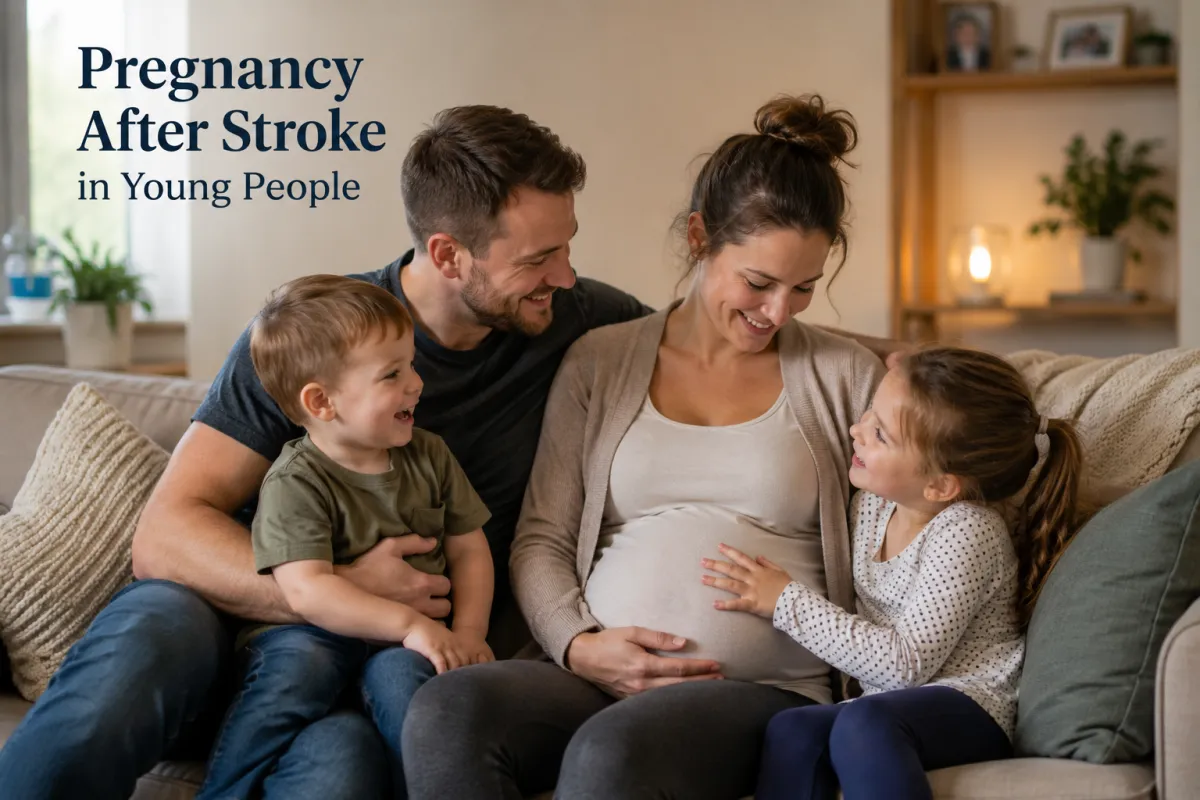
Pregnancy after a stroke may be possible for many women, but it deserves careful planning. A previous stroke does not automatically mean that you cannot become pregnant or have a healthy pregnancy. However, pregnancy changes blood pressure, blood volume and the body's tendency to form clots, and some stroke-prevention medicines may need to be reviewed before conception. Your individual risk depends heavily on why you had the stroke, whether that cause is still present, your blood pressure, clotting history, heart health and the medication you take. Ideally, pregnancy should be planned with your stroke specialist and an obstetric team experienced in higher-risk pregnancies.
After your stroke...
You may eventually begin thinking about the future again.
And for some women, that future includes another question.
Pregnancy.
Perhaps you had always planned to have children.
Maybe you already have one child and wanted another.
Perhaps your stroke happened before you had even started thinking seriously about motherhood.
Now suddenly...
Something that once felt completely ordinary seems medically complicated.
You begin wondering...
"Can I safely get pregnant after a stroke?"
"Could pregnancy cause another stroke?"
"Will I have to stop my medication?"
"Can I give birth normally?"
"What happens if I have high blood pressure?"
"Will my baby inherit whatever caused my stroke?"
These are not questions that should be answered with either:
"Don't worry about it."
or:
"You should never become pregnant."
The answer is much more individual.
A previous stroke changes the conversation.
It does not automatically end it.
✦ ✦ ✦
The Good News
Many women who have previously experienced a stroke can go on to have pregnancies.
The key is planning.
You want your healthcare team to understand your stroke history before pregnancy rather than trying to reconstruct everything after you are already pregnant.
Ideally, pre-pregnancy planning may involve:
✓ Your GP
✓ Stroke specialist or neurologist
✓ Obstetrician
✓ Maternal medicine team where appropriate
✓ Haematologist if clotting disorders are involved
✓ Cardiologist if your stroke had a cardiac cause
Your team can then review:
What caused your stroke.
Whether that cause is still relevant.
What your current recurrence risk appears to be.
Which medications you take.
Whether medication needs changing.
How your blood pressure should be monitored.
And whether you need additional surveillance during pregnancy.
Pregnancy after stroke is therefore not necessarily:
"Too dangerous."
It is often:
"Needs individual planning."
✦ ✦ ✦
Does Pregnancy Increase Stroke Risk?
Pregnancy and childbirth do increase stroke risk compared with the non-pregnant state, although stroke remains uncommon.
The Stroke Association states that stroke is rare in pregnancy, but pregnancy and childbirth can increase the risk. (stroke.org.uk)
The NHS also identifies pregnancy with pre-eclampsia and the period shortly after giving birth among situations associated with increased stroke risk. (nhs.uk)
Pregnancy produces major physiological changes.
Your body experiences changes in:
✓ Blood volume
✓ Blood pressure
✓ Hormones
✓ Blood clotting
✓ Cardiovascular workload
These changes are normal parts of pregnancy.
But if you already have a condition that contributed to a previous stroke, they may deserve additional attention.
✦ ✦ ✦
Your Original Stroke Cause Matters
This is probably the most important point in the entire article.
"Previous stroke" is not one single diagnosis.
Imagine three women.
One experienced a stroke after an arterial dissection that healed.
Another has antiphospholipid syndrome.
Another has severe chronic hypertension.
All three had strokes.
Their pregnancy risks may be completely different.
Your healthcare team therefore needs to understand:
✓ Whether your stroke was ischaemic or haemorrhagic
✓ Whether a definite cause was identified
✓ Whether the cause was temporary or ongoing
✓ Whether you have a clotting disorder
✓ Whether you have high blood pressure
✓ Whether you have heart disease
✓ Whether you have a vascular abnormality
✓ Whether your stroke was related to pregnancy previously
This information shapes the pregnancy plan.
✦ ✦ ✦
What If Doctors Never Found the Cause?
Some strokes remain unexplained even after extensive investigation.
This can make pregnancy planning frustrating.
You may think:
"If nobody knows why it happened, how can they know whether pregnancy is safe?"
That uncertainty deserves discussion with your stroke and obstetric teams.
They may review:
Your old brain scans.
Vascular imaging.
Heart investigations.
Blood tests.
Family history.
Previous pregnancy history.
Current cardiovascular risk factors.
You may not get a perfect answer.
Medicine sometimes has to work with probabilities rather than certainty.
But a specialist risk assessment is still considerably better than assuming either that pregnancy is completely safe or completely impossible.
✦ ✦ ✦
Pre-Conception Review Is Important
Ideally, do not wait until the pregnancy test is positive.
Arrange a medical review while you are planning pregnancy.
Bring an up-to-date medication list.
Ask:
✓ Does the cause of my previous stroke affect pregnancy?
✓ Is my blood pressure adequately controlled?
✓ Do I need additional clotting investigations?
✓ Are my medications suitable during pregnancy?
✓ Should any medicine be changed before conception?
✓ Will I require specialist antenatal care?
✓ Is there anything specific I should do before trying?
This is also a good opportunity to review general pregnancy preparation, including folic acid and management of existing medical conditions.
The objective is to enter pregnancy as medically stable as reasonably possible.
✦ ✦ ✦
Never Stop Stroke Medication on Your Own
This deserves emphasis.
Some women discover they are pregnant and immediately panic about medication.
They stop everything.
That can create its own danger.
Stroke survivors may take:
✓ Antiplatelet medication
✓ Anticoagulants
✓ Blood-pressure medication
✓ Statins
✓ Anti-seizure medication
✓ Other cardiovascular drugs
Pregnancy may change which medicines are appropriate.
But the solution is professional medication review, not abruptly stopping treatment yourself.
The danger of the medicine needs to be balanced against the danger of leaving the underlying condition untreated.
Contact your GP, stroke specialist, pharmacist or maternity team promptly if you become pregnant while taking long-term stroke medication.
✦ ✦ ✦
Antiplatelet Medication and Pregnancy
Some women may require antiplatelet treatment during pregnancy.
Low-dose aspirin, for example, is commonly prescribed in pregnancy for certain women at increased risk of pre-eclampsia. NHS guidance states that women considered at higher risk may be advised to take aspirin from around 12 weeks of pregnancy. (nhs.uk)
But that does not mean every woman who has had a stroke should independently begin aspirin.
Your previous stroke mechanism matters.
Your bleeding risk matters.
Other medication matters.
The dose and duration matter.
Take antiplatelet medication during pregnancy only according to professional advice.
"Available over the counter" does not mean:
"Prescribe it to yourself."
✦ ✦ ✦
Anticoagulants Need Particular Planning
If you take anticoagulant medication because of:
✓ Atrial fibrillation
✓ Previous blood clots
✓ A clotting disorder
✓ Certain heart conditions
pregnancy planning becomes particularly important.
Different anticoagulants have different considerations during pregnancy.
A medication that was appropriate before conception may not necessarily be the preferred treatment throughout pregnancy.
Do not stop anticoagulation because you are worried about the baby.
And do not switch medications yourself.
Your specialists need to balance:
Your clotting risk.
Your bleeding risk.
Pregnancy.
Delivery.
And the postpartum period.
That is exactly why pre-conception planning is useful.
✦ ✦ ✦
What About Antiphospholipid Syndrome?
Antiphospholipid syndrome, or APS, deserves particular attention because it can affect both thrombosis and pregnancy.
APS increases the risk of blood clots and can contribute to stroke or TIA. It is also associated with pregnancy complications including pre-eclampsia, recurrent miscarriage and premature birth. (nhs.uk)
If APS was involved in your stroke...
Pregnancy should be planned with specialist medical input.
Your treatment may need careful management throughout pregnancy and after delivery.
This is not an area for generic internet recommendations.
Your own clotting history and pregnancy history matter enormously.
✦ ✦ ✦
Blood Pressure Becomes Especially Important
High blood pressure is one of the major risk factors for stroke.
Pregnancy makes blood-pressure monitoring particularly important because some women develop pregnancy-related hypertension or pre-eclampsia.
Pre-eclampsia usually involves high blood pressure and other signs of organ involvement during pregnancy.
The NHS notes that severe complications of pre-eclampsia can include stroke. (nhs.uk)
If you already had hypertension before pregnancy, your maternity team will need to know.
Your medication may also require review because not every blood-pressure medicine routinely used outside pregnancy is suitable during pregnancy.
Do not stop treatment.
Get it reviewed.
✦ ✦ ✦
Attend Your Antenatal Appointments
This is not the pregnancy for casually skipping blood-pressure checks.
Regular antenatal care allows professionals to monitor:
✓ Blood pressure
✓ Urine
✓ General wellbeing
✓ Risk of pre-eclampsia
✓ Blood-clotting risk
✓ Fetal growth
NICE recommends ongoing antenatal assessment of factors including venous thromboembolism, gestational diabetes and pre-eclampsia risk. (nice.org.uk)
Your appointments are not pointless routine.
They are opportunities to identify developing problems early.
If you have a previous stroke, make sure your full medical history is documented rather than assuming every member of the maternity team already knows it.
✦ ✦ ✦
Pregnancy and Blood Clots
Pregnancy naturally increases the tendency of blood to clot.
This helps protect against excessive bleeding during delivery.
But it also means the risk of venous thromboembolism increases.
NICE specifically recommends assessing the risk of venous thromboembolism during pregnancy and after significant medical events. (nice.org.uk)
Your individual clot risk may be influenced by:
✓ Previous thrombosis
✓ Clotting disorders
✓ Reduced mobility
✓ Obesity
✓ Hospital admission
✓ Caesarean birth
✓ Other medical conditions
A prior arterial stroke does not automatically mean you will develop a venous blood clot.
But your overall clotting history deserves proper review.
✦ ✦ ✦
Reduced Mobility After Stroke
If your stroke left you with significant mobility limitations, pregnancy may create additional practical challenges.
As pregnancy progresses, changes in:
Balance.
Body weight.
Centre of gravity.
Fatigue.
can affect mobility even in women without neurological disability.
If you already have:
✓ Foot drop
✓ Leg weakness
✓ Balance problems
✓ Spasticity
✓ Reduced endurance
you may need additional support.
A physiotherapist or occupational therapist may help with:
✓ Safe mobility
✓ Exercise
✓ Falls prevention
✓ Equipment
✓ Managing transfers
Your rehabilitation needs do not disappear because you are pregnant.
They may need adapting.
✦ ✦ ✦
Post-Stroke Fatigue and Pregnancy Fatigue
This combination deserves respect.
Pregnancy can cause fatigue.
Stroke can cause fatigue.
Together...
You may find your energy considerably reduced.
Do not judge yourself against someone else's pregnancy.
You may need to:
✓ Rest more
✓ Reduce unnecessary commitments
✓ Adjust work
✓ Accept practical help
✓ Pace physical activity
Fatigue itself does not necessarily indicate that something is medically wrong.
But severe or sudden deterioration should still be discussed with your healthcare team.
And remember...
Pregnancy should not become the reason every neurological symptom is ignored.
✦ ✦ ✦
Can Pregnancy Make Old Stroke Symptoms Feel Worse?
Some stroke survivors notice that symptoms fluctuate with:
Fatigue.
Stress.
Poor sleep.
Illness.
Pregnancy may amplify these factors.
You might notice:
More fatigue.
Reduced balance.
More difficulty concentrating.
Greater physical effort when walking.
That does not necessarily mean you are having another stroke.
But new sudden neurological symptoms require emergency assessment.
Do not tell yourself:
"It's probably pregnancy."
If you suddenly develop facial weakness, arm weakness, speech difficulty, severe new neurological symptoms or other signs suggesting stroke...
Treat it as an emergency.
Pregnant women can still receive urgent stroke assessment and treatment.
✦ ✦ ✦
Can You Have Brain Scans During Pregnancy?
If urgent neurological assessment is necessary, pregnancy should not become a reason to avoid appropriate medical care.
Clinicians can determine which imaging is required and how to minimise unnecessary exposure.
Do not refuse emergency stroke assessment because you are frightened that every scan will harm the baby.
Tell the medical team that you are pregnant.
Then let them balance the risks appropriately.
An untreated maternal medical emergency can also be dangerous for the pregnancy.
Your health matters too.
✦ ✦ ✦
What About Giving Birth?
A previous stroke does not automatically mean you must have a caesarean section.
The safest mode of delivery depends on your individual medical circumstances.
Your team may consider:
✓ Why you had the stroke
✓ Blood pressure
✓ Anticoagulation
✓ Vascular abnormalities
✓ Heart disease
✓ Obstetric factors
✓ Mobility
✓ Your previous pregnancies
Some women may be able to have a vaginal birth.
Others may have a planned caesarean for obstetric or medical reasons.
This decision should be made individually.
Do not assume:
"Stroke history equals caesarean."
And do not assume:
"Natural birth is always safer."
The safest delivery is the one appropriate to the actual clinical situation.
✦ ✦ ✦
Make a Delivery Medication Plan
If you take medication affecting blood clotting, delivery needs planning.
Your maternity and specialist teams may need to determine:
✓ Whether medication needs adjusting near delivery
✓ Timing around labour or planned caesarean
✓ Bleeding considerations
✓ Anaesthetic options
✓ When treatment should restart afterwards
This is not something you should be trying to work out while already in labour.
Ask during pregnancy:
"What is the medication plan around delivery?"
Make sure it is clearly documented.
That gives everyone a shared understanding before the situation becomes urgent.
✦ ✦ ✦
The Postpartum Period Matters
One of the most important misconceptions is thinking:
"The baby is born, so the increased risk is finished."
Not immediately.
The period after childbirth remains important for both blood pressure and clotting risk.
The NHS specifically identifies having recently given birth as a factor associated with increased stroke risk. (nhs.uk)
NICE also includes women who have recently given birth in venous-thromboembolism risk assessment. (nice.org.uk)
Make sure you understand:
✓ What medication to restart
✓ When to restart it
✓ Whether blood pressure needs additional monitoring
✓ What symptoms require urgent attention
Your medical plan should continue beyond delivery.
✦ ✦ ✦
Do Not Ignore Severe Postpartum Headaches
Headaches after childbirth can have many causes.
Most will not be strokes.
But severe new headache, especially when accompanied by:
✓ Weakness
✓ Speech difficulty
✓ Visual disturbance
✓ Confusion
✓ Seizure
✓ Severe high blood pressure
requires urgent assessment.
Do not assume:
"I'm just tired."
or:
"It's hormones."
Your previous stroke history means significant neurological symptoms deserve proper medical attention.
The same principle applies during pregnancy.
Sudden neurological symptoms should never simply be watched at home.
✦ ✦ ✦
Breastfeeding and Medication
If you plan to breastfeed, medication needs another review.
Some medicines may be compatible with breastfeeding.
Others may require:
✓ A different drug
✓ Different timing
✓ Specialist advice
Do not stop essential stroke-prevention medication because you want to breastfeed.
And do not assume a medicine is safe simply because you took it during pregnancy.
Pregnancy safety and breastfeeding safety are related but not identical questions.
Discuss your medication plan before delivery where possible.
That prevents an unnecessary scramble after the baby arrives.
✦ ✦ ✦
What About Future Stroke Risk?
This is often the question underneath every other question.
"If I become pregnant, will I have another stroke?"
There is no single percentage that applies to every stroke survivor.
Risk depends on factors such as:
✓ The original stroke mechanism
✓ Whether the cause is still present
✓ Previous pregnancy-related stroke
✓ Blood pressure
✓ Clotting disorders
✓ Heart conditions
✓ Smoking
✓ Diabetes
✓ Medication
A woman whose previous stroke had a temporary, resolved cause may have a very different risk profile from someone with an ongoing vascular or clotting disorder.
Ask your specialist to discuss your recurrence risk rather than relying on statistics from completely different stroke populations.
✦ ✦ ✦
What If Your Previous Stroke Happened During Pregnancy?
This can make considering another pregnancy particularly frightening.
You may associate pregnancy itself with the moment your life changed.
Before trying again, ask your specialists:
What probably caused the previous stroke?
Was pre-eclampsia involved?
Was there a clotting disorder?
Was there cerebral venous thrombosis?
Was there an arterial problem?
Is that risk likely to recur?
What would be done differently next time?
A future pregnancy may require more intensive monitoring.
Or, in some circumstances, your doctors may advise that pregnancy presents substantial risk.
You deserve a clear explanation of why, not just a vague statement that you are "high risk."
✦ ✦ ✦
Emotional Readiness Matters Too
Medical clearance does not automatically mean you feel emotionally ready.
Pregnancy after stroke can bring enormous anxiety.
Every headache may frighten you.
Every blood-pressure reading may feel threatening.
Every hospital appointment may bring memories back.
You may worry:
"Will I survive the pregnancy?"
"Will my child lose me?"
These fears deserve attention.
Consider discussing them with:
✓ Your maternity team
✓ GP
✓ Psychologist
✓ Counsellor
✓ Stroke support service
Planning should include psychological wellbeing as well as blood tests and medication.
You are not simply preparing a cardiovascular system for pregnancy.
You are preparing yourself.
✦ ✦ ✦
Practical Parenting With Residual Disability
Pregnancy is only the beginning.
Ask practical questions too.
If your stroke left you with:
One-sided weakness.
Poor balance.
Reduced hand function.
Fatigue.
Visual difficulties.
How will you manage:
✓ Carrying the baby
✓ Night feeds
✓ Bathing
✓ Pushchairs
✓ Car seats
✓ Getting up from the floor
✓ Sleep deprivation
Occupational therapists can sometimes suggest practical adaptations.
Plan support before the baby arrives.
Do not wait until you are exhausted at 3am to discover that a particular baby-care task is unsafe.
✦ ✦ ✦
My Perspective
Pregnancy after stroke is one of those subjects where people can become overly absolute.
They hear:
Stroke.
Pregnancy.
And immediately assume:
Too dangerous.
But "stroke survivor" describes an enormous range of people.
Different causes.
Different medication.
Different levels of recovery.
Different risk factors.
So the question should never simply be:
"Can women have babies after stroke?"
It should be:
"What caused my stroke, what risks remain, and how should my pregnancy be managed?"
Maybe the answer is that pregnancy can proceed with additional monitoring.
Maybe medication needs changing.
Maybe specialist anticoagulation is required.
Maybe blood pressure becomes the main concern.
Or perhaps your doctors identify a risk significant enough that pregnancy requires much more serious discussion.
What matters is obtaining an answer based on your body and your medical history.
Not fear.
Not assumptions.
And not somebody else's stroke story online.
✦ ✦ ✦
When Should You Seek Medical Advice?
Arrange specialist advice before pregnancy if possible if you have:
✓ A previous stroke or TIA
✓ A known clotting disorder
✓ Antiphospholipid syndrome
✓ Significant hypertension
✓ Heart disease
✓ A previous pregnancy-related stroke
✓ Long-term anticoagulant treatment
✓ A known vascular abnormality
During pregnancy or after giving birth, seek urgent assessment for:
✓ Sudden facial weakness
✓ New arm or leg weakness
✓ Speech difficulty
✓ Sudden vision changes
✓ Severe new neurological symptoms
✓ Seizure
✓ Severe unexplained headache, particularly with neurological symptoms
Do not delay because you are worried about disrupting the pregnancy.
Maternal emergencies require treatment.
✦ ✦ ✦
Frequently Asked Questions
Can You Get Pregnant After Having a Stroke?
For many women, yes.
A previous stroke does not automatically prevent pregnancy, but individual risk should ideally be assessed before conception.
Does Pregnancy Increase Stroke Risk?
Pregnancy and childbirth can increase stroke risk, although stroke remains uncommon in pregnancy. (stroke.org.uk)
Will I Need to Stop My Stroke Medication?
Possibly some medicines may need changing, but you should never stop medication without professional advice.
Your healthcare team should review your prescriptions before or as soon as possible after pregnancy begins.
Can I Take Aspirin During Pregnancy?
Low-dose aspirin is used in some pregnancies, including for certain women at increased risk of pre-eclampsia. (nhs.uk)
Whether you personally should take it depends on specialist advice.
Will I Need a Caesarean Section?
Not necessarily.
A previous stroke alone does not automatically determine how you must give birth.
The decision depends on neurological, cardiovascular, medication and obstetric factors.
Is the Postpartum Period Risky Too?
Yes.
Blood-clotting and blood-pressure risks remain important after delivery, so follow-up and medication planning should continue postpartum. (nice.org.uk)
Can I Breastfeed While Taking Stroke Medication?
That depends on the medicine.
Ask your doctor or pharmacist to review each prescription rather than stopping treatment yourself.
✦ ✦ ✦
Key Takeaways
✓ Pregnancy may be possible after stroke.
✓ Your individual risk depends heavily on what caused your stroke.
✓ Pre-conception medical review is strongly advisable.
✓ Never stop stroke-prevention medication independently because you are planning pregnancy.
✓ Pregnancy and childbirth increase stroke risk, although maternal stroke remains uncommon.
✓ Blood pressure deserves careful monitoring during pregnancy.
✓ Pre-eclampsia can increase the risk of serious complications, including stroke.
✓ Pregnancy increases blood-clotting tendency, so individual thrombosis risk should be assessed.
✓ Anticoagulant and antiplatelet treatment may need specialist planning.
✓ A previous stroke does not automatically mean you need a caesarean section.
✓ The postpartum period remains medically important.
✓ Breastfeeding plans should include a medication review.
✓ New sudden neurological symptoms during pregnancy or after birth require emergency assessment.
✓ Pregnancy after stroke should be planned around your individual medical history, not generic fear.
✦ ✦ ✦
Related Articles
Continue learning about young stroke, pregnancy and recovery:
Stroke in Your 30s
Stroke Under 50
Stroke During Pregnancy
Postpartum Stroke
Pre-Eclampsia and Stroke Risk
Young Stroke Survivors
Parenting After Stroke
Raising Young Children After Stroke
Medication Adherence After Stroke
Fear of Another Stroke
✦ ✦ ✦
About the Author
Alisia Gayle is a stroke survivor who achieved 96% neurological recovery following an ischaemic stroke.
After years of rehabilitation, she now shares practical, evidence-informed resources to help stroke survivors, carers and families better understand recovery and rebuild their lives with confidence.
Alisia is also the author of Brain Damage: My Journey to 96% Recovery, where she shares her personal stroke recovery story and the lessons she learned throughout her rehabilitation.
✦ ✦ ✦
Medical Disclaimer
This article is intended for educational purposes only and should not replace professional medical, obstetric or pharmaceutical advice.
Pregnancy after stroke requires individual assessment because risk varies according to the cause and type of stroke, blood pressure, clotting history, cardiovascular health, medication and previous pregnancy complications.
Ideally, discuss pregnancy with your GP, stroke specialist and appropriate maternity team before conception.
Never stop, start or change anticoagulants, antiplatelet medicines, blood-pressure medication or other prescribed treatment without professional advice.
If you become pregnant unexpectedly while taking stroke medication, contact an appropriate healthcare professional promptly for medication review rather than stopping treatment yourself.
Seek emergency medical attention immediately for new or sudden symptoms of stroke during pregnancy or after childbirth.
✦ ✦ ✦
Final Thoughts
Pregnancy after stroke...
Can feel frightening.
Because pregnancy requires you to trust your body again.
And after a stroke...
That trust may have been badly damaged.
You may wonder whether becoming pregnant is reckless.
Whether another stroke is inevitable.
Whether medication will harm the baby.
Whether your body can cope.
Those questions deserve proper answers.
But they deserve answers based on your medical history.
Not fear.
Not assumptions.
Not another survivor's experience.
Find out what caused your stroke where possible.
Review your medication.
Control your blood pressure.
Understand any clotting risk.
Plan pregnancy with the right specialists.
Attend your antenatal appointments.
Make a clear plan for delivery and the postpartum period.
And ask for practical help where residual stroke symptoms may affect pregnancy or caring for a baby.
A previous stroke may mean your pregnancy requires more planning.
More monitoring.
More specialist involvement.
But additional care does not automatically mean pregnancy is impossible.
Your stroke changed your medical history.
It did not necessarily remove motherhood from your future.
The goal is not to pretend the previous stroke never happened.
It is to understand exactly what it means...
And then make the safest, most informed decision possible about what comes next.