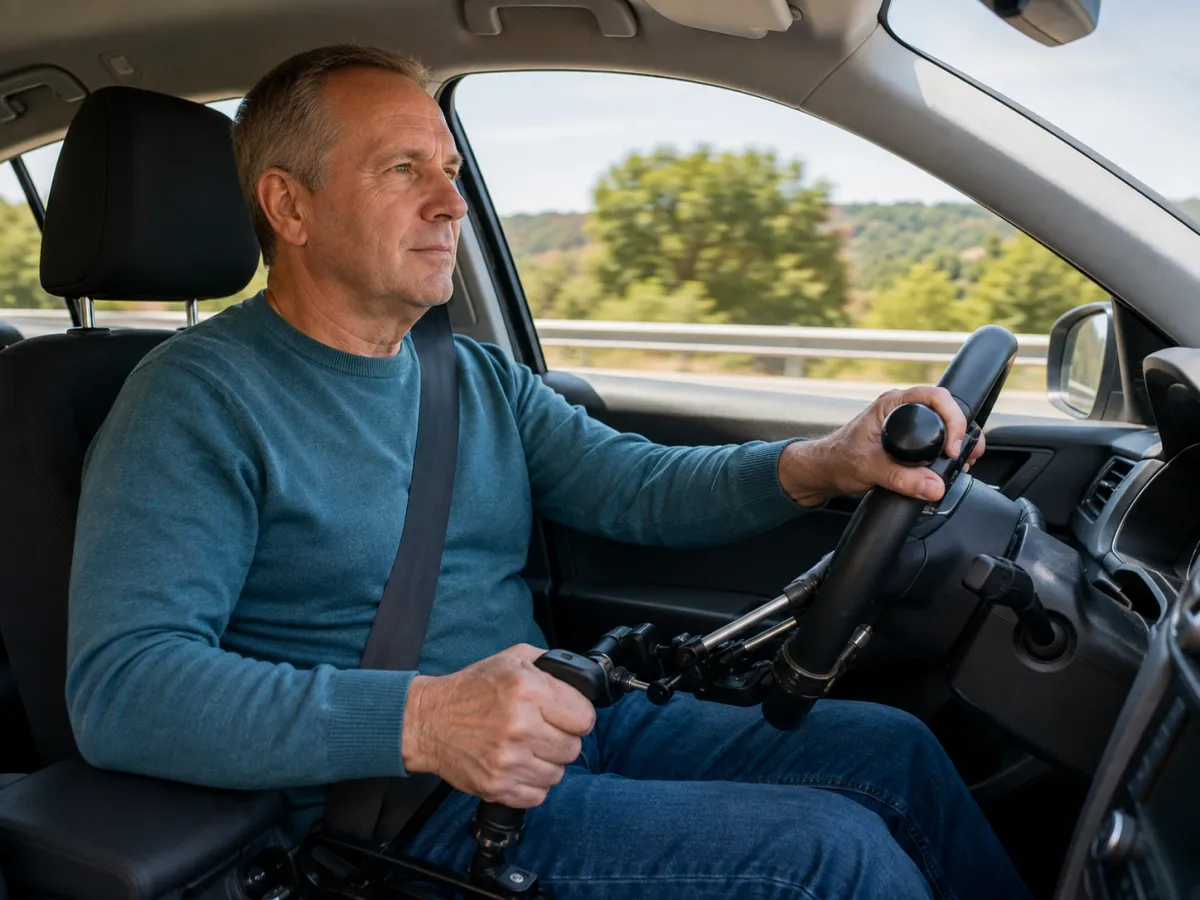
Getting back behind the wheel after a stroke can feel like reclaiming a major piece of your independence. But even when you are medically and legally able to drive again, your confidence may not return immediately. You may worry about your reactions, vision, concentration, coordination or whether you will cope in busy traffic. Confidence often comes back gradually through preparation, short journeys, familiar routes and repeated evidence that you can still drive safely.
After your stroke...
Driving may suddenly become one of the things you miss most.
Not because you love driving.
But because driving represents freedom.
You can go where you want.
When you want.
Without asking anyone.
Then your stroke happens.
Suddenly you are being driven everywhere.
To appointments.
To rehabilitation.
To the shops.
To visit family.
Perhaps you rely on your partner.
Your children.
Friends.
Taxis.
Public transport.
You begin thinking...
"Will I ever drive again?"
"What if my reactions are too slow?"
"What if I panic?"
"What if my vision is different?"
"What if I make a mistake?"
"What if I have another stroke while driving?"
And even when you eventually receive permission to return...
You may sit behind the steering wheel and realise something unexpected.
You are frightened.
That does not mean you will never drive confidently again.
It means something that once felt completely automatic now needs to be rebuilt.
✦ ✦ ✦
The Good News
Confidence behind the wheel can return.
For many stroke survivors, it happens gradually.
The Stroke Association advises that once you are legally able to drive again, beginning with short journeys and gradually increasing your driving can help confidence return.
You do not need to start by driving:
Through a busy city centre.
At rush hour.
At night.
On a motorway.
For three hours.
Your first drive might simply be around your neighbourhood.
Then perhaps to a familiar shop.
Then slightly further.
Each successful journey gives your brain another piece of evidence.
"I managed that."
Then:
"I managed that too."
Confidence is built through successful repetition.
✦ ✦ ✦
Why Can Driving Feel So Different After a Stroke?
Driving is extremely complex.
Before your stroke, you probably did not think about most of the processes involved.
Your brain automatically had to:
✓ Monitor traffic
✓ Judge distances
✓ Control the vehicle
✓ Read road signs
✓ Scan mirrors
✓ Watch pedestrians
✓ Maintain lane position
✓ Process speed
✓ Coordinate your hands and feet
✓ Make rapid decisions
✓ Filter irrelevant information
After a stroke, some of these processes may require more conscious effort.
Even if you are physically capable of driving, the task may initially feel mentally exhausting.
That can make you believe something is wrong.
Sometimes your brain is simply working much harder than it used to.
✦ ✦ ✦
Understand the Legal Rules First
Before rebuilding confidence, you need to establish that you are legally allowed to drive.
In the UK, car and motorcycle drivers must stop driving for at least one month after a stroke or TIA. If relevant stroke-related problems remain after that period, you may need to notify the DVLA and should not simply resume driving.
Ongoing problems that may affect driving include difficulties with:
✓ Vision
✓ Coordination
✓ Memory
✓ Understanding
✓ Arm or leg weakness affecting vehicle control
Certain circumstances, including seizures, brain surgery and some licence categories, can also require DVLA notification.
The rules for bus and lorry drivers are stricter than those for ordinary car licences.
Do not treat this part casually.
Confidence is irrelevant if you are not medically or legally fit to drive.
Check current DVLA guidance and speak to your healthcare team if you are uncertain.
✦ ✦ ✦
Being Allowed to Drive Does Not Mean You Will Feel Ready
This catches many people by surprise.
You may have been waiting desperately to drive again.
Then finally the day arrives.
And suddenly you hesitate.
You may think:
"I should be excited."
But instead you feel nervous.
There is nothing unusual about that.
A stroke changes your relationship with your body and brain.
Before the stroke, you trusted them automatically.
Afterwards, you may constantly monitor yourself.
Is my leg responding?
Am I concentrating?
Did I see that cyclist?
Was my reaction quick enough?
That internal monitoring can make driving feel much more difficult.
Confidence needs time to catch up.
✦ ✦ ✦
Start With a Familiar Car
If possible, begin in a vehicle you already know.
Familiarity removes unnecessary mental demands.
You already know:
✓ Where the indicators are
✓ How sensitive the brakes are
✓ Where the mirrors sit
✓ How the steering feels
✓ How the seat adjusts
✓ How the vehicle responds
Trying to rebuild driving confidence while simultaneously learning an unfamiliar vehicle adds another layer of difficulty.
Simplify the task.
The goal is not to challenge yourself unnecessarily.
The goal is to build safe, repeatable confidence.
✦ ✦ ✦
Start Somewhere Quiet
Your first drive does not need an audience.
And it definitely does not need rush-hour traffic.
Choose somewhere familiar and relatively quiet.
For example:
A quiet residential area.
A familiar local route.
A large empty car park, where appropriate and legally permitted.
A short journey at a quiet time of day.
Reduce the number of things your brain has to process.
Then gradually add complexity.
Quiet roads first.
Busier roads later.
Short routes first.
Longer routes later.
Daylight first.
Night driving later if appropriate.
This is graded exposure.
You rebuild tolerance rather than throwing yourself directly into the most difficult environment.
✦ ✦ ✦
Consider a Refresher Driving Lesson
You do not have to rebuild your confidence alone.
The Stroke Association specifically suggests refresher driving lessons as one option for people who have regained their licence but do not yet feel confident.
A professional instructor can provide something friends and family cannot always give you:
Objective feedback.
That matters.
A nervous relative may constantly gasp.
Grab the door.
Tell you to slow down.
Or reassure you excessively.
None of that necessarily tells you whether you are actually driving safely.
An experienced instructor can identify whether your:
Observation.
Positioning.
Control.
Judgement.
Speed.
Reactions.
Are genuinely safe.
Sometimes objective confirmation is exactly what confidence needs.
✦ ✦ ✦
What If You Are Unsure Whether You Are Safe?
Do not guess.
Driving assessment services can evaluate your ability.
An occupational therapist may also assess relevant physical or cognitive skills and, where appropriate, refer you for an in-car assessment.
A specialist driving assessment may look at areas such as:
✓ Vision
✓ Reaction speed
✓ Physical control
✓ Attention
✓ Cognitive processing
✓ Road awareness
✓ Vehicle adaptations
Being assessed does not automatically mean you will lose your licence.
Sometimes assessment identifies simple solutions.
For example, an automatic vehicle or particular adaptations may make driving easier for someone with residual physical weakness.
The objective is safe independence.
Not proving that you can drive exactly as you did before.
✦ ✦ ✦
Vision Must Be Taken Seriously
Vision problems after stroke can directly affect driving safety.
Potential difficulties include:
✓ Visual field loss
✓ Double vision
✓ Reduced visual attention
✓ Problems scanning
✓ Visual neglect
✓ Reduced visual processing
✓ Difficulty judging distances
Current NHS guidance notes that certain visual problems, including double vision and significant visual field loss, can prevent safe driving and require proper assessment.
Do not assume that because your eyesight looks normal on a standard eye chart, every aspect of visual processing required for driving is normal.
Stroke can affect how the brain interprets visual information, not merely whether the eyes can see clearly.
If you have ongoing visual symptoms, get them assessed before returning to the road.
✦ ✦ ✦
What About Slower Reactions?
This is one of the most common fears.
You may think:
"What happens if somebody pulls out in front of me?"
"What if I cannot brake quickly enough?"
"What if my brain freezes?"
Those concerns deserve proper assessment if you genuinely notice slower reactions.
But do not confuse anxiety with evidence.
Feeling slower is not the same as objectively being unsafe.
If you are worried, professional assessment can help determine whether your reaction time and decision-making are adequate for driving.
Do not repeatedly test yourself in dangerous real-world situations to find out.
There are safer ways to assess driving ability.
✦ ✦ ✦
Fatigue Changes Everything
You may drive perfectly well when rested but struggle when tired.
Post-stroke fatigue can affect:
✓ Concentration
✓ Attention
✓ Processing speed
✓ Decision-making
✓ Physical coordination
That means timing matters.
Perhaps initially you drive only:
In the morning.
After resting.
For short distances.
Without several demanding activities immediately beforehand.
A mistake many people make is testing themselves when already exhausted.
You spend several hours shopping.
Then drive home.
Your concentration is poor.
You struggle.
You conclude:
"I can't drive anymore."
The actual problem may have been fatigue.
Understand when your brain performs best.
Use that information.
✦ ✦ ✦
Keep Your First Journeys Short
Your first successful drive does not need to be impressive.
Ten minutes may be enough.
Perhaps you drive:
Around your neighbourhood.
To the local shop.
To a nearby family member.
Along a familiar route.
Then stop.
You are trying to finish while things are still going well.
If you continue until your concentration collapses, your brain may remember the journey as frightening.
Successful short drives build better evidence.
Gradually increase the duration as your confidence and stamina improve.
✦ ✦ ✦
Familiar Routes Can Help
A familiar route reduces uncertainty.
You already know:
Where the junctions are.
Where the roundabouts are.
Which lane you need.
Where traffic usually builds.
Where you need to turn.
That leaves more mental capacity for controlling the car and monitoring traffic.
Once familiar routes become comfortable, introduce unfamiliar journeys gradually.
You do not need to challenge every part of your driving ability simultaneously.
✦ ✦ ✦
Avoid Too Much Conversation Initially
Driving with somebody beside you may feel reassuring.
But conversation can also become distracting.
Early on, you may need more mental capacity for driving than you used to.
Tell your passenger:
"I need to concentrate, so let's keep conversation minimal for now."
That is not rude.
It is sensible.
Music may also be distracting initially.
Turn it down.
Reduce unnecessary stimulation.
Driving itself is enough.
✦ ✦ ✦
Motorways May Need to Come Later
Motorway driving can be intimidating even for people who have never had a stroke.
Speeds are higher.
Traffic is faster.
Lane changes happen quickly.
You may need to process signs and vehicles simultaneously.
If you are rebuilding confidence, there is nothing wrong with leaving motorway driving until later.
You might first become comfortable with:
Residential roads.
Local main roads.
Dual carriageways.
Then motorways.
A refresher lesson specifically focused on motorway driving can also help.
Again, the goal is not to prove anything.
The goal is safe confidence.
✦ ✦ ✦
Night Driving Can Feel Completely Different
Some people feel comfortable driving during daylight but struggle at night.
Night driving can involve:
✓ Reduced visibility
✓ Glare from headlights
✓ More difficult distance judgement
✓ Increased visual fatigue
✓ Greater concentration demands
If your stroke affected vision or visual processing, these difficulties may feel even stronger.
There is no rule saying that once you return to driving you must immediately drive under every possible condition.
Build gradually.
Daylight first if that feels safer.
Then test other conditions when appropriate.
✦ ✦ ✦
What If Someone Else Makes You Nervous?
Be selective about who accompanies you during your early drives.
A nervous passenger can destroy confidence.
Someone constantly saying:
"Watch that!"
"Slow down!"
"Are you sure?"
"Careful!"
May make you believe you are driving badly even when you are not.
Choose someone calm.
Better still, use a professional instructor if you want objective reassurance.
Your passenger should help you feel focused.
Not turn the vehicle into a moving anxiety chamber.
✦ ✦ ✦
Do Not Drive Simply to Prove Something
This is important.
You may feel pressure to demonstrate that you have recovered.
You may think:
"I used to drive everywhere. I'm not going to let this beat me."
That attitude can push you too far too soon.
Stroke recovery is not a competition.
Driving is one area where pride should never override safety.
If you are:
Exhausted.
Unwell.
Unable to concentrate.
Experiencing visual symptoms.
Having new neurological symptoms.
Do not drive simply because you want to prove that you can.
Confidence should be built on safe performance.
Not stubbornness.
✦ ✦ ✦
What If You Make a Mistake?
You will probably make one eventually.
Every driver does.
You miss a turning.
Choose the wrong lane.
Stall.
Brake slightly harder than intended.
Forget where you parked.
The danger after stroke is interpreting every ordinary driving error as:
"My stroke has made me unsafe."
Ask yourself:
Was this genuinely dangerous?
Could I have done this before my stroke?
Do other drivers make the same mistake?
Is this happening repeatedly?
Was fatigue involved?
A single minor mistake does not automatically prove that you cannot drive.
But repeated or serious errors should not be ignored.
That is when professional assessment becomes important.
✦ ✦ ✦
Anxiety Can Affect Your Driving
Fear itself can interfere with performance.
When anxious, you may:
Grip the steering wheel tightly.
Overthink every decision.
Brake unnecessarily.
Avoid changing lanes.
Become hyperaware of every vehicle.
Feel your heart racing.
Experience dizziness.
Lose confidence further.
This can create a cycle.
You are afraid you will drive badly.
The fear makes driving harder.
The difficulty confirms your fear.
Gradual exposure can break that cycle.
Short.
Familiar.
Quiet.
Successful.
Then slightly more challenging.
Confidence grows through repetition.
✦ ✦ ✦
What If You Are Afraid of Having Another Stroke While Driving?
This fear can be difficult to shake.
After experiencing a stroke once, your brain knows that serious illness can happen suddenly.
You may think:
"What if it happens again when I am driving?"
It is understandable to have that thought.
But constantly imagining the worst possible event can make normal life impossible.
Your medical team should advise you about your individual risk and fitness to drive.
If you have been medically cleared and meet the legal requirements, confidence then becomes a separate issue.
If the fear remains overwhelming, discuss it with your GP or rehabilitation team.
You should not have to live permanently expecting another emergency every time you leave home.
✦ ✦ ✦
Driving Can Restore Independence
For many stroke survivors, getting their licence and car back means much more than transport.
It means:
✓ Going shopping independently
✓ Taking children to school
✓ Visiting friends
✓ Returning to work
✓ Attending appointments alone
✓ Travelling spontaneously
✓ No longer relying on family
✓ Reclaiming privacy
The emotional effect can be enormous.
Stroke Association resources describe loss of driving as something that can affect independence and leave survivors frustrated by reliance on others.
That is why returning to driving can feel like such a major milestone.
It restores choices.
✦ ✦ ✦
Adaptations Can Make Driving Possible
Residual weakness does not automatically mean driving is impossible.
Some people may benefit from:
✓ Automatic transmission
✓ Steering aids
✓ Hand controls
✓ Pedal adaptations
✓ Modified seating
✓ Other specialist equipment
The correct adaptation depends on your individual impairment and should be assessed professionally.
Do not improvise modifications yourself.
A specialist driving assessment can help determine what is appropriate and whether licence restrictions or adaptations need to be formally recorded.
The aim is not necessarily to drive a completely standard vehicle.
The aim is to drive safely.
✦ ✦ ✦
Keep Track of Your Progress
You may find it useful to record your early journeys.
For example:
Journey: Local supermarket
Time: 12 minutes
Traffic: Light
Fatigue before driving: Low
Confidence before: 4/10
Confidence after: 7/10
Problems: None
This may seem excessive.
But after several weeks you may see something important.
Your first drive terrified you.
Your fifth felt manageable.
Your tenth felt normal.
Confidence changes gradually, so you may not notice the improvement unless you look back.
✦ ✦ ✦
Emotional Impact
Not driving can affect much more than transport.
You may feel:
✓ Dependent
✓ Frustrated
✓ Trapped
✓ Embarrassed
✓ Less spontaneous
✓ Less confident
✓ Like part of your identity has disappeared
Then returning to the driver's seat can trigger another set of emotions.
Fear.
Relief.
Excitement.
Nervousness.
Pride.
For some people, driving again represents one of the clearest signs that life is returning.
That emotional significance should not be underestimated.
✦ ✦ ✦
My Perspective
Driving is one of those abilities we barely think about until it disappears.
Before a stroke, getting into the car can feel completely ordinary.
Keys.
Seatbelt.
Engine.
Drive.
Then suddenly you cannot do it.
Someone else drives you.
Someone else decides when you leave.
Someone else waits outside your appointment.
And something that once felt completely insignificant suddenly represents independence.
That is why returning to driving can matter so much.
But I do not think confidence should be forced.
Being legally allowed to drive and emotionally trusting yourself to drive are two different things.
Your confidence may need rehabilitation too.
Start small.
Use familiar roads.
Drive when rested.
Reduce distractions.
Ask for professional assessment if you need it.
Take refresher lessons if they would help.
Then collect evidence.
One drive.
Then another.
Then another.
Eventually, you may notice that you are no longer analysing every movement.
You are simply driving.
And perhaps that is when you realise...
The confidence has returned.
✦ ✦ ✦
When Should You Seek Medical Advice?
Speak to your GP, stroke team or another appropriate healthcare professional if you are uncertain about whether your stroke has affected your ability to drive safely.
Seek advice particularly if you experience:
✓ New or worsening visual problems
✓ Double vision
✓ Visual field loss
✓ Significant weakness
✓ Poor coordination
✓ Memory problems
✓ Difficulty concentrating
✓ Episodes of confusion
✓ Seizures
✓ Severe dizziness
✓ New neurological symptoms
If ongoing stroke effects could affect driving after the required period off the road, you may also need to notify the DVLA.
Never continue driving against medical advice.
✦ ✦ ✦
Frequently Asked Questions
How Long After a Stroke Can I Drive?
In the UK, ordinary car and motorcycle drivers generally must stop driving for at least one month after a stroke or TIA. Whether you can resume after that depends on your recovery and any ongoing symptoms.
Do I Need to Tell the DVLA?
It depends on your circumstances.
Certain ongoing symptoms, seizures, multiple strokes or TIAs, particular licence categories and other factors may require notification.
Always check current DVLA rules rather than relying on general advice.
Is It Normal to Be Scared of Driving Again?
Yes.
Stroke Association resources specifically recognise that people may lose confidence or experience anxiety about returning to driving.
How Can I Rebuild My Confidence?
Start gradually.
Choose short, familiar routes.
Drive when rested.
Reduce distractions.
Increase difficulty slowly.
Refresher lessons can also help.
Should I Have a Driving Assessment?
If there are concerns about your physical, cognitive or visual ability to drive safely, a specialist driving assessment can be extremely useful.
Can I Drive With Weakness After Stroke?
Possibly.
Some people can drive safely using an automatic vehicle or specialist adaptations, depending on the nature of their impairment and professional assessment.
Can Vision Problems Stop Me Driving?
Yes.
Some visual problems after stroke can make driving unsafe and may prevent you from meeting licensing requirements. Proper visual assessment is important.
✦ ✦ ✦
Key Takeaways
✓ Losing confidence behind the wheel after stroke is common.
✓ Being legally able to drive does not mean you will immediately feel confident.
✓ UK drivers generally need to stop driving for at least one month after stroke or TIA.
✓ Ongoing physical, visual or cognitive problems may require DVLA notification and further assessment.
✓ Start with short journeys on familiar roads.
✓ Drive when you are rested and avoid unnecessary distractions initially.
✓ Increase driving difficulty gradually.
✓ Refresher driving lessons can help rebuild confidence.
✓ Specialist driving assessments can provide objective information about safety.
✓ Vehicle adaptations may help some survivors return to driving.
✓ Never allow pride or pressure from other people to override safety.
✓ Confidence usually returns through repeated successful experiences.
✦ ✦ ✦
Related Articles
Continue learning about independence and everyday life after stroke:
Driving After a Stroke
Vision Problems and Driving After Stroke
Fatigue and Driving After Stroke
Returning to Work After a Stroke
Confidence Returning to Work After Stroke
Dizziness After a Stroke
Visual Field Loss After Stroke
Double Vision After a Stroke
Memory Problems After Stroke
Regaining Independence After Stroke
✦ ✦ ✦
About the Author
Alisia Gayle is a stroke survivor who achieved 96% neurological recovery following an ischaemic stroke.
After years of rehabilitation, she now shares practical, evidence-informed resources to help stroke survivors, carers and families better understand recovery and rebuild their lives with confidence.
Alisia is also the author of Brain Damage: My Journey to 96% Recovery, where she shares her personal stroke recovery story and the lessons she learned throughout her rehabilitation.
✦ ✦ ✦
Medical Disclaimer
This article is intended for educational purposes only and should not replace professional medical advice, diagnosis, treatment or formal assessment of fitness to drive.
Driving regulations vary by country and can change.
The legal information in this article refers primarily to UK guidance available in August 2026.
Always check current DVLA requirements and follow advice from your doctor, stroke team, occupational therapist, ophthalmologist or other appropriate healthcare professional before returning to driving.
If you have been told not to drive, do not resume driving until you have received appropriate medical or licensing clearance.
✦ ✦ ✦
Final Thoughts
Returning behind the wheel after a stroke...
Can feel enormous.
Your hands may grip the steering wheel tighter than they used to.
A familiar junction may suddenly feel complicated.
Traffic may seem faster.
And you may wonder whether driving will ever feel natural again.
Do not judge your future confidence by your first nervous journey.
Start small.
Choose familiar roads.
Drive when rested.
Reduce distractions.
Get professional help if you need it.
Then build gradually.
One quiet road.
One short journey.
One successful trip.
Then another.
Because confidence behind the wheel does not usually return because you force yourself to stop being afraid.
It returns when your brain collects enough evidence that you can still do this safely.
And one day...
You may pull into your driveway, switch off the engine and realise you barely thought about the stroke at all.
You simply drove.