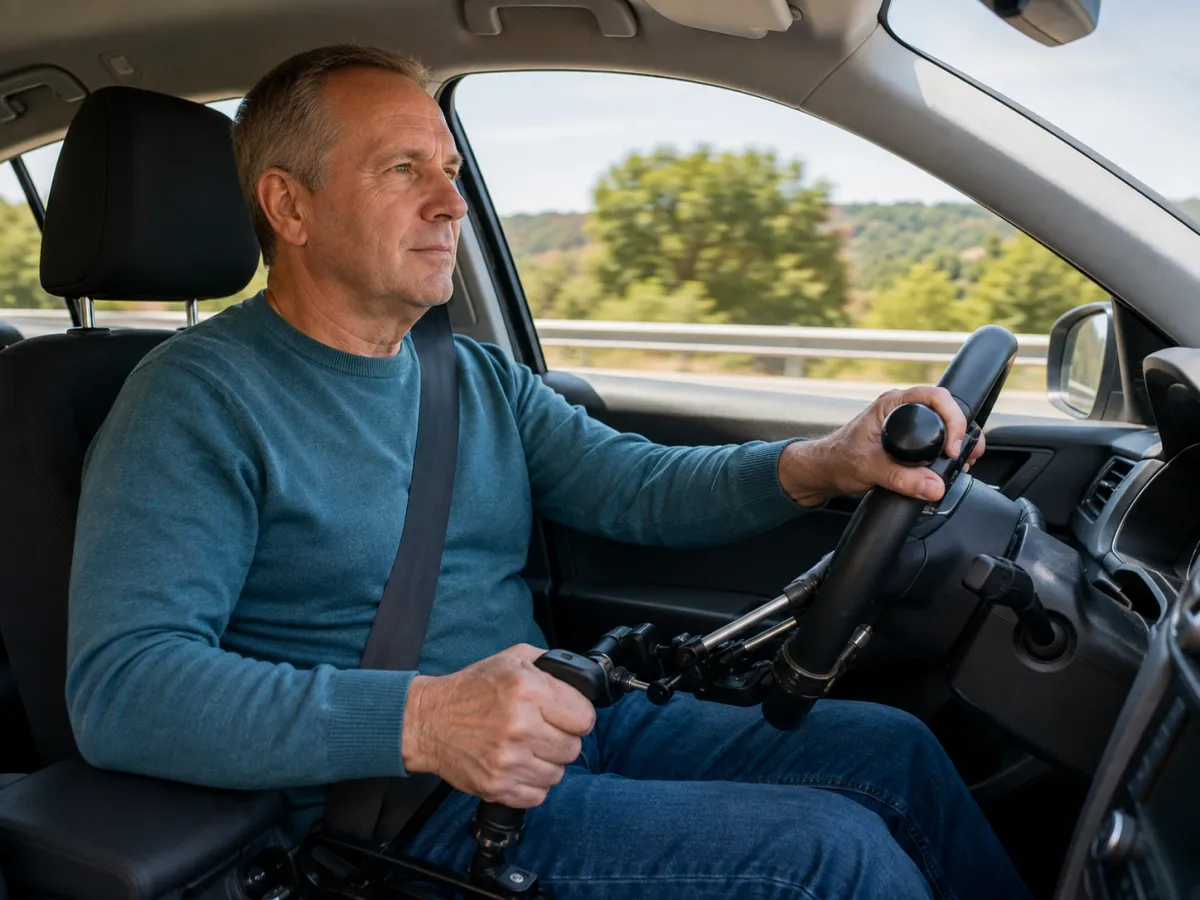
Returning to driving for work after a stroke can feel like a major step towards independence, but it is not something to rush. Driving depends on vision, reaction time, concentration, judgement, movement, coordination and the ability to manage fatigue. Even if you feel physically recovered, you may still need medical clearance, licensing checks, driving assessment or practical adjustments before driving safely for work again.
After your stroke...
Perhaps you stopped driving immediately.
Someone else began taking you to appointments.
You relied on family.
Taxis.
Public transport.
Colleagues.
Maybe work became much harder simply because you could no longer get there independently.
Then recovery progresses.
Your strength improves.
Your vision improves.
Your concentration improves.
And eventually you start thinking...
"Can I drive again?"
"When can I start?"
"What if I need to drive for work?"
"Do I need to tell the DVLA?"
"What if my employer expects me to travel?"
"Will I still be safe behind the wheel?"
These are important questions.
Because returning to driving is not simply about getting your independence back.
It is about making sure that your recovery has reached the point where you can safely manage a complex task that affects you, your passengers and everyone else on the road.
✦ ✦ ✦
The Good News
Many stroke survivors do return to driving.
A stroke does not automatically mean that you will never drive again.
However, the rules depend on the type of licence you hold, your remaining symptoms and whether your doctor considers you safe to drive.
In Great Britain, car and motorcycle licence holders must stop driving for at least one month after a stroke. You can restart after that only when a doctor or healthcare professional considers it safe.
That one-month period is a minimum.
It does not mean everyone is automatically safe to drive after four weeks.
Some people need longer.
Some need further assessment.
Some need vehicle adaptations.
And some may not be able to return to driving at all.
The important thing is not how quickly you return.
It is whether you return safely.
✦ ✦ ✦
Why Can Driving Be Difficult After a Stroke?
Driving is one of the most complicated everyday activities your brain performs.
You need to:
✓ See clearly
✓ Scan the road
✓ Judge distance
✓ Maintain attention
✓ React quickly
✓ Coordinate your hands and feet
✓ Make rapid decisions
✓ Monitor several things at once
✓ Understand signs and road markings
✓ Manage distractions
✓ Stay alert for long periods
A stroke can affect any of these abilities.
Sometimes the problem is obvious.
Perhaps one arm is weak.
Perhaps you have visual field loss.
Perhaps you cannot move one foot quickly enough.
But other problems can be much more subtle.
You may walk normally and speak normally yet still have difficulties with:
✓ Processing speed
✓ Attention
✓ Visual scanning
✓ Reaction time
✓ Fatigue
✓ Spatial awareness
These are exactly the kinds of difficulties that may matter enormously while driving.
✦ ✦ ✦
Do You Have to Stop Driving After a Stroke?
Yes.
In Great Britain, car and motorcycle drivers must stop driving for at least one month following a stroke.
After that period, whether you can restart depends on your recovery.
You should not simply decide:
"A month has passed, so I'm driving again."
The official guidance says you should restart only when your doctor or healthcare professional tells you it is safe.
Different rules apply to lorry, bus and coach licences, which have stricter medical standards. The DVLA publishes separate guidance for these licence categories.
If driving is part of your employment, getting this right matters even more.
✦ ✦ ✦
Do You Need to Tell the DVLA?
Not every car or motorcycle driver who has had a stroke automatically needs to notify the DVLA after the minimum period.
According to current GOV.UK guidance, you do not usually need to tell the DVLA if you have recovered.
However, you must tell the DVLA if certain problems remain after one month or if your doctor tells you that your condition must be reported.
This is not an area where guessing is sensible.
The DVLA has a specific medical-condition checking system, and failing to report a relevant condition can lead to a fine of up to £1,000. You could also face prosecution if you are involved in an accident after failing to disclose a condition that affects your ability to drive safely.
If in doubt, check the current DVLA rules or speak to your doctor.
✦ ✦ ✦
What Stroke Problems May Affect Driving?
Several post-stroke problems may interfere with safe driving.
Vision Problems
These may include:
✓ Visual field loss
✓ Double vision
✓ Poor depth perception
✓ Difficulty scanning
✓ Reduced contrast sensitivity
✓ Light sensitivity
Visual field problems can be particularly important because you may fail to notice vehicles, cyclists or pedestrians approaching from one side.
Weakness
Weakness in an arm or leg may affect:
✓ Steering
✓ Gear changes
✓ Braking
✓ Accelerator control
✓ Emergency manoeuvres
Coordination Problems
Poor coordination may make controlling the vehicle more difficult.
Slower Reaction Time
A small delay may not matter when sitting at home.
On the road, it may matter enormously.
Cognitive Problems
Driving requires rapid processing.
Problems with attention, judgement, memory or concentration can therefore affect safety.
Fatigue
Stroke Association guidance warns that fatigue may make it harder to stay focused or alert at the wheel.
This can become particularly important when driving long distances for work.
✦ ✦ ✦
Why Driving for Work Can Be Harder Than Ordinary Driving
Driving ten minutes to a local shop is very different from driving as part of your working day.
Work-related driving may involve:
✓ Motorways
✓ Unfamiliar routes
✓ Long journeys
✓ Rush-hour traffic
✓ Tight schedules
✓ Driving after meetings
✓ Driving while mentally fatigued
✓ Multiple destinations
✓ Early mornings
✓ Late finishes
✓ Carrying equipment
✓ Pressure to arrive on time
You may technically be able to drive but still find this level of demand exhausting.
That distinction matters.
Your question should not only be:
"Can I drive?"
It should also be:
"Can I safely manage the type and amount of driving my job requires?"
✦ ✦ ✦
Fatigue Is One of the Biggest Risks
Post-stroke fatigue can be deceptive.
You may feel fine when you begin your working day.
Then you spend several hours concentrating.
You attend meetings.
You answer emails.
You solve problems.
By late afternoon, your mental energy has fallen dramatically.
Then you get into a car.
That may be the most demanding task you perform all day.
Stroke Association guidance notes that fatigue after stroke can make it difficult to stay focused or awake while driving.
Pay attention to warning signs such as:
✓ Heavy eyes
✓ Difficulty concentrating
✓ Missing road signs
✓ Slower reactions
✓ Irritability
✓ Losing track of your route
✓ Struggling to process busy traffic
✓ Feeling mentally "foggy"
Do not treat fatigue as something to defeat through willpower.
If your brain is tired, it is tired.
✦ ✦ ✦
Start With Short, Familiar Journeys
If you have been medically cleared to drive, your first journey does not need to be a motorway commute during rush hour.
Start sensibly.
Consider:
✓ Familiar roads
✓ Quiet times of day
✓ Short journeys
✓ Good weather
✓ Daylight driving
✓ Minimal distractions
Then gradually increase the challenge.
For example:
Local road.
Then slightly longer journey.
Then busier traffic.
Then commuting.
Then work-related travel.
You are rebuilding driving confidence and assessing your stamina.
There is no benefit in making the first journey unnecessarily difficult.
✦ ✦ ✦
A Driving Assessment May Help
If there is uncertainty about whether you can safely return to driving, you may be referred for a specialist driving assessment.
Stroke Association guidance recommends assessments where appropriate and provides information on specialist mobility centres and driving evaluations.
An assessment may look at things such as:
✓ Vision
✓ Reaction time
✓ Attention
✓ Physical control
✓ Road awareness
✓ Decision-making
✓ Practical driving ability
This can feel intimidating.
But an assessment can also give you something valuable.
Evidence.
Instead of repeatedly wondering:
"Am I safe?"
You may receive a clearer professional evaluation of your abilities and any adaptations that could help.
✦ ✦ ✦
Vehicle Adaptations May Make Driving Easier
Some people can return to driving with modifications to their vehicle.
Depending on your impairment, adaptations might include:
✓ Hand controls
✓ Steering aids
✓ Automatic transmission
✓ Pedal adaptations
✓ Modified indicators
✓ Additional mirrors
✓ Seating adjustments
The exact adaptation depends on your individual needs.
A specialist driving or mobility assessment can help determine whether changes are necessary.
Adaptations are not evidence that you have failed to recover.
They are tools.
The question is whether they allow you to drive safely and independently.
✦ ✦ ✦
Do Not Hide Problems Because You Need to Work
This is where people can make poor decisions.
Perhaps your job requires driving.
Perhaps you are worried that telling your employer about difficulties will threaten your position.
So you minimise symptoms.
You tell yourself:
"My vision is probably fine."
"My reactions are probably quick enough."
"I'll just push through the fatigue."
That is dangerous thinking.
A driving requirement does not override safety.
If your stroke has left you with symptoms that may affect your ability to drive, those symptoms need to be properly assessed.
A job can be changed.
A journey can be rearranged.
A serious road accident cannot be undone.
✦ ✦ ✦
Speak to Your Employer About the Driving Requirement
If driving is only one part of your role, consider whether it can temporarily be reduced.
For example:
✓ Colleagues may cover some site visits
✓ Meetings may be held online
✓ Public transport may be used
✓ Taxis may be appropriate
✓ Journeys may be grouped together
✓ Long-distance travel may be reduced
✓ Overnight stays may reduce same-day driving
✓ Your schedule may be changed
The objective is not necessarily to remove driving permanently.
It may simply be to reduce the load while your stamina continues to improve.
✦ ✦ ✦
Reasonable Adjustments May Help
If the effects of your stroke amount to a disability under UK law, your employer may have a duty to consider reasonable adjustments to prevent you being placed at a substantial disadvantage. GOV.UK lists changes to working arrangements and equipment among possible adjustments.
For work-related travel, possible practical changes might include:
✓ Reducing unnecessary journeys
✓ Allowing more travel time
✓ Avoiding back-to-back site visits
✓ Using remote meetings
✓ Scheduling demanding driving earlier in the day
✓ Providing alternative transport
✓ Changing duties temporarily
The appropriate solution depends on the job.
The point is that returning to employment does not always require immediately returning to every aspect of your old working pattern.
✦ ✦ ✦
Access to Work May Help With Travel
If a disability or health condition makes travelling to work difficult, the UK government's Access to Work scheme may provide support in some circumstances.
Access to Work can help people get or stay in employment, and support may include help with costs associated with travelling to work where the need arises because of a disability or health condition.
Eligibility depends on your circumstances.
The programme may be relevant if, for example, you cannot safely use your previous form of transport because of the effects of your stroke.
It is worth investigating rather than automatically assuming you must solve every transport problem yourself.
✦ ✦ ✦
What About Car Insurance?
Do not forget your insurer.
The medical rules governing whether you can legally drive and the requirements of your insurance policy are related but separate issues.
Stroke Association guidance advises people returning to driving to check their insurance arrangements.
If your medical circumstances have changed, make sure you understand whether your insurer needs to be informed.
Driving without valid insurance could create serious legal and financial problems.
✦ ✦ ✦
Returning to Motorway Driving
Motorways can be particularly demanding after a stroke.
They require:
✓ Sustained attention
✓ High-speed judgement
✓ Lane positioning
✓ Mirror scanning
✓ Rapid decision-making
✓ Confidence merging into traffic
✓ Managing large vehicles around you
Do not make motorway driving your first test simply because your job requires it.
Build towards it.
If motorway driving causes severe anxiety or cognitive fatigue, that is useful information.
It does not necessarily mean you will never manage it.
It may mean you are not ready yet.
✦ ✦ ✦
Driving in Busy Cities
Urban driving creates a different challenge.
You may need to process:
Traffic lights.
Pedestrians.
Cyclists.
Buses.
Road signs.
Navigation systems.
Parked vehicles.
People stepping into the road.
Multiple lanes.
All within seconds.
If you have visual processing or attention difficulties, this can be exhausting.
Plan journeys where possible.
Know where you are going.
Avoid unnecessary distractions.
And do not assume that because you are comfortable on a quiet road you will automatically feel equally comfortable in dense city traffic.
✦ ✦ ✦
Reduce Distractions
Your brain may have less spare processing capacity than before your stroke.
That makes unnecessary distractions more expensive.
Consider reducing:
✓ Loud music
✓ Complicated conversations
✓ Phone notifications
✓ Constant navigation changes
✓ Eating while driving
✓ Unnecessary multitasking
You want as much of your attention as possible available for the road.
This is particularly important while you are rebuilding confidence.
✦ ✦ ✦
Plan Around Your Best Time of Day
Recovery can produce noticeable patterns.
Perhaps your concentration is strongest between 8am and midday.
Perhaps fatigue becomes severe after 3pm.
That information should influence your work travel where possible.
You might schedule:
✓ Longer journeys earlier
✓ Site visits in the morning
✓ Fewer journeys after demanding meetings
✓ Breaks before driving home
✓ Overnight accommodation after particularly long days
Working with your energy pattern is smarter than pretending it does not exist.
✦ ✦ ✦
Confidence Can Lag Behind Ability
Even after you have been medically cleared, you may feel nervous.
Your first journey may feel strange.
Cars seem faster.
Junctions feel more complicated.
You become intensely aware of everything you are doing.
That does not automatically mean you are unsafe.
It may simply mean that driving is no longer automatic yet.
Confidence often returns through repetition.
One short journey.
Then another.
Then another.
Eventually the task may feel familiar again.
✦ ✦ ✦
But Do Not Confuse Confidence With Competence
The reverse is also true.
Feeling confident does not automatically mean that you are medically fit to drive.
Some stroke-related cognitive or visual problems are not obvious to the person experiencing them.
That is why medical guidance and formal assessment matter.
You should not rely solely on:
"I feel fine."
Driving safely involves objective abilities as well as confidence.
Both matter.
✦ ✦ ✦
What If You Cannot Return to Driving?
For some people, this becomes one of the most difficult consequences of stroke.
Driving may represent:
Independence.
Work.
Parenting.
Freedom.
Social life.
Normality.
Losing it can feel enormous.
But not being able to drive does not automatically mean you cannot work.
Alternatives might include:
✓ Public transport
✓ Taxis
✓ Lift-sharing
✓ Remote working
✓ Changing your work location
✓ Reducing travel-based duties
✓ Access to Work support
✓ Moving into a different role
These alternatives may not feel equivalent.
But they can preserve employment and independence while you adapt.
✦ ✦ ✦
Emotional Impact
Returning to driving can be surprisingly emotional.
Your first drive after stroke may represent much more than transport.
You may think:
"I am independent again."
"I don't have to ask someone to take me."
"I can take myself to work."
"I can pick up my children."
"I can go where I want."
That independence can have a powerful effect on confidence.
At the same time, fear can appear unexpectedly.
You may worry about another stroke while driving.
You may become overly alert to every physical sensation.
You may fear making a mistake.
These reactions can improve as confidence returns.
But persistent anxiety that significantly affects driving should be discussed with an appropriate healthcare professional.
✦ ✦ ✦
My Perspective
Driving after stroke represents something that is easy to underestimate until you lose it.
Independence.
You suddenly realise how many ordinary parts of life depend on being able to get into a car and go somewhere.
Work.
Appointments.
Shopping.
Family responsibilities.
Social life.
Losing that freedom can make recovery feel even more restrictive.
So naturally, getting your keys back can feel like a victory.
But returning to driving should never become a competition with recovery.
There is nothing impressive about returning too early.
The real achievement is returning when you can do it safely.
That may require patience.
Medical advice.
Assessment.
Adaptation.
Practice.
And perhaps a different approach to work travel than you had before your stroke.
Your independence matters.
But your safety matters more.
✦ ✦ ✦
When Should You Seek Medical Advice?
Speak to your doctor or stroke team before returning to driving if you have concerns about your ability to drive safely.
This is particularly important if you still experience:
✓ Visual field loss
✓ Double vision
✓ Significant weakness
✓ Poor coordination
✓ Severe fatigue
✓ Dizziness
✓ Seizures
✓ Attention difficulties
✓ Cognitive problems
✓ Slowed reactions
✓ New neurological symptoms
You should also stop driving and seek urgent medical advice if you develop sudden new stroke-like symptoms.
A sudden change in:
Face.
Arm strength.
Speech.
Vision.
Balance.
Or neurological function should never be ignored.
✦ ✦ ✦
Frequently Asked Questions
How Long After a Stroke Can I Drive?
For ordinary car and motorcycle licences in Great Britain, you must stop driving for at least one month after a stroke. You should restart only when a doctor or healthcare professional considers it safe.
Do I Have to Tell the DVLA?
Not always.
If you have recovered, notification may not be required for an ordinary car or motorcycle licence.
However, certain ongoing problems must be reported, and different rules apply to other licence categories. Always check the current DVLA guidance.
Can I Drive for Work After a Stroke?
Possibly.
You need to be medically fit to drive and meet the relevant licensing requirements.
You should also consider whether you can safely tolerate the amount and type of driving your job requires.
Can Fatigue Make Driving Unsafe?
Yes.
Post-stroke fatigue may reduce attention and alertness, which can affect driving safety.
Can I Have a Driving Assessment?
Yes.
Specialist driving assessments may help evaluate whether you are ready to return and whether vehicle adaptations would be useful.
What If I Cannot Drive to Work?
Discuss alternatives with your employer.
Depending on your circumstances, reasonable adjustments or Access to Work support may also be relevant.
✦ ✦ ✦
Key Takeaways
✓ Car and motorcycle drivers in Great Britain must stop driving for at least one month after a stroke.
✓ Do not restart until a doctor or healthcare professional considers it safe.
✓ Some ongoing symptoms must be reported to the DVLA.
✓ Vision, reaction time, cognition, coordination and fatigue can all affect driving.
✓ Driving for work may be more demanding than ordinary local driving.
✓ Start with short, familiar journeys where appropriate.
✓ Specialist driving assessments can be useful.
✓ Vehicle adaptations may help some survivors.
✓ Fatigue should never be ignored before or during a journey.
✓ Employers may be able to adjust travel requirements.
✓ Access to Work may help with some disability-related travel costs.
✓ Returning safely matters more than returning quickly.
✦ ✦ ✦
Related Articles
Continue learning about work, independence and stroke recovery:
Returning to Work After a Stroke
Confidence Returning to Work After Stroke
Fatigue at Work After Stroke
Changing Careers After Stroke
Reasonable Adjustments After Stroke
Working From Home After Stroke
Vision Problems After Stroke
Visual Field Loss After Stroke
Dizziness After Stroke
Concentration Problems After Stroke
✦ ✦ ✦
About the Author
Alisia Gayle is a stroke survivor who achieved 96% neurological recovery following an ischaemic stroke.
After years of rehabilitation, she now shares practical, evidence-informed resources to help stroke survivors, carers and families better understand recovery and rebuild their lives with confidence.
Alisia is also the author of Brain Damage: My Journey to 96% Recovery, where she shares her personal stroke recovery story and the lessons she learned throughout her rehabilitation.
✦ ✦ ✦
Medical Disclaimer
This article is intended for educational purposes only and should not replace professional medical, legal, licensing or occupational advice.
Driving regulations vary according to licence type, medical circumstances and location, and they can change.
Always check the current rules that apply where you live and speak to your doctor, stroke specialist, rehabilitation team or relevant driving authority before returning to driving after a stroke.
Never drive if you have been advised not to drive or if you believe your symptoms could make driving unsafe.
✦ ✦ ✦
Final Thoughts
Returning to driving after a stroke...
Can feel enormous.
The first time you sit behind the wheel again...
You may feel nervous.
Excited.
Uncertain.
Free.
Perhaps driving was once something you never thought about.
Now it represents independence.
Work.
Choice.
And another part of your life returning.
But do not rush it.
Give your brain time.
Follow the medical rules.
Understand your symptoms.
Have an assessment if you need one.
Build up gradually.
Respect fatigue.
And be prepared to change how you travel for work if your old routine is no longer sensible.
Because returning to driving is not about proving that the stroke did not affect you.
It is about proving that you can safely take responsibility for the road again.
And when you are ready...
That first independent journey can become another powerful reminder of just how far you have come.