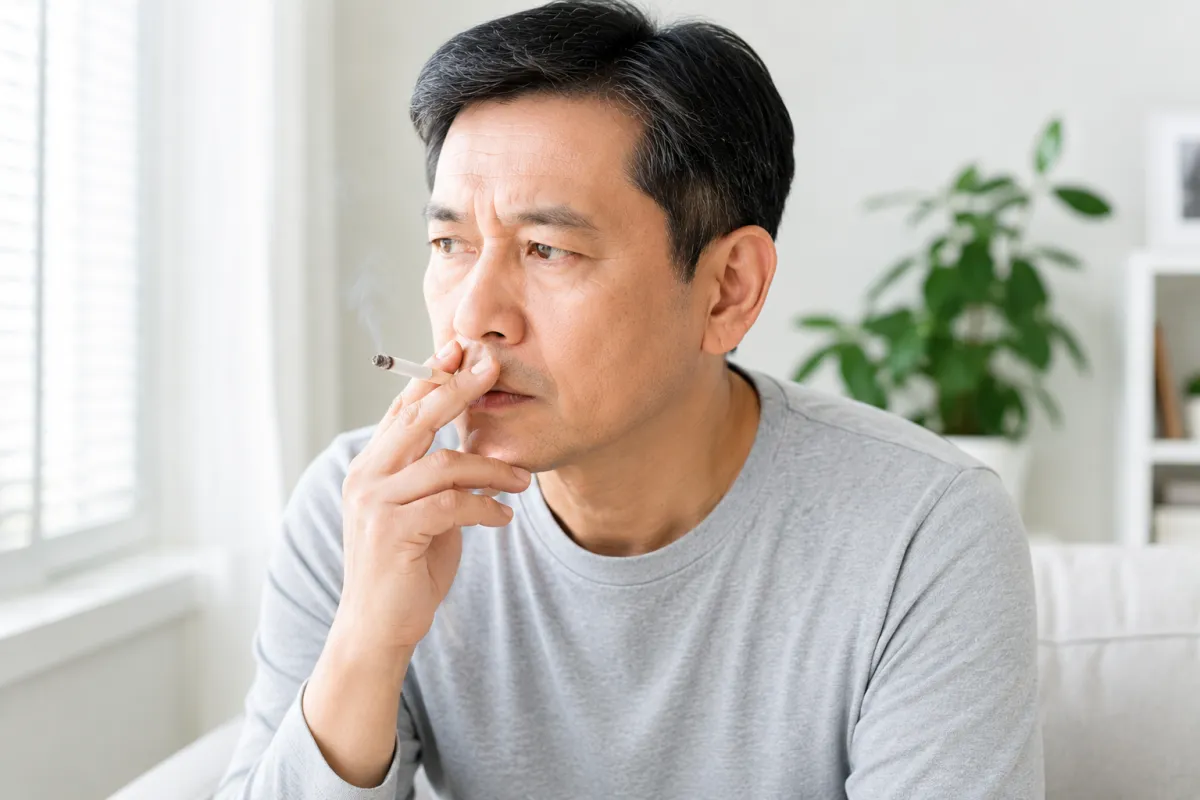
Smoking after a stroke can significantly increase the risk of another stroke because tobacco smoke damages blood vessels, promotes atherosclerosis and makes blood more likely to clot. Quitting is one of the most powerful changes a smoker can make after stroke. Even cutting down reduces exposure, but complete cessation gives the greatest health benefit. Support such as nicotine replacement therapy, stop-smoking medicines and behavioural support can make quitting more achievable.
After your stroke...
You may suddenly look at cigarettes very differently.
Perhaps you have smoked for twenty years.
Maybe you only smoke socially.
Perhaps you stopped in hospital but started again when you returned home.
Or perhaps smoking has become one of the ways you deal with stress.
Then somebody tells you:
"You really need to stop."
You begin wondering...
"Has the damage already been done?"
"Will quitting now actually make a difference?"
"What if I only smoke a few cigarettes?"
"Can nicotine replacement be used after stroke?"
"What if I have tried to quit before and failed?"
These questions matter.
Because smoking is not simply a lung problem.
It is also a blood-vessel problem.
And after a stroke...
Your blood vessels deserve serious protection.
✦ ✦ ✦
The Good News
It is never too late to stop smoking.
The benefits begin after quitting and continue over time.
The NHS states that stopping smoking reduces the longer-term risks of heart disease and stroke, while the Stroke Association identifies quitting as one of the best ways smokers can reduce stroke risk.
You do not have to undo every cigarette you ever smoked.
You cannot.
But you can stop adding further exposure.
Quitting can help protect:
✓ Your blood vessels
✓ Your heart
✓ Your lungs
✓ Your brain
✓ People exposed to your second-hand smoke
Your past smoking history cannot be changed.
Your next cigarette can.
✦ ✦ ✦
Why Does Smoking Increase Stroke Risk?
Cigarette smoke contains thousands of chemicals.
These chemicals affect the cardiovascular system as well as the lungs.
Smoking contributes to damage inside blood vessels and promotes atherosclerosis, where arteries become narrowed by fatty deposits. Atherosclerosis can restrict blood flow and increase the risk of heart attack and stroke.
Smoking can also make the blood more likely to clot.
This combination is dangerous.
Narrower arteries.
Damaged vessel walls.
Greater tendency toward clotting.
All of these can increase the likelihood that blood flow to part of the brain becomes interrupted.
That is why smoking is such an important modifiable stroke risk factor.
✦ ✦ ✦
Smoking and Ischaemic Stroke
Most strokes are ischaemic.
An ischaemic stroke happens when blood flow to part of the brain is blocked.
Smoking contributes to several processes involved in these blockages.
It can promote:
✓ Atherosclerosis
✓ Narrowing of arteries
✓ Blood-vessel inflammation
✓ Clot formation
The NHS explains that smoking increases the risk of TIA and stroke because it narrows arteries and makes the blood more likely to clot.
This is particularly important if your first stroke was caused by a blood clot or arterial disease.
Continuing to smoke means continuing to expose the same vascular system to one of the factors that can damage it.
✦ ✦ ✦
What About Haemorrhagic Stroke?
Smoking is also relevant to overall vascular health if you have had a haemorrhagic stroke.
A haemorrhagic stroke involves bleeding in or around the brain rather than a blockage.
Blood pressure and blood-vessel integrity become especially important.
Smoking contributes to cardiovascular and vascular disease, so quitting remains an important part of protecting your general health after any type of stroke.
Your individual prevention plan will depend on why your stroke occurred.
That is why you should follow the advice of your stroke team rather than assuming that all stroke prevention is identical.
✦ ✦ ✦
Is One Cigarette a Day Really That Bad?
A common thought is:
"I hardly smoke."
Perhaps you have reduced from twenty cigarettes per day to two.
That is progress.
But it is not the same as becoming a non-smoker.
The Stroke Association specifically warns that even smoking one cigarette per day still carries a significantly higher stroke risk than not smoking.
So reducing the number you smoke can be useful as part of a quitting plan.
But if your goal is maximum cardiovascular protection, complete cessation is better.
Do not allow:
"I barely smoke"
to become a permanent excuse for continuing indefinitely.
✦ ✦ ✦
Does Cutting Down Still Help?
Cutting down reduces the amount of smoke you inhale.
That can be a useful step toward quitting.
But some people compensate without realising it.
They smoke fewer cigarettes but:
✓ Inhale more deeply
✓ Smoke each cigarette further down
✓ Take more frequent puffs
✓ Make each cigarette "count"
This is one reason simply reducing the number of cigarettes may not reduce exposure as much as expected.
If cutting down helps you move toward stopping completely, use it strategically.
Set a direction.
For example:
Twenty cigarettes.
Then ten.
Then five.
Then zero.
Do not let five become your new permanent target.
✦ ✦ ✦
Does Quitting Actually Reduce Stroke Risk?
Yes.
Stroke risk falls after smoking cessation.
NHS England notes that cardiovascular benefits occur in both the short and long term, and that after sustained abstinence the risk of stroke and coronary heart disease can eventually approach that of people who have never smoked.
The exact timeline varies between individuals.
It depends on:
✓ How long you smoked
✓ How heavily you smoked
✓ Your age
✓ Other cardiovascular conditions
✓ Blood pressure
✓ Cholesterol
✓ Diabetes
But the important message is simple.
Stopping changes your future risk.
Continuing does not.
✦ ✦ ✦
"But the Stroke Already Happened"
This is one of the most dangerous thoughts.
You may think:
"The damage is done."
Yes.
The stroke already happened.
But stroke prevention after the first event matters because having had one stroke means your healthcare team will usually pay close attention to reducing the risk of another.
Smoking is one factor you can change.
The first stroke cannot be reversed by quitting.
But quitting can help reduce future vascular risk.
Secondary prevention is about what happens next.
That is where your choices still matter.
✦ ✦ ✦
Why Is Quitting So Difficult?
Nicotine is addictive.
That means struggling to stop does not simply mean you lack discipline.
Nicotine dependence can involve:
✓ Strong cravings
✓ Irritability
✓ Restlessness
✓ Difficulty concentrating
✓ Sleep problems
✓ Low mood
✓ Increased appetite
You may also have behavioural habits tied to smoking.
A cigarette with coffee.
A cigarette after food.
A cigarette while driving.
A cigarette during stressful conversations.
A cigarette with alcohol.
So quitting often involves two problems:
Nicotine dependence.
And learned routine.
You need to address both.
✦ ✦ ✦
Stroke Can Make Quitting Feel Even Harder
Recovering from stroke can already involve enormous stress.
You may be dealing with:
✓ Disability
✓ Fatigue
✓ Financial problems
✓ Work uncertainty
✓ Relationship changes
✓ Anxiety
✓ Loss of independence
✓ Rehabilitation
You may think:
"Smoking is the only thing I have left."
But smoking is not actually removing the underlying problem.
It is temporarily satisfying nicotine dependence while continuing to expose your cardiovascular system to tobacco smoke.
After stroke, you may need another coping strategy rather than another cigarette.
That might include walking, music, breathing exercises, therapy, support groups or simply changing routines that trigger smoking.
✦ ✦ ✦
Should You Quit Cold Turkey?
Some people stop abruptly and never smoke again.
Others struggle repeatedly when they try to rely on willpower alone.
There is no prize for making quitting unnecessarily difficult.
Current NHS and public-health guidance supports using evidence-based stop-smoking aids and behavioural support because they improve the likelihood of successful quitting.
If stopping suddenly works for you, excellent.
If it does not, use support.
The goal is not proving how strong you are.
The goal is becoming smoke-free.
✦ ✦ ✦
Can You Use Nicotine Replacement Therapy After Stroke?
Nicotine replacement therapy, usually called NRT, provides nicotine without exposing you to the toxic products produced by burning tobacco.
Examples include:
✓ Patches
✓ Gum
✓ Lozenges
✓ Inhalators
✓ Mouth sprays
✓ Nasal sprays
The Stroke Association notes that NRT will still be prescribed in many cases after stroke because the risks associated with continuing to smoke are usually greater than the risks of using NRT.
However, your medical circumstances matter.
Discuss the most appropriate option with your doctor, pharmacist or stop-smoking adviser.
✦ ✦ ✦
Combining Nicotine Products
Some people benefit from using more than one form of NRT.
For example:
A patch can provide steady nicotine throughout the day.
A faster-acting product such as gum, lozenges or spray can help when sudden cravings appear.
Government guidance notes that combination NRT can improve quitting success compared with relying on a single form for some smokers.
Again, obtain advice on suitable products and doses.
Do not assume that because nicotine replacement is available without prescription, every dose and combination is automatically appropriate for you.
✦ ✦ ✦
What About Stop-Smoking Medication?
Some people may be offered medication to help them quit.
The available options can change over time and depend on your medical history and local NHS services.
That is why it is better to discuss current treatment choices with:
✓ Your GP
✓ Pharmacist
✓ NHS stop-smoking service
✓ Stroke team
Medication may reduce cravings or make smoking less rewarding.
But medication works best when it is combined with a proper plan.
You still need to identify:
Your triggers.
Your routines.
Your high-risk situations.
The medication helps.
It does not smoke-proof your life.
✦ ✦ ✦
What About Vaping?
For an adult who already smokes, switching completely away from combustible cigarettes may reduce exposure to many of the harmful chemicals produced by burning tobacco.
UK smoking-cessation guidance includes e-cigarettes among options that may be considered to help adults stop smoking.
But this should not be translated into:
"Vaping is healthy."
It is not risk-free.
The key distinction is between continuing to smoke cigarettes and using a less harmful alternative as part of stopping tobacco use.
If you do not smoke, there is no health reason to start vaping.
✦ ✦ ✦
Avoid Dual Use Becoming Permanent
Some people begin vaping but continue smoking cigarettes as well.
Then months later they are doing both.
That defeats much of the purpose.
If vaping is being used as a smoking-cessation tool, the important transition is away from combustible tobacco.
Do not simply add another nicotine habit on top.
Use support to develop a clear quitting strategy.
The same principle applies to NRT.
The objective is not collecting products.
The objective is getting cigarettes out of your life.
✦ ✦ ✦
Identify Your Smoking Triggers
Before quitting, spend a few days noticing exactly when you smoke.
Common triggers include:
✓ Morning coffee
✓ Alcohol
✓ Driving
✓ Work breaks
✓ Stress
✓ Arguments
✓ Socialising
✓ Boredom
✓ After meals
Then plan replacements.
Coffee and cigarette?
Change where you drink coffee.
After-dinner cigarette?
Brush your teeth or take a short walk.
Smoking break at work?
Take the break but leave the cigarettes behind.
Stress trigger?
Use a different coping strategy before the craving becomes overwhelming.
You are not only removing cigarettes.
You are redesigning routines.
✦ ✦ ✦
Remove Smoking Cues
Make your environment work for you.
Get rid of:
✓ Cigarettes
✓ Tobacco
✓ Lighters
✓ Ashtrays
✓ Hidden emergency packets
Clean areas where you usually smoked.
Wash clothing that smells of smoke.
Clean your car.
Tell people close to you that you are quitting.
Keeping cigarettes "just in case" sounds sensible when cravings are calm.
It becomes a terrible idea when a craving hits at 10pm.
Make smoking inconvenient.
Make quitting easier.
✦ ✦ ✦
What If Someone Else at Home Smokes?
This can make quitting considerably harder.
Seeing cigarettes.
Smelling smoke.
Watching someone step outside.
All of these can trigger cravings.
Second-hand smoke also exposes other people to tobacco smoke, and stopping smoking creates a healthier environment for those around you.
Ask household members not to:
✓ Smoke around you
✓ Leave cigarettes visible
✓ Offer you cigarettes
✓ Smoke inside the home or car
Ideally, they may choose to quit too.
But even if they do not, boundaries can help protect your quit attempt.
✦ ✦ ✦
What If You Slip and Smoke One Cigarette?
One cigarette is a lapse.
It does not have to become a full relapse.
The dangerous thought is:
"I've ruined it now."
Then one cigarette becomes a packet.
Instead ask:
What triggered it?
Where was I?
Who was I with?
What will I do differently next time?
Use the mistake as information.
Then continue quitting.
Many people need more than one attempt before becoming permanently smoke-free.
A failed attempt still teaches you which situations are dangerous.
Use that information instead of using the lapse as permission to give up.
✦ ✦ ✦
Do Not Replace Smoking With Constant Eating
Some people notice increased appetite after quitting.
Others miss having something to do with their hands and mouth.
That can lead to constant snacking.
Prepare for it.
Keep options such as:
✓ Fruit
✓ Unsalted nuts
✓ Sugar-free gum
✓ Vegetable sticks
✓ Water
available.
Weight management matters, but do not let fear of gaining a few pounds become the excuse you use to continue smoking.
Smoking carries substantial cardiovascular risk.
You can deal with diet and activity as part of the bigger plan.
✦ ✦ ✦
Smoking and Other Stroke Risk Factors
Smoking rarely exists in isolation.
You may also have:
✓ High blood pressure
✓ High cholesterol
✓ Diabetes
✓ Excess weight
✓ Low physical activity
✓ Atrial fibrillation
This is why stroke prevention should not focus on one factor alone.
Stopping smoking while ignoring very high blood pressure would be incomplete.
Taking medication while continuing to smoke heavily would also leave avoidable risk.
Think of prevention as layers of protection.
Medication.
Blood-pressure management.
Cholesterol control.
Healthy eating.
Physical activity.
Not smoking.
Each layer matters.
✦ ✦ ✦
The Emotional Impact of Quitting
Giving up smoking can feel like losing something.
That may sound strange to someone who has never smoked.
But cigarettes can become tied to:
Routine.
Comfort.
Identity.
Social interaction.
Stress.
Reward.
Taking that away during stroke recovery can feel unfair.
Acknowledge that.
But do not romanticise smoking.
The cigarette was not your friend.
It was feeding an addiction while exposing your cardiovascular system to harmful chemicals.
You may miss the ritual.
That does not mean you need the cigarette.
Create a replacement ritual.
Your brain can learn a new one.
✦ ✦ ✦
My Perspective
After a stroke, there are some risk factors you cannot change.
You cannot change your age.
You cannot rewrite your genetics.
You cannot make the stroke disappear.
Smoking is different.
If you smoke, this is one area where you can actually do something.
That does not mean quitting is easy.
It may be brutally difficult.
But difficult and impossible are not the same thing.
Use the patch.
Use the gum.
Get professional support.
Change your routines.
Avoid triggers.
Try again after a relapse.
Do whatever legitimate thing increases your chance of becoming smoke-free.
Because after everything required to recover from a stroke...
Continuing to damage your blood vessels with cigarettes makes no sense.
Protect the recovery you have already fought for.
✦ ✦ ✦
When Should You Seek Professional Support?
Ask your GP, pharmacist, stroke team or local stop-smoking service for help if:
✓ You have tried repeatedly to quit
✓ Cravings are severe
✓ Withdrawal symptoms are difficult
✓ You are unsure whether NRT is suitable
✓ You take multiple medications
✓ You have significant heart disease
✓ Stress or low mood repeatedly triggers smoking
✓ You have returned to smoking after leaving hospital
Using professional support alongside stop-smoking treatment can substantially improve the chances of quitting successfully.
You do not need to prove you can do it alone.
✦ ✦ ✦
Frequently Asked Questions
Does Smoking Increase Stroke Risk?
Yes.
Smoking damages blood vessels, promotes atherosclerosis and increases the tendency of blood to clot, all of which can contribute to stroke risk.
Is It Worth Quitting After I Have Already Had a Stroke?
Absolutely.
Stopping smoking reduces future cardiovascular and stroke risk and is an important part of secondary prevention.
Is One Cigarette a Day Safe?
No level of cigarette smoking should be considered safe for stroke prevention. The Stroke Association notes that even one cigarette per day is associated with significantly greater stroke risk than not smoking.
Can I Use Nicotine Replacement After Stroke?
Often, yes.
The Stroke Association states that the risks of continuing to smoke are usually greater than those associated with NRT after stroke, although individual medical advice is important.
Is Vaping the Same as Smoking?
No.
E-cigarettes do not burn tobacco in the same way cigarettes do, and UK stop-smoking guidance includes them among cessation options for adults who smoke. They should not be regarded as harmless products, however.
What If I Have Tried to Quit Before?
Try again.
Previous failed attempts can help identify your strongest triggers and which support you need.
✦ ✦ ✦
Key Takeaways
✓ Smoking is a major modifiable stroke risk factor.
✓ Tobacco smoke damages blood vessels and contributes to atherosclerosis.
✓ Smoking can make the blood more likely to clot.
✓ Even very low levels of cigarette smoking still carry increased stroke risk.
✓ Quitting after a stroke can reduce future cardiovascular risk.
✓ Cutting down can be a step toward quitting, but becoming smoke-free provides the greatest benefit.
✓ Nicotine replacement therapy can help manage cravings and is commonly used in smoking cessation.
✓ Combining stop-smoking treatment with professional support improves the chance of success.
✓ A lapse does not mean your entire quit attempt has failed.
✓ Protecting your recovery means addressing smoking alongside blood pressure, cholesterol, diabetes and other risk factors.
✦ ✦ ✦
Related Articles
Continue learning about reducing stroke risk:
Diabetes and Stroke Risk
Salt and Blood Pressure After Stroke
High Blood Pressure After Stroke
Mediterranean Diet After Stroke
Cholesterol After Stroke
Preventing a Second Stroke
Alcohol After Stroke
Healthy Eating After Stroke
Exercise and Stroke Prevention
Weight Management After Stroke
✦ ✦ ✦
About the Author
Alisia Gayle is a stroke survivor who achieved 96% neurological recovery following an ischaemic stroke.
After years of rehabilitation, she now shares practical, evidence-informed resources to help stroke survivors, carers and families better understand recovery and rebuild their lives with confidence.
Alisia is also the author of Brain Damage: My Journey to 96% Recovery, where she shares her personal stroke recovery story and the lessons she learned throughout her rehabilitation.
✦ ✦ ✦
Medical Disclaimer
This article is intended for educational purposes only and should not replace professional medical or smoking-cessation advice.
The most suitable approach to quitting may depend on your medical history, medications and the circumstances of your stroke.
Speak with your doctor, pharmacist, stroke team or qualified stop-smoking adviser before starting medication or if you have concerns about nicotine replacement therapy.
Never stop or change prescribed stroke-prevention medication without professional advice.
Seek emergency medical attention immediately if you develop new symptoms of stroke.
✦ ✦ ✦
Final Thoughts
Smoking after stroke...
Is not just about your lungs.
It is about your arteries.
Your circulation.
Your heart.
And your brain.
Perhaps you have smoked for decades.
Perhaps you have already tried to quit ten times.
Perhaps cigarettes currently feel like one of the few familiar things left after everything your stroke changed.
But continuing to smoke does not protect you from stress.
It adds another risk to a cardiovascular system that has already been through a major event.
You do not need to quit perfectly.
You need to keep moving toward smoke-free.
Get support.
Use appropriate treatment.
Remove triggers.
Change routines.
Learn from lapses.
Then try again.
Because you cannot change the cigarettes you smoked yesterday.
But you can decide whether you smoke the next one.
And after stroke...
That decision can be one of the most important investments you make in protecting the recovery you have already achieved.