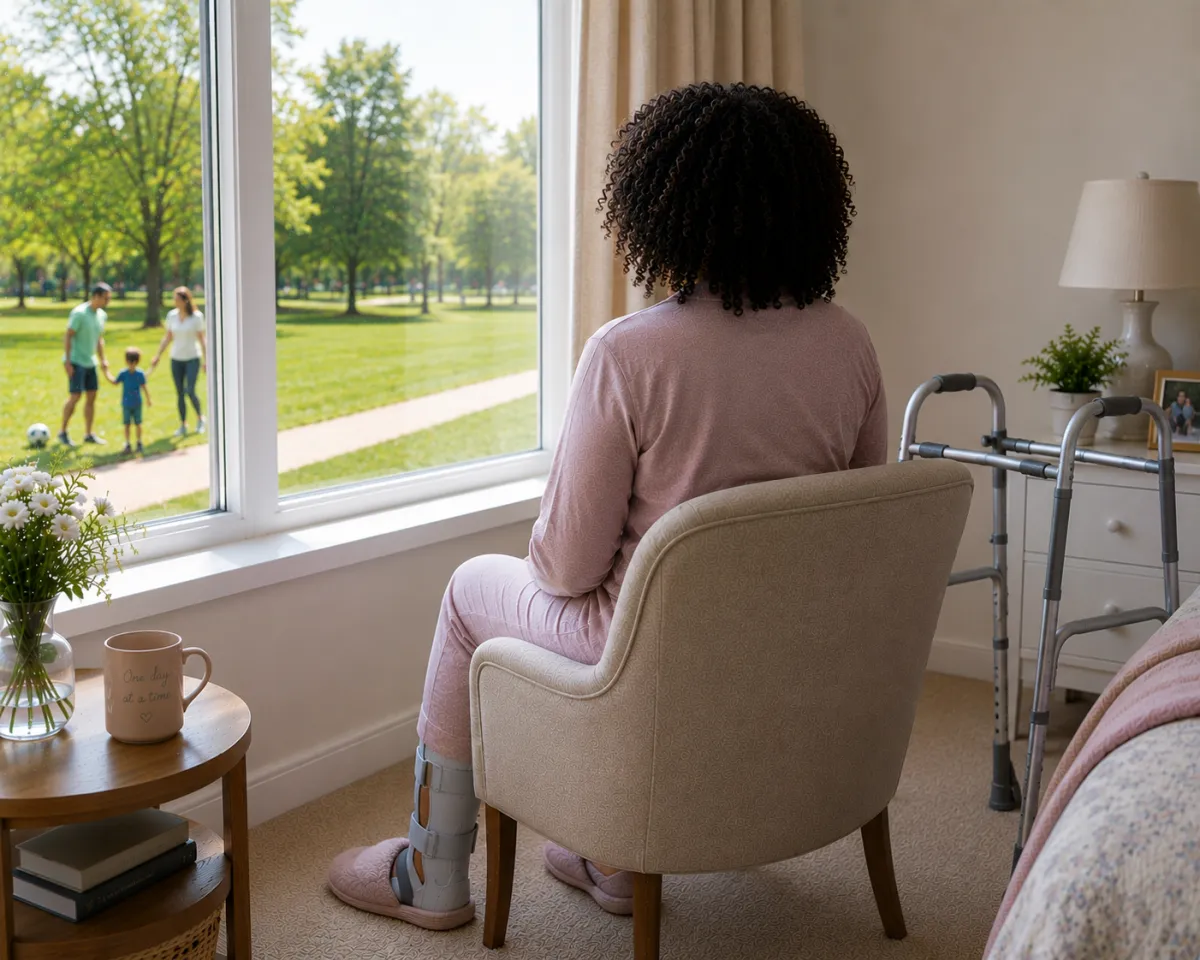
A stroke at a young age can affect far more than your physical health. It can change friendships, confidence, hobbies, nights out, travel, dating and the sense that you still belong in the life you had before. Fatigue, mobility problems, communication difficulties, anxiety and reduced independence can all make socialising harder. Some friendships may strengthen, others may fade, and you may need to rebuild your social life around what your brain and body can manage now rather than trying to force yourself back into exactly the same routine you had before.
After your stroke...
Your social life may be one of the first things to disappear.
At first, that makes sense.
You are in hospital.
Then rehabilitation.
Then recovering at home.
Friends message.
People visit.
Everyone says:
"We'll do something when you're better."
But weeks become months.
Your friends return to:
Work.
Parties.
Restaurants.
Dating.
Holidays.
Festivals.
Weekends away.
Meanwhile...
You may be thinking about:
Physiotherapy.
Medication.
Fatigue.
Hospital appointments.
Whether you can drive.
Whether you can even stay awake past 8pm.
You start wondering...
"Where did everybody go?"
"Why don't people invite me anymore?"
"Will I ever enjoy going out again?"
"Why do I feel exhausted around people?"
"Why do I feel older than everyone my age?"
"Have I lost my old social life forever?"
These questions are common.
Because young stroke can disrupt the social world just as dramatically as it disrupts the physical one.
✦ ✦ ✦
The Good News
Your social life can be rebuilt.
It may not look identical to the life you had before your stroke.
But different does not automatically mean worse.
The Stroke Association recognises that stroke survivors can become isolated when they stop seeing friends, lose confidence or are no longer able to participate in the hobbies and activities they previously enjoyed. (stroke.org.uk)
The answer is not necessarily to force yourself straight back into every social event.
Instead, you can gradually work out:
✓ What you still enjoy
✓ What drains you
✓ Which friends make things easier
✓ Which environments are too demanding
✓ How much rest you need
✓ What new activities might fit your life better
Social recovery is still recovery.
It deserves attention too.
✦ ✦ ✦
Why Can Young Stroke Feel So Socially Isolating?
A young adult may have very little experience of serious illness.
Your friends may have even less.
They are discussing:
Promotions.
Weddings.
Dating.
Children.
Gym routines.
Concerts.
Travel.
You may suddenly be discussing:
MRI results.
Medication.
Walking aids.
Fatigue.
Speech therapy.
Neurology appointments.
That difference can make you feel separated from people you were once very similar to.
The stroke may have moved you into a world your peers simply do not understand.
Not because they are necessarily uncaring.
But because their everyday experience is now very different from yours.
✦ ✦ ✦
Friends May Not Know What to Say
Immediately after your stroke, people may contact you constantly.
They ask:
"How are you?"
"Do you need anything?"
"When can I visit?"
Then contact sometimes decreases.
Why?
Some people assume you need space.
Some think you have recovered because you look better.
Some are uncomfortable around illness.
Some simply return to their own lives.
And some do not know what to say after:
"How are you feeling?"
has already been asked twenty times.
Communication problems can also contribute to social isolation after stroke, particularly when conversation becomes difficult or confidence falls. (stroke.org.uk)
Silence does not always mean someone stopped caring.
But sometimes relationships genuinely do change.
✦ ✦ ✦
Some Friendships Will Change
This is difficult to accept.
Stroke can expose the structure of friendships.
Before your stroke, perhaps the relationship was built around:
Drinking.
Going out.
Football.
Gym sessions.
Work.
Travel.
Parties.
If you can no longer participate in those activities for a while, the friendship may struggle.
That does not necessarily mean it was fake.
Sometimes relationships depend heavily on shared routines.
Remove the routine...
And people discover they have less holding them together than they realised.
Other friends may adapt immediately.
They visit you at home.
Meet for lunch instead of a late night.
Drive to you.
Check in.
Learn about fatigue.
Those friendships may become stronger.
✦ ✦ ✦
You May Lose Friends
This can happen.
Some people disappear.
You may find it incredibly painful.
Especially if they were people you expected to be there.
You may think:
"How can someone disappear after what I've just survived?"
There may not be a satisfying answer.
Some people cannot cope with illness.
Some dislike responsibility.
Some friendships were already weaker than you realised.
Some people become uncomfortable when the relationship suddenly requires more from them.
Whatever the reason...
Chasing somebody repeatedly for basic friendship can become exhausting.
Give people an opportunity to show up.
But pay attention to what they actually do.
A stroke can teach you a lot about who belongs in your life.
✦ ✦ ✦
Do Not Assume Every Friend Who Steps Back Is Bad
There is another side to this.
Your friends have lives too.
Jobs.
Children.
Relationships.
Their own health.
Their own problems.
A friend who does not call every week is not automatically abandoning you.
Sometimes stroke changes your need for support much faster than another person understands.
If someone matters to you...
Tell them what would help.
You might say:
"I'd really like to start getting out again. Could we meet for coffee rather than doing a late night?"
Clear requests are easier to respond to than expecting someone to guess what you need.
✦ ✦ ✦
Fatigue Can Destroy Your Old Social Routine
Post-stroke fatigue can make ordinary socialising feel like work.
You may manage:
Getting dressed.
Travelling.
Conversation.
Noise.
Walking.
Sitting upright.
Processing what people are saying.
Then suddenly...
Your energy disappears.
Fatigue after stroke can affect interest in activities and the ability to socialise and carry out ordinary tasks. (wyh-allthingsstroke.nhs.uk)
This is difficult for friends to understand because you may look completely fine.
They see you sitting in a restaurant.
They do not see the amount of neurological energy required to keep functioning.
✦ ✦ ✦
Learn Your Social Energy Limit
Instead of asking:
"Can I go out?"
ask:
"How much can I realistically manage?"
Perhaps you can enjoy two hours.
But four hours destroys the following day.
Perhaps you can manage dinner.
But dinner followed by a bar is too much.
Perhaps you can attend the wedding ceremony but not the entire reception.
That is useful information.
Socialising should not become an endurance competition.
Try:
✓ Shorter events
✓ Arriving later
✓ Leaving earlier
✓ Building in rest beforehand
✓ Keeping the following morning free
✓ Choosing quieter venues
You may be able to participate much more when you stop demanding that every outing last as long as it once did.
✦ ✦ ✦
Noise Can Become Exhausting
Busy social environments can be surprisingly difficult after stroke.
A crowded restaurant may contain:
Music.
People talking.
Cutlery.
Movement.
Lights.
Several conversations at once.
Your brain has to filter all of it.
If attention or processing has changed after stroke, this can become overwhelming.
You may notice:
✓ Headache
✓ Brain fog
✓ Irritability
✓ Difficulty following conversation
✓ Sudden exhaustion
✓ Needing to leave
This does not mean you have become antisocial.
Your brain may simply tolerate sensory overload less effectively.
Try quieter places.
Sit away from speakers.
Meet smaller groups.
Go out at less busy times.
Environment matters.
✦ ✦ ✦
Communication Problems Can Make Socialising Hard
If stroke affected your speech or language, social situations may become particularly stressful.
Perhaps you know exactly what you want to say...
But cannot find the word.
Maybe conversation moves too quickly.
People interrupt.
Several people speak simultaneously.
Then you stop contributing.
Communication problems may become worse when you are tired, stressed or unwell. (wyh-allthingsstroke.nhs.uk)
Friends can help by:
✓ Giving you time
✓ Not finishing every sentence for you
✓ Speaking one at a time
✓ Reducing background noise
✓ Checking that they understood correctly
You deserve to remain part of the conversation even if you now communicate differently.
✦ ✦ ✦
Looking "Fine" Can Create Another Problem
Some young survivors recover extremely well physically.
You may walk normally.
Dress normally.
Look exactly as you did before.
Friends conclude:
"You're back to normal."
But you may still experience:
✓ Fatigue
✓ Memory problems
✓ Poor concentration
✓ Anxiety
✓ Headaches
✓ Emotional changes
✓ Slower processing
This can create tension.
You cancel a night out.
Someone says:
"But you look fine."
Invisible symptoms are still symptoms.
You do not need to repeatedly justify them.
Explain what matters once.
Then create boundaries around what you can realistically manage.
✦ ✦ ✦
You May Feel Older Than Your Friends
Stroke can change your priorities overnight.
Before, perhaps you worried about small things.
Then you experience a medical emergency that threatens your independence or life.
Suddenly...
Some conversations may feel different.
Arguments about trivial social drama may seem ridiculous.
You may become more selective about how you spend your time.
That does not mean you have lost your personality.
Your perspective may simply have shifted.
Serious illness can accelerate certain forms of maturity.
But be careful not to turn that into contempt for everyone who has not experienced what you have.
Your friends are still entitled to ordinary problems.
You simply have a different reference point now.
✦ ✦ ✦
Nights Out May Need to Change
Young social life is often built around late nights.
That may no longer work temporarily or permanently.
You may now struggle with:
✓ Fatigue
✓ Balance
✓ Medication schedules
✓ Alcohol tolerance
✓ Transport
✓ Noise
✓ Staying awake
You do not need to choose between:
"Party until 3am"
and:
"Never socialise again."
There is enormous space between those options.
Try:
Dinner.
Lunch.
Brunch.
Coffee.
Cinema.
A daytime event.
A barbecue.
A short evening out.
Your social life can mature without disappearing.
✦ ✦ ✦
Alcohol Can Complicate Socialising
Alcohol can be central to young adult social life.
After stroke, however, you may need to reconsider:
How much you drink.
Whether alcohol interacts with medication.
Whether it affects your balance.
Whether it worsens fatigue.
Whether your doctor has advised you to avoid it.
You do not owe anyone an explanation for declining alcohol.
You can simply say:
"I'm not drinking tonight."
If friends repeatedly pressure you after a major health event...
That tells you something about the quality of the social environment.
Your health does not need to be negotiated at a bar.
✦ ✦ ✦
What If You Cannot Drive?
Losing driving independence can dramatically affect social life.
Before stroke you may have jumped in the car and gone anywhere.
Now a simple evening out requires:
A lift.
Taxi.
Train.
Bus.
Someone else planning around you.
That can make you decline invitations.
Try not to disappear simply because transport is inconvenient.
Instead:
✓ Meet closer to home
✓ Use public transport where manageable
✓ Share taxis
✓ Ask close friends for occasional lifts
✓ Choose accessible venues
✓ Arrange daytime events
Loss of driving can be temporary for some survivors.
But while it lasts...
You need another transport system rather than no social life at all.
✦ ✦ ✦
Mobility Problems Can Affect Confidence
You may avoid going out because you are embarrassed about:
A limp.
Walking slowly.
Using a stick.
Wearing an AFO.
Using a wheelchair.
Needing help with stairs.
You may think everyone is staring.
Most people are far less interested than you imagine.
And those who matter will adapt.
Choose venues with:
✓ Accessible entrances
✓ Nearby toilets
✓ Seating
✓ Minimal stairs
✓ Short walking distances
Accessibility is not a luxury.
It determines whether you can actually participate.
Do not repeatedly attend unsuitable venues just to prove you can.
✦ ✦ ✦
Social Media Can Make Isolation Feel Worse
You are home recovering.
Then you open Instagram.
Everyone appears to be:
Travelling.
Getting married.
Going out.
Running races.
Having babies.
Buying houses.
Living.
Meanwhile, you are exhausted from taking a shower.
Social media can turn temporary recovery into a comparison with everybody else's highlight reel.
Be careful.
You are seeing selected moments.
Not entire lives.
If scrolling repeatedly leaves you feeling worse...
Reduce it.
Mute accounts.
Take breaks.
Your recovery does not need a daily comparison group.
✦ ✦ ✦
FOMO After Stroke Is Real
Fear of missing out can become painful.
You may miss:
Birthdays.
Weddings.
Festivals.
Holidays.
Work events.
Group trips.
Some things genuinely will happen without you.
That hurts.
But trying to attend everything can leave you permanently exhausted.
Prioritise.
Ask:
"Which events actually matter to me?"
Spend your energy there.
You may need to decline three ordinary evenings so that you can attend your best friend's wedding.
That is not failure.
That is energy management.
✦ ✦ ✦
Travel With Friends May Feel Different
Group holidays can become difficult after stroke.
Other people may want:
Early flights.
Long walking days.
Late nights.
Constant activities.
You may need:
Rest.
Medication.
Accessible accommodation.
A slower pace.
Do not assume everyone will naturally understand.
Discuss practical requirements before booking.
You may need:
✓ A private room
✓ More rest time
✓ Accessible transport
✓ Shorter excursions
✓ Travel insurance that covers your medical history
✓ Medication in your hand luggage
A holiday that ignores your current needs may become exhausting rather than enjoyable.
✦ ✦ ✦
Hobbies Can Help Rebuild Social Life
Not all socialising needs to happen in bars or restaurants.
Returning to hobbies can reconnect you with people through a shared interest.
Depending on your abilities, you might try:
✓ Swimming
✓ Walking groups
✓ Art
✓ Music
✓ Gaming
✓ Photography
✓ Book clubs
✓ Exercise classes
✓ Volunteering
✓ Community activities
If your previous hobby is no longer possible, that can be painful.
But a new hobby can create a social identity that has nothing to do with stroke.
That matters.
You need places where you are not always:
"The person who had the stroke."
✦ ✦ ✦
Meeting Other Young Stroke Survivors
Sometimes your existing friends cannot fully understand.
That is not necessarily their fault.
They have not lived it.
Peer support can fill a different need.
The Stroke Association offers groups and activities where younger survivors can meet people of similar ages, including Young People Connect activities for adults aged 18–45. (stroke.org.uk)
There are also support groups specifically aimed at younger and working-age adults. (stroke.org.uk)
You may finally meet someone who understands what you mean when you say:
"I can do it — I just cannot do it for four hours."
That kind of recognition can be powerful.
✦ ✦ ✦
But Do Not Let Stroke Become Your Entire Social World
Peer support can be extremely valuable.
But ideally, stroke does not become your only social identity.
You may want:
Stroke friends.
Old friends.
Work friends.
Family.
Hobby friends.
People who understand your medical experience.
And people with whom you barely discuss it.
A broad social life helps prevent everything becoming organised around illness.
You are allowed to attend a support group on Tuesday...
And spend Saturday talking about football, films, fashion or anything else.
Recovery should gradually expand your world.
Not replace one small world with another.
✦ ✦ ✦
Learn to Say No Without Guilt
Before stroke, perhaps you accepted every invitation.
Now you may need to decline.
That can produce guilt.
You worry people will stop inviting you.
So you say yes when your body is clearly saying no.
Try a different approach.
"I can't manage tonight, but please keep inviting me."
That sentence matters.
It tells friends:
I still want to be included.
I simply cannot do this particular event.
Declining one invitation does not mean rejecting the friendship.
And good friends should eventually understand the difference.
✦ ✦ ✦
Keep Initiating Too
There is a risk in waiting.
You think:
"If they cared, they would contact me."
Sometimes that is true.
But sometimes both sides are waiting.
Your friends think:
"I don't want to bother them."
You think:
"They've forgotten me."
Months pass.
If you want connection...
Initiate sometimes.
Send the message.
Suggest coffee.
Invite someone over.
Ask whether they want to walk with you.
Friendship is still a two-way relationship.
Stroke may temporarily change how much you can contribute.
But complete passivity can gradually turn temporary isolation into permanent distance.
✦ ✦ ✦
Rebuilding Confidence Takes Practice
Your first social outing may feel strange.
You may be hyperaware of:
How you walk.
How you speak.
Whether you look different.
Whether you become tired.
Whether anyone notices.
The second outing may feel slightly easier.
Then the third.
Confidence often returns through exposure.
Not through waiting at home until you magically feel confident.
Start small.
One trusted friend.
One hour.
Somewhere familiar.
Then build.
Social rehabilitation works much like physical rehabilitation.
Repeated safe experiences teach you:
"I can do this."
✦ ✦ ✦
Loneliness Deserves Attention
There is a difference between:
Choosing solitude.
And feeling painfully isolated.
Stroke survivors can experience loneliness when friendships, hobbies and everyday community contact reduce. (stroke.org.uk)
If you spend most days alone and feel increasingly disconnected...
Do something about it.
Consider:
✓ Contacting old friends
✓ Joining a stroke group
✓ Trying a community activity
✓ Volunteering when appropriate
✓ Speaking with your rehabilitation team
✓ Seeking psychological support
Isolation can become self-reinforcing.
The longer you remain at home...
The harder going out can feel.
Break the cycle gradually.
✦ ✦ ✦
Anxiety Can Shrink Your World
After stroke, you may become frightened of being away from home.
You think:
"What if I have another stroke?"
"What if I fall?"
"What if I become exhausted?"
"What if nobody knows what to do?"
So you stay home.
The immediate anxiety decreases.
That can accidentally teach your brain:
"Home is safe. Outside is dangerous."
Then your world gets smaller.
If anxiety is repeatedly preventing normal activities, discuss it with your healthcare team.
The NHS includes psychological approaches such as cognitive behavioural therapy among treatments that may help with anxiety, depression and tiredness during stroke recovery. (nhs.uk)
You do not need to surrender your social life to fear.
✦ ✦ ✦
My Perspective
Social recovery after young stroke is strange because nobody gives you exercises for it.
Physiotherapy tells you how to strengthen your leg.
Speech therapy helps you communicate.
Occupational therapy helps you dress or cook.
But nobody necessarily tells you how to walk back into a room full of friends after months of living like a patient.
That part requires practice too.
You may discover that some friendships survive.
Some become stronger.
Some disappear.
You may also discover that you no longer enjoy certain parts of your old life.
That is allowed.
Your goal should not be:
"Get my exact old social life back."
It should be:
"Build a social life that actually works for who I am now."
Keep people who show up.
Reconnect where relationships matter.
Meet new people.
Protect your energy.
Say no when necessary.
Say yes when you genuinely want to.
And remember that recovery is not complete simply because you can walk around your house independently.
A life needs people in it too.
✦ ✦ ✦
When Should You Seek Professional Support?
Consider speaking with your GP, stroke team or another healthcare professional if:
✓ You are becoming increasingly isolated
✓ Anxiety prevents you leaving home
✓ You have lost interest in almost all social activities
✓ Fatigue is severely restricting everyday life
✓ Communication problems make socialising extremely difficult
✓ Low mood persists
✓ You feel unable to reconnect with other people
✓ Fear of another stroke dominates social situations
Emotional changes after stroke can include anxiety, low mood, grief and other reactions, and support is available. (newcastle-hospitals.nhs.uk)
Seeking help with social or emotional recovery is not less legitimate than seeking physiotherapy for a weak leg.
✦ ✦ ✦
Frequently Asked Questions
Is Social Isolation Common After Stroke?
Yes.
Stroke survivors may become isolated because of disability, fatigue, communication difficulties, reduced confidence or loss of previous activities. (stroke.org.uk)
Why Do I Get So Tired When Socialising?
Conversation, noise, travel, movement and concentration can all require considerable energy after stroke.
Post-stroke fatigue can therefore limit your ability to socialise.
Should I Force Myself to Go Out?
Not to the point of exhaustion.
Gradual, manageable social activity is usually more sustainable than repeatedly pushing beyond your limits.
What If My Friends Stop Inviting Me?
Tell important friends that you still want to be included even if you cannot accept every invitation.
You can also suggest activities that suit your current abilities.
Should I Join a Young Stroke Group?
It can be useful if you want to meet people who understand the experience of stroke during working-age life.
Can I Still Go on Nights Out?
Possibly, depending on your health, fatigue, mobility, medication and alcohol advice.
You may need shorter or earlier outings.
Will My Social Life Ever Feel Normal Again?
It can.
But your definition of normal may change.
You may eventually build a social life that is different from before but still enjoyable and meaningful.
✦ ✦ ✦
Key Takeaways
✓ Young stroke can disrupt friendships, hobbies and social confidence.
✓ Post-stroke fatigue can make socialising unexpectedly exhausting.
✓ Noise and busy environments may become harder to tolerate.
✓ Communication difficulties can contribute to isolation.
✓ Some friendships may strengthen while others fade.
✓ Not every friend who contacts you less has abandoned you.
✓ Shorter and quieter social activities can make participation easier.
✓ Losing the ability to drive can affect social independence but does not have to end your social life.
✓ You do not need to drink alcohol to remain socially included.
✓ Stroke support groups can help younger survivors meet people with similar experiences.
✓ Peer support should complement rather than replace the rest of your social life.
✓ Saying no to one invitation does not mean rejecting a friendship.
✓ Gradual social exposure can help rebuild confidence.
✓ Persistent loneliness, low mood or anxiety deserves professional support.
✦ ✦ ✦
Related Articles
Continue learning about rebuilding life after young stroke:
Stroke Under 50
Stroke in Your 20s
Stroke in Your 30s
Stroke in Your 40s
Dating After Young Stroke
Financial Impact of Young Stroke
Why Friends Disappear After Stroke
Friendships After Stroke
Stroke and Loneliness
Confidence After Stroke
✦ ✦ ✦
About the Author
Alisia Gayle is a stroke survivor who achieved 96% neurological recovery following an ischaemic stroke.
After years of rehabilitation, she now shares practical, evidence-informed resources to help stroke survivors, carers and families better understand recovery and rebuild their lives with confidence.
Alisia is also the author of Brain Damage: My Journey to 96% Recovery, where she shares her personal stroke recovery story and the lessons she learned throughout her rehabilitation.
✦ ✦ ✦
Medical Disclaimer
This article is intended for educational purposes only and should not replace professional medical or psychological advice.
The physical, cognitive, emotional and social effects of stroke vary considerably between individuals.
Speak with your GP, stroke rehabilitation team or another qualified healthcare professional if fatigue, communication problems, anxiety, depression, mobility difficulties or fear of another stroke are preventing you from participating in everyday life.
Follow individual medical advice concerning alcohol, driving, physical activity and stroke-prevention medication.
Seek emergency medical attention immediately for any new or sudden symptoms of stroke.
✦ ✦ ✦
Final Thoughts
Social life after young stroke...
Can disappear quietly.
There may be no dramatic moment.
You simply stop going out.
Then stop being invited.
Then stop asking.
And eventually you realise that your world has become very small.
Do not accept that as an unavoidable consequence of stroke.
You may need to socialise differently.
Shorter outings.
Quieter places.
More rest.
Different hobbies.
Different people.
That is adaptation.
Not defeat.
Some old friendships may survive.
Some may not.
New friendships may appear in places you never expected.
And you may discover that your definition of a good social life has changed completely.
You do not have to return to being the person who stayed out until 2am.
You do not have to attend every party.
You do not have to pretend fatigue does not exist.
But you do need connection.
Conversation.
Laughter.
People who know you outside hospital appointments and rehabilitation sessions.
People who remind you that you still belong in the world beyond stroke.
So begin small.
Send one message.
Meet one friend.
Stay for one hour.
Join one activity.
Then build from there.
Because recovering from a young stroke is not only about getting your body functioning again.
It is about rebuilding a life you actually want to participate in.
And your social life deserves a place in that recovery too.