

MOBILITY & PHYSICAL RECOVERY

Sitting Balance After a Stroke.

A calmer, easier-to-scan guide to why sitting balance can change after stroke, what may help, and when to seek professional advice.

Speech Therapy After a Stroke: What to Expect

Speech Therapy After a Stroke: What to Expect

July 06, 20267 min read

Speech therapy is one of the most important parts of stroke rehabilitation for people with communication or swallowing difficulties. Whether you're struggling to find words, speak clearly or understand conversations, speech and language therapy can help you rebuild confidence and improve everyday communication. Learn what speech therapy involves, how it works, and what recovery may look like.

After your stroke...

You struggle to find words.

Your speech sounds slurred.

People ask you to repeat yourself.

Conversations feel exhausting.

You begin wondering...

"Will speech therapy actually help?"

"What happens during the sessions?"

If you've never had speech therapy before...

It's completely normal to feel unsure.

✦ ✦ ✦

The Good News

Speech therapy helps thousands of stroke survivors every year.

Many people regain significant communication skills through regular practice and personalised rehabilitation.

Even if your speech doesn't return exactly as it was before, therapy can help you communicate more clearly, confidently and independently.

Recovery is often much greater than people first imagine.

✦ ✦ ✦

What Is Speech Therapy?

Speech therapy is rehabilitation provided by a speech and language therapist (SLT).

The goal is to improve communication and, when needed, swallowing.

Treatment is tailored to your individual needs and may focus on:

✓ Speaking.

✓ Understanding language.

✓ Reading.

✓ Writing.

✓ Finding words.

✓ Speech clarity.

✓ Swallowing safely.

No two therapy programmes are exactly the same.

✦ ✦ ✦

Who Needs Speech Therapy?

Speech therapy may help if your stroke has caused:

✓ Aphasia.

✓ Dysarthria.

✓ Apraxia of speech.

✓ Difficulty finding words.

✓ Slurred speech.

✓ Problems understanding language.

✓ Reading or writing difficulties.

✓ Swallowing problems (dysphagia).

Even mild communication problems may benefit from therapy.

✦ ✦ ✦

What Happens During the First Assessment?

Your speech and language therapist will usually assess:

✓ Your speech.

✓ Language skills.

✓ Understanding.

✓ Reading.

✓ Writing.

✓ Memory and attention.

✓ Swallowing, if needed.

They'll also ask about the communication challenges you're experiencing in everyday life.

This helps them create a treatment plan that's right for you.

✦ ✦ ✦

What Happens During Therapy?

Every session is different.

Depending on your needs, therapy may include:

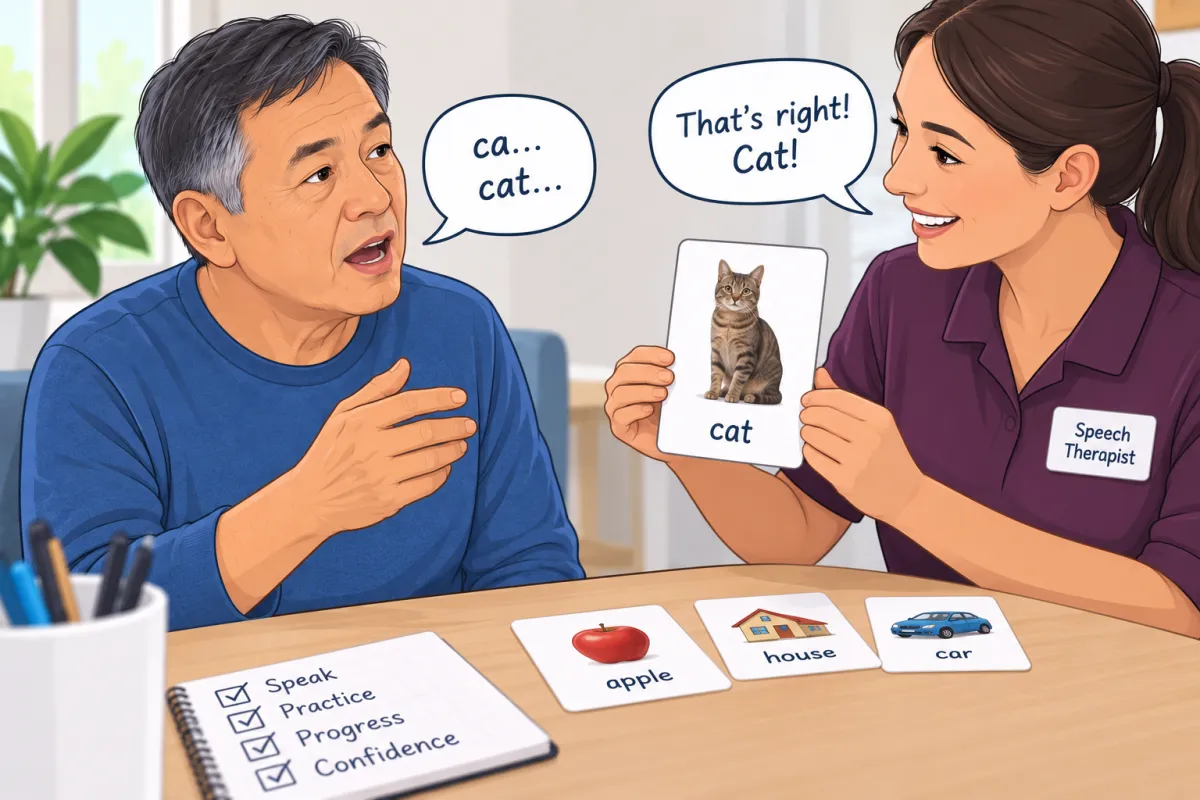
Speaking Exercises

You may practise:

✓ Saying sounds.

✓ Naming objects.

✓ Repeating words.

✓ Building sentences.

✓ Holding conversations.

The exercises gradually become more challenging as you improve.

✦ ✦ ✦

Word-Finding Practice

If you're struggling to find words, your therapist may use pictures, categories or conversation exercises to strengthen language pathways.

✦ ✦ ✦

Reading and Writing

Some people practise reading newspapers, books or everyday signs.

Others work on writing shopping lists, emails or simple sentences.

The aim is to improve communication in real-life situations.

✦ ✦ ✦

Speech Clarity

If your speech is slurred, therapy may focus on:

✓ Speaking more slowly.

✓ Improving pronunciation.

✓ Strengthening breath control.

✓ Increasing voice volume.

✓ Improving speech rhythm.

✦ ✦ ✦

Swallowing Therapy

If swallowing has been affected, your therapist may recommend:

✓ Swallowing exercises.

✓ Changes to food texture.

✓ Safer swallowing techniques.

✓ Positioning advice.

Improving swallowing can reduce the risk of choking and chest infections.

✦ ✦ ✦

How Does Speech Therapy Work?

Speech therapy works by encouraging neuroplasticity.

Neuroplasticity is the brain's ability to reorganise itself by creating new pathways around damaged areas.

Every exercise...

Every conversation...

Every repetition...

Gives your brain another opportunity to strengthen these pathways.

Recovery happens through repetition.

✦ ✦ ✦

How Often Will I Need Therapy?

This varies from person to person.

Some people have therapy several times a week.

Others have less frequent sessions combined with a home exercise programme.

The most important factor isn't always how many appointments you have.

It's how consistently you practise between them.

Daily practice usually produces the greatest improvements.

✦ ✦ ✦

Can I Practise at Home?

Absolutely.

Home practice is one of the most important parts of recovery.

You might practise:

✓ Reading aloud.

✓ Naming objects.

✓ Everyday conversations.

✓ Repeating words.

✓ Writing short sentences.

✓ Following your therapist's exercises.

Even ten to fifteen minutes of daily practice can make a real difference over time.

✦ ✦ ✦

Practical Tips

Practise Little and Often

Short daily sessions are usually more effective than occasional long ones.

Consistency helps your brain learn.

✦ ✦ ✦

Don't Rush

Give yourself time to speak.

Your brain is rebuilding communication pathways.

✦ ✦ ✦

Reduce Background Noise

A quiet environment makes practising much easier.

✦ ✦ ✦

Celebrate Small Improvements

Every new word...

Every clearer sentence...

Every successful conversation...

Is progress.

Recovery is built through hundreds of small victories.

✦ ✦ ✦

Keep Talking

Don't stop communicating because it feels difficult.

Every conversation is helping your brain recover.

✦ ✦ ✦

Tips for Family and Friends

Family members play an important role in speech recovery.

It helps to:

✓ Give extra time to respond.

✓ Avoid interrupting.

✓ Speak clearly.

✓ Reduce distractions.

✓ Encourage communication without correcting every mistake.

Patience and encouragement often build confidence faster than perfection.

✦ ✦ ✦

When Should You Seek Medical Advice?

Speak with your healthcare professional if:

✓ Your speech suddenly becomes worse.

✓ You develop new communication problems.

✓ Swallowing becomes more difficult.

✓ You begin choking while eating or drinking.

Seek emergency medical attention immediately if speech problems appear suddenly, especially alongside facial drooping, arm weakness or confusion.

These may be signs of another stroke.

✦ ✦ ✦

My Perspective

Speech therapy isn't about passing a test.

It's about helping you reconnect with the people around you.

Some sessions will feel easy.

Others will feel frustrating.

That's normal.

Every word you practise...

Every exercise you complete...

Every conversation you have...

Is helping your brain rebuild communication.

Keep showing up.

Keep practising.

The progress often comes when you least expect it.

✦ ✦ ✦

Frequently Asked Questions

How Soon Should Speech Therapy Start?

Whenever possible, speech therapy should begin as soon as you're medically stable.

However, it's never too late to benefit from rehabilitation.

✦ ✦ ✦

How Long Will I Need Speech Therapy?

This depends on your individual needs.

Some people need only a few weeks.

Others continue therapy for months or longer while making steady progress.

✦ ✦ ✦

Can I Improve Without Therapy?

Some natural recovery does occur.

However, speech and language therapy usually provides structured practice that helps maximise recovery and improve communication more effectively.

✦ ✦ ✦

Can Recovery Continue Years After a Stroke?

Yes.

Thanks to neuroplasticity, many people continue improving their communication months and even years after their stroke.

✦ ✦ ✦

Key Takeaways

✓ Speech therapy is one of the most effective treatments for communication problems after stroke.

✓ Therapy is tailored to your individual needs.

✓ Regular practice supports neuroplasticity and recovery.

✓ Home exercises are just as important as therapy sessions.

✓ Recovery can continue for months and even years.

✓ Every conversation helps strengthen your brain's communication pathways.

✦ ✦ ✦

About the Author

Alisia Gayle is a stroke survivor who achieved 96% neurological recovery following an ischaemic stroke.

After years of rehabilitation, she now shares practical, evidence-informed resources to help stroke survivors, carers and families better understand recovery and rebuild their lives with confidence.

Alisia is also the author of Brain Damage: My Journey to 96% Recovery, where she shares her personal stroke recovery story and the lessons she learned throughout her rehabilitation.

✦ ✦ ✦

Medical Disclaimer

This article is intended for educational purposes only and should not replace professional medical advice, diagnosis or treatment.

Always seek advice from your doctor, speech and language therapist or other healthcare professional regarding symptoms, concerns or changes in your condition.

✦ ✦ ✦

Final Thoughts

Speech therapy isn't about speaking perfectly.

It's about helping you communicate with the people who matter most.

Every exercise...

Every word...

Every conversation...

Is helping your brain find new ways to connect.

Stay patient.

Keep practising.

Recovery happens one sound, one sentence and one conversation at a time.

blog author avatar
Stroke Survivor and Author
Back to Blog

What you’ll learn

Why sitting balance can be affected after a stroke

Common problems people notice day to day

Simple rehabilitation approaches that may help

When changes in balance need medical attention

Why sitting balance matters

Sitting balance is often one of the foundations for standing, walking and everyday activities. After a stroke, some people find it difficult to sit upright without support, lean to one side, or feel unsteady when reaching.

The good news

Sitting balance often improves with rehabilitation, practice and time. Even small improvements can support confidence and independence.

Why can balance change after a stroke?

A stroke may affect several systems that help you stay upright, including strength, coordination, sensation, body awareness and balance control.

Strength

Trunk muscles may become weaker or slower to respond.

Coordination

Movements may feel less automatic or less controlled.

Sensation

You may have less feedback about where your body is in space.

Confidence

Fear of falling can make movement feel harder.

Common sitting problems after a stroke

  • Leaning to one side

  • Difficulty sitting upright without support

  • Feeling unstable when reaching

  • Falling or drifting backwards

  • Increased fatigue during longer periods of sitting

Some people may also experience pusher syndrome, where they actively push towards their weaker side. This should be assessed by a rehabilitation professional.

What May Help

Physiotherapy and occupational therapy often work on trunk control, weight shifting, posture, coordination and everyday activities.

Examples of exercises

  • Sitting unsupported for short periods

  • Gentle reaching tasks

  • Weight shifting from side to side

  • Trunk strengthening

  • Practising on different safe surfaces when appropriate

Keep it individual

Exercises should be matched to your own abilities and professional advice.

More detail: posture and positioning

Helpful strategies may include keeping both feet supported, maintaining an upright posture, and using supportive cushions when recommended.

More detail: fatigue and balance

Balance can become worse when you are tired. Regular rest periods and shorter practice sessions may help.

More detail: tips for family and carers

Encourage safe practice, avoid unexpected pulling or pushing, and help maintain good posture while celebrating small improvements.

When should you seek medical advice?

Arrange an appointment with a healthcare professional if sitting balance is worsening, falls are occurring, new weakness develops, or balance problems are significantly affecting daily activities.

Seek urgent medical attention for sudden new weakness, new speech difficulties, sudden confusion or sudden vision changes.

Key takeaways

Sitting balance is commonly affected after stroke.

Weakness, sensation and body awareness can all contribute.

Good sitting balance supports everyday activity and later mobility.

Recovery can continue over months and years.

Frequently asked questions

Is poor sitting balance common after a stroke?

Yes. Many stroke survivors experience difficulty with sitting balance, particularly during earlier stages of recovery.

Will my sitting balance improve?

Many people improve through rehabilitation, ongoing recovery and repeated practice.

Can exercises help?

Targeted exercises can help improve trunk control, balance and confidence when they are appropriate for the individual.

About Alisia

Alisia Gayle is a stroke survivor who achieved 96% neurological recovery following an ischaemic stroke.

After years of rehabilitation, she now shares practical, evidence-informed resources to help stroke survivors, carers and families better understand recovery and rebuild their lives with confidence.

Alisia is also the author of Brain Damage: My Journey to 96% Recovery, where she shares her personal stroke recovery story and the lessons she learned throughout her rehabilitation.

Next articles

Medical disclaimer

This article is intended for educational purposes only and should not replace professional medical advice, diagnosis or treatment.

Always seek advice from your doctor, physiotherapist or rehabilitation team regarding symptoms, concerns or changes in your condition.

Alisia Gayle is a stroke survivor, author, and advocate whose life was transformed in a single, ordinary day.

Contact us

800 1234 5678

FOLLOW US

Copyright 2026. Alisia Gayle | Stroke Recovery Through Lived Experience. All Rights Reserved.