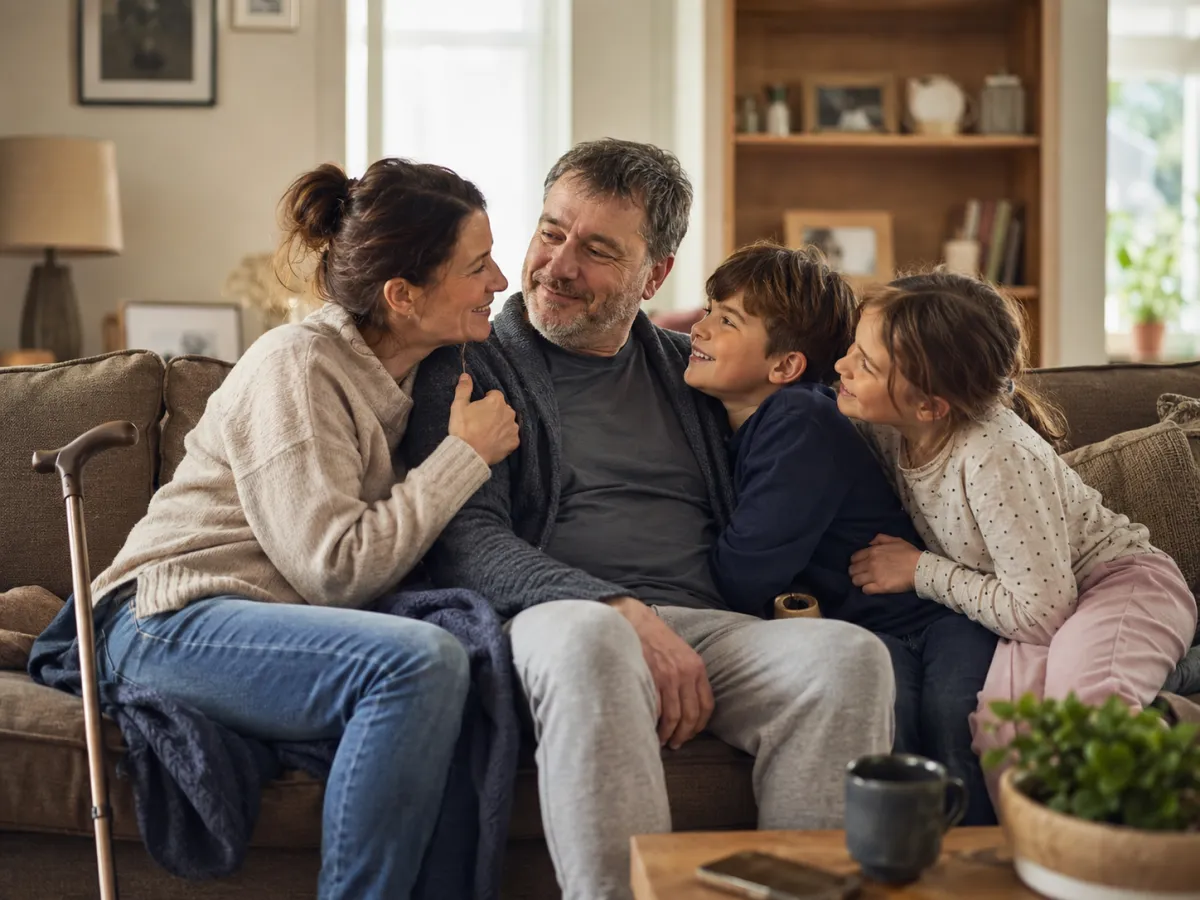
Raising a family after a stroke can involve much more than managing physical recovery. A stroke can change who drives, who earns, who cooks, who handles school runs, who manages the household and how much energy you have left for your children at the end of the day. Children may become frightened or confused, partners may take on unfamiliar responsibilities and the survivor may struggle with guilt about no longer parenting in exactly the same way. Family life can recover too, but it often requires honest communication, practical adjustments and a willingness to create a new version of normal rather than constantly comparing everything with life before the stroke.
After your stroke...
One of your first thoughts may not be about yourself.
It may be:
"What about my children?"
Who will collect them from school?
Who will make dinner?
Who will take them to swimming?
Who will help with homework?
Perhaps you were the parent who organised everything.
You worked.
Cooked.
Drove.
Cleaned.
Remembered appointments.
Managed birthdays.
Took the children out at weekends.
Then suddenly...
You are the one who needs help.
You may begin wondering...
"Am I still a good parent?"
"How much should I tell my children?"
"Will they be frightened that I will have another stroke?"
"What happens if I cannot do everything I used to do?"
"Is my partner becoming more of a carer than a partner?"
"How do we get our family life back?"
These questions are not secondary to stroke recovery.
For a parent...
They may be some of the most important questions of all.
✦ ✦ ✦
The Good News
Family life does not have to return to exactly what it was before the stroke in order to become good again.
You may need to change:
✓ Routines
✓ Responsibilities
✓ Expectations
✓ Working patterns
✓ Parenting activities
✓ How you ask for help
But children can adapt.
Partners can adapt.
And you can adapt.
The NHS notes that family and friends can be involved in stroke rehabilitation, including helping with exercises and activities as part of recovery.
That means recovery does not always have to happen separately from family life.
Sometimes family life becomes part of rehabilitation.
Walking your child to the corner.
Making lunch.
Reading together.
Going to the park.
Helping with homework.
These may all become meaningful recovery goals.
✦ ✦ ✦
Stroke Can Change the Whole Family System
A stroke does not happen only to one person.
The brain injury belongs to the survivor.
But the consequences can spread across the household.
The Stroke Association recognises that stroke can have a major impact on family dynamics and relationships.
Before your stroke, responsibilities may have been divided almost automatically.
One person handled:
School.
Another handled:
Cooking.
One managed finances.
One drove.
One worked longer hours.
Then the stroke disrupts that arrangement.
Suddenly the family has to ask:
Who can do what now?
That can be uncomfortable.
Especially when nobody chose the change.
✦ ✦ ✦
Losing Your Parenting Role Can Hurt
Perhaps you were the parent who did everything.
Then suddenly someone else is:
Making your child's breakfast.
Taking them to school.
Helping them dress.
Driving them to activities.
Putting them to bed.
You may watch from the sofa and think:
"That's my job."
This can create enormous guilt.
But parenting is not one task.
You have not stopped being a parent because somebody else temporarily handles the school run.
Your role may need to change while you recover.
That is different from disappearing from your child's life.
You can still provide:
✓ Reassurance
✓ Affection
✓ Guidance
✓ Conversation
✓ Discipline
✓ Interest
✓ Emotional security
You may need help with the physical tasks.
That does not erase the relationship.
✦ ✦ ✦
Explain the Stroke to Your Children
Children usually know when something serious has happened.
Even when adults avoid explaining it.
They see:
Hospital visits.
Whispered conversations.
A parent walking differently.
Medication.
Tears.
Fatigue.
Anxiety.
If nobody explains what is happening, children may invent their own explanation.
The Stroke Association advises families to talk to children about stroke, answer their questions and reassure them that being frightened or upset is okay.
How much you explain depends on age.
A young child may need:
"Mummy's brain was hurt and she is learning to use her arm properly again."
An older child may want to understand:
What caused the stroke.
Whether it can happen again.
Whether you will recover.
Simple honesty is usually more reassuring than secrecy.
✦ ✦ ✦
Children May Become Afraid You Will Die
This fear may not be obvious.
A child may not say:
"I'm frightened you will have another stroke."
Instead, they may:
✓ Become clingy
✓ Refuse to leave you
✓ Wake at night
✓ Become angry
✓ Ask repeated health questions
✓ Watch you closely
✓ Worry when you sleep
Imagine what the stroke looked like from their perspective.
One day their parent was normal.
Then suddenly that parent disappeared into hospital.
Children need reassurance.
Not false promises.
You cannot honestly say:
"I will never become ill again."
But you can say:
"The doctors are helping me, I am taking my medicine and we know what to do if I become unwell."
Reassurance should create security without pretending life contains no risk.
✦ ✦ ✦
Do Not Make Your Child Your Carer
Children can help.
That can even make them feel included.
A child might:
Bring you a bottle of water.
Carry something light.
Join you on a short rehabilitation walk.
But there is a difference between participating...
And becoming responsible for your wellbeing.
Try not to make a young child feel responsible for:
✓ Monitoring your medication
✓ Watching for another stroke
✓ Helping you transfer physically
✓ Managing your emotional distress
✓ Running the household
✓ Protecting younger siblings
Children should not feel:
"If I don't look after Mum properly, something terrible might happen."
Adult care responsibilities should remain with adults wherever possible.
✦ ✦ ✦
Your Partner May Suddenly Become a Carer
This is one of the biggest changes in family life.
Before the stroke, you may have been equals managing the household together.
Afterwards, your partner may suddenly handle:
✓ Personal care
✓ Medication
✓ Hospital appointments
✓ Transport
✓ Children
✓ Shopping
✓ Cooking
✓ Finances
✓ Their own job
That is a huge workload.
The Stroke Association specifically recognises that carers and family members can also need support after someone experiences a stroke.
Your partner may love you deeply and still feel overwhelmed.
Those things are not contradictory.
A family does better when both the survivor and the person supporting them are allowed to acknowledge that the situation is difficult.
✦ ✦ ✦
Try Not to Turn the Relationship Into Patient and Carer Forever
Some caregiving may be unavoidable early on.
But as you recover...
Ask:
"What can I take back?"
Perhaps you can:
Make your own medication.
Prepare simple meals.
Handle school emails.
Pay bills.
Help with homework.
Order groceries.
Gradually resume driving when medically permitted.
Recovery includes reclaiming responsibilities where you safely can.
Otherwise, temporary roles can become permanent long after they are necessary.
Your partner may continue doing everything because:
"It's quicker."
But independence often requires the opportunity to practise.
✦ ✦ ✦
Fatigue Can Make Parenting Much Harder
Post-stroke fatigue can be devastating when you have children.
Children do not naturally organise themselves around neurological fatigue.
They need breakfast when they need breakfast.
They want attention after school.
They wake at night.
They want to play.
You may love them completely...
And still have absolutely no energy.
This can create guilt.
You think:
"I should be doing more."
But pushing yourself until you collapse does not necessarily make you a better parent.
Pacing may mean:
✓ Resting before school pickup
✓ Scheduling quieter activities
✓ Alternating active and restful days
✓ Sharing demanding tasks
✓ Avoiding too many commitments in one day
Energy management can be part of responsible parenting after stroke.
✦ ✦ ✦
Change the Activity, Not the Relationship
Perhaps before stroke you:
Played football.
Went cycling.
Ran around the playground.
Took long day trips.
Now those activities may be difficult.
You can still connect.
Try:
✓ Reading together
✓ Board games
✓ Drawing
✓ Films
✓ Cooking simple meals
✓ Homework
✓ Short walks
✓ Sitting at the park
✓ Building toys together
A child is unlikely to measure your parenting according to cardiovascular endurance.
What they remember may be:
You listened.
You laughed.
You were interested.
You were there.
Do not confuse reduced physical capacity with reduced parental value.
✦ ✦ ✦
Discipline Can Become Difficult
Illness can make parents feel guilty.
And guilt can make boundaries collapse.
You may think:
"My child has already been through enough."
So you allow behaviour that would never have been acceptable before.
Or perhaps you are too tired to enforce rules.
Over time, the household becomes chaotic.
Children usually still benefit from predictable boundaries.
Stroke may require flexibility.
It does not mean:
No rules.
No bedtime.
No expectations.
No consequences.
Where possible, parents should agree on basic expectations so that children are not receiving completely different messages depending on which adult is present.
Consistency can actually feel reassuring after a period of enormous disruption.
✦ ✦ ✦
Your Child May Become Angry With You
This can hurt.
Your child may say:
"I hate your stroke."
"Why can't you come?"
"Why are you always tired?"
"You used to do this."
It can feel cruel.
But children may be expressing loss.
Their life changed too.
They may miss:
Your energy.
Your availability.
Their old routine.
They may not possess the language to say:
"I feel frightened and sad because everything changed."
So it comes out as anger.
You can acknowledge the feeling without accepting disrespectful behaviour.
For example:
"I know you miss how things were. I miss some of those things too."
That validates the emotion without making the child responsible for fixing yours.
✦ ✦ ✦
Siblings May React Differently
Two children in the same family may respond completely differently.
One may become protective.
Another may seem completely unaffected.
One may ask endless questions.
Another may refuse to discuss the stroke.
Children have different personalities and different levels of understanding.
Avoid assuming that the quiet child is automatically coping better.
Check in occasionally.
Ask:
"How are you feeling about everything that happened?"
Then listen.
You do not need to turn every conversation into therapy.
Sometimes simply creating permission to talk is enough.
✦ ✦ ✦
Family Routines Can Help Everyone
Stroke creates uncertainty.
Routine can restore predictability.
Try rebuilding anchors such as:
✓ Regular mealtimes
✓ Bedtime routines
✓ School routines
✓ Medication routines
✓ Family time
✓ Rest periods
✓ Weekend activities
You may not recreate your exact pre-stroke schedule.
That is fine.
Create one that works now.
A child who knows:
Dad rests after lunch but we watch a film together later
may cope better than a child who never knows what the day will look like.
Structure can reduce anxiety for everyone.
✦ ✦ ✦
Household Standards May Need to Change
Before stroke, perhaps your house was always immaculate.
Meals were cooked from scratch.
Everything was organised.
Now keeping that standard may consume energy needed for recovery and parenting.
Something has to give.
Maybe:
The laundry waits.
You order groceries.
Meals become simpler.
Someone else cleans.
The garden is not perfect.
That is not failure.
Prioritise.
Your family needs:
Food.
Safety.
Basic organisation.
Connection.
It does not need a showroom.
Recovery is already a full-time demand.
Do not create another impossible job by expecting your household to operate exactly as it did before the stroke.
✦ ✦ ✦
Money Can Become a Family Problem Too
A stroke during working age can reduce income at exactly the time household demands increase.
You may have:
✓ Sick pay ending
✓ Reduced hours
✓ Rehabilitation expenses
✓ Transport costs
✓ Childcare costs
✓ Mortgage payments
✓ Less opportunity for overtime
Money worries can quickly affect family relationships.
Try to discuss finances openly with your partner.
Know:
What comes in.
What goes out.
How long sick pay lasts.
What insurance exists.
What benefits or financial support may apply.
Whether returning to work needs to be phased.
Avoiding the bank account because you are frightened does not make the problem disappear.
Practical certainty is usually less frightening than vague financial dread.
✦ ✦ ✦
Returning to Work Changes Family Life Again
Returning to work may seem like the final step back to normal.
But it can create another adjustment.
You may have enough energy for:
Work.
Or parenting.
But not both at full intensity.
You return home exhausted.
Your partner thinks:
"You can work all day but can't help here?"
This can create resentment if nobody explains what is happening.
Work may consume almost all your available cognitive and physical energy.
That does not mean home responsibilities should automatically fall permanently on someone else.
It means the family may need to consciously redesign the week.
Perhaps:
You do more on remote-working days.
Your partner handles certain evenings.
Weekend responsibilities are shared differently.
The arrangement needs discussion rather than assumption.
✦ ✦ ✦
Do Not Compare Yourself With Other Parents
This is difficult.
You see another parent:
Running alongside their child.
Driving everyone everywhere.
Working full-time.
Coaching football.
And you think:
"That should be me."
Comparison can turn recovery into punishment.
You do not know their life.
And they do not have your neurological injury.
The relevant comparison is not:
"What can that parent do?"
It is:
"What can I do now that I could not do three months ago?"
Maybe today you walked to school.
Maybe you made dinner.
Maybe you sat through the entire school play despite fatigue.
Those are real family milestones after stroke.
✦ ✦ ✦
Let Your Children See Progress
Children often notice disability more easily than recovery.
Help them notice both.
You might say:
"Remember when I couldn't walk to the end of the road? Look how far I can walk now."
Or:
"I couldn't use this hand properly before, but I can hold this now."
This gives them evidence that recovery is happening.
It can also help them understand why rehabilitation matters.
Family members can be involved in rehabilitation where appropriate, and NICE guidance supports involving family members and carers when the survivor wants this.
Your child does not need to become your therapist.
But they can sometimes celebrate the journey with you.
✦ ✦ ✦
Accept Help Without Giving Away Your Entire Life
Family members may offer:
School pickups.
Meals.
Childcare.
Shopping.
Transport.
Take useful help.
But retain decisions where you can.
There is a difference between:
"Can you collect the children on Tuesdays while I recover?"
and:
"Everyone else now decides how my household operates."
Illness can make extended family overstep.
Help should reduce your burden.
Not remove your authority.
You are still:
A parent.
A partner.
An adult.
Recovery may temporarily increase dependence without cancelling autonomy.
✦ ✦ ✦
Protect Time With Your Partner
When a family is dealing with stroke, every conversation can become logistical.
Medication.
Appointments.
Children.
Physiotherapy.
Bills.
Work.
Eventually you stop talking as a couple.
You become two project managers running a rehabilitation programme.
Try to preserve some relationship that is not entirely about the stroke.
Maybe that means:
Eating together.
Watching something together.
Talking after the children go to bed.
Taking a short walk.
It does not need to be dramatic.
The point is remembering:
You were a couple before one of you became a patient.
That part of the relationship may need rehabilitation too.
✦ ✦ ✦
Look After the Supporting Parent
The non-stroke parent may be carrying an enormous hidden load.
They may be trying to:
Work.
Parent.
Manage the home.
Support rehabilitation.
Stay positive.
Deal with their own fear.
They may not feel entitled to complain because:
"You are the one who had the stroke."
But carers and family members can themselves experience significant psychological strain after stroke, which is recognised in stroke rehabilitation evidence and support guidance.
A struggling partner does not mean they love you less.
They may simply be exhausted.
Support needs to extend to the family where possible.
✦ ✦ ✦
When Family Members Become Overprotective
Your family may have watched you nearly die.
So when you begin recovering, they may react to every risk.
"Don't carry that."
"Don't go upstairs."
"Don't travel."
"Don't go back to work."
"Sit down."
Initially, caution may be appropriate.
Eventually, excessive protection can interfere with independence.
NICE rehabilitation guidance emphasises active participation and personally meaningful goal setting after stroke.
If an activity is medically safe and part of your rehabilitation...
You may need your family to tolerate watching you struggle.
Recovery often looks uncomfortable.
That does not automatically mean it is dangerous.
✦ ✦ ✦
Make Family Goals, Not Just Rehabilitation Goals
Clinical goals might say:
"Increase walking endurance."
A family goal might be:
"Walk around the zoo with my children."
Clinical goal:
"Improve upper-limb function."
Family goal:
"Make my child's breakfast."
Clinical goal:
"Improve community mobility."
Family goal:
"Do the school run independently."
NICE recommends involving stroke survivors actively in rehabilitation goal setting.
Make those goals meaningful.
You are not rehabilitating just to perform better in a clinic.
You are rehabilitating to participate in your life.
For a parent...
Family life may be one of the strongest motivations you have.
✦ ✦ ✦
Do Not Hide Every Difficult Emotion
You do not need to cry in front of your children every day.
But pretending nothing affected you can create another problem.
Children learn about coping partly by watching adults.
It is okay to say:
"I'm frustrated today because recovery is difficult."
Then also show:
What you are doing about it.
Resting.
Going to therapy.
Practising.
Asking for help.
The lesson becomes:
Difficult things happen.
We acknowledge them.
Then we respond.
That is very different from making your child emotionally responsible for you.
✦ ✦ ✦
My Perspective
Raising a family after stroke can make recovery feel less optional.
You may not have the luxury of spending every day thinking only about yourself.
Children still need breakfast.
School still starts.
Birthdays still happen.
Laundry still appears.
And sometimes that normality is exhausting.
But sometimes...
It is also what pulls you forward.
Your child does not need the exact parent who existed before your stroke.
They need you.
Perhaps adapted.
Perhaps slower.
Perhaps more tired.
Perhaps unable to do everything yet.
But still present.
I would not waste recovery trying to recreate every detail of the old household.
Take back what matters as your abilities return.
Let other people help where they genuinely need to.
Keep your authority.
Keep your relationship with your children.
And build family routines around reality rather than around what you think a perfect family should look like.
✦ ✦ ✦
When Should You Seek Additional Support?
Speak with your healthcare or rehabilitation team if:
✓ Parenting responsibilities are overwhelming your recovery
✓ Fatigue makes basic family life unmanageable
✓ Your partner is struggling with caring responsibilities
✓ Children are showing persistent distress
✓ Communication problems are affecting family relationships
✓ Depression or anxiety is affecting your parenting
✓ You need help becoming more independent at home
✓ Family conflict has increased significantly
NICE quality standards support ongoing review of health and social-care needs after stroke, including structured reviews after discharge.
Support may involve:
✓ Occupational therapy
✓ Psychological support
✓ Social care
✓ Family support
✓ Stroke support services
✓ Carer support
You do not have to solve every family problem alone.
✦ ✦ ✦
Frequently Asked Questions
Can I Still Be a Good Parent After a Stroke?
Yes.
Stroke may change some of the things you can physically do, but parenting involves far more than physical ability.
Connection, guidance, reassurance and involvement still matter.
Should I Tell My Children About My Stroke?
Age-appropriate honesty is generally better than leaving children to invent explanations.
The Stroke Association advises talking to children, answering questions and reassuring them that difficult feelings are okay.
What If I Cannot Play With My Children Like Before?
Change the activity.
Reading, drawing, games, films, short walks and quiet time together can preserve connection while your physical capacity develops.
Is It Normal for My Partner to Feel Overwhelmed?
Yes.
A stroke can place significant practical and emotional demands on family members and carers.
Should My Children Help With My Recovery?
They can sometimes participate in small, age-appropriate ways, but they should not be made responsible for your medical care or safety.
Why Is My Child Acting Differently Since My Stroke?
Fear, uncertainty and disrupted routines can affect children's behaviour.
Talk to them and seek additional support if distress persists or significantly affects daily life.
Will Family Life Ever Feel Normal Again?
It can.
But "normal" may eventually mean a new routine rather than an exact recreation of life before stroke.
✦ ✦ ✦
Key Takeaways
✓ Stroke can affect the entire family, not only the survivor.
✓ Parenting roles and household responsibilities may need to change temporarily or permanently.
✓ Children benefit from honest, age-appropriate explanations about what happened.
✓ Children should not be made responsible for monitoring or caring for a parent's medical condition.
✓ Post-stroke fatigue can make parenting difficult even when physical recovery is good.
✓ Changing activities can preserve connection with children.
✓ Partners and carers may also need emotional and practical support.
✓ Routine can help children feel secure after a major family disruption.
✓ Guilt should not lead to abandoning all boundaries or discipline.
✓ Returning to work may require another redistribution of family responsibilities.
✓ Family involvement can support meaningful rehabilitation goals.
✓ Overprotection can eventually interfere with independence.
✓ A good family life after stroke does not have to look exactly like the family life you had before.
✦ ✦ ✦
Related Articles
Continue learning about family life and young stroke:
Parenting After Stroke
Stroke in Your 30s
Stroke Under 50
Fertility After Stroke
Pregnancy After Stroke
Young Stroke and Depression
Friendships After Young Stroke
Relationships After Stroke
Financial Stress After Stroke
Returning to Work After a Stroke
✦ ✦ ✦
About the Author
Alisia Gayle is a stroke survivor who achieved 96% neurological recovery following an ischaemic stroke.
After years of rehabilitation, she now shares practical, evidence-informed resources to help stroke survivors, carers and families better understand recovery and rebuild their lives with confidence.
Alisia is also the author of Brain Damage: My Journey to 96% Recovery, where she shares her personal stroke recovery story and the lessons she learned throughout her rehabilitation.
✦ ✦ ✦
Medical Disclaimer
This article is intended for educational purposes only and should not replace professional medical, psychological, rehabilitation or family-support advice.
The effects of stroke on parenting and family life vary considerably according to the survivor's neurological difficulties, level of independence, family circumstances, children's ages and available support.
Speak with your GP, stroke rehabilitation team, occupational therapist, psychologist or other appropriate professional if stroke is significantly affecting your ability to manage family life.
If a child is showing persistent emotional or behavioural difficulties following a parent's stroke, consider discussing this with an appropriate healthcare or educational professional.
Never stop or change prescribed stroke-prevention medication because of difficulties managing parenting or family routines.
✦ ✦ ✦
Final Thoughts
Stroke and raising a family...
Can feel like trying to recover while ordinary life refuses to stop.
Your child still needs you.
Your partner still needs you.
The bills continue.
School continues.
Birthdays continue.
Dinner still has to appear somehow.
And you may sometimes look at everything you used to manage and think:
"I cannot do this anymore."
Maybe you cannot do all of it.
Not yet.
Perhaps not in exactly the same way.
But parenting is not measured by how many tasks you complete before bedtime.
It is built through relationship.
Presence.
Guidance.
Love.
Consistency.
Showing interest.
Being there.
Take help where you need it.
Take responsibilities back where you safely can.
Explain the stroke to your children.
Let them ask questions.
Allow your partner to admit that this has been difficult for them too.
Build routines that match the family you have now rather than constantly mourning the schedule you had before.
And make rehabilitation personal.
Do not exercise simply so that a therapist can record another improvement.
Work towards:
Walking your child to school.
Driving them somewhere again.
Preparing dinner.
Going on a family day out.
Returning to the parts of parenting that matter most to you.
Because after stroke...
Recovery is not only about getting your body back.
For many parents...
It is about finding your place inside your family again.
And that place may change.
But it does not disappear.