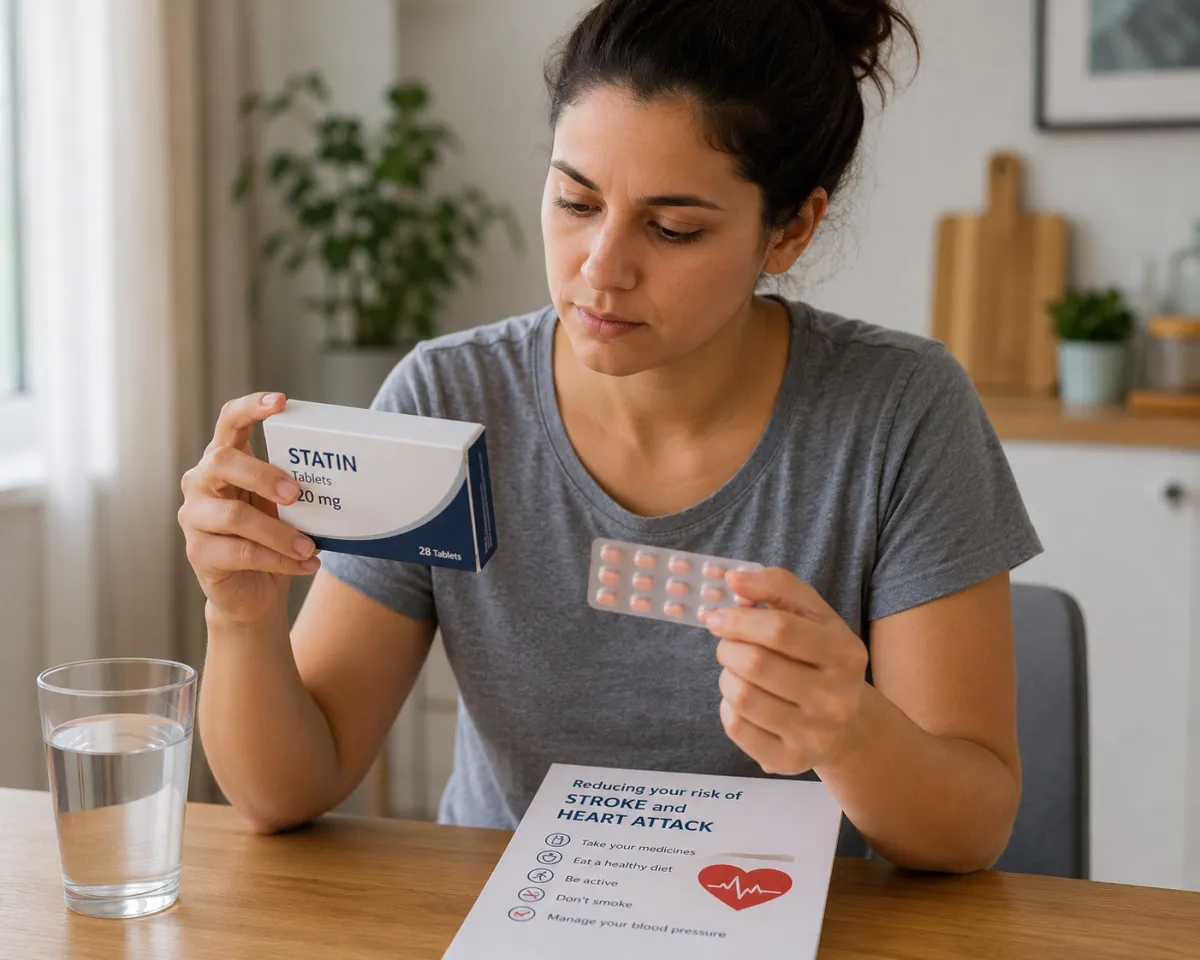
Taking your prescribed medication consistently after a stroke can be one of the most important parts of reducing the risk of another vascular event. Depending on the cause of your stroke, treatment may include antiplatelet medication, anticoagulants, statins, blood-pressure tablets or diabetes medication. These medicines work only when they are taken correctly. Missing doses, stopping because you feel well or changing treatment without medical advice can remove important protection that may have been prescribed specifically to reduce your future stroke risk.
After your stroke...
You may leave hospital with a bag of medication.
Perhaps before your stroke you took nothing.
Now suddenly there are tablets for:
Blood pressure.
Cholesterol.
Blood clots.
Diabetes.
Heart rhythm.
You may look at them and think...
"Do I really need all of these?"
Perhaps your blood pressure now looks normal.
Your cholesterol was never particularly high.
You feel completely recovered.
Maybe one tablet makes you tired.
Perhaps you forget doses.
Or perhaps after several months you start wondering...
"Surely I don't need this forever?"
These questions are common.
But medication after stroke is often prescribed for a very specific reason:
To reduce the chance of the problem happening again.
And feeling well does not necessarily mean the underlying risk has disappeared.
✦ ✦ ✦
The Good News
Medication adherence does not need to become complicated.
You do not need a perfect memory.
You need a reliable system.
That might involve:
✓ A pill organiser
✓ Phone reminders
✓ Taking tablets with a regular meal
✓ Keeping an updated medication list
✓ Automatic repeat prescriptions
✓ Asking your pharmacist to simplify the schedule where possible
The aim is not to prove that you can remember every tablet unaided.
The aim is to make taking your medication so routine that forgetting becomes unusual.
And if side effects, cost, swallowing difficulties or uncertainty are making adherence difficult...
Those problems can often be addressed.
The answer should usually be:
"How can we make this treatment work?"
Not:
"I'll just stop taking it."
✦ ✦ ✦
Why Is Medication So Important After Stroke?
Once you have experienced a stroke or TIA, your healthcare team may prescribe medication aimed at reducing specific causes or risk factors.
NICE guidance states that medicines for secondary prevention should generally be initiated by the specialist stroke team following diagnosis.
Depending on your circumstances, treatment may target:
✓ Blood clot formation
✓ Atrial fibrillation
✓ High blood pressure
✓ Cholesterol
✓ Diabetes
✓ Other cardiovascular conditions
The medication you take should therefore reflect why your stroke happened and what risks remain.
Two stroke survivors may leave hospital with completely different medication lists.
That does not mean one person is being overtreated.
Their underlying risks may simply be different.
✦ ✦ ✦
What Does Medication Adherence Actually Mean?
Medication adherence means taking your medicine:
✓ At the prescribed dose
✓ At the correct frequency
✓ For the recommended duration
✓ In the correct way
It also means speaking with your healthcare professional before making major changes.
Adherence is not simply:
"I take most of my tablets most of the time."
Some medications rely on consistent dosing to maintain their protective effect.
Repeatedly missing tablets can reduce that protection.
And stopping completely because you feel better may be particularly risky when the medicine is treating something you cannot feel.
You cannot usually feel:
High cholesterol.
Atrial fibrillation between episodes.
A tendency to form blood clots.
Early vascular disease.
Medication often protects against problems that are invisible.
✦ ✦ ✦
Antiplatelet Medication After Stroke
Some people who have experienced an ischaemic stroke or TIA may be prescribed an antiplatelet medicine such as clopidogrel.
Antiplatelets reduce the ability of platelets to stick together and form unwanted blood clots.
Clopidogrel, for example, is used to help prevent blood clots and reduce the risk of future heart attacks and strokes.
If you are prescribed an antiplatelet...
Do not decide that because you have recovered physically, the medication is no longer necessary.
Recovery from the neurological damage and prevention of another vascular event are two different issues.
Your walking may improve.
Your speech may recover.
Your fatigue may disappear.
None of those things automatically tell you whether your clotting risk has disappeared.
✦ ✦ ✦
Anticoagulants After Stroke
Anticoagulants are different from antiplatelets.
They are often prescribed when a stroke risk is related to conditions such as atrial fibrillation.
Examples can include:
✓ Apixaban
✓ Rivaroxaban
✓ Edoxaban
✓ Dabigatran
✓ Warfarin
NHS guidance explains that anticoagulants help prevent harmful blood clots and are used in people at increased risk of serious conditions including stroke.
If you have atrial fibrillation, anticoagulant treatment may be a central part of preventing another embolic stroke. NHS stroke guidance also recognises anticoagulants as an important treatment where AF increases ischaemic stroke risk.
Missing doses therefore matters.
Do not treat an anticoagulant as though it were an optional vitamin.
✦ ✦ ✦
Do Not Mix Up Antiplatelets and Anticoagulants
People often refer to both as:
"Blood thinners."
But they are not the same medication class.
They act differently.
And you should not add, remove or combine these medicines yourself.
For example, specialist guidance warns against casually combining antiplatelet and anticoagulant treatment because bleeding risk and clinical indications need proper medical consideration.
So do not think:
"If one blood thinner is good, two must be better."
That is not how stroke prevention works.
Take exactly what has been prescribed.
✦ ✦ ✦
Statins After Stroke
Statins are commonly prescribed as part of cardiovascular risk reduction after ischaemic stroke or TIA.
They lower cholesterol production and help reduce cardiovascular risk.
The NHS notes that statins may be recommended after TIA even when cholesterol is not particularly high because they can help reduce future stroke risk.
This can confuse people.
You may think:
"My cholesterol wasn't bad."
"So why am I taking a statin?"
Because the decision may be based on your overall cardiovascular risk, not simply whether one cholesterol result was dramatically abnormal.
After a vascular event, the threshold for treatment may be different from that of someone who has never had a stroke.
✦ ✦ ✦
"My Cholesterol Is Normal Now"
Good.
But ask why.
If you have been taking a statin for months and your cholesterol improves, the medication may be part of the reason.
Stopping it because the number improved can be like turning off the heating because the room finally became warm.
The result you are pleased with may be evidence that treatment is working.
NICE-linked guidance also emphasises reviewing medication adherence as part of ongoing cardiovascular risk management in people taking statins.
If you believe you no longer need the medication...
Ask.
Do not guess.
✦ ✦ ✦
Blood-Pressure Medication After Stroke
Blood-pressure management is another major part of secondary prevention for many stroke survivors.
You may be prescribed one or several medications.
Then you start checking your blood pressure at home.
It looks normal.
You conclude:
"I don't have high blood pressure anymore."
Maybe.
Or perhaps the medication is controlling it.
This distinction matters.
Blood-pressure medication is often part of long-term treatment after stroke because hypertension is a major vascular risk factor. NHS stroke guidance lists blood-pressure-lowering treatment among medicines used to reduce the risk of future strokes.
Do not stop tablets solely because one or two readings look good.
If blood pressure becomes consistently low or you develop dizziness...
That deserves review.
Not improvisation.
✦ ✦ ✦
Diabetes Medication Matters Too
If diabetes contributed to your cardiovascular risk, maintaining appropriate glucose control remains important.
Your treatment might involve:
✓ Tablets
✓ Injectable medication
✓ Insulin
The exact treatment depends on the type of diabetes and your individual circumstances.
Again...
Do not decide medication is unnecessary because your readings improved.
Your treatment may be why they improved.
If you repeatedly experience low blood sugar, gastrointestinal side effects or other problems...
Tell your diabetes team.
Medication can often be adjusted.
Stopping it without a plan may allow glucose levels to rise again.
✦ ✦ ✦
Why Do People Stop Taking Their Medication?
There are many reasons.
Some are completely understandable.
You may stop because:
✓ You feel well
✓ You forget
✓ You experience side effects
✓ You dislike taking tablets
✓ You worry about long-term harm
✓ You cannot swallow them easily
✓ The schedule is complicated
✓ You run out
✓ Repeat prescriptions are inconvenient
✓ You read frightening information online
✓ Someone tells you medication is "toxic"
✓ You believe diet alone can replace it
The problem is not admitting that adherence is difficult.
The problem is pretending it is fine while regularly missing important treatment.
Identify the barrier.
Then solve the barrier.
✦ ✦ ✦
"I Feel Fine"
This may be the most dangerous reason to stop.
Many stroke risk factors do not make you feel ill.
You may have high blood pressure without knowing it.
High cholesterol does not usually announce itself.
Atrial fibrillation can sometimes occur without obvious symptoms.
The absence of symptoms therefore does not prove that treatment is unnecessary.
Secondary-prevention medication is often designed to prevent something you hope never to feel:
Another stroke.
That makes adherence psychologically difficult.
You take a tablet every day...
And nothing happens.
But "nothing happens" may be exactly the outcome you want.
✦ ✦ ✦
What If You Get Side Effects?
Do not ignore them.
But do not automatically stop treatment either.
Possible medication problems might include:
✓ Dizziness
✓ Muscle aches
✓ Stomach problems
✓ Bruising
✓ Fatigue
✓ Cough
✓ Swelling
✓ Headaches
✓ Low blood pressure
Different medications have different side-effect profiles.
If something feels wrong, contact your doctor or pharmacist.
There may be options such as:
✓ Changing the dose
✓ Changing the timing
✓ Trying a different medicine
✓ Investigating another cause of the symptom
✓ Monitoring more closely
Sometimes the medication is not actually responsible.
And sometimes it is.
The only sensible response is to investigate rather than guess.
✦ ✦ ✦
Do Not Stop Because of Something You Read Online
Medication misinformation after stroke is everywhere.
You may read:
"Statins destroy your brain."
"Blood thinners are poison."
"Blood-pressure medication damages your kidneys."
"Natural remedies are safer."
These statements are often stripped of context.
Every medication has potential risks.
That is true.
But stroke-prevention medication is prescribed because your clinician believes the expected benefit outweighs those risks in your situation.
If something you read worries you...
Ask your pharmacist or doctor.
Do not allow a random social-media post to overrule your individual medical history.
✦ ✦ ✦
Natural Does Not Mean Safer
Herbal supplements can also cause problems.
Some may affect:
✓ Blood clotting
✓ Blood pressure
✓ Liver enzymes
✓ Drug absorption
✓ Blood glucose
This becomes particularly important if you take anticoagulants, antiplatelet medication or multiple prescriptions.
If you want to take:
Herbal remedies.
Vitamins.
CBD products.
Traditional medicines.
High-dose supplements.
Tell your pharmacist exactly what you intend to use.
Do not assume:
"It's natural, therefore it cannot interact."
That assumption is simply false.
✦ ✦ ✦
What If You Forget a Dose?
This depends on the medication.
Do not create one universal rule such as:
"Just double the next dose."
That can be dangerous.
Different medicines have different missed-dose instructions.
For example, anticoagulant timing may matter significantly.
If you forget a dose:
✓ Check the patient information leaflet
✓ Follow the instructions provided with your medicine
✓ Ask your pharmacist if you are unsure
✓ Do not automatically take two doses together
The correct response depends on what you are taking and how long it has been since the dose was due.
✦ ✦ ✦
Use a Pill Organiser
A pill organiser can remove a surprising amount of uncertainty.
Instead of wondering:
"Did I take my morning tablets?"
you can look.
Useful organisers may separate medication into:
✓ Morning
✓ Afternoon
✓ Evening
✓ Night
across each day of the week.
This can be particularly helpful after stroke if you experience:
✓ Memory problems
✓ Cognitive fatigue
✓ Attention difficulties
✓ Complex medication schedules
The system compensates for memory.
That is exactly what you want.
✦ ✦ ✦
Use Your Phone
A simple alarm can be extremely effective.
Set reminders for medication that needs to be taken at regular times.
Label the alarm clearly.
Not:
"Reminder."
Use:
"Take evening apixaban."
or:
"Take blood-pressure tablets."
If you dismiss alarms automatically, use a medication-tracking application or require yourself to physically tick the dose off.
The goal is to create a closed loop:
Reminder.
Medication taken.
Dose recorded.
Done.
✦ ✦ ✦
Link Medication to Existing Habits
Your brain remembers routines better than isolated tasks.
Try linking tablets to something you already do every day.
For example:
Morning medication → breakfast.
Evening medication → brushing your teeth.
Medication requiring a particular timing → phone reminder.
Be careful, however.
Some medicines have specific instructions regarding:
✓ Food
✓ Timing
✓ Other medicines
✓ Supplements
So first confirm how your medication should be taken.
Then build the routine around those instructions.
✦ ✦ ✦
Keep an Updated Medication List
This becomes especially useful after stroke because you may see several professionals.
Your:
GP.
Stroke consultant.
Pharmacist.
Cardiologist.
Neurologist.
Diabetes team.
Hospital.
should ideally know what you are actually taking.
Keep a list showing:
✓ Medicine name
✓ Dose
✓ Frequency
✓ Why you take it
✓ Any known allergy or reaction
Update it whenever treatment changes.
If you are admitted to hospital unexpectedly, having an accurate list can be extremely useful.
Do not rely on remembering eight medication names when you are frightened or unwell.
✦ ✦ ✦
Repeat Prescriptions Can Become the Weak Point
Sometimes the problem is not forgetting to swallow tablets.
It is forgetting to order them.
You suddenly realise:
"I have one tablet left."
Then the pharmacy cannot fill the prescription immediately.
Now you miss several doses.
Avoid this.
Consider:
✓ Automatic repeat dispensing where available
✓ Calendar reminders
✓ Ordering medication before you run out
✓ Using the NHS App or your practice's prescription system where appropriate
Medication adherence includes having medication available.
A perfect schedule means nothing if the packet is empty.
✦ ✦ ✦
Swallowing Problems Can Affect Medication
Dysphagia after stroke can make tablets difficult or unsafe to swallow.
Do not simply crush every tablet.
Some medicines must not be:
✓ Crushed
✓ Split
✓ Opened
✓ Dissolved
because changing the formulation can alter how the drug is absorbed or released.
If swallowing medication is difficult, speak with your pharmacist or speech and language therapist.
Alternative formulations may sometimes be available.
These might include:
✓ Liquids
✓ Dispersible tablets
✓ Smaller tablets
✓ Different formulations
The solution should be professionally planned.
✦ ✦ ✦
What If You Cannot Remember Why You Take Each Tablet?
Ask.
This sounds basic, but understanding the purpose of medication can improve motivation.
Instead of:
"Blue tablet."
know:
"This is my anticoagulant for atrial fibrillation."
Instead of:
"White tablet."
know:
"This helps control my blood pressure."
Instead of:
"Another evening pill."
know:
"This reduces cholesterol-related cardiovascular risk."
Medication feels far less arbitrary when you understand what problem each tablet is addressing.
NICE's medicines-adherence work emphasises involving people in decisions about prescribed medication rather than treating them as passive recipients.
Understanding matters.
✦ ✦ ✦
Have Regular Medication Reviews
Your medication list should not become frozen forever without review.
Your health may change.
Your blood pressure may change.
Your kidney function may change.
New medications may be added.
Side effects may emerge.
A medication review gives you an opportunity to ask:
✓ Do I still need this?
✓ Is this dose still right?
✓ Could this be causing my symptoms?
✓ Are there interactions?
✓ Can the schedule be simplified?
✓ Are there alternatives?
This is very different from stopping medication yourself.
Review means:
"Let's assess whether this is still appropriate."
Non-adherence means:
"I decided not to take it."
Those are not equivalent.
✦ ✦ ✦
Do Not Borrow Someone Else's Medication
Even if they had the same type of stroke.
Even if the tablet looks identical.
Even if their blood pressure sounds similar.
Medication choice depends on:
✓ Your diagnosis
✓ Kidney function
✓ Other medication
✓ Bleeding risk
✓ Age
✓ Medical history
✓ Allergies
✓ Stroke mechanism
Two people with stroke can require completely different treatments.
Your friend's medication is not your backup supply.
✦ ✦ ✦
Do Not Stop Medication Before Procedures Without Advice
If you take an anticoagulant or antiplatelet medicine and need:
Dental treatment.
Surgery.
An injection.
Another invasive procedure.
Do not decide independently to stop your medication several days beforehand.
The balance between bleeding risk and clotting risk needs proper assessment.
Tell the clinician performing the procedure exactly what you take.
If medication needs to be temporarily interrupted, you should receive clear instructions.
Guessing can expose you to unnecessary risk.
✦ ✦ ✦
What If Medication Makes You Anxious?
Some survivors become frightened of tablets after reading about possible side effects.
Every new sensation gets blamed on medication.
A headache.
Fatigue.
Muscle pain.
Dizziness.
Then medication becomes associated with danger.
Try to separate:
A possible side effect.
From:
An assumption.
Write down:
What symptom occurred.
When it started.
Which medication had changed.
Whether the symptom is persistent.
Then discuss it.
This produces useful information.
Stopping three medications at once because you felt tired one afternoon does not.
✦ ✦ ✦
My Perspective
After stroke, medication can feel like another reminder that something serious happened.
Every morning...
There are the tablets.
They can make you feel:
Ill.
Old.
Dependent.
Different.
So I understand why people want to get rid of them.
But the question should not be:
"How quickly can I stop these?"
It should be:
"Why am I taking each one, and does the evidence still support it?"
If your doctor says a medication is no longer necessary...
Fine.
Stop it according to their advice.
If the dose needs changing...
Change it properly.
If side effects are unacceptable...
Find an alternative.
But do not confuse feeling healthy with no longer needing prevention.
Sometimes medication is one of the reasons you are staying healthy.
✦ ✦ ✦
When Should You Seek Medical Advice?
Speak with your doctor, pharmacist or stroke team if:
✓ You are regularly missing doses
✓ Medication causes significant side effects
✓ You cannot swallow your tablets safely
✓ Your blood pressure becomes consistently very low
✓ You experience unexpected bleeding or bruising
✓ You are unsure why you take a medication
✓ You want to start supplements or herbal products
✓ You are struggling to manage a complicated medication schedule
✓ You want to stop a prescribed medicine
If you take anticoagulants and develop significant bleeding, seek urgent medical advice according to the instructions provided with your medication.
And if you develop new stroke symptoms...
Do not simply take an extra tablet.
Seek emergency medical care.
✦ ✦ ✦
Frequently Asked Questions
Why Is Medication Adherence Important After Stroke?
Many medicines prescribed after stroke are intended to reduce the risk of another vascular event by addressing problems such as blood clots, atrial fibrillation, high blood pressure or cholesterol.
Can I Stop My Medication If I Feel Fully Recovered?
Not without medical advice.
Neurological recovery does not necessarily mean the underlying stroke risk has disappeared.
Why Am I Taking a Statin If My Cholesterol Is Normal?
Statins may be prescribed after TIA or ischaemic stroke as part of broader cardiovascular-risk reduction, even when cholesterol was not dramatically elevated.
What Should I Do If I Forget a Dose?
Follow the specific instructions for that medicine or ask your pharmacist.
Do not automatically double the next dose.
Can I Crush Tablets If I Cannot Swallow Them?
Not necessarily.
Some tablets should not be crushed or altered.
Ask your pharmacist whether another formulation is available.
Can Herbal Supplements Replace Stroke Medication?
No.
Supplements do not replace anticoagulants, antiplatelets, statins, blood-pressure medication or other evidence-based secondary-prevention treatment.
What If I Think My Medication Is Causing Side Effects?
Discuss the problem with your doctor or pharmacist rather than stopping treatment independently.
✦ ✦ ✦
Key Takeaways
✓ Medication adherence is an important part of preventing another stroke.
✓ Different medications address different stroke risks.
✓ Antiplatelets and anticoagulants are not interchangeable.
✓ Anticoagulants may be prescribed when atrial fibrillation increases clot-related stroke risk.
✓ Statins may be recommended even when cholesterol is not dramatically elevated.
✓ Normal blood pressure while taking medication does not automatically mean the medicine is no longer needed.
✓ Side effects should be investigated rather than ignored.
✓ Pill organisers, alarms and routines can make adherence easier.
✓ Never automatically double a missed dose.
✓ Do not crush tablets without checking that it is safe.
✓ Keep an accurate medication list.
✓ Review medication regularly with your healthcare professional.
✓ Do not replace prescribed treatment with vitamins, supplements or herbal remedies.
✓ Never stop secondary-prevention medication without appropriate medical advice.
✦ ✦ ✦
Related Articles
Continue learning about reducing stroke risk:
Preventing a Second Stroke
High Blood Pressure After Stroke
Cholesterol After Stroke
Diabetes and Stroke Risk
Smoking After Stroke
Alcohol After Stroke
Mediterranean Diet After Stroke
Salt and Blood Pressure After Stroke
Vitamin Deficiencies After Stroke
Atrial Fibrillation and Stroke Risk
✦ ✦ ✦
About the Author
Alisia Gayle is a stroke survivor who achieved 96% neurological recovery following an ischaemic stroke.
After years of rehabilitation, she now shares practical, evidence-informed resources to help stroke survivors, carers and families better understand recovery and rebuild their lives with confidence.
Alisia is also the author of Brain Damage: My Journey to 96% Recovery, where she shares her personal stroke recovery story and the lessons she learned throughout her rehabilitation.
✦ ✦ ✦
Medical Disclaimer
This article is intended for educational purposes only and should not replace professional medical, pharmaceutical or stroke-prevention advice.
Medication requirements after stroke vary according to the cause and type of stroke, medical history, heart rhythm, blood pressure, cholesterol, kidney function, diabetes, bleeding risk and other individual factors.
Always take prescribed medication according to the instructions provided by your healthcare professional.
Do not stop, double, crush, combine or change prescribed medication without appropriate advice from your doctor or pharmacist.
If you experience significant side effects, difficulty taking medication or concerns about interactions, seek professional advice rather than stopping treatment independently.
Seek emergency medical attention immediately for any new or sudden symptoms of stroke.
✦ ✦ ✦
Final Thoughts
Medication adherence after stroke...
May not feel like rehabilitation.
There is no dramatic exercise.
No visible improvement.
No moment where you suddenly realise:
"My arm moved better today."
It is quieter than that.
You take a tablet.
Then another tomorrow.
And the next day.
Sometimes for years.
That can make medication feel unimportant.
But prevention often looks exactly like that.
Routine.
Consistency.
Doing something boring because the alternative could be catastrophic.
Understand what each medicine is for.
Create a system.
Use reminders.
Order prescriptions early.
Report side effects.
Ask questions.
Have medication reviews.
And if something does not seem right...
Challenge it properly.
Do not simply stop.
Because recovering from one stroke is hard enough.
If medication has been prescribed to reduce the risk of another...
Taking it correctly may be one of the simplest things you can do to protect everything you have already worked to regain.