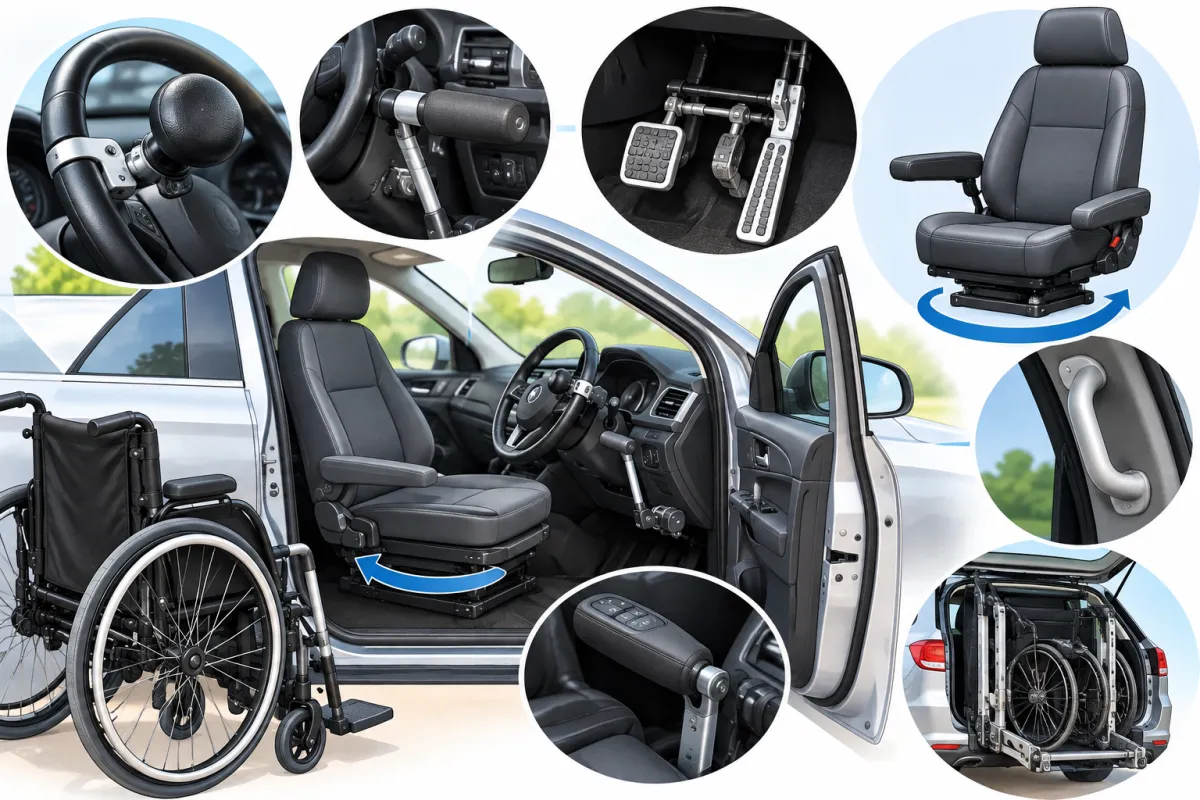
Driving after a stroke can represent independence, freedom and a return to normal life. But weakness, reduced coordination, visual problems or difficulty using one side of the body can make an ordinary car harder to control. Vehicle adaptations can sometimes make driving safer and more manageable by changing how you steer, accelerate, brake, enter the vehicle or operate secondary controls. The right adaptation should be based on your individual abilities and a proper driving assessment, not guesswork.
After your stroke...
You may look at your car very differently.
Perhaps one leg feels weaker.
Maybe your hand no longer grips the steering wheel in the same way.
Perhaps changing gear feels awkward.
You may struggle to turn your head.
Getting into the car may take much more effort.
Or perhaps you can physically drive, but ordinary controls simply do not feel as easy or safe as they once did.
You begin wondering...
"Will I ever drive normally again?"
"Do I need an adapted car?"
"Can I drive using one hand?"
"What if my right leg is weak?"
"Will I need hand controls?"
"Can adaptations be temporary?"
For many stroke survivors, needing an adaptation does not necessarily mean giving up driving.
In some cases, the adaptation is exactly what makes driving possible again.
✦ ✦ ✦
The Good News
Physical disability after stroke does not automatically prevent you from driving.
Current UK medical-driving guidance states that even significant physical impairment may sometimes be compatible with driving when appropriate vehicle adaptations are used.
Adaptations can compensate for difficulties involving:
✓ Arms
✓ Hands
✓ Legs
✓ Foot control
✓ Steering
✓ Transfers into the vehicle
✓ Reaching ordinary controls
The important word is appropriate.
You should not simply buy equipment online and assume it solves the problem.
Driving is a safety-critical activity.
A specialist assessment can identify what you actually need and whether you can use it safely.
✦ ✦ ✦
Before Thinking About Adaptations: Can You Drive Yet?
This comes first.
In Great Britain, you must stop driving immediately after a stroke or TIA. For ordinary car and motorcycle licence holders, the minimum period off the road is generally at least one calendar month, but whether you can resume after that depends on your remaining symptoms and the applicable DVLA requirements.
Some complications may mean you need to notify the DVLA or remain off the road longer.
These can include issues affecting:
✓ Vision
✓ Cognition
✓ Movement
✓ Coordination
✓ Seizures
✓ Driving safety
Bus and lorry licensing has stricter requirements, and drivers in those categories must notify the DVLA after stroke or TIA.
Do not treat the one-month point as automatic permission to drive.
You still need to be medically and functionally safe.
✦ ✦ ✦
Why Might You Need a Vehicle Adaptation?
Stroke can affect many of the physical abilities required for driving.
You need to be able to:
✓ Steer accurately
✓ Accelerate and brake reliably
✓ Operate indicators and other controls
✓ Turn or observe surrounding traffic
✓ Respond quickly
✓ Enter and exit the car
✓ Maintain control during unexpected situations
If one part of this system is difficult, an adaptation may compensate.
For example:
A weak right leg may make ordinary pedals difficult.
A weak left arm may make steering harder.
Reduced grip may affect control of the wheel.
Poor mobility may make getting into the driver's seat difficult.
The adaptation should solve a specific functional problem.
✦ ✦ ✦
Hand Controls After Stroke
Hand controls are among the better-known adaptations.
They can allow the accelerator and brake to be operated by hand instead of using the feet.
Stroke Association guidance lists hand-operated acceleration and braking among adaptations that may help some people return to driving.
They may be considered when:
✓ One leg has significant weakness
✓ Foot control is unreliable
✓ An ankle does not move effectively
✓ Pedal transfer is difficult
✓ Lower-limb coordination is impaired
Different systems exist.
Some use a mechanical lever.
Others use electronic controls.
The exact system matters because one design may suit you much better than another.
A person with weakness in one arm, for example, will need a system that takes that into account.
✦ ✦ ✦
Can You Drive Using Only One Hand?
Sometimes.
One-handed steering can be possible with appropriate assessment and equipment.
Driving Mobility centres assess alternative steering systems, including one-handed steering solutions.
A steering aid may allow you to maintain controlled contact with the wheel using one hand.
However, steering is only part of the problem.
That same hand may also need to operate:
✓ Indicators
✓ Lights
✓ Wipers
✓ Horn
✓ Other controls
This is why adaptations sometimes combine a steering aid with relocated or electronic secondary controls.
Do not assume that being able to turn a steering wheel one-handed in a stationary car means you can safely manage real traffic.
Emergency manoeuvres are different.
✦ ✦ ✦
Steering Knobs and Steering Aids
A steering knob attaches to the steering wheel and can make turning easier with one hand.
Other designs include:
✓ Steering balls
✓ Steering spinners
✓ Steering grips
✓ Steering cups
The best option depends on your grip, wrist movement, arm strength and coordination.
For someone with weakness on one side after stroke, a steering aid may reduce the amount of hand movement required.
But it should be professionally positioned.
The wrong location can make control awkward rather than easier.
✦ ✦ ✦
Lightened Power Steering
Modern cars already have power-assisted steering.
But some people still find the steering too heavy after neurological injury.
Lightened power steering can reduce the amount of force needed to turn the wheel.
Stroke Association guidance identifies lightened power steering as one possible adaptation after stroke.
This may be useful if you have:
✓ Arm weakness
✓ Reduced shoulder strength
✓ Limited endurance
✓ One-sided weakness
The amount of assistance required should be assessed carefully.
Too little assistance may leave driving exhausting.
But steering also needs enough feedback for you to maintain safe control.
✦ ✦ ✦
Left-Foot Accelerator
If your right leg has been significantly affected but your left leg remains strong and coordinated, a left-foot accelerator may sometimes be considered.
This changes pedal operation so that acceleration can be controlled with the left foot.
However, this is not something to improvise.
Using the opposite foot changes years of learned driving behaviour.
You may require:
✓ Specialist assessment
✓ Adapted driving lessons
✓ Practice
✓ A formal restriction or adaptation specification on your licence where applicable
Your ability to brake safely and avoid confusing pedals must be assessed.
✦ ✦ ✦
Switching From Manual to Automatic
Sometimes the simplest adaptation is changing the type of vehicle.
A manual car requires:
✓ Clutch control
✓ Gear changes
✓ Coordination between both legs
✓ One hand repeatedly leaving the steering wheel
After stroke, that may become unnecessarily demanding.
An automatic car removes the clutch pedal and manual gear changes.
DVLA guidance notes that limb disability after stroke may sometimes be managed by restricting the driver to an automatic vehicle or using adapted controls.
For some survivors, moving to an automatic dramatically reduces physical workload.
That does not mean everyone with limb weakness needs one.
But it can be an effective solution.
✦ ✦ ✦
Secondary Control Adaptations
Driving involves much more than steering and pedals.
You also need to operate:
✓ Indicators
✓ Windscreen wipers
✓ Lights
✓ Horn
✓ Heating and demisting controls
✓ Other vehicle functions
If one hand is weak, reaching these controls may be difficult.
Adaptations can bring several functions closer to the driver's stronger hand.
Examples can include:
✓ Indicator extensions
✓ Electronic control pads
✓ Combined control units
✓ Modified switches
✓ Remote buttons
These adaptations can reduce the need to take your stronger hand away from the steering system.
✦ ✦ ✦
Getting Into and Out of the Car
Sometimes driving itself is not the hardest part.
Getting into the car is.
Stroke may affect:
✓ Balance
✓ Hip movement
✓ Leg strength
✓ Trunk control
✓ Coordination
✓ Transfers
You may be perfectly capable of controlling the vehicle once seated but struggle to get safely into position.
Possible solutions include:
✓ Swivel seats
✓ Transfer boards
✓ Grab handles
✓ Lower or repositioned seating
✓ Seat extensions
✓ Powered seat systems
The goal is not simply comfort.
A difficult transfer can create a genuine fall risk.
✦ ✦ ✦
Wheelchair and Mobility Equipment
Some stroke survivors use a wheelchair or mobility aid for longer distances.
That can create another problem:
Where does the equipment go once you are inside the vehicle?
Vehicle adaptations may include:
✓ Boot hoists
✓ Wheelchair hoists
✓ Ramps
✓ Lifts
✓ Storage systems
✓ Transfer equipment
These adaptations may be particularly important if you drive independently and cannot manually lift heavy mobility equipment.
Driving Mobility centres assess both driving controls and driver or passenger access requirements.
✦ ✦ ✦
Adapted Mirrors
Visual or movement restrictions may sometimes make checking mirrors harder.
Additional mirrors may improve visibility in some circumstances.
These can include:
✓ Wider rear-view mirrors
✓ Additional side mirrors
✓ Blind-spot mirrors
However, extra mirrors cannot compensate for unsafe visual field loss or serious visual-processing problems.
If vision has been affected by your stroke, that needs proper assessment.
A larger mirror is not a solution to a neurological visual deficit that makes driving unsafe.
✦ ✦ ✦
What About Weakness on the Left Side?
Left-sided weakness may affect:
✓ Steering
✓ Indicator operation
✓ Gear changing in a manual car
✓ Getting into the vehicle
✓ Seatbelt use
Your stronger right side may be able to compensate for some tasks with adaptations.
A steering aid, automatic transmission and relocated controls may reduce demands on the weaker side.
But the correct setup depends on how much strength and coordination remain.
Two people with apparently similar weakness may require completely different solutions.
✦ ✦ ✦
What About Weakness on the Right Side?
Right-sided weakness can particularly affect pedal control in a conventional UK vehicle.
Potential solutions might include:
✓ Hand controls
✓ A left-foot accelerator
✓ Automatic transmission
✓ Alternative pedal arrangements
Again, the correct choice depends on what you can do reliably.
Do not focus only on strength.
Driving also depends on:
✓ Reaction time
✓ Accuracy
✓ Sensation
✓ Coordination
✓ Endurance
Being able to press a pedal is not enough.
You must be able to operate it consistently and safely.
✦ ✦ ✦
Can Adaptations Help With Fatigue?
Sometimes indirectly.
Driving after stroke can require much more concentration and physical effort than it did previously.
An easier steering system or automatic transmission may reduce unnecessary workload.
But adaptations do not eliminate neurological fatigue.
Stroke Association guidance notes that people returning to driving may need to consider changes such as avoiding driving when fatigued or adjusting work patterns.
If you become cognitively exhausted after twenty minutes, changing your pedals will not magically fix that.
You may still need to:
✓ Drive shorter distances
✓ Avoid heavy traffic
✓ Take breaks
✓ Avoid driving late in the day
✓ Avoid driving when unwell or exhausted
Fatigue management remains a safety issue.
✦ ✦ ✦
Why You Should Have a Specialist Driving Assessment
This is probably the most important practical step.
Driving Mobility provides independent specialist driving and mobility assessments across the UK, including assessments for people considering vehicle adaptations.
A specialist assessment can consider:
✓ Physical movement
✓ Strength
✓ Coordination
✓ Vision
✓ Cognition
✓ Reaction time
✓ Driving technique
✓ Vehicle access
✓ Potential adaptations
You may also be able to try different equipment.
This is far more useful than guessing what you need from photographs online.
A proper assessment can identify the simplest safe solution.
Sometimes the result may even be:
You do not need an adaptation.
That is useful information too.
✦ ✦ ✦
Do Not Buy Adaptations Before Assessment
This deserves its own section.
It can be tempting to search online, find a steering knob or pedal device and order it immediately.
That is a poor approach.
Why?
Because you may:
✓ Buy the wrong device
✓ Install it incorrectly
✓ Discover it makes driving harder
✓ Create an insurance problem
✓ Need a completely different system
✓ Develop unsafe habits
Government guidance specifically directs drivers who are told they need adaptations towards an independent assessment through Driving Mobility.
Assessment first.
Equipment second.
✦ ✦ ✦
Will You Need Driving Lessons Again?
Possibly.
Driving with adapted controls is a new skill.
You may have driven for thirty years, but operating an accelerator by hand or using your left foot instead of your right requires new motor patterns.
That takes practice.
Specialist instructors can help you become familiar with:
✓ Hand controls
✓ Steering aids
✓ Automatic vehicles
✓ Alternative pedal systems
✓ New techniques
There is nothing embarrassing about this.
You are not relearning how roads work.
You are learning how to control the vehicle differently.
✦ ✦ ✦
Tell Your Insurer
If your health condition or vehicle has changed, make sure your insurer has the information they require.
Do not assume that because an adaptation is medically sensible it can simply be installed without any other action.
You may need to tell your insurer about:
✓ The stroke
✓ Licence restrictions
✓ Vehicle modifications
✓ Adapted controls
✓ Relevant medical information
Give accurate information.
Driving without appropriate insurance is a much bigger problem than an uncomfortable phone call.
✦ ✦ ✦
Can the DVLA Specify Adapted Controls?
Yes.
Depending on your medical circumstances, driving entitlement may include restrictions or requirements relating to the type of vehicle or controls you can use.
Government medical-driving guidance specifically recognises that some stroke-related limb weakness may require restriction to particular vehicle types or adapted controls.
This is another reason not to treat vehicle adaptation as a purely personal choice.
It may become part of your licensing arrangements.
✦ ✦ ✦
Can Adaptations Be Removed Later?
Sometimes.
Stroke recovery can continue.
Strength may improve.
Coordination may improve.
Foot control may return.
You might eventually find that an adaptation you once depended upon is no longer necessary.
But do not simply remove it yourself if it forms part of the conditions under which you have been assessed or licensed to drive.
Seek appropriate reassessment first.
Your ability has changed.
That is good.
Now make sure your driving arrangements change safely too.
✦ ✦ ✦
Choosing the Right Car
Sometimes adapting the wrong car becomes unnecessarily expensive or awkward.
When choosing a vehicle after stroke, consider:
✓ Automatic versus manual transmission
✓ Door width
✓ Seat height
✓ Ease of entry
✓ Boot size
✓ Steering weight
✓ Visibility
✓ Space for mobility equipment
✓ Ease of modifying the controls
✓ How far you need to drive
A low sports-style seat may look attractive but be miserable to climb out of with impaired leg strength.
A larger car may provide easier access but could be harder to manoeuvre.
Choose based on function.
Not appearance alone.
✦ ✦ ✦
Paying for Vehicle Adaptations
Vehicle adaptations can vary enormously in price.
Simple changes may be relatively modest.
Complex systems involving hand controls, seating, lifts or wheelchair access can be significantly more expensive.
Depending on your circumstances, there may be sources of financial support.
For people whose disability affects their ability to work, Access to Work may sometimes help with practical support or travel costs, subject to eligibility and current scheme rules.
Some disabled people may also qualify for mobility-related support or schemes that can contribute towards suitable vehicles or adaptations.
Eligibility varies.
Do not assume you qualify.
But do not assume you have to fund everything yourself either.
Investigate the options before spending substantial amounts of money.
✦ ✦ ✦
Emotional Impact
Driving represents much more than transport.
It can represent:
Freedom.
Privacy.
Independence.
Spontaneity.
Parenting.
Work.
Social life.
Not having to ask someone:
"Can you take me?"
Losing driving after stroke can therefore feel like another part of your independence has disappeared.
Then the suggestion of an adapted vehicle may trigger another reaction:
"I don't want a disabled car."
But an adapted car is still a car.
The purpose of the equipment is not to define you.
It is to remove a barrier.
If a £200 control or a modified pedal gives you safe independence again, rejecting it because of what it symbolises may cost you far more freedom than accepting it.
✦ ✦ ✦
My Perspective
Driving after stroke is one of those areas where determination alone is not enough.
You may desperately want your independence back.
You may feel physically strong.
You may even sit behind the wheel and think:
"I can do this."
But driving is different from most rehabilitation activities.
Your decisions affect other people too.
That means pride has to disappear from the equation.
If you need an automatic...
Use one.
If you need hand controls...
Use them.
If you need a steering aid...
Use it.
If you need another assessment...
Get one.
And if you are not yet safe to drive...
Do not drive.
The goal is not proving that your stroke changed nothing.
The goal is getting as much independence back as possible without compromising safety.
Sometimes an adaptation is not evidence of what you lost.
It is the tool that gives something important back.
✦ ✦ ✦
When Should You Seek Professional Advice?
Seek appropriate medical or driving advice if you experience:
✓ New weakness
✓ Worsening coordination
✓ Visual changes
✓ Seizures
✓ Blackouts
✓ Severe fatigue while driving
✓ Difficulty controlling pedals
✓ Difficulty steering safely
✓ Problems judging distance
✓ Cognitive problems affecting road decisions
✓ Any new neurological symptoms
Do not try to compensate for a new neurological problem by simply buying another piece of equipment.
A new or worsening symptom needs medical assessment.
✦ ✦ ✦
Frequently Asked Questions
Can I Drive After a Stroke If One Side Is Weak?
Possibly.
UK guidance recognises that limb weakness does not automatically prevent driving and that adaptations may sometimes allow safe driving.
Your individual ability needs to be assessed.
What Vehicle Adaptations Are Available After Stroke?
Options may include:
✓ Hand controls
✓ Steering aids
✓ Lightened power steering
✓ Left-foot accelerators
✓ Automatic transmission
✓ Secondary-control adaptations
✓ Seating modifications
✓ Wheelchair hoists
✓ Access equipment
Can I Drive Using One Hand?
Some people can drive using one-handed steering adaptations, but you should have a specialist assessment to determine whether this is safe and what equipment is suitable.
Do I Need a New Car?
Not always.
Some adaptations can be fitted to an existing vehicle.
In other cases, switching vehicle type may be easier or safer.
Should I Buy Adaptations Before Having an Assessment?
No.
A specialist assessment should normally come first so that equipment matches your actual needs.
Can I Eventually Stop Using the Adaptation?
Possibly if your recovery improves.
But if your licence or driving assessment requires adapted controls, seek reassessment before changing the setup.
Where Can I Get a Driving Assessment?
Driving Mobility operates specialist assessment centres across the UK that can assess driving ability and adaptation requirements.
✦ ✦ ✦
Key Takeaways
✓ Physical disability after stroke does not automatically mean you cannot drive.
✓ Vehicle adaptations can compensate for some arm, hand and leg difficulties.
✓ Hand controls may replace conventional accelerator and brake pedals.
✓ Steering aids may help people with one-sided weakness.
✓ Switching from a manual to an automatic may significantly reduce driving demands.
✓ Vehicle access and transferring into the seat may also require adaptation.
✓ Fatigue, vision and cognitive problems cannot always be solved by physical vehicle modifications.
✓ Have a specialist driving assessment before buying adaptations.
✓ You may need adapted-driving tuition to learn new controls safely.
✓ Follow DVLA, medical and insurance requirements before returning to the road.
✦ ✦ ✦
Related Articles
Continue learning about driving and independence after stroke:
Driving After a Stroke
When Can You Drive After a Stroke?
Driving Assessment After Stroke
Vision Problems and Driving After Stroke
Reaction Time After Stroke
Fatigue and Driving After Stroke
Returning to Work After a Stroke
Travel After Stroke
Walking After a Stroke
Regaining Independence After Stroke
✦ ✦ ✦
Final Thoughts
Vehicle adaptations after stroke...
Can initially feel like another reminder of what happened.
A steering aid.
Hand controls.
A different pedal.
An automatic car.
A modified seat.
Perhaps none of these things were part of your life before.
But look at what they can represent.
Getting yourself to work.
Taking your children somewhere.
Doing your own shopping.
Visiting friends.
Going somewhere simply because you decided to go.
That is independence.
The important question is not:
"Can I drive exactly the way I drove before?"
It is:
"What allows me to drive safely now?"
Have the assessment.
Use the equipment you genuinely need.
Practise until the new controls become familiar.
Respect fatigue and other neurological symptoms.
And never allow pride to become more important than safety.
Because after stroke...
Sometimes recovery is about regaining an old ability.
And sometimes it is about finding a new way to achieve exactly the same freedom.