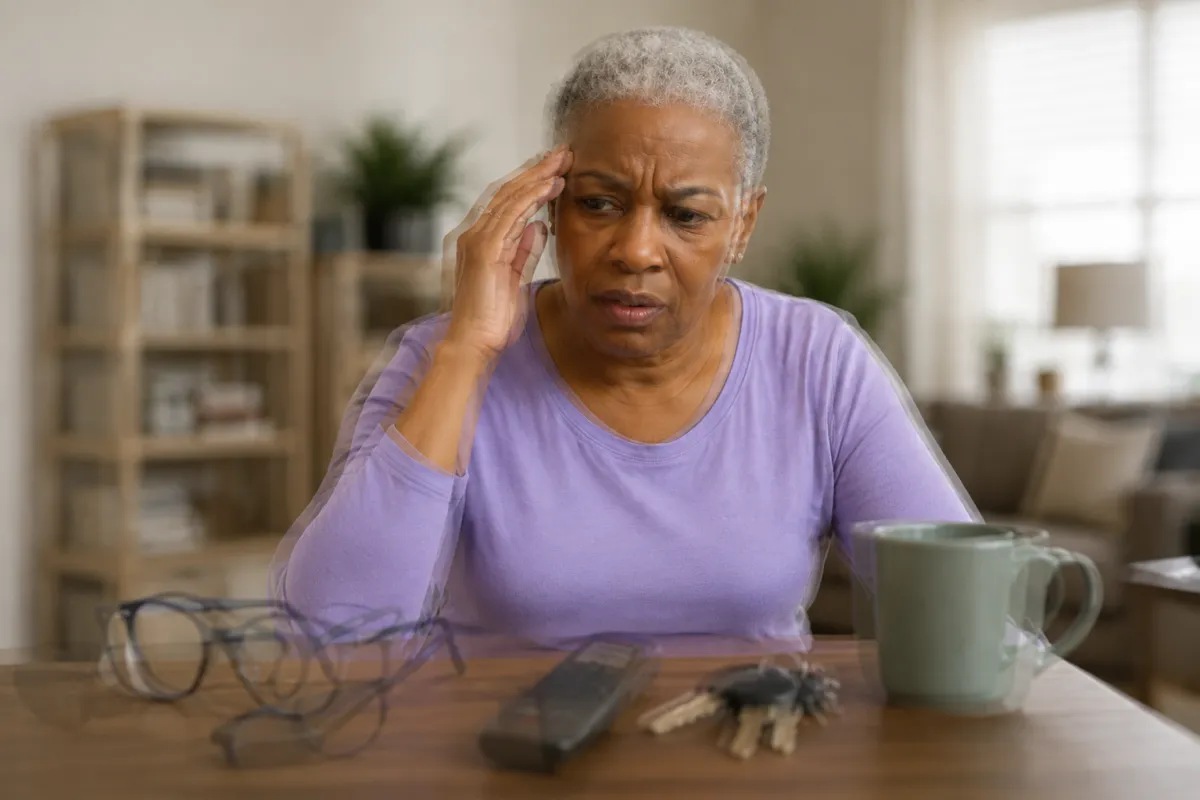
Visual processing problems after a stroke can make the world feel confusing, overwhelming or unfamiliar. You may be able to see clearly, yet struggle to understand what you are looking at. Objects may be difficult to recognise, busy places may feel impossible to navigate and everyday activities such as reading, dressing or finding items can suddenly require enormous effort. Learn why visual processing problems happen after a stroke, how they differ from eyesight problems and what may help recovery.
After your stroke...
You open your eyes.
Everything appears to be there.
But something does not feel right.
You can see the objects in front of you.
Yet it takes longer to understand what they are.
Perhaps you cannot find an item sitting directly on the table.
Maybe crowded rooms feel overwhelming.
Or you look at something familiar...
And for a moment, you do not recognise it.
You begin wondering...
"Why can I see things but not understand what I am seeing?"
Or...
"Is there something wrong with my eyesight?"
The good news is...
Visual processing problems can occur after stroke, and many people improve or learn effective ways to manage them.
✦ ✦ ✦
The Good News
Seeing involves much more than the eyes.
Your eyes collect visual information.
But your brain must then:
✓ Organise what you see.
✓ Recognise objects and faces.
✓ Judge distance and position.
✓ Separate important details from the background.
✓ Understand how objects relate to one another.
✓ Connect visual information with memory.
A stroke can disrupt one or more of these processes.
Even when your eyesight appears normal, the brain may need more time to interpret what the eyes are seeing.
With rehabilitation, practice and neuroplasticity, visual processing may gradually become easier.
✦ ✦ ✦
What Are Visual Processing Problems?
Visual processing problems occur when the brain has difficulty interpreting visual information.
This is different from simply having blurred vision or needing glasses.
You may be able to see an object clearly but struggle to:
✓ Recognise it.
✓ Find it among other objects.
✓ Judge where it is.
✓ Understand its shape or purpose.
✓ Work out how far away it is.
The problem is not always with the eyes themselves.
It may be caused by damage to the parts of the brain that make sense of vision.
✦ ✦ ✦
What Do Visual Processing Problems Feel Like?
Symptoms vary depending on which areas of the brain were affected.
You may notice:
✓ Difficulty recognising familiar objects.
✓ Problems recognising faces.
✓ Losing items that are directly in front of you.
✓ Difficulty following television programmes.
✓ Becoming overwhelmed in supermarkets or crowded rooms.
✓ Trouble judging steps, kerbs or doorways.
✓ Difficulty reading maps or following directions.
✓ Problems matching colours, shapes or patterns.
✓ Feeling confused by cluttered surfaces.
These difficulties can make ordinary environments feel unfamiliar and exhausting.
✦ ✦ ✦
Visual Agnosia
Some stroke survivors develop visual agnosia.
This means they can see an object but cannot recognise or identify it through sight alone.
For example...
You may look at a cup and be unable to name it.
But once you pick it up or use it, you may understand what it is.
Visual agnosia may affect recognition of:
✓ Everyday objects.
✓ Pictures.
✓ Shapes.
✓ Colours.
✓ Faces.
This does not mean the person has lost their intelligence or knowledge of the object.
The brain is struggling to connect the visual image with stored information.
✦ ✦ ✦
Difficulty Recognising Faces
Face recognition is a specialised type of visual processing.
Some survivors develop prosopagnosia, also known as face blindness.
You may struggle to recognise:
✓ Family members.
✓ Friends.
✓ Colleagues.
✓ Yourself in photographs.
You may instead identify people through their voice, hairstyle, clothing or the way they walk.
✦ ✦ ✦
Visual Attention Problems
Stroke can affect where the brain directs attention.
You may see many objects but struggle to focus on the one you need.
This may cause:
✓ Difficulty finding items.
✓ Missing important details.
✓ Becoming overwhelmed by busy scenes.
✓ Trouble switching attention between objects.
A table containing several objects may feel far more confusing than a table containing only one.
✦ ✦ ✦
Visual Neglect
Visual neglect occurs when the brain does not properly attend to one side of space.
It most commonly affects the side opposite the brain injury.
You may:
✓ Ignore food on one side of the plate.
✓ Bump into objects on one side.
✓ Read only part of a page.
✓ Dress only one side of the body.
✓ Fail to notice people approaching from one direction.
The eyes may still be capable of seeing that side.
The brain is simply not paying sufficient attention to it.
✦ ✦ ✦
Visual Field Loss
Visual field loss is different from neglect.
It occurs when part of the normal field of vision is missing.
You may notice:
✓ Objects suddenly appearing from one side.
✓ Missing words when reading.
✓ Bumping into doorframes.
✓ Difficulty crossing roads safely.
Some people experience both visual field loss and visual neglect, which can make daily activities especially challenging.
✦ ✦ ✦
Difficulty Judging Distance and Depth
A stroke may affect depth perception and spatial awareness.
You may struggle to judge:
✓ The height of a step.
✓ The distance between objects.
✓ How far away a chair is.
✓ Whether a cup is full.
✓ Where to place your foot.
This can increase the risk of:
✓ Falls.
✓ Spilling drinks.
✓ Misjudging kerbs.
✓ Reaching past objects.
✓ Feeling unsafe on stairs.
✦ ✦ ✦
Problems With Crowded or Busy Environments
Many survivors cope reasonably well in quiet environments but become overwhelmed in visually busy places.
Examples include:
✓ Supermarkets.
✓ Shopping centres.
✓ Train stations.
✓ Crowded rooms.
✓ Busy roads.
✓ Cluttered workspaces.
The brain may struggle to filter out unnecessary information and focus on what matters.
This is sometimes described as visual overload.
✦ ✦ ✦
Why Can I See Something but Not Find It?
You may look repeatedly for an object that is directly in front of you.
This can happen because your brain is struggling to separate the object from its background.
For example...
A white cup may be difficult to find on a white surface.
Keys may disappear among other items on a cluttered table.
This is not carelessness.
It is a genuine visual processing difficulty.
✦ ✦ ✦
Reading and Visual Processing
Visual processing problems can make reading extremely difficult.
You may:
✓ Lose your place.
✓ Skip words or lines.
✓ Read only one side of the page.
✓ Struggle with crowded text.
✓ Have difficulty recognising letters.
✓ Become tired after reading briefly.
Using larger print, wider spacing or a reading guide may help.
✦ ✦ ✦
Visual Processing and Movement
Vision plays a major role in balance and movement.
When visual information is processed incorrectly, you may feel:
✓ Unsteady.
✓ Hesitant when walking.
✓ Unsafe on stairs.
✓ Confused in unfamiliar places.
✓ More dependent on walls or furniture.
This may happen even when muscle strength is relatively good.
✦ ✦ ✦
Fatigue Makes Visual Processing Harder
Visual processing requires significant mental effort.
Symptoms may become worse:
✓ Later in the day.
✓ After poor sleep.
✓ In bright or busy environments.
✓ During long conversations.
✓ When trying to complete several tasks at once.
You may notice that visual tasks are easier in the morning and harder when tired.
This does not necessarily mean your condition is worsening.
It may mean your brain has reached its processing limit.
✦ ✦ ✦
Emotional Effects
Visual processing problems can be frightening.
Many people experience:
✓ Anxiety.
✓ Frustration.
✓ Loss of confidence.
✓ Fear of falling.
✓ Social withdrawal.
✓ Concern about losing independence.
You may worry that others think you are careless or confused.
But these difficulties are caused by brain injury.
They are not a reflection of intelligence.
✦ ✦ ✦
Does This Mean I Have Dementia?
No.
Visual processing problems after stroke do not automatically mean dementia.
They may result from damage to specific brain pathways involved in vision, attention and recognition.
However, medical assessment is important if symptoms are new, worsening or changing over time.
✦ ✦ ✦
Can Visual Processing Improve?
Yes.
Some people experience significant recovery.
Others learn strategies that make daily activities safer and easier.
Recovery depends on:
✓ Which areas of the brain were affected.
✓ The severity of the stroke.
✓ Whether visual field loss or neglect is present.
✓ Access to rehabilitation.
✓ Opportunities to practise.
✓ Fatigue management.
Improvements can continue for months and years.
✦ ✦ ✦
What Can Help?
Reduce Clutter
Keep surfaces clear and organise belongings in consistent places.
Increase Contrast
Use contrasting colours to make objects easier to see.
For example:
✓ A dark plate on a light table.
✓ Bright tape on the edge of steps.
✓ A coloured cup against a plain background.
Improve Lighting
Good, even lighting may make objects easier to identify.
Avoid glare where possible.
Slow Down
Give your brain enough time to process what you are seeing.
Scan the Environment
Practise deliberately moving your eyes and head from one side to the other.
Use Other Senses
Touch, sound and movement may help you recognise objects or people.
Take Regular Breaks
Shorter periods of visual activity may reduce overload and fatigue.
✦ ✦ ✦
Rehabilitation for Visual Processing Problems
Support may involve:
✓ Occupational therapy.
✓ Neuropsychology.
✓ Orthoptics.
✓ Neuro-ophthalmology.
✓ Specialist vision rehabilitation.
Therapy may focus on:
✓ Visual scanning.
✓ Object recognition.
✓ Attention.
✓ Reading.
✓ Navigation.
✓ Safer movement.
The most appropriate support depends on the specific type of visual problem.
✦ ✦ ✦
Making the Home Safer
Practical changes may include:
✓ Removing unnecessary clutter.
✓ Keeping furniture in consistent positions.
✓ Marking step edges clearly.
✓ Improving lighting.
✓ Organising frequently used items in fixed locations.
✓ Removing trip hazards.
✓ Using labels or pictures on cupboards.
Small environmental changes can make a significant difference.
✦