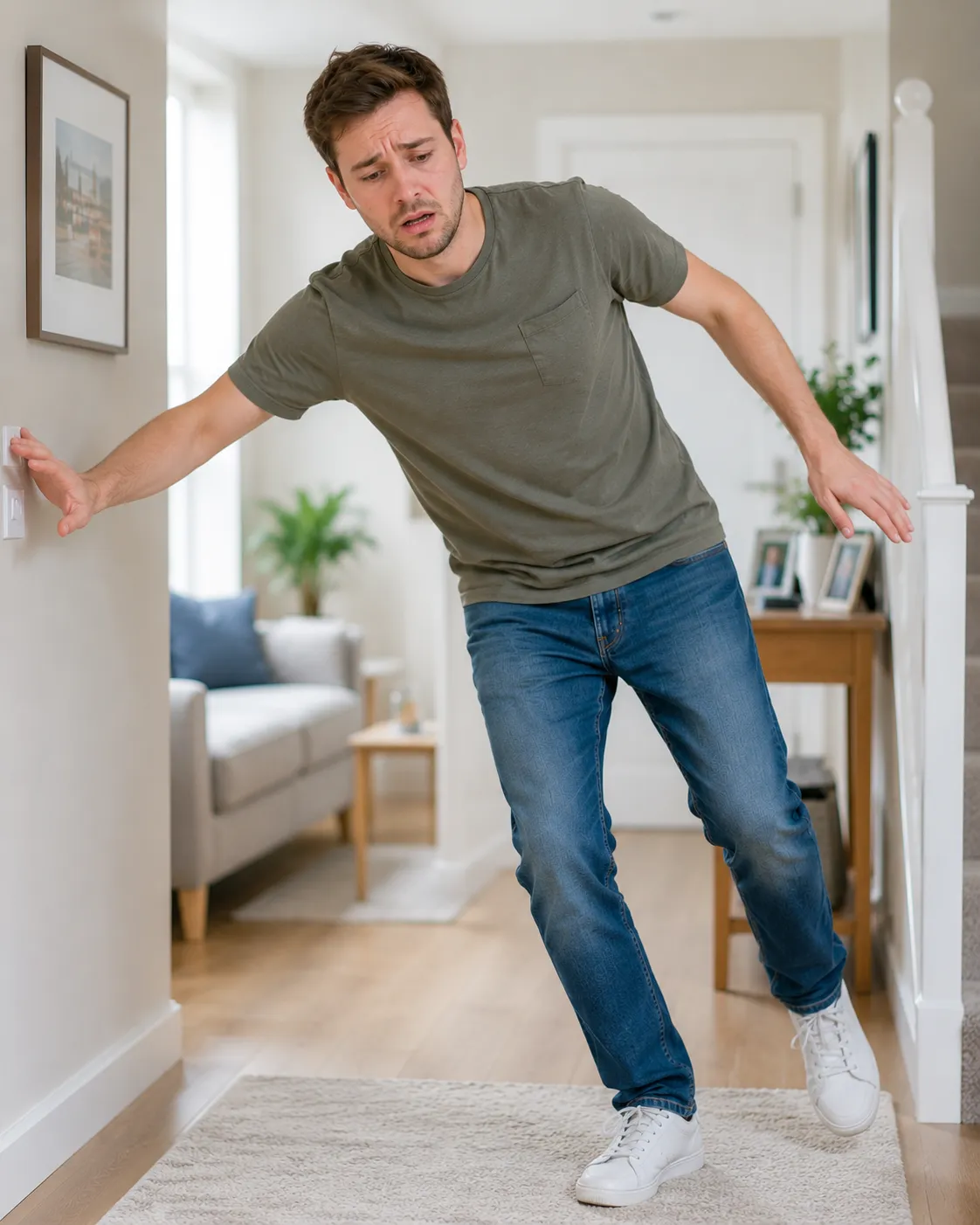
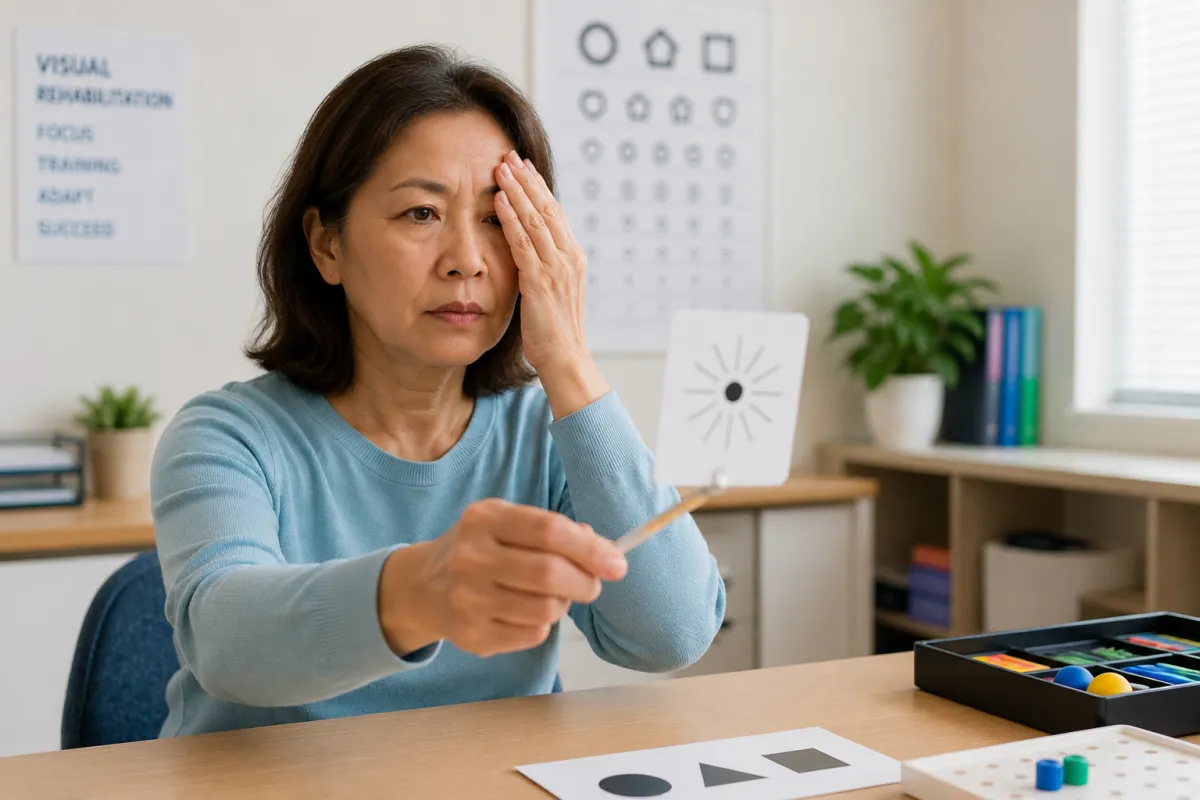
Visual rehabilitation after a stroke aims to help you make the best possible use of your remaining vision, improve visual skills where possible and develop practical strategies for everyday life. Rehabilitation may address visual field loss, eye movement problems, double vision, visual neglect or difficulty processing what you see. Learn what visual rehabilitation may involve, which professionals can help and why progress may continue long after leaving hospital.
After your stroke...
The world looks different.
Perhaps part of your vision is missing.
Maybe your eyes no longer work together properly.
You lose your place when reading.
Bump into doorframes.
Misjudge steps.
Or feel overwhelmed in busy environments.
You begin wondering...
"Can anything be done about my vision?"
Or...
"Do I simply have to learn to live with this?"
The good news is...
Visual rehabilitation may help you improve particular visual skills, compensate for changes and become safer and more independent.
✦ ✦ ✦
The Good News
Vision involves much more than seeing clearly.
Your brain and eyes work together to:
✓ Move the eyes accurately.
✓ Scan the environment.
✓ Notice objects on both sides.
✓ Judge distance and depth.
✓ Recognise people and objects.
✓ Maintain balance while moving.
✓ Read and process visual information.
A stroke can affect any part of this system.
Visual rehabilitation does not rely on one single treatment.
It usually combines assessment, targeted exercises, practical strategies and environmental changes based on your individual difficulties.
✦ ✦ ✦
What Is Visual Rehabilitation?
Visual rehabilitation is a personalised programme designed to reduce the impact of visual problems on everyday life.
It may focus on:
✓ Restoring a visual skill where recovery is possible.
✓ Training the brain to use vision more effectively.
✓ Compensating for permanently altered vision.
✓ Improving safety and independence.
✓ Adapting tasks and environments.
Rehabilitation should be based on the specific type of visual problem rather than a general set of eye exercises.
✦ ✦ ✦
Why Is a Specialist Assessment Important?
Two people may describe similar symptoms but have completely different problems.
For example...
Bumping into objects on one side may be caused by:
✓ Visual field loss.
✓ Visual neglect.
✓ Eye movement difficulties.
✓ Reduced attention.
✓ Poor spatial awareness.
Each problem may require a different approach.
A specialist assessment helps identify what is actually happening before treatment begins.
✦ ✦ ✦
Who May Be Involved in Visual Rehabilitation?
Depending on your symptoms, support may come from:
✓ Orthoptists.
✓ Ophthalmologists.
✓ Neuro-ophthalmologists.
✓ Optometrists with specialist experience.
✓ Occupational therapists.
✓ Physiotherapists.
✓ Neuropsychologists.
✓ Speech and language therapists.
Different professionals address different parts of visual recovery.
You may need support from more than one specialist.
✦ ✦ ✦
Rehabilitation for Visual Field Loss
Visual field loss means part of your normal field of vision is missing.
One common type is hemianopia, where half of the visual field is affected.
Rehabilitation may include:
✓ Systematic scanning practice.
✓ Turning the head towards the affected side.
✓ Searching for objects in structured layouts.
✓ Using visual anchors when reading.
✓ Practising navigation in safe environments.
The goal is often to teach you to scan more consistently into the missing area.
This does not necessarily restore the lost visual field.
But it may help you compensate more effectively.
✦ ✦ ✦
Visual Scanning Training
Visual scanning involves deliberately moving your eyes and head across the entire environment.
You may practise:
✓ Looking from left to right.
✓ Finding targets on a page.
✓ Locating objects around a room.
✓ Checking both sides before walking.
✓ Scanning shelves in a shop.
✓ Turning towards the affected side before crossing a road.
At first, scanning may feel slow and unnatural.
With repetition, it may become more automatic.
✦ ✦ ✦
Rehabilitation for Visual Neglect
Visual neglect is different from visual field loss.
The eyes may be capable of seeing both sides, but the brain does not attend properly to one side of space.
Rehabilitation may involve:
✓ Visual scanning activities.
✓ Placing important objects on the affected side during therapy.
✓ Using brightly coloured visual anchors.
✓ Encouraging head and body turning.
✓ Increasing awareness of the neglected side.
✓ Practising dressing, eating and grooming tasks.
Because some people are unaware of their neglect, family support and professional guidance can be particularly important.
✦ ✦ ✦
Eye Movement Rehabilitation
Stroke may affect the ability to move the eyes smoothly or accurately.
You may struggle to:
✓ Follow moving objects.
✓ Shift your gaze between targets.
✓ Keep your place while reading.
✓ Look in a particular direction.
✓ Coordinate both eyes.
An orthoptist or other specialist may assess eye alignment and movement before recommending appropriate exercises or treatment.
✦ ✦ ✦
Double Vision After Stroke
Double vision can occur when the eyes no longer align or move together properly.
Treatment depends on the cause and may include:
✓ Monitoring during natural recovery.
✓ Prisms fitted to glasses.
✓ Temporary covering or blurring of one lens.
✓ Specific exercises when clinically appropriate.
✓ Treatment of the underlying eye movement problem.
Covering one eye without professional advice may reduce double vision temporarily but can also affect depth perception and awareness.
It is best to seek specialist guidance.
✦ ✦ ✦
Rehabilitation for Reading Problems
Reading may become difficult because of:
✓ Visual field loss.
✓ Eye movement problems.
✓ Visual neglect.
✓ Aphasia.
✓ Attention difficulties.
✓ Visual processing problems.
Rehabilitation may include:
✓ Using a ruler or reading guide.
✓ Marking the beginning or end of each line.
✓ Enlarging text.
✓ Increasing spacing between lines.
✓ Practising short passages.
✓ Using text-to-speech or audiobooks.
The right strategy depends on why reading has become difficult.
✦ ✦ ✦
Visual Processing Rehabilitation
Some survivors can see clearly but struggle to understand or organise visual information.
You may have difficulty:
✓ Recognising objects.
✓ Finding items against a busy background.
✓ Understanding pictures.
✓ Recognising faces.
✓ Navigating unfamiliar environments.
Rehabilitation may focus on:
✓ Matching objects and pictures.
✓ Identifying objects using several senses.
✓ Reducing visual clutter.
✓ Improving attention.
✓ Using labels and consistent organisation.
✓ Learning alternative recognition strategies.
✦ ✦ ✦
Improving Depth Perception and Spatial Awareness
Stroke may affect your ability to judge distance, position and movement.
You may misjudge:
✓ Steps.
✓ Kerbs.
✓ Doorways.
✓ The position of a chair.
✓ The distance of a cup.
Therapy may involve supervised practice with:
✓ Reaching for objects.
✓ Stepping over obstacles.
✓ Walking on different surfaces.
✓ Using stairs.
✓ Navigating familiar environments.
Because these problems can increase fall risk, practise should be guided by an appropriate professional where safety is uncertain.
✦ ✦ ✦
Vision and Balance Rehabilitation
Vision contributes significantly to balance.
Visual problems may cause you to feel:
✓ Unsteady when walking.
✓ Unsafe in low light.
✓ Dizzy in busy environments.
✓ Dependent on walls or furniture.
✓ Nervous on stairs.
Physiotherapy and occupational therapy may help you combine visual strategies with balance and mobility training.
This can be particularly important when visual problems occur alongside weakness or reduced sensation.
✦ ✦ ✦
Can Eye Exercises Restore Vision?
This depends on the problem.
Exercises may help improve:
✓ Scanning.
✓ Attention.
✓ Eye movement control.
✓ Coordination.
✓ Reading efficiency.
However, exercises cannot correct every type of post-stroke visual loss.
Some online programmes make strong promises about restoring lost vision.
Evidence and suitability vary.
Exercises should ideally be recommended after a specialist assessment so that they target your actual difficulty.
✦ ✦ ✦
What Are Compensatory Strategies?
Compensatory strategies do not necessarily repair the damaged visual pathway.
Instead, they help you work around the problem.
Examples include:
✓ Turning your head further towards the affected side.
✓ Keeping important items in consistent locations.
✓ Using contrast to make objects easier to find.
✓ Reducing clutter.
✓ Increasing font size.
✓ Using handrails on stairs.
✓ Allowing more time for visual tasks.
Compensation is not failure.
It is a practical part of rehabilitation and can greatly improve independence.
✦ ✦ ✦
Making the Home Safer
Your occupational therapist may suggest changes such as:
✓ Improving lighting.
✓ Removing trip hazards.
✓ Keeping furniture in fixed positions.
✓ Marking the edges of steps.
✓ Using contrasting plates and cups.
✓ Labelling cupboards and drawers.
✓ Keeping walkways clear.
✓ Organising frequently used items consistently.
Small environmental changes can reduce frustration and prevent accidents.
✦ ✦ ✦
Using Technology
Technology may make visual tasks easier.
Helpful features may include:
✓ Screen magnification.
✓ Text-to-speech.
✓ Voice controls.
✓ High-contrast settings.
✓ Larger text.
✓ Audiobooks.
✓ Navigation assistance.
✓ Reminders and labelled photographs.
Accessibility settings on phones, tablets and computers can support independence while rehabilitation continues.
✦ ✦ ✦
How Often Should You Practise?
Rehabilitation is often most effective when practice is:
✓ Regular.
✓ Focused.
✓ Short enough to avoid excessive fatigue.
✓ Relevant to everyday activities.
A few brief sessions may be more manageable than one long session.
Quality and consistency are usually more important than pushing through exhaustion.
✦ ✦ ✦
Managing Visual Fatigue
Visual rehabilitation can be tiring.
You may notice:
✓ Headaches.
✓ Eye strain.
✓ Reduced concentration.
✓ Increased blurring.
✓ More mistakes.
✓ Worsening symptoms later in the day.
Helpful strategies may include:
✓ Taking regular breaks.
✓ Practising when most alert.
✓ Reducing glare.
✓ Working in a quiet environment.
✓ Stopping before becoming exhausted.
Recovery does not require forcing your brain beyond its limits.
✦ ✦ ✦
Can Visual Rehabilitation Help Years Later?
It may.
The fastest neurological recovery often occurs earlier after stroke, but learning and adaptation can continue much longer.
Even years later, some people improve their ability to:
✓ Scan more consistently.
✓ Navigate safely.
✓ Read more efficiently.
✓ Manage visual overload.
✓ Use compensatory strategies.
Progress may involve better function rather than complete restoration of normal vision.
✦ ✦ ✦
Driving and Visual Rehabilitation
Visual rehabilitation does not automatically mean you are safe or legally permitted to drive.
Driving requires:
✓ Adequate visual fields.
✓ Reliable eye movements.
✓ Good visual attention.
✓ Fast processing.
✓ Safe judgement.
You should not return to driving until you have received appropriate medical advice and completed any required visual or driving assessment.
✦ ✦ ✦
What Can Family Members Do?
Family and friends can help by:
✓ Keeping the environment organised.
✓ Avoiding moving important items without explanation.
✓ Reminding you to scan when necessary.
✓ Giving extra time.
✓ Reducing clutter.
✓ Supporting practice recommended by professionals.
✓ Avoiding rushing or criticising mistakes.
Support should encourage independence rather than taking over every task.
✦ ✦ ✦
When Should You Seek Medical Advice?
Arrange an assessment if:
✓ Visual symptoms are interfering with daily activities.
✓ You frequently bump into objects.
✓ Reading has become difficult.
✓ You experience double vision.
✓ You struggle with steps or judging distance.
✓ Busy environments feel confusing or unsafe.
Seek urgent medical attention if you develop sudden new vision loss, sudden double vision or other new stroke symptoms.
✦ ✦ ✦
My Perspective
After a stroke...
Vision problems can quietly affect almost every part of life.
Reading.
Walking.
Cooking.
Shopping.
Recognising people.
Moving through the world safely.
It can be frustrating when others assume that being able to see clearly means your vision is normal.
But visual recovery involves the brain as much as the eyes.
Rehabilitation may not provide an instant cure.
It may involve repetition.
Adaptation.
Patience.
And learning new ways to do familiar things.
But every improvement that increases safety, confidence or independence matters.
✦ ✦ ✦
Frequently Asked Questions
What is visual rehabilitation after stroke?
It is a personalised approach that uses assessment, training, practical strategies and environmental adaptations to reduce the impact of visual problems.
✦ ✦ ✦
Can visual rehabilitation restore lost vision?
Sometimes visual abilities improve, but rehabilitation often focuses on compensation and making better use of remaining vision.
✦ ✦ ✦
Who provides visual rehabilitation?
Support may involve orthoptists, ophthalmologists, occupational therapists, physiotherapists, neuropsychologists and other specialists.
✦ ✦ ✦
Can I practise visual exercises by myself?
Some activities can be practised independently after assessment and instruction.
Exercises should match your specific visual problem.
✦ ✦ ✦
How long does visual rehabilitation take?
There is no fixed timeline.
Progress depends on the type and severity of the visual problem, rehabilitation and individual recovery.
✦ ✦ ✦
Key Takeaways
✓ Visual rehabilitation should be tailored to the specific problem.
✓ Rehabilitation may address visual fields, eye movements, neglect, reading, balance or visual processing.
✓ Specialist assessment is important because similar symptoms can have different causes.
✓ Scanning training and compensatory strategies may improve safety and independence.
✓ Technology and environmental adaptations can make everyday tasks easier.
✓ Progress and adaptation may continue months or years after stroke.
✦ ✦ ✦
Related Articles
Continue learning about visual recovery after stroke with these helpful guides:
Can Vision Return After a Stroke? – Learn how visual recovery and adaptation may occur.
Visual Processing Problems After Stroke – Understand why the brain may struggle to interpret visual information.
Can Vision Problems Worsen After a Stroke? – Learn why visual symptoms may fluctuate and when to seek help.
Reading Problems After Stroke – Discover why reading may become difficult and what can help.
Difficulty Recognising Faces After Stroke – Understand why familiar faces may become difficult to identify.
✦ ✦ ✦
About the Author
Alisia Gayle is a stroke survivor who achieved 96% neurological recovery following an ischaemic stroke.
After years of rehabilitation, she now shares practical, evidence-informed resources to help stroke survivors, carers and families better understand recovery and rebuild their lives with confidence.
Alisia is also the author of Brain Damage: My Journey to 96% Recovery, where she shares her personal stroke recovery story and the lessons she learned throughout her rehabilitation.
✦ ✦ ✦
Medical Disclaimer
This article is intended for educational purposes only and should not replace professional medical advice, diagnosis or treatment.
Always seek advice from your doctor, orthoptist, ophthalmologist, optometrist or other qualified healthcare professional regarding visual rehabilitation following a stroke.
✦ ✦ ✦
Final Thoughts
After a stroke...
Your vision may no longer guide you through the world as effortlessly as it once did.
Things may feel slower.
Less certain.
More tiring.
But rehabilitation can help you understand what has changed.
It can teach you how to use your vision more effectively.
How to adapt your environment.
And how to move through daily life more safely.
Recovery may not happen all at once.
But every time you find an object more easily...
Read another line...
Notice something on your affected side...
Or take a step with greater confidence...
You are building a more independent life.