Weight management after a stroke is not simply about appearance or reaching a particular number on the scales. Maintaining a healthy weight can support cardiovascular health and may help reduce important stroke risk factors such as high blood pressure, type 2 diabetes and abnormal cholesterol levels. But stroke can also make weight management harder because fatigue, reduced mobility, swallowing problems, appetite changes and medication can all affect eating and activity. The goal should be sustainable health — not crash dieting, extreme restriction or trying to lose weight as quickly as possible.
After your stroke...
Your body may change.
Perhaps you gained weight while you were less mobile.
Maybe rehabilitation reduced the amount of exercise you could do.
Perhaps fatigue made cooking difficult.
You started relying more on convenient foods.
Or perhaps the opposite happened.
You lost your appetite.
Eating became difficult.
Swallowing changed.
Food stopped tasting the same.
And you began losing weight without trying.
You start wondering...
"Do I need to lose weight after a stroke?"
"Is my weight increasing my risk of another stroke?"
"How can I exercise when I am still recovering?"
"Should I start dieting?"
"What if I am actually losing too much weight?"
These are important questions.
Because weight management after stroke is not always about weight loss.
For some survivors, the priority is losing excess weight gradually.
For others, the priority may be maintaining weight.
And for some...
The real problem is preventing unwanted weight loss and malnutrition.
✦ ✦ ✦
The Good News
You do not need a perfect body weight to improve your health.
And you do not need to transform everything overnight.
Being overweight or living with obesity is associated with an increased risk of conditions including high blood pressure, type 2 diabetes, cardiovascular disease and stroke.
But weight is only one part of the picture.
Your overall stroke risk is also influenced by factors such as:
✓ Blood pressure
✓ Cholesterol
✓ Diabetes
✓ Smoking
✓ Physical activity
✓ Diet
✓ Atrial fibrillation
✓ Medication adherence
The NHS identifies high blood pressure, diabetes, high cholesterol and atrial fibrillation among important stroke risk factors.
So the goal should not simply be:
"I need to become thinner."
A better goal is:
"I want to improve the things that protect my heart and brain."
✦ ✦ ✦
Why Can Weight Matter After Stroke?
Excess weight can interact with several other cardiovascular risk factors.
For example, being overweight can increase the likelihood of developing high blood pressure. High blood pressure itself is a major cause of stroke.
Living with overweight or obesity is also associated with:
✓ Type 2 diabetes
✓ Heart disease
✓ High blood pressure
✓ Stroke
The NHS specifically lists these among the health risks associated with overweight and obesity.
This means weight management can sometimes influence stroke risk indirectly.
Losing excess weight may help improve the wider cardiovascular picture...
But it should be approached sensibly.
✦ ✦ ✦
Why Is Weight Management Harder After a Stroke?
Someone might simply tell you:
"Eat less and exercise more."
That advice is far too simplistic for many stroke survivors.
After stroke, you may be dealing with:
✓ Reduced mobility
✓ Muscle weakness
✓ Balance problems
✓ Post-stroke fatigue
✓ Pain
✓ Depression or low mood
✓ Problems shopping
✓ Difficulty cooking
✓ Swallowing problems
✓ Changes in appetite
✓ Reduced independence
✓ Medication changes
Your previous weight-management routine may no longer be realistic.
Perhaps you used to walk several miles every day.
Now walking around the house is rehabilitation.
Perhaps you previously cooked fresh meals every evening.
Now standing in the kitchen for thirty minutes exhausts you.
Your strategy therefore needs to reflect your current abilities, not your pre-stroke lifestyle.
✦ ✦ ✦
Reduced Mobility Can Lead to Weight Gain
A stroke can drastically reduce how much you move.
Before your stroke you may have:
Walked to work.
Driven yourself to activities.
Climbed stairs repeatedly.
Gone to the gym.
Cleaned the house.
Gone shopping.
Moved around your workplace.
All of these activities use energy.
After stroke, your daily movement may fall dramatically.
Even if your eating habits remain exactly the same...
Your body's energy requirements may be different.
Over time, weight can gradually increase.
This is not necessarily because you suddenly developed poor discipline.
Your circumstances changed.
The solution is to adapt your food intake and activity as recovery progresses.
✦ ✦ ✦
Post-Stroke Fatigue Can Affect Eating
Fatigue creates another problem.
When you are exhausted, preparing a balanced meal can feel like an enormous task.
You may reach for whatever requires the least effort.
Biscuits.
Takeaways.
Ready meals.
Toast.
Snacks.
Delivery food.
That does not make you lazy.
It means convenience becomes more attractive when energy is limited.
Planning can help.
Consider keeping easy options available such as:
✓ Pre-cut vegetables
✓ Frozen vegetables
✓ Tinned beans or lentils
✓ Fruit
✓ Wholegrain bread
✓ Eggs
✓ Yoghurt
✓ Simple soups
✓ Ready-cooked healthy protein options
The Stroke Association recommends balanced meals including fruit, vegetables and wholegrains and advises keeping salt, sugar and unhealthy fats lower where possible.
Healthy eating does not have to mean complicated cooking.
✦ ✦ ✦
You May Also Lose Weight After Stroke
This side of weight management is often overlooked.
Not everybody gains weight.
Some stroke survivors lose too much.
Stroke Association guidance notes that reduced appetite, fatigue and swallowing difficulties can cause people to eat less and lose weight after stroke.
You may experience:
✓ Reduced appetite
✓ Changes in taste
✓ Difficulty chewing
✓ Difficulty swallowing
✓ Fatigue during meals
✓ Difficulty preparing food
✓ Low mood
✓ Nausea
✓ Reduced interest in eating
If you are losing weight unintentionally...
Do not celebrate automatically because you think thinner must always mean healthier.
Unintentional weight loss can indicate that you are not getting enough:
Protein.
Energy.
Vitamins.
Minerals.
That can work against rehabilitation.
Your recovering body needs nutrition.
✦ ✦ ✦
Do Not Crash Diet After a Stroke
A stroke can leave you desperate to control every risk factor immediately.
You may think:
"I need to lose three stone as quickly as possible."
So you dramatically restrict food.
Skip meals.
Fast for long periods.
Eliminate entire food groups.
Exercise excessively.
That is not automatically safer.
Your body may already be recovering from a major neurological injury.
You need sufficient nutrition to support:
✓ Muscle maintenance
✓ Rehabilitation
✓ Energy
✓ General health
✓ Physical activity
Weight loss, where appropriate, should generally be gradual and sustainable rather than extreme.
NICE's current guidance on overweight and obesity management emphasises individualised approaches involving diet, physical activity and behavioural support rather than treating weight management as a simplistic short-term diet.
✦ ✦ ✦
Focus on the Quality of Your Diet
Weight loss is not the only goal.
The quality of the food you eat matters too.
A diet that supports cardiovascular health generally emphasises:
✓ Fruit
✓ Vegetables
✓ Wholegrains
✓ Fibre
✓ Healthy protein sources
✓ Healthier fats
And limits excess:
✓ Salt
✓ Sugar
✓ Saturated fat
✓ Highly processed foods
Stroke Association advice includes aiming for at least five portions of fruit and vegetables per day, getting enough fibre and reducing salt and sugar.
NHS guidance on reducing TIA and stroke risk similarly recommends a balanced, high-fibre eating pattern with fruit, vegetables and wholegrains.
This approach can support more than your weight.
It may also help your:
Blood pressure.
Cholesterol.
Blood sugar.
Overall cardiovascular health.
✦ ✦ ✦
Why Salt Matters
Salt deserves particular attention after stroke because eating too much salt can contribute to high blood pressure.
And high blood pressure is one of the most important stroke risk factors.
A lot of salt may come from foods where you do not consciously add it.
For example:
✓ Processed meats
✓ Ready meals
✓ Takeaways
✓ Sauces
✓ Crisps
✓ Some soups
✓ Processed snacks
This does not mean you can never eat these foods.
But regularly checking food labels and reducing heavily salted foods may be worthwhile.
Weight management and stroke prevention overlap.
The same dietary changes can often support both.
✦ ✦ ✦
Protein Matters During Recovery
If you are losing weight or trying to reduce body fat, do not forget about muscle.
Stroke can already lead to reduced muscle use, particularly on the affected side.
If you then drastically reduce food intake, maintaining muscle may become harder.
Include appropriate protein sources in your diet.
Examples may include:
✓ Fish
✓ Eggs
✓ Chicken
✓ Beans
✓ Lentils
✓ Yoghurt
✓ Tofu
✓ Other suitable protein-rich foods
Your individual needs depend on your health, kidney function, appetite and other medical factors.
If you have significant weight loss, swallowing difficulties or complex medical needs, ask your healthcare team whether a dietitian should assess you.
✦ ✦ ✦
What About Exercise?
Physical activity can support:
✓ Cardiovascular health
✓ Mobility
✓ Strength
✓ Mood
✓ Blood pressure control
✓ Weight management
But exercise after stroke must match your ability.
You may not be ready for:
Running.
Long walks.
Gym sessions.
Intense cardio.
That is fine.
Your exercise might currently involve:
✓ Physiotherapy exercises
✓ Sit-to-stand practice
✓ Short walks
✓ Supported standing
✓ Stationary cycling
✓ Strength exercises
✓ Pool-based rehabilitation
✓ Chair-based activity
Your starting point is your starting point.
Do not compare your rehabilitation exercise with someone else's fitness routine.
The objective is progression.
✦ ✦ ✦
You Do Not Need to Burn Huge Numbers of Calories
People often overestimate the importance of exercise alone for weight loss.
You may think:
"If I cannot exercise hard, I cannot lose weight."
That is not true.
Weight management depends on the overall balance between energy intake and energy use.
Physical activity is extremely valuable for health...
But you do not need to punish yourself with exhausting workouts.
For stroke survivors especially, excessive activity may simply worsen fatigue and interfere with rehabilitation.
Think consistency.
Not punishment.
Ten manageable minutes completed regularly may be more useful than one enormous workout that leaves you unable to function for two days.
✦ ✦ ✦
Build Movement Into Everyday Life
Exercise does not have to happen only in a gym.
As recovery improves, everyday movement may gradually increase.
For example:
✓ Walking around the house
✓ Standing while preparing food
✓ Walking to a nearby shop
✓ Gardening
✓ Doing household tasks
✓ Taking stairs where safe
✓ Walking short distances outdoors
✓ Completing rehabilitation exercises
This movement adds up.
More importantly, it helps rebuild independence.
The aim should not simply be:
"How many calories did I burn?"
Ask:
"Am I becoming stronger and more active?"
That is a much more useful recovery question.
✦ ✦ ✦
What About BMI?
Body mass index, or BMI, is commonly used to estimate whether someone's weight may increase their health risk.
But BMI has limitations.
The NHS explains that BMI cannot distinguish between muscle and fat, meaning someone with substantial muscle mass may have a higher BMI without having a high level of body fat.
Waist measurement can provide additional information.
NICE also considers central adiposity — fat carried around the abdomen — when assessing weight-related health risks.
So do not become obsessed with one number.
Weight.
Waist measurement.
Blood pressure.
Cholesterol.
Blood glucose.
Fitness.
Mobility.
Diet.
All contribute information about your health.
✦ ✦ ✦
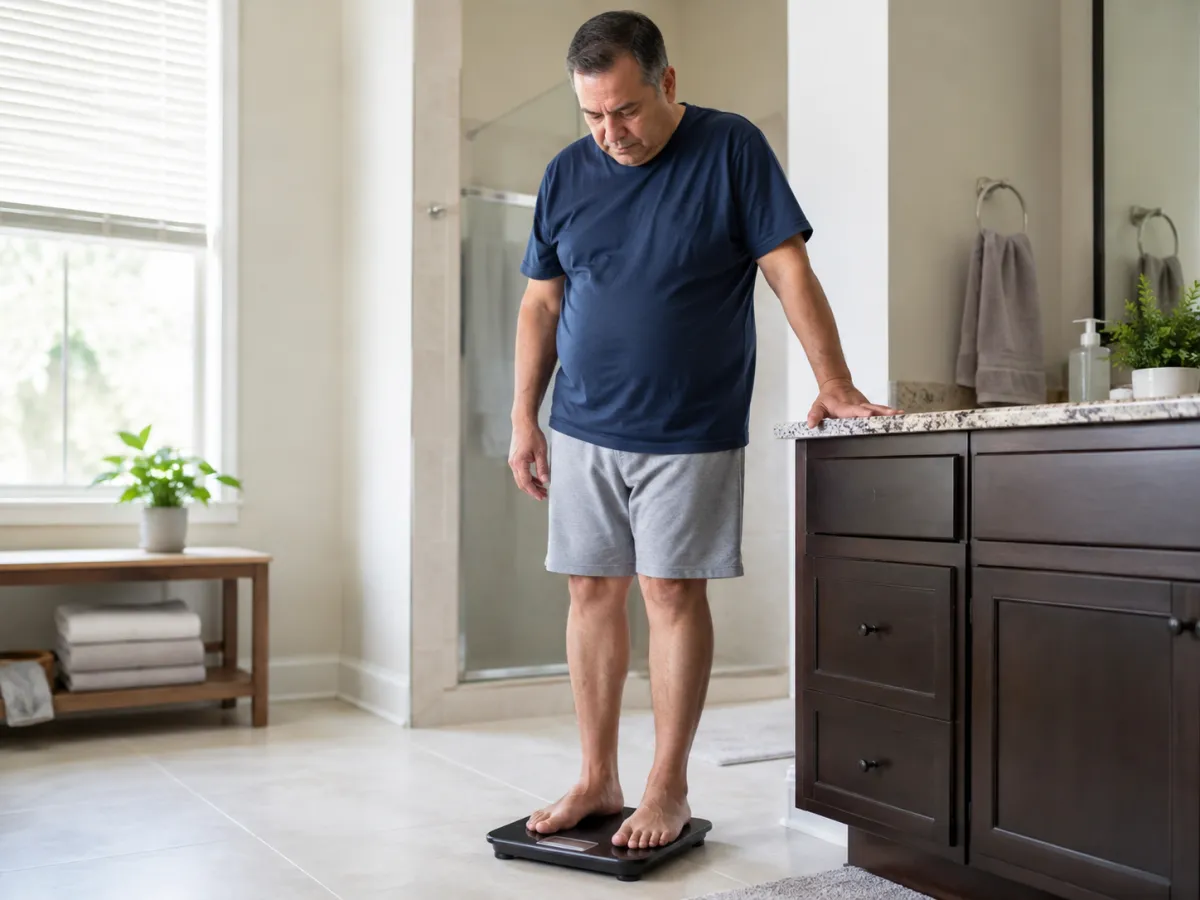
Do Not Weigh Yourself Constantly
Weight naturally fluctuates.
Your weight may change because of:
Fluid.
Food.
Bowel movements.
Time of day.
Hormonal changes.
Different clothing.
If you weigh yourself repeatedly throughout the day, normal fluctuations may create unnecessary anxiety.
If monitoring weight is useful for you, consistency is more helpful.
Use the same scales.
Under similar conditions.
And focus on the overall trend rather than one reading.
A single number does not tell you whether your health is improving.
✦ ✦ ✦
Emotional Eating After Stroke
Stroke can change your entire life.
You may experience:
Fear.
Boredom.
Frustration.
Loneliness.
Loss of independence.
Anxiety.
Food can become comforting.
You may find yourself eating when you are not physically hungry simply because eating provides temporary relief or something enjoyable.
This does not make you weak.
But if emotional eating is regularly working against your health goals, identify the pattern.
Ask:
"Am I physically hungry?"
Or:
"Am I trying to change how I feel?"
Sometimes another response may help.
Talking to someone.
Going outside.
Listening to music.
Doing something enjoyable.
Resting.
Addressing the emotion does not mean food can never be pleasurable.
Food should be pleasurable.
The issue is whether it has become your main strategy for coping with distress.
✦ ✦ ✦
Portion Sizes May Need to Change
If your activity level is much lower than before your stroke, your previous portion sizes may no longer match your current needs.
You do not necessarily need to count every calorie.
Simple adjustments may help.
For example:
✓ Use slightly smaller portions
✓ Fill more of the plate with vegetables
✓ Choose wholegrain carbohydrates
✓ Include protein with meals
✓ Reduce frequent high-calorie snacks
✓ Watch liquid calories
✓ Eat slowly
✓ Stop when comfortably satisfied
Small changes maintained for months are often more useful than an extreme diet maintained for ten days.
✦ ✦ ✦
Be Careful With Liquid Calories
Drinks can contribute significant energy without making you feel particularly full.
Examples may include:
✓ Sugary fizzy drinks
✓ Sweetened coffee drinks
✓ Large quantities of fruit juice
✓ Milkshakes
✓ Alcohol
Water is usually the simplest everyday drink.
If plain water is difficult for you, other low-sugar alternatives may help depending on your health needs.
If you have swallowing difficulties and require thickened fluids, follow the advice of your speech and language therapist rather than changing fluid consistency yourself.
✦ ✦ ✦
Weight-Loss Medication After Stroke
Weight-management medicines are increasingly available for certain eligible adults.
NICE guidance includes medication as one possible part of obesity management for people who meet specific clinical criteria.
These medicines are not appropriate for everybody.
And they should not be obtained casually or used without proper medical supervision.
Your clinician may need to consider:
✓ Your BMI
✓ Other medical conditions
✓ Current medication
✓ Cardiovascular history
✓ Potential side effects
✓ Nutritional intake
✓ Whether medication is clinically appropriate
Having had a stroke does not mean you should automatically use weight-loss medication.
Nor does it mean such treatment is automatically unsuitable.
It requires individual medical assessment.
✦ ✦ ✦
What If You Are in a Wheelchair?
Being unable to walk does not make weight management impossible.
But your energy requirements and exercise options may differ.
You may benefit from:
✓ Upper-body exercise
✓ Resistance training
✓ Physiotherapy
✓ Chair-based exercise
✓ Dietary adjustments
✓ Specialist weight-management advice
NHS-linked stroke guidance specifically recognises that people using wheelchairs may need tailored support with managing their weight.
Do not use standard exercise advice as evidence that you cannot succeed.
Your strategy simply needs to match your body and circumstances.
✦ ✦ ✦
Avoid the "Perfect Diet" Trap
You do not need to eat perfectly.
Trying to follow an impossibly strict diet often produces this cycle:
Restriction.
Hunger.
Frustration.
Overeating.
Guilt.
Restriction again.
That is not sustainable.
Instead, build a diet you could realistically maintain for years.
Mostly nutritious foods.
Reasonable portions.
Foods you enjoy.
Occasional treats.
Flexibility.
Consistency.
You are not dieting for a holiday photograph.
You are protecting your cardiovascular health.
Those are very different goals.
✦ ✦ ✦
Track More Than Your Weight
The scales are not the only measure of progress.
You might also notice:
✓ Walking becomes easier
✓ Your waist measurement reduces
✓ Your blood pressure improves
✓ Your blood sugar improves
✓ You become stronger
✓ Your stamina increases
✓ Clothes fit differently
✓ You can perform more daily activities
✓ You require fewer rest periods
These improvements matter.
Sometimes your body is changing even when the number on the scales moves slowly.
✦ ✦ ✦
What If Your Weight Will Not Move?
Do not immediately respond by starving yourself.
First look objectively at what is happening.
Consider:
✓ Portion sizes
✓ Snacking
✓ Drinks
✓ Weekend eating
✓ Activity levels
✓ Medication
✓ Sleep
✓ Whether you are actually maintaining rather than gaining
If you have made sustained changes and remain concerned about your weight, speak with your GP or another qualified healthcare professional.
NICE recommends personalised assessment and treatment rather than a one-size-fits-all approach to overweight and obesity.
Sometimes professional support is more useful than another restrictive diet.
✦ ✦ ✦
The Emotional Impact of Weight Gain After Stroke
Body changes can be difficult.
Perhaps you already feel that stroke changed your:
Walk.
Face.
Arm.
Posture.
Energy.
Independence.
Then your weight changes too.
You may look in the mirror and feel as though you no longer recognise yourself.
Try not to turn this frustration into self-punishment.
Your body has survived a major medical event.
That does not mean you must ignore health risks.
It means you should address them intelligently rather than attacking yourself.
Your body needs rehabilitation.
Nutrition.
Movement.
Sleep.
Time.
Not punishment.
✦ ✦ ✦
My Perspective
Weight after stroke can become another number people obsess over.
The scales say one thing...
And suddenly you feel as though your entire recovery is being judged by it.
But your body weight does not tell the whole story.
You may weigh more but be walking further.
Stronger.
More independent.
Eating better.
Controlling your blood pressure.
You may weigh less but actually be losing muscle because you are struggling to eat.
Context matters.
For some stroke survivors, losing excess weight will be an important part of reducing cardiovascular risk.
For others, maintaining weight and getting enough nutrition is the bigger priority.
There is no intelligent one-size-fits-all answer.
The aim is not to become as thin as possible.
It is to create a body that is:
Well nourished.
As active as your recovery allows.
Strong enough for rehabilitation.
And supported by habits that reduce future cardiovascular risk.
That is what weight management after stroke should really mean.
✦ ✦ ✦
When Should You Seek Medical Advice?
Speak with your GP, rehabilitation team or another appropriate healthcare professional if:
✓ You are losing weight unintentionally
✓ You are gaining weight rapidly without explanation
✓ You have difficulty swallowing
✓ You struggle to eat enough
✓ Fatigue prevents you preparing meals
✓ Your mobility severely limits activity
✓ You have diabetes
✓ You have kidney or heart disease
✓ You are considering weight-loss medication
✓ You are planning a major restrictive diet
✓ You are concerned about your nutritional intake
A dietitian may be particularly helpful where stroke has affected swallowing, appetite, body weight or nutritional intake.
Do not attempt aggressive weight loss while ignoring medical or nutritional problems that require proper assessment.
✦ ✦ ✦
Frequently Asked Questions
Should I Lose Weight After a Stroke?
Not necessarily.
If you are living with overweight or obesity, gradual weight loss may improve aspects of cardiovascular health.
But if you are already a healthy weight or losing weight unintentionally, further weight loss may be inappropriate.
Discuss your individual situation with a healthcare professional.
Does Being Overweight Increase Stroke Risk?
Yes.
Living with overweight or obesity is associated with increased risk of conditions including high blood pressure, type 2 diabetes and stroke.
Can I Lose Weight if I Cannot Exercise Much?
Potentially, yes.
Weight management involves both dietary intake and activity.
Your activity programme can also be adapted to your mobility and recovery level.
Should I Follow a Very Low-Calorie Diet?
Do not begin an extreme or highly restrictive diet after stroke without appropriate professional advice.
Your nutritional and rehabilitation needs need to be considered.
Why Am I Gaining Weight After Stroke?
Reduced activity, fatigue, changes in eating habits and loss of your previous routine may all contribute.
Why Am I Losing Weight After Stroke?
Reduced appetite, fatigue and swallowing difficulties can all reduce food intake after stroke.
Unintentional weight loss should be discussed with your healthcare team.
Is BMI the Best Measure of Health?
BMI is useful but imperfect.
The NHS notes that it cannot distinguish between muscle and fat, so waist measurement and other health indicators can provide additional information.
✦ ✦ ✦
Key Takeaways
✓ Weight management after stroke is about health, not simply appearance.
✓ Living with overweight or obesity can increase cardiovascular and stroke risk.
✓ Excess weight is often linked with high blood pressure and type 2 diabetes.
✓ Reduced mobility after stroke can make weight gain easier.
✓ Fatigue can make healthy food preparation more difficult.
✓ Some stroke survivors lose too much weight rather than gaining it.
✓ Unintentional weight loss should not be ignored.
✓ Avoid crash diets and extreme restriction.
✓ Prioritise fruit, vegetables, wholegrains, fibre and appropriate protein.
✓ Reduce excess salt, sugar and heavily processed foods.
✓ Exercise should match your current rehabilitation abilities.
✓ BMI is only one measure of health.
✓ Weight-loss medication requires proper medical assessment.
✓ Small sustainable changes are generally more useful than extreme short-term diets.
✓ Your aim is better cardiovascular health and a sustainable recovery.
✦ ✦ ✦
Related Articles
Continue learning about health and stroke prevention:
Diabetes and Stroke Risk
Atrial Fibrillation and Stroke
High Blood Pressure and Stroke Risk
High Cholesterol and Stroke Risk
Diet After Stroke
Exercise After Stroke
Preventing a Second Stroke
Post-Stroke Fatigue
Healthy Eating After Stroke
Stroke Risk Factors You Can Change
✦ ✦ ✦
About the Author
Alisia Gayle is a stroke survivor who achieved 96% neurological recovery following an ischaemic stroke.
After years of rehabilitation, she now shares practical, evidence-informed resources to help stroke survivors, carers and families better understand recovery and rebuild their lives with confidence.
Alisia is also the author of Brain Damage: My Journey to 96% Recovery, where she shares her personal stroke recovery story and the lessons she learned throughout her rehabilitation.
✦ ✦ ✦
Medical Disclaimer
This article is intended for educational purposes only and should not replace professional medical advice, diagnosis, nutritional advice or treatment.
Every stroke and every recovery is different.
Weight-management needs can also vary considerably depending on your current weight, mobility, swallowing ability, medications and other medical conditions.
Always seek advice from your doctor, dietitian, stroke rehabilitation team or another appropriate healthcare professional before making significant changes to your diet, exercise programme or weight-management treatment.
Do not start prescription weight-loss medication or an extreme restrictive diet without appropriate medical supervision.
✦ ✦ ✦
Final Thoughts
Weight management after stroke...
Is not about punishing your body.
It is not about starving yourself.
And it is certainly not about trying to look like someone else.
Your body has already been through something enormous.
What it needs now is support.
Good nutrition.
Movement where possible.
Rehabilitation.
Rest.
And sensible attention to the cardiovascular risks that can affect your future.
If you need to lose excess weight...
Do it gradually.
If you need to maintain your weight...
Protect your nutrition.
If you are unintentionally losing weight...
Ask for help.
And do not allow one number on the scales to determine how you feel about your recovery.
Look at the bigger picture.
Your blood pressure.
Your strength.
Your mobility.
Your blood sugar.
Your cholesterol.
Your stamina.
Your independence.
Your ability to live your life.
Because the real goal after stroke is not simply weighing less.
It is building the healthiest, strongest and most sustainable version of your recovery that you realistically can.