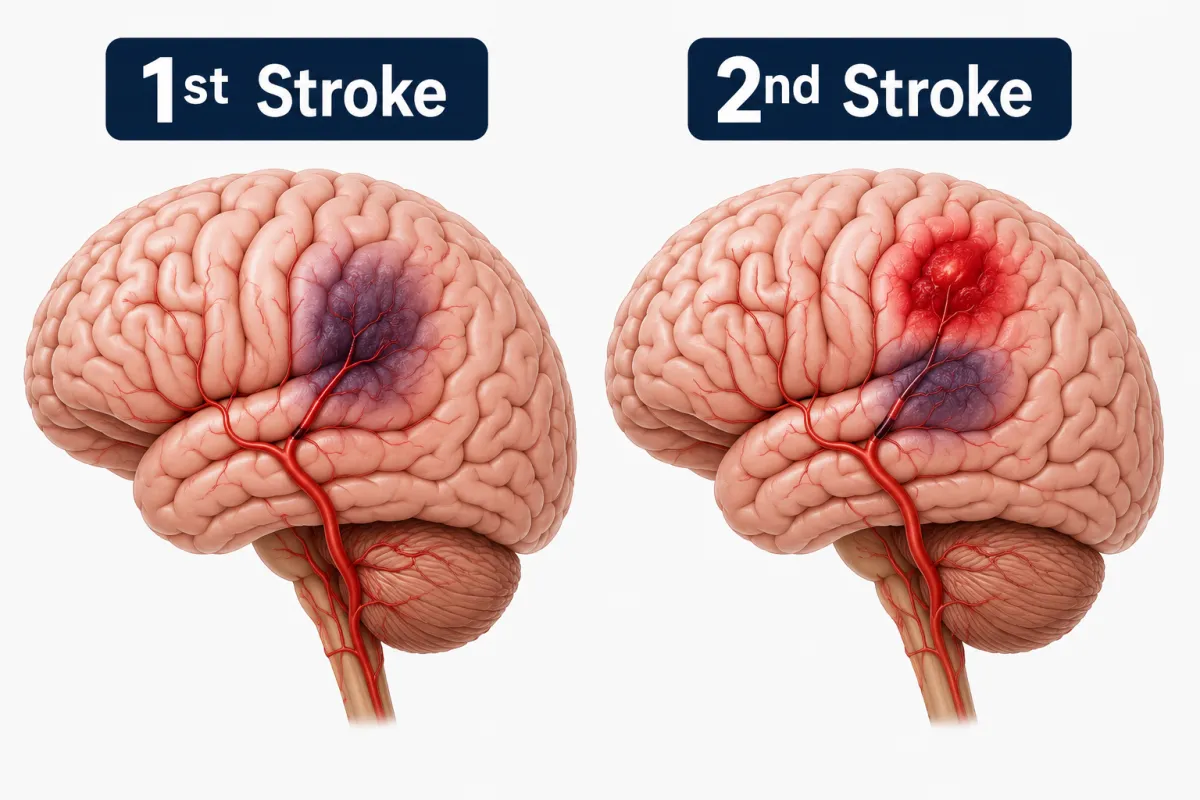
A second stroke can happen when the underlying cause of the first stroke remains active or when other stroke risk factors develop or are not adequately controlled. High blood pressure, atrial fibrillation, high cholesterol, diabetes, smoking, artery disease and problems with blood clotting can all increase the risk. Having already experienced a stroke also means your future risk is higher than someone who has never had one. The good news is that many of the factors responsible for recurrent stroke can be identified, treated or reduced.
After your first stroke...
Recovery may become your entire focus.
Walking.
Talking.
Memory.
Fatigue.
Physiotherapy.
Medication.
Appointments.
Getting your life back.
Then eventually another thought appears.
And it can be frightening.
"Could this happen again?"
"What actually causes a second stroke?"
"Does having one stroke make another inevitable?"
"What can I do to stop it?"
"How do I know whether the cause of my first stroke has actually been fixed?"
These questions matter.
Because having one stroke does increase your future stroke risk.
The Stroke Association notes that recurrent stroke remains an important problem among survivors, with research it supports citing approximately one in four stroke survivors experiencing another stroke within five years.
But increased risk does not mean another stroke is inevitable.
A major part of life after stroke is secondary prevention.
That means identifying why the first stroke happened and reducing the chance of another.
✦ ✦ ✦
The Good News
There is a great deal that can be done to reduce the risk of another stroke.
Stroke prevention after a first event commonly involves:
✓ Controlling blood pressure
✓ Treating atrial fibrillation
✓ Lowering cholesterol where appropriate
✓ Managing diabetes
✓ Taking prescribed antiplatelet or anticoagulant medication when indicated
✓ Stopping smoking
✓ Reducing excessive alcohol intake
✓ Maintaining physical activity where medically appropriate
✓ Managing weight
✓ Attending follow-up appointments
The Stroke Association specifically emphasises taking prescribed medication and making appropriate lifestyle changes to reduce recurrent stroke risk.
This means you are not powerless.
The fact that you have already had a stroke gives your medical team something extremely important:
Information.
They can investigate what happened.
Identify risk factors.
Treat underlying conditions.
And create a prevention plan designed specifically for you.
✦ ✦ ✦
Why Does Having One Stroke Increase Your Risk of Another?
A stroke often does not occur completely at random.
There may be an underlying reason.
For example:
High blood pressure may have damaged blood vessels.
Atrial fibrillation may have caused a blood clot.
Atherosclerosis may have narrowed an artery.
Diabetes may have contributed to vascular damage.
A blood clot may have travelled from somewhere else in the body.
If that underlying problem remains, the mechanism that contributed to the first stroke may still be present.
That is why understanding the cause of your first stroke matters so much.
The NHS identifies high blood pressure, diabetes, atrial fibrillation, high cholesterol and previous TIA among important factors associated with stroke.
A second stroke may therefore not be an entirely new problem.
Sometimes it is the same disease process continuing.
✦ ✦ ✦
High Blood Pressure
High blood pressure is one of the most important stroke risk factors.
Over time, excessive pressure inside the arteries can damage their walls.
This can make blood vessels more vulnerable to:
✓ Narrowing
✓ Hardening
✓ Blockage
✓ Rupture
The UK government has reported that high blood pressure contributes to around half of strokes, demonstrating just how important blood-pressure control is in prevention.
One difficulty is that high blood pressure often causes no obvious symptoms.
You may feel completely normal.
That means:
"I feel fine."
Does not necessarily mean:
"My blood pressure is fine."
After a stroke, regular monitoring becomes especially important.
If you have been prescribed blood-pressure medication, do not stop or alter it simply because your readings improve without discussing it with the clinician managing your treatment.
The improvement may be evidence that the treatment is working.
✦ ✦ ✦
Atrial Fibrillation
Atrial fibrillation, often shortened to AF, is an irregular heart rhythm.
It is particularly important in stroke because abnormal movement of blood inside the heart can encourage a clot to form.
That clot may then travel through the bloodstream and block an artery supplying the brain.
The NHS lists atrial fibrillation among important causes and risk factors for stroke.
Some people know they have AF because they experience:
✓ Palpitations
✓ Racing heartbeat
✓ Breathlessness
✓ Dizziness
✓ Fatigue
But AF can also occur without obvious symptoms.
That is why heart monitoring may form part of the investigation following an unexplained stroke.
For people with AF who are considered at sufficient stroke risk, anticoagulant medication can substantially reduce that risk. UK public-health guidance has reported reductions of up to about two-thirds with effective anticoagulation in appropriate patients.
If AF caused your first stroke, treating the heart rhythm and clotting risk can become one of the most important parts of preventing another.
✦ ✦ ✦
High Cholesterol and Narrowed Arteries
Cholesterol is another important part of the picture.
High levels of certain cholesterol-containing particles can contribute to fatty deposits developing inside artery walls.
Over time, this process — atherosclerosis — can narrow blood vessels and make them more vulnerable to blockage.
If a plaque becomes unstable, material may also break away and contribute to a blood clot.
High cholesterol is recognised by the NHS and UK cardiovascular-prevention guidance as an important stroke risk factor.
After an ischaemic stroke, some people are prescribed cholesterol-lowering medication such as a statin.
Do not assume that because your cholesterol was "not that high" before the stroke, treatment is unnecessary.
After a vascular event, doctors may use cholesterol treatment as part of reducing future cardiovascular risk, not simply because of one isolated cholesterol number.
✦ ✦ ✦
Carotid Artery Disease
The carotid arteries run through your neck and supply blood to the brain.
Atherosclerosis can cause fatty material to build up inside these arteries.
If the narrowing becomes significant, blood flow may be affected or material can break away and travel into smaller arteries in the brain.
That can cause an ischaemic stroke.
If carotid disease contributed to your first stroke and significant disease remains, your medical team may recommend medication, surveillance or in selected cases a procedure to treat the narrowing.
This is one reason stroke investigations may include imaging of the blood vessels supplying the brain.
The goal is not simply to identify that a stroke happened.
It is to determine where the clot or blockage came from.
✦ ✦ ✦
Diabetes
Diabetes increases the risk of vascular disease.
Persistently elevated blood glucose can damage blood vessels over time and is associated with other conditions that increase stroke risk.
These may include:
✓ High blood pressure
✓ High cholesterol
✓ Obesity
✓ Atherosclerosis
The NHS includes diabetes among the major conditions associated with stroke risk.
If you have diabetes after a stroke, managing it becomes part of secondary prevention.
That may involve:
✓ Medication
✓ Blood-glucose monitoring
✓ Dietary changes
✓ Physical activity
✓ Weight management
✓ Regular medical reviews
The objective is not only to improve a glucose reading.
It is to protect your blood vessels over the long term.
✦ ✦ ✦
Smoking
Smoking significantly increases cardiovascular risk.
Chemicals in tobacco smoke damage blood vessels and promote processes that make artery disease and blood clotting more likely.
Smoking is also associated with many of the conditions that contribute to stroke.
UK public-health guidance consistently includes stopping smoking among important strategies for reducing cardiovascular and stroke risk.
If you smoked before your stroke, quitting may be one of the most powerful lifestyle changes you can make.
You do not need to do it entirely through willpower.
Support may include:
✓ Stop-smoking services
✓ Nicotine replacement therapy
✓ Prescription treatments where appropriate
✓ Behavioural support
Your GP or pharmacist can help you find an appropriate approach.
✦ ✦ ✦
Excessive Alcohol Intake
Excessive alcohol consumption can contribute to several stroke risk factors.
These include:
✓ High blood pressure
✓ Abnormal heart rhythms
✓ Weight gain
✓ Poor medication adherence
✓ Other cardiovascular problems
NHS guidance includes excessive alcohol consumption among factors that contribute to TIA and stroke risk.
This does not mean that every stroke survivor must automatically avoid alcohol forever.
But drinking heavily after a stroke is a poor gamble.
Your healthcare professional can advise whether alcohol is appropriate given:
Your stroke type.
Your blood pressure.
Your medication.
Your liver health.
Your heart rhythm.
And your wider medical history.
✦ ✦ ✦
Not Taking Medication as Prescribed
Stroke-prevention medication can only help if it is taken correctly.
Depending on the cause of your stroke, treatment may include:
✓ Antiplatelet medication
✓ Anticoagulants
✓ Blood-pressure medication
✓ Statins
✓ Diabetes medication
These medicines do different jobs.
An antiplatelet is not interchangeable with an anticoagulant.
A statin does not replace blood-pressure treatment.
And a medication prescribed because of atrial fibrillation should not simply be stopped because you feel well.
Stroke Association prevention advice explicitly stresses the importance of taking prescribed medication as part of reducing recurrent stroke risk.
If you experience side effects, discuss them.
Do not quietly stop treatment and hope for the best.
There may be alternatives.
✦ ✦ ✦
Could Another Blood Clot Cause a Second Stroke?
Yes.
Most strokes are ischaemic strokes, meaning blood flow to part of the brain becomes blocked.
A clot may form:
✓ Inside an artery supplying the brain
✓ In the heart
✓ Around an area of diseased artery
And then block blood flow to brain tissue.
The mechanism behind the clot matters because prevention depends on its origin.
For example:
A clot associated with atrial fibrillation may require anticoagulation.
A stroke caused by artery disease may require a different prevention strategy.
This is why two people who both experienced an ischaemic stroke may leave hospital taking different medications.
Their strokes may have had different causes.
✦ ✦ ✦
What About Haemorrhagic Stroke?
Not all strokes are caused by blood clots.
A haemorrhagic stroke occurs when a blood vessel in or around the brain ruptures and bleeds.
Risk factors and prevention can therefore differ from those for ischaemic stroke.
High blood pressure is especially important because prolonged hypertension can weaken blood vessels.
Some haemorrhagic strokes may also relate to abnormalities of the blood vessels themselves or problems affecting blood clotting.
The prevention strategy therefore needs to match the type and cause of stroke.
This is why advice designed for someone who experienced an ischaemic stroke should not automatically be applied to someone who experienced a brain haemorrhage.
✦ ✦ ✦
Can Stress Cause a Second Stroke?
Stress is often blamed for stroke.
The reality is more complicated.
Stress is not usually treated as a simple direct cause in the same way as atrial fibrillation or severe hypertension.
But chronic stress can influence behaviours and physical conditions associated with cardiovascular disease.
For example, during periods of stress you may:
✓ Sleep poorly
✓ Drink more alcohol
✓ Smoke more
✓ Exercise less
✓ Eat poorly
✓ Forget medication
Stress may also temporarily affect blood pressure.
So stress management can still form part of looking after your cardiovascular health.
But if you have had a stroke, do not become frightened that feeling angry or stressed for one afternoon means another stroke is about to occur.
Focus on the established risk factors your medical team can actually measure and manage.
✦ ✦ ✦
Can Dehydration Cause Another Stroke?
Severe dehydration can affect blood volume and circulation and may be relevant in certain vulnerable people, but it should not be treated as the universal explanation for recurrent stroke.
The bigger question is your overall vascular risk and medical history.
Maintaining appropriate hydration is sensible, particularly during:
✓ Hot weather
✓ Illness
✓ Exercise
✓ Episodes of vomiting or diarrhoea
But drinking enormous amounts of water does not "flush out" blood clots or guarantee stroke prevention.
Stroke prevention requires addressing the actual cause and risk factors.
✦ ✦ ✦
Could Sleep Apnoea Matter?
Sleep apnoea causes repeated interruptions to breathing during sleep.
It is associated with cardiovascular problems, including high blood pressure and abnormal heart rhythms.
If you:
✓ Snore very loudly
✓ Stop breathing during sleep
✓ Wake choking or gasping
✓ Experience severe daytime sleepiness
✓ Have resistant high blood pressure
Speak to your healthcare professional.
Sleep disorders may form part of a broader cardiovascular assessment, particularly when several risk factors are present.
Good stroke prevention looks beyond the obvious.
✦ ✦ ✦
What If Doctors Never Found the Cause of Your First Stroke?
Sometimes extensive investigations fail to identify a definite cause.
You may hear terms such as:
Cryptogenic stroke.
Or:
Stroke of undetermined origin.
This can be frustrating.
You want an explanation.
You may think:
"If nobody knows what caused it, how can I stop it happening again?"
But an unknown cause does not mean nothing can be done.
Doctors may still assess and manage known risks such as:
✓ Blood pressure
✓ Cholesterol
✓ Diabetes
✓ Smoking
✓ Heart rhythm
✓ Weight
✓ Physical activity
In selected cases, further heart monitoring or specialist investigations may also be considered.
The absence of a perfect explanation does not mean prevention stops.
✦ ✦ ✦
Can Another Stroke Happen Even If You Do Everything Right?
Unfortunately, yes.
Risk reduction is not the same as risk elimination.
You can:
Take your medication.
Control your blood pressure.
Exercise.
Avoid smoking.
Manage cholesterol.
Follow medical advice.
And still never reduce risk to absolute zero.
That is true for many medical conditions.
But this does not make prevention pointless.
Reducing risk still matters enormously.
Think about a seat belt.
A seat belt cannot guarantee that you will survive every possible accident.
You still wear one because it dramatically improves the odds.
Stroke prevention works on the same principle.
You are improving probability.
Not purchasing certainty.
✦ ✦ ✦
Why Knowing the Cause of Your First Stroke Matters
One of the most useful questions you can ask your medical team is:
"What do you believe caused my stroke?"
If you do not know, ask.
Possible explanations might include:
✓ Large-artery atherosclerosis
✓ Small-vessel disease
✓ Atrial fibrillation
✓ Another cardiac source of embolism
✓ Carotid disease
✓ Blood-clotting abnormalities
✓ Arterial dissection
✓ High blood pressure
✓ Another specific vascular disorder
✓ No definite cause identified
Once you understand the suspected mechanism, your treatment plan makes much more sense.
You can understand why you are taking each medication.
And what risk factor requires the most attention.
✦ ✦ ✦
How Can You Reduce Your Risk of Another Stroke?
There is no single miracle technique.
Prevention usually involves several things working together.
Take Your Medication
Take prescribed medication as directed.
Know Your Blood Pressure
Have it checked and discuss your target with your healthcare professional.
Treat Atrial Fibrillation
If you have AF, follow your anticoagulation and cardiac treatment plan.
Manage Cholesterol
Take prescribed treatment and attend monitoring where required.
Control Diabetes
Work towards the individual targets agreed with your healthcare team.
Stop Smoking
Seek professional support if necessary.
Limit Excessive Alcohol
Follow medical advice based on your individual circumstances.
Stay Active
Exercise can support cardiovascular health when it is safe and appropriate for your recovery.
Attend Follow-Up Appointments
Monitoring allows problems to be identified before they become emergencies.
These are not glamorous interventions.
But they are the foundations of secondary prevention.
✦ ✦ ✦
Do Not Become Obsessed With Preventing Every Possible Trigger
After surviving a stroke, it is easy to become frightened of ordinary sensations.
A headache.
A stressful day.
A glass of wine.
A poor night's sleep.
A skipped workout.
Suddenly everything feels dangerous.
But effective prevention is not about living in permanent fear.
It is about controlling the risks that actually matter.
Know your blood pressure.
Understand why you take your medication.
Know whether you have atrial fibrillation.
Know your cholesterol and diabetes status where relevant.
Stop smoking.
Attend reviews.
Learn the warning signs of stroke.
Those actions are far more useful than trying to eliminate every conceivable trigger from your life.
✦ ✦ ✦
What Are the Warning Signs of Another Stroke?
A second stroke can produce the same warning signs as a first stroke.
The NHS continues to emphasise symptoms such as sudden facial weakness, arm weakness and speech difficulty as reasons to seek emergency help immediately.
Other sudden neurological changes may also occur, depending on the part of the brain affected.
These can include:
✓ Sudden weakness or numbness
✓ Sudden vision loss or disturbance
✓ Sudden difficulty speaking
✓ Sudden confusion
✓ Sudden severe balance problems
✓ Sudden inability to coordinate movement
Do not think:
"I have already had one stroke, so this is probably just an old symptom."
If symptoms are new, suddenly worse or suggest another stroke, seek emergency medical help immediately.
Time matters.
✦ ✦ ✦
Emotional Impact
Fear of a second stroke can become almost as disruptive as the physical recovery itself.
You may constantly check:
Your speech.
Your smile.
Your hands.
Your balance.
Your blood pressure.
Every strange sensation becomes:
"Is it happening again?"
Some vigilance is understandable.
You have experienced something serious.
But permanent hypervigilance can steal the life you worked so hard to recover.
The objective of secondary prevention is not to make you terrified of your body.
It is to give you a plan.
Know your risks.
Manage them.
Know the warning signs.
Then continue living.
✦ ✦ ✦
My Perspective
After a stroke, the idea of another one can sit quietly in the back of your mind.
You know what stroke can take from you.
Your movement.
Your speech.
Your memory.
Your independence.
Your identity.
So naturally you want certainty that it will never happen again.
Medicine cannot give you that certainty.
But there is a huge difference between having no control and having no guarantee.
You may not be able to guarantee that another stroke will never happen.
But you can understand why the first one happened.
You can know your blood pressure.
Take medication.
Treat atrial fibrillation.
Manage cholesterol.
Stop smoking.
Look after your cardiovascular health.
Attend follow-up appointments.
And recognise warning signs quickly.
That is not helplessness.
That is active prevention.
Do not spend your recovery waiting for the next stroke.
Use what happened to understand your risk.
Then do what you reasonably can to reduce it.
And continue rebuilding your life.
✦ ✦ ✦
When Should You Seek Medical Advice?
Speak to your GP, stroke specialist or another appropriate healthcare professional if:
✓ You do not understand what caused your first stroke
✓ Your blood pressure remains high
✓ You experience palpitations or an irregular heartbeat
✓ You are struggling with medication side effects
✓ You have stopped taking prescribed stroke-prevention medication
✓ Your diabetes is poorly controlled
✓ You continue to smoke and want help stopping
✓ You are concerned about cholesterol
✓ You have questions about alcohol
✓ You have symptoms that may suggest another vascular problem
For new sudden stroke symptoms, do not wait for a routine appointment.
Seek emergency medical help immediately.
✦ ✦ ✦
Frequently Asked Questions
Are You More Likely to Have Another Stroke After Having One?
Yes.
Previous stroke increases future stroke risk, which is why secondary prevention is such an important part of long-term care. Stroke Association-supported research cites roughly one in four survivors experiencing another stroke within five years.
What Is the Biggest Cause of a Second Stroke?
There is no single cause for everyone.
Important risks include high blood pressure, atrial fibrillation, high cholesterol, diabetes and underlying vascular disease.
Can Missing Medication Cause Another Stroke?
Stopping medication can leave the condition it was treating uncontrolled.
If medication was prescribed to reduce your stroke risk, do not stop it without discussing this with your healthcare professional.
Can Atrial Fibrillation Cause Repeated Strokes?
Yes.
Untreated or inadequately managed atrial fibrillation can allow blood clots to form in the heart and travel to the brain. Appropriate anticoagulant treatment can substantially reduce this risk in eligible patients.
Can High Blood Pressure Cause Another Stroke?
Yes.
High blood pressure is one of the major modifiable stroke risk factors and is strongly associated with stroke.
Does a Second Stroke Always Happen in the Same Part of the Brain?
No.
A recurrent stroke may affect a different blood vessel and therefore a different area of the brain.
Symptoms may consequently be different from those experienced during your first stroke.
Can You Completely Prevent a Second Stroke?
No strategy can guarantee zero risk.
But appropriate medication, management of underlying conditions and lifestyle changes can significantly reduce your risk.
✦ ✦ ✦
Key Takeaways
✓ Having one stroke increases your risk of another.
✓ A second stroke may occur because the underlying cause of the first stroke remains present.
✓ High blood pressure is one of the most important modifiable stroke risks.
✓ Atrial fibrillation can cause blood clots that travel from the heart to the brain.
✓ High cholesterol, diabetes and artery disease can increase stroke risk.
✓ Smoking and excessive alcohol consumption can contribute to recurrent risk.
✓ Taking prescribed medication is an important part of secondary prevention.
✓ Understanding the cause of your first stroke can help you understand your prevention plan.
✓ Even excellent prevention cannot reduce risk to absolute zero.
✓ New or sudden stroke symptoms require emergency medical attention.
✓ Prevention should help you live with greater control — not permanent fear.
✦ ✦ ✦
Related Articles
Continue learning about preventing another stroke:
How to Prevent a Second Stroke
High Blood Pressure After Stroke
Atrial Fibrillation and Stroke
High Cholesterol After Stroke
Blood Thinners After Stroke
Statins After Stroke
Alcohol After Stroke
Smoking After Stroke
Diet After Stroke
Exercise After Stroke
Warning Signs of a Second Stroke
TIA After Stroke
✦ ✦ ✦
About the Author
Alisia Gayle is a stroke survivor who achieved 96% neurological recovery following an ischaemic stroke.
After years of rehabilitation, she now shares practical, evidence-informed resources to help stroke survivors, carers and families better understand recovery and rebuild their lives with confidence.
Alisia is also the author of Brain Damage: My Journey to 96% Recovery, where she shares her personal stroke recovery story and the lessons she learned throughout her rehabilitation.
✦ ✦ ✦
Medical Disclaimer
This article is intended for educational purposes only and should not replace professional medical advice, diagnosis or treatment.
Your risk of recurrent stroke depends on the type and cause of your original stroke, your medical history, medications and individual risk factors.
Always speak to your doctor, stroke specialist, pharmacist or other appropriate healthcare professional before changing medication or making significant changes to your treatment.
Never stop anticoagulants, antiplatelet medication, blood-pressure medication, statins or other prescribed stroke-prevention treatment without medical advice.
If you develop sudden new symptoms that could indicate another stroke, seek emergency medical help immediately.
✦ ✦ ✦
Final Thoughts
A second stroke...
Is one of the fears many survivors quietly carry.
You survived once.
You know what is at stake.
And understandably, you never want to experience it again.
But fear alone cannot prevent another stroke.
Information can help.
Treatment can help.
Monitoring can help.
Lifestyle changes can help.
Know what caused your first stroke if a cause was identified.
Know your blood pressure.
Understand your medication.
Treat atrial fibrillation.
Manage cholesterol and diabetes.
Do not smoke.
Be sensible with alcohol.
Attend your medical reviews.
And learn the warning signs.
You cannot control every possibility.
Nobody can.
But you can control far more than you may initially realise.
Because surviving the first stroke is only part of the journey.
Protecting the recovery you fought so hard to achieve matters too.