

MOBILITY & PHYSICAL RECOVERY

Sitting Balance After a Stroke.

A calmer, easier-to-scan guide to why sitting balance can change after stroke, what may help, and when to seek professional advice.

When Stroke Changes Intimacy but Not Desire

When Stroke Changes Intimacy but Not Desire

August 18, 20266 min read

Stroke recovery is often measured in visible things.

Movement.

Speech.

Balance.

How far you can walk.

How much strength has returned.

But there is another part of recovery that is much harder to measure.

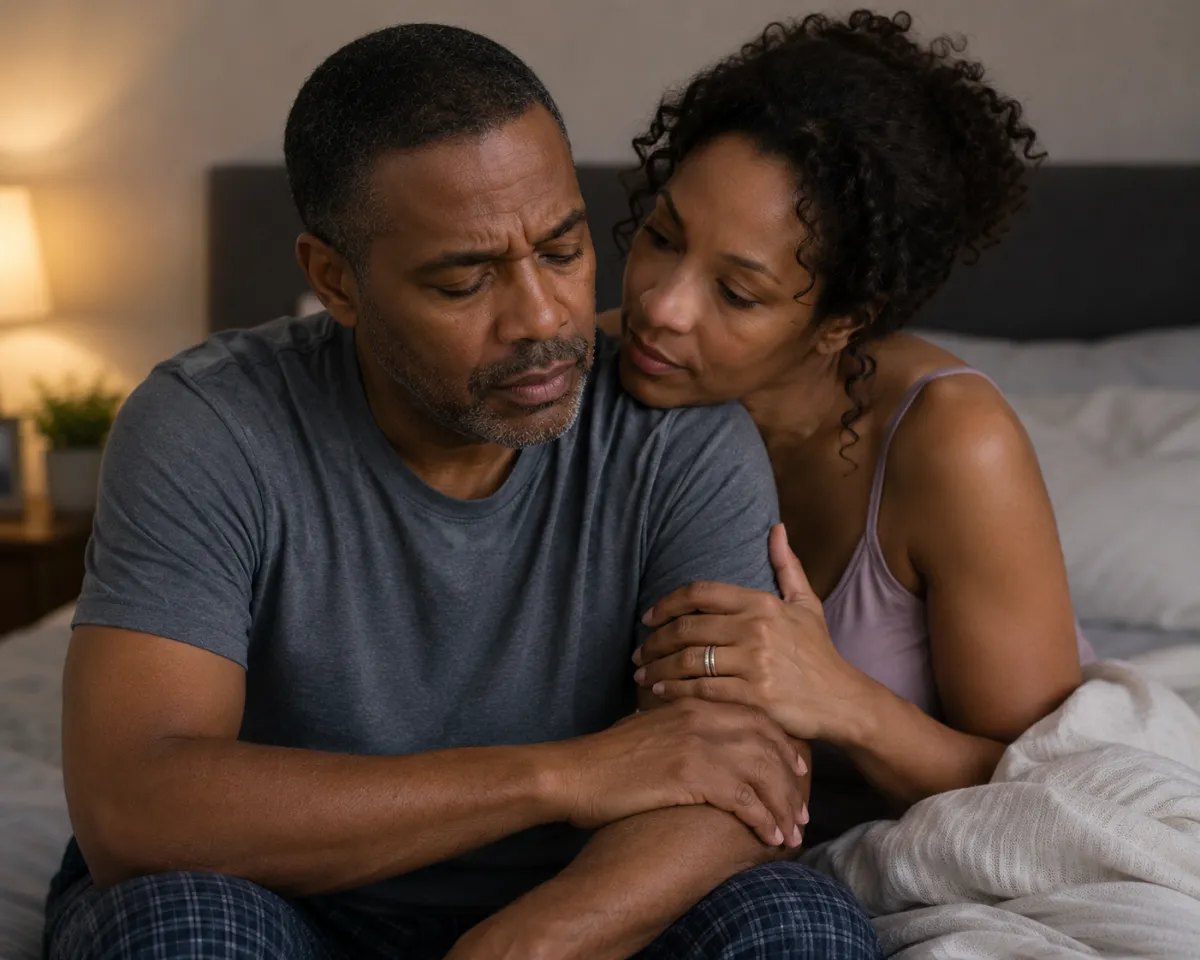
What happens when stroke changes intimacy.

When desire is still there.

When love is still there.

But the body no longer responds in ways either person understands.

Touch Used to Be Instinctive

Before stroke, intimacy may have required very little thought.

A hand reached out.

A body responded.

A kiss led somewhere without either person needing to explain what came next.

There was rhythm.

Ease.

Spontaneity.

Then stroke happens.

And the body that once felt familiar can become unpredictable.

Sensation changes.

Movement changes.

Fatigue changes what is possible.

Intimacy does not necessarily disappear.

But instinct can.

Intimacy Becomes Something You Have to Think About

The partner reaches out.

The survivor wants the touch.

But the body hesitates.

A muscle tightens.

A hand pulls away.

A flinch appears where pleasure used to be.

Nobody intended it.

So what once happened naturally begins to require questions.

Is this comfortable?

Should I stop?

Do you still want this?

Intimacy becomes something that has to be negotiated.

Not because love has gone.

Because certainty has.

The Body Says the Wrong Thing

Sometimes the body communicates something the survivor does not mean.

The partner reaches out.

The survivor flinches.

The partner pauses.

For the survivor, the reaction may mean:

My body just did something I did not ask it to do.

For the partner, it can feel like:

You don't want me touching you.

Neither may be true.

But the moment has already changed.

A hand that once moved without hesitation now hovers.

A pause becomes loaded.

And suddenly both people are trying to interpret something that once required no translation.

The Future Begins to Shrink

At first, you tell yourselves it is temporary.

Recovery is still happening.

Things will settle.

But weeks become months.

And quietly, the questions change.

Will this ever feel natural again?

Will I ever trust my body?

Will they stop wanting me?

Am I going to hurt them if I try?

Touch becomes careful.

Initiation becomes less frequent.

What once happened without thought becomes something both people are afraid to get wrong.

What the Survivor May Be Carrying

The survivor may still feel desire.

That can make everything more confusing.

Your mind wants closeness.

Your body does not always cooperate.

You may wonder whether your partner still sees you as desirable rather than fragile.

Whether they are reaching for you because they want you or because they are trying to reassure you.

You may feel embarrassed by reactions you cannot control.

Frustrated by sensation that has changed.

Angry at a body that no longer expresses what you feel inside.

And underneath it can sit one fear:

What if they think I am rejecting them when I am not?

What the Partner May Be Carrying

The partner may be frightened too.

They may worry about causing pain.

About exhausting you.

About making you uncomfortable.

They may interpret hesitation as rejection.

So they stop initiating.

Not because they no longer want you.

Because they do not want to pressure you.

And underneath the patience can be grief.

Not grief because love has disappeared.

Grief for ease.

For confidence.

For the freedom of reaching for someone without having to calculate what might happen next.

Protecting Each Other Into Distance

Then both people begin protecting each other.

The survivor initiates less because they do not want to disappoint.

The partner reaches less because they do not want to pressure.

Both tell themselves they are being considerate.

Both wait for the other person to move first.

And slowly, touch becomes rarer.

Not because nobody wants it.

Because both people are trying so hard not to hurt each other that they stop reaching.

Intimacy Erodes Quietly

There may be no argument.

No rejection.

No moment where someone says:

I don't want this anymore.

Instead, there are smaller things.

A hand that stays on the other side of the bed.

A kiss that ends sooner.

A moment where one person waits and the other does not move.

Another night postponed.

Another conversation avoided.

Intimacy can begin disappearing through hesitation rather than decision.

The Painful Realisation

Eventually, the real problem becomes clearer.

It is not necessarily lack of desire.

It is not necessarily lack of love.

It is fear of misreading each other.

The survivor is afraid their body is betraying what they still feel.

The partner is afraid every hesitation means they are no longer wanted.

Two people can be inches apart while both are terrified of getting the other person wrong.

That can be one of the loneliest places inside a relationship.

Grief in the Same Room as Love

Both people may grieve what existed before.

The survivor may grieve confidence in their own body.

Sensation.

Spontaneity.

Feeling desirable without wondering whether disability changed how they are seen.

The partner may grieve ease.

The freedom of reaching out without fear.

The intimacy that once required no explanation.

And both may feel guilty for grieving any of it.

Because the survivor is alive.

Because the relationship survived.

Because there are supposedly bigger things to be grateful for.

But gratitude does not erase loss.

The Truth People Avoid Naming

Love alone does not automatically restore intimacy after stroke.

Wanting each other does not always make the body cooperate.

Patience does not remove neurological change.

Sometimes intimacy has to be relearned.

Not because the relationship has failed.

Because stroke changed the language the body speaks.

Touch Finds a New Language

Then sometimes something small happens.

A hand reaches out.

This time, nobody rushes.

The survivor says what feels comfortable.

The partner listens.

A touch stays where it feels safe.

A shared breath.

Fingers resting together.

Nobody is trying to recreate the past.

Slowly, touch begins to feel less like a test.

They learn new signals.

New ways of asking.

New ways of saying yes.

New ways of saying not yet.

What once happened through instinct begins to happen through intention.

It is different.

But different does not mean empty.

Intimacy Returns Differently

Sometimes recovery is not about getting back exactly what existed before.

It is discovering what closeness can become now.

Touch may be slower.

Communication may be clearer.

Spontaneity may take longer to return.

But trust can grow in its place.

Stroke can change the language two people once spoke effortlessly.

It does not automatically erase desire.

And it does not automatically erase love.

Sometimes love stays long enough for both people to learn how to reach each other again.

If intimacy changed after your stroke, what was hardest to navigate: desire, sensation, confidence, communication, or the fear of initiating?

About the Author

Alisia Gayle is a stroke survivor and author of Brain Damage: My Journey to 96% Recovery. She writes honestly about the emotional, relational and practical realities of rebuilding life after stroke.

blog author avatar
Stroke Survivor and Author
Back to Blog

What you’ll learn

Why sitting balance can be affected after a stroke

Common problems people notice day to day

Simple rehabilitation approaches that may help

When changes in balance need medical attention

Why sitting balance matters

Sitting balance is often one of the foundations for standing, walking and everyday activities. After a stroke, some people find it difficult to sit upright without support, lean to one side, or feel unsteady when reaching.

The good news

Sitting balance often improves with rehabilitation, practice and time. Even small improvements can support confidence and independence.

Why can balance change after a stroke?

A stroke may affect several systems that help you stay upright, including strength, coordination, sensation, body awareness and balance control.

Strength

Trunk muscles may become weaker or slower to respond.

Coordination

Movements may feel less automatic or less controlled.

Sensation

You may have less feedback about where your body is in space.

Confidence

Fear of falling can make movement feel harder.

Common sitting problems after a stroke

  • Leaning to one side

  • Difficulty sitting upright without support

  • Feeling unstable when reaching

  • Falling or drifting backwards

  • Increased fatigue during longer periods of sitting

Some people may also experience pusher syndrome, where they actively push towards their weaker side. This should be assessed by a rehabilitation professional.

What May Help

Physiotherapy and occupational therapy often work on trunk control, weight shifting, posture, coordination and everyday activities.

Examples of exercises

  • Sitting unsupported for short periods

  • Gentle reaching tasks

  • Weight shifting from side to side

  • Trunk strengthening

  • Practising on different safe surfaces when appropriate

Keep it individual

Exercises should be matched to your own abilities and professional advice.

More detail: posture and positioning

Helpful strategies may include keeping both feet supported, maintaining an upright posture, and using supportive cushions when recommended.

More detail: fatigue and balance

Balance can become worse when you are tired. Regular rest periods and shorter practice sessions may help.

More detail: tips for family and carers

Encourage safe practice, avoid unexpected pulling or pushing, and help maintain good posture while celebrating small improvements.

When should you seek medical advice?

Arrange an appointment with a healthcare professional if sitting balance is worsening, falls are occurring, new weakness develops, or balance problems are significantly affecting daily activities.

Seek urgent medical attention for sudden new weakness, new speech difficulties, sudden confusion or sudden vision changes.

Key takeaways

Sitting balance is commonly affected after stroke.

Weakness, sensation and body awareness can all contribute.

Good sitting balance supports everyday activity and later mobility.

Recovery can continue over months and years.

Frequently asked questions

Is poor sitting balance common after a stroke?

Yes. Many stroke survivors experience difficulty with sitting balance, particularly during earlier stages of recovery.

Will my sitting balance improve?

Many people improve through rehabilitation, ongoing recovery and repeated practice.

Can exercises help?

Targeted exercises can help improve trunk control, balance and confidence when they are appropriate for the individual.

About Alisia

Alisia Gayle is a stroke survivor who achieved 96% neurological recovery following an ischaemic stroke.

After years of rehabilitation, she now shares practical, evidence-informed resources to help stroke survivors, carers and families better understand recovery and rebuild their lives with confidence.

Alisia is also the author of Brain Damage: My Journey to 96% Recovery, where she shares her personal stroke recovery story and the lessons she learned throughout her rehabilitation.

Next articles

Medical disclaimer

This article is intended for educational purposes only and should not replace professional medical advice, diagnosis or treatment.

Always seek advice from your doctor, physiotherapist or rehabilitation team regarding symptoms, concerns or changes in your condition.

Alisia Gayle is a stroke survivor, author, and advocate whose life was transformed in a single, ordinary day.

Contact us

800 1234 5678

FOLLOW US

Copyright 2026. Alisia Gayle | Stroke Recovery Through Lived Experience. All Rights Reserved.