

MOBILITY & PHYSICAL RECOVERY

Sitting Balance After a Stroke.

A calmer, easier-to-scan guide to why sitting balance can change after stroke, what may help, and when to seek professional advice.

Wrong Words After a Stroke

Why Do I Say the Wrong Words After a Stroke?

July 19, 20266 min read

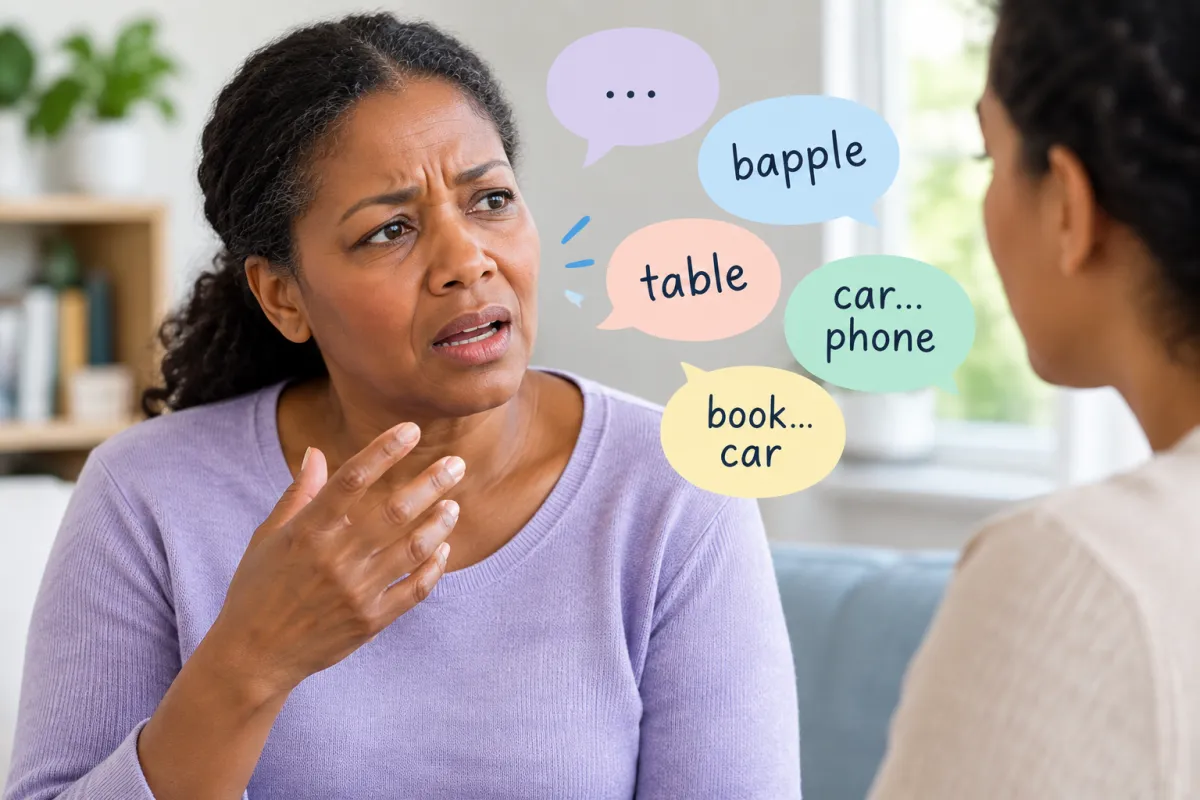
Saying the wrong words after a stroke can be confusing, frustrating and sometimes embarrassing. You may know exactly what you want to say, but a completely different word comes out instead. This may happen occasionally or happen frequently during conversations. Learn why word substitutions occur after a stroke, what they may mean and whether they can improve over time.

After your stroke...

You try to ask for a spoon.

But instead, you say "fork."

You want to say your son's name.

A different name comes out.

Perhaps you ask someone to close the "window" when you actually mean the "door."

You immediately realise the mistake.

Or sometimes you do not notice it at all.

You begin wondering...

"Why am I saying the wrong words?"

"Is something seriously wrong?"

"Will this ever get better?"

These experiences are extremely common after a stroke.

✦ ✦ ✦

The Good News

Saying the wrong words after a stroke often improves over time.

For many people, these difficulties become less frequent as the brain heals and adapts.

Speech and language therapy, practice and neuroplasticity can all support recovery.

Although some people continue to experience occasional word errors, many regain confidence in communication.

✦ ✦ ✦

Why Does This Happen?

A stroke can damage areas of the brain responsible for language.

This may affect your ability to:

✓ Find the correct word

✓ Access stored vocabulary

✓ Organise language

✓ Monitor speech output

As a result, the brain may accidentally retrieve the wrong word.

This is a recognised language difficulty and is not a sign of reduced intelligence.

✦ ✦ ✦

What Are These Word Errors Called?

Speech therapists often refer to these mistakes as paraphasias.

Paraphasias are unintentional word substitutions.

They can occur in different ways.

✦ ✦ ✦

Semantic Paraphasias

This occurs when you say a related word instead of the intended one.

Examples include:

✓ Saying "fork" instead of "spoon"

✓ Saying "chair" instead of "table"

✓ Saying "daughter" instead of "sister"

The words are usually connected in meaning.

This is one of the most common types of word error after stroke.

✦ ✦ ✦

Sound-Based Errors

Sometimes the word sounds similar.

Examples include:

✓ "Cat" instead of "cap"

✓ "Train" instead of "tray"

✓ "Television" instead of "telephone"

This may happen because the brain is having difficulty organising speech sounds correctly.

✦ ✦ ✦

Made-Up Words

Some people occasionally produce words that do not exist.

This can happen in more severe forms of aphasia.

The person may not always realise that the word is incorrect.

✦ ✦ ✦

Why Does It Feel Like the Word Is "Stuck"?

Many stroke survivors describe feeling as though the correct word is somewhere in their mind but cannot quite be reached.

You may:

✓ Know what the object is.

✓ Know how to use it.

✓ Even know the first letter.

But the actual word refuses to appear.

This is called a word-finding difficulty and is extremely common after stroke.

✦ ✦ ✦

Why Is It Worse When I'm Tired?

Fatigue often makes language difficulties more noticeable.

You may find that:

✓ Words come more easily in the morning.

✓ You make more mistakes in the evening.

✓ Stress worsens communication.

✓ Busy environments make it harder to find words.

This fluctuation is very common.

Temporary worsening does not necessarily mean recovery is getting worse.

✦ ✦ ✦

Why Do I Sometimes Not Notice My Mistakes?

Some stroke survivors immediately recognise their errors.

Others may not realise that the wrong word has been used.

This depends on which areas of the brain were affected.

Both experiences are recognised consequences of stroke.

✦ ✦ ✦

Can Saying the Wrong Words Be Embarrassing?

Absolutely.

Many people feel:

✓ Frustrated

✓ Embarrassed

✓ Self-conscious

✓ Anxious about conversations

You may worry that others think you are confused or not paying attention.

But these difficulties are neurological.

They are not your fault.

✦ ✦ ✦

Can It Affect Relationships?

Yes.

Communication difficulties can sometimes lead to misunderstandings.

Family members may become confused.

Conversations may feel slower.

Social situations may become tiring.

Explaining your difficulties to others can often help reduce frustration.

✦ ✦ ✦

Can This Improve?

Yes.

Many people experience significant improvements over time.

Recovery occurs because:

✓ The brain adapts through neuroplasticity.

✓ Alternative pathways develop.

✓ Word retrieval improves with practice.

✓ Confidence gradually returns.

Improvement may continue for months and years.

✦ ✦ ✦

What Can Help?

Speech and Language Therapy

Speech therapists can provide exercises specifically designed to improve word retrieval.

Taking Your Time

Allowing yourself extra time can reduce pressure and improve communication.

Giving Yourself Clues

Thinking about:

✓ The first letter

✓ The category

✓ How the object is used

May help the word come back.

Practising Naming Activities

Repeated practice can strengthen language pathways.

Managing Fatigue

Rest and pacing often improve communication.

✦ ✦ ✦

Helpful Communication Strategies

You may find it helpful to:

✓ Describe the object if the word will not come.

✓ Use gestures.

✓ Write the word down.

✓ Keep conversations calm and unhurried.

These strategies can reduce frustration.

✦ ✦ ✦

My Perspective

Saying the wrong words can feel incredibly strange.

You know exactly what you mean.

Yet your mouth seems to say something completely different.

It can be frustrating.

Embarrassing.

And exhausting.

But this does not mean you are losing your intelligence.

It simply means that the language networks in your brain are still recovering.

And for many people, these difficulties improve considerably with time and practice.

✦ ✦ ✦

Frequently Asked Questions

Is It Normal to Say the Wrong Words After a Stroke?

Yes.

Word substitutions are very common after stroke and are often part of aphasia.

Does This Mean I Have Dementia?

No.

Stroke-related language problems are different from dementia.

Will It Improve?

Many people experience significant improvements over time.

Why Does It Happen More When I'm Tired?

Fatigue often reduces the brain's ability to process language efficiently.

✦ ✦ ✦

Key Takeaways

✓ Saying the wrong words after stroke is common.

✓ These errors are often called paraphasias.

✓ Word substitutions are caused by changes in language processing.

✓ Fatigue and stress may worsen symptoms.

✓ Speech therapy and practice can help.

✓ Improvement may continue for years.

✦ ✦ ✦

Related Articles

Continue learning about communication problems after stroke:

Mild Aphasia After a Stroke
Expressive Aphasia After a Stroke
Why Can't I Find My Words After a Stroke?
Reading Problems After a Stroke
Best Aphasia Apps After a Stroke

✦ ✦ ✦

About the Author

Alisia Gayle is a stroke survivor who achieved 96% neurological recovery following an ischaemic stroke.

After years of rehabilitation, she now shares practical, evidence-informed resources to help stroke survivors, carers and families better understand recovery and rebuild their lives with confidence.

Alisia is also the author of Brain Damage: My Journey to 96% Recovery, where she shares her personal stroke recovery story and the lessons she learned throughout her rehabilitation.

✦ ✦ ✦

Medical Disclaimer

This article is intended for educational purposes only and should not replace professional medical advice, diagnosis or treatment.

Always seek advice from your doctor or speech and language therapist regarding any communication difficulties following a stroke.

✦ ✦ ✦

Final Thoughts

Saying the wrong words after a stroke...

Can feel confusing.

And sometimes frightening.

But it is a recognised part of stroke recovery for many people.

Your brain knows what you want to say.

It is simply having difficulty accessing the correct words.

Be patient with yourself.

Take your time.

Keep practising.

And remember...

Communication may feel different right now.

But meaningful improvement remains possible.

blog author avatar
Stroke Survivor and Author
Back to Blog

What you’ll learn

Why sitting balance can be affected after a stroke

Common problems people notice day to day

Simple rehabilitation approaches that may help

When changes in balance need medical attention

Why sitting balance matters

Sitting balance is often one of the foundations for standing, walking and everyday activities. After a stroke, some people find it difficult to sit upright without support, lean to one side, or feel unsteady when reaching.

The good news

Sitting balance often improves with rehabilitation, practice and time. Even small improvements can support confidence and independence.

Why can balance change after a stroke?

A stroke may affect several systems that help you stay upright, including strength, coordination, sensation, body awareness and balance control.

Strength

Trunk muscles may become weaker or slower to respond.

Coordination

Movements may feel less automatic or less controlled.

Sensation

You may have less feedback about where your body is in space.

Confidence

Fear of falling can make movement feel harder.

Common sitting problems after a stroke

  • Leaning to one side

  • Difficulty sitting upright without support

  • Feeling unstable when reaching

  • Falling or drifting backwards

  • Increased fatigue during longer periods of sitting

Some people may also experience pusher syndrome, where they actively push towards their weaker side. This should be assessed by a rehabilitation professional.

What May Help

Physiotherapy and occupational therapy often work on trunk control, weight shifting, posture, coordination and everyday activities.

Examples of exercises

  • Sitting unsupported for short periods

  • Gentle reaching tasks

  • Weight shifting from side to side

  • Trunk strengthening

  • Practising on different safe surfaces when appropriate

Keep it individual

Exercises should be matched to your own abilities and professional advice.

More detail: posture and positioning

Helpful strategies may include keeping both feet supported, maintaining an upright posture, and using supportive cushions when recommended.

More detail: fatigue and balance

Balance can become worse when you are tired. Regular rest periods and shorter practice sessions may help.

More detail: tips for family and carers

Encourage safe practice, avoid unexpected pulling or pushing, and help maintain good posture while celebrating small improvements.

When should you seek medical advice?

Arrange an appointment with a healthcare professional if sitting balance is worsening, falls are occurring, new weakness develops, or balance problems are significantly affecting daily activities.

Seek urgent medical attention for sudden new weakness, new speech difficulties, sudden confusion or sudden vision changes.

Key takeaways

Sitting balance is commonly affected after stroke.

Weakness, sensation and body awareness can all contribute.

Good sitting balance supports everyday activity and later mobility.

Recovery can continue over months and years.

Frequently asked questions

Is poor sitting balance common after a stroke?

Yes. Many stroke survivors experience difficulty with sitting balance, particularly during earlier stages of recovery.

Will my sitting balance improve?

Many people improve through rehabilitation, ongoing recovery and repeated practice.

Can exercises help?

Targeted exercises can help improve trunk control, balance and confidence when they are appropriate for the individual.

About Alisia

Alisia Gayle is a stroke survivor who achieved 96% neurological recovery following an ischaemic stroke.

After years of rehabilitation, she now shares practical, evidence-informed resources to help stroke survivors, carers and families better understand recovery and rebuild their lives with confidence.

Alisia is also the author of Brain Damage: My Journey to 96% Recovery, where she shares her personal stroke recovery story and the lessons she learned throughout her rehabilitation.

Next articles

Medical disclaimer

This article is intended for educational purposes only and should not replace professional medical advice, diagnosis or treatment.

Always seek advice from your doctor, physiotherapist or rehabilitation team regarding symptoms, concerns or changes in your condition.

Alisia Gayle is a stroke survivor, author, and advocate whose life was transformed in a single, ordinary day.

Contact us

800 1234 5678

FOLLOW US

Copyright 2026. Alisia Gayle | Stroke Recovery Through Lived Experience. All Rights Reserved.